periodical issue
Freedom First
A Journal of Liberal Ideas
By B. Ratnasabhapati, Raghunath Rakibe, Geeta Doctor, Nissim Ezekiel, R. K. Laxman, A. H. Desai, J. R. Patel
Published for the Democratic Research Service by J. R. Patel, Associate Editor, Freedom First at 127, M. Gandhi Road Bombay 1 ('Phone: 254341) and printed by him at Inland Printers, 55 Gamdevi Road, Bombay 7. · Bombay · 1973
16 pages
Freedom First
Summary
Freedom First issue no. 250 (March 1973), edited by M. R. Masani, is a 16-page issue of the classical-liberal monthly published by the Democratic Research Service in Bombay. Its lead article, B. Ratnasabhapati’s ‘Andhra in Ferment,’ reports on the Telangana-Andhra bifurcation agitation following the Supreme Court’s Mulki Rules judgment, describing a strike by non-gazetted officers, CRP firings on protesters, and a breakdown of central authority in the state. The editorial column ‘Between You & Me and The Lamp Post’ comments on Pakistani POWs still held in India, Indira Gandhi’s remarks on racism, and factional maneuvering inside the Jana Sangh, Swatantra Party, and the Biju Patnaik-led Orissa ‘Pragati’ alliance (rebuffed by Jayaprakash Narayan). A short news item covers the Liberal International’s Executive Council meeting in Jerusalem. The rest of the issue carries a first-person account by a blind M.A. student on the neglect of disabled people in India, Geeta Doctor’s comic account of attending a Test match at the Brabourne Stadium, Nissim Ezekiel’s critical review of Suzanne Labin’s anti-hippie polemic, book reviews by R. K. Laxman and A. H. Desai, J. R. Patel’s review of Vijay Tendulkar’s play Sakharam Binder, and a closing page of quoted aphorisms (‘With Many Voices’). All 16 pages of the issue were rendered, so this record covers the complete issue.
Key points
-
B. Ratnasabhapati’s “Andhra in Ferment” reports on the Telangana-Andhra bifurcation agitation following the Mulki Rules judgment, describing CRP firings that killed over 300 and the collapse of Delhi’s authority in the state.
-
The “Notes” column criticises continued detention of Pakistani POWs and covers factional maneuvering inside the Jana Sangh, Swatantra Party and the Orissa “Pragati” alliance rebuffed by J.P. Narayan.
-
A blind M.A. student, Raghunath Rakibe, describes the social neglect and lack of vocational opportunity facing India’s blind population, calling for enforceable employment rights.
-
A report on the Liberal International’s Jerusalem Executive Council meeting covers its condemnation of Jewish persecution in the USSR and the expulsion of Asians from Uganda.
-
Geeta Doctor’s comic account of a Test match at Brabourne Stadium satirises the quasi-religious devotion of Indian cricket fans.
-
Nissim Ezekiel critiques Suzanne Labin’s anti-hippie polemic “Hippies, Drugs and Promiscuity” as fundamentally unsound despite a legitimate case against drug dependence.
-
J. R. Patel reviews Vijay Tendulkar’s “Sakharam Binder”, arguing its commercial success owed more to an obscenity prosecution than to artistic merit, while R. K. Laxman and A. H. Desai review books on workaholism and Renaissance erotica.
Essays
Essay 1
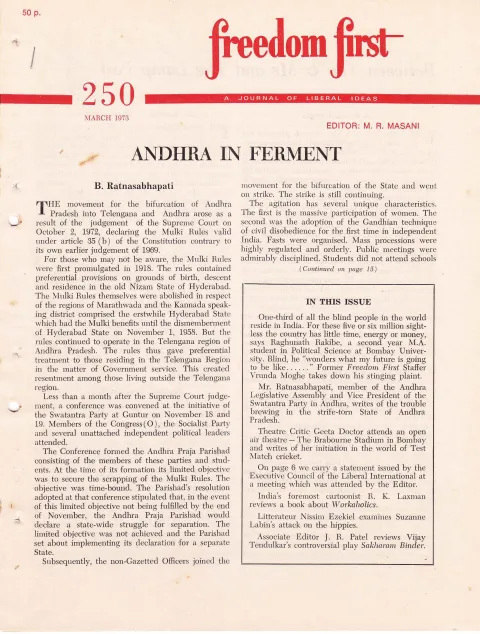
B. Ratnasabhapati, a member of the Andhra Legislative Assembly and Vice President of the Swatantra Party in Andhra, reports on the movement to bifurcate Andhra Pradesh into Telangana and Andhra following the Supreme Court’s October 1972 ruling upholding the Mulki Rules (job-reservation provisions dating to 1918 favoring residents of the former Hyderabad State). He traces the formation of the Andhra Praja Parishad at a Swatantra-initiated conference in Guntur, the escalation from a limited demand (scrapping the Mulki Rules) to a full statehood agitation, and the strike by non-gazetted officers that paralyzed the state administration. The essay emphasizes the agitation’s Gandhian civil-disobedience character and heavy participation of women, and, in its continuation, catalogues CRP firings that killed over three hundred people, denies that Naxalites are behind the movement, names Swatantra Party leaders (Latchanna, Satyanarayana, Tenneti Viswanathan) as directing it, describes a parallel local administration collecting land taxes to pay salaries, and concludes that the Indira Gandhi government’s authority in Andhra has effectively collapsed.
- The Mulki Rules (1918) gave job preference to residents of the former Hyderabad State; the Supreme Court upheld them in October 1972, reversing its own 1969 ruling.
- A Swatantra-initiated conference at Guntur (Nov 18-19, 1972) formed the Andhra Praja Parishad, initially demanding only scrapping of the Mulki Rules.
- When that limited objective failed, the Parishad declared a state-wide separation struggle; non-gazetted government officers subsequently joined the strike.
- The agitation is marked by mass participation of women, Gandhian civil disobedience, and orderly, disciplined public meetings.
- CRP (Central Reserve Police) forces, described as not understanding Telugu, have fired on crowds, killing over 300 people according to the author.
- The author denies government claims that Naxalites control the agitation, asserting Naxalite strength in the state had already been suppressed.
- Swatantra Party leaders are named as the effective leadership of the agitation, and a parallel local administration (e.g., in Cuddapah district) is collecting taxes to fund the strike.
- The author concludes the Delhi government’s writ has effectively ceased to run in Andhra and predicts eventual bifurcation.
Andhra in Ferment
By B. Ratnasabhapati
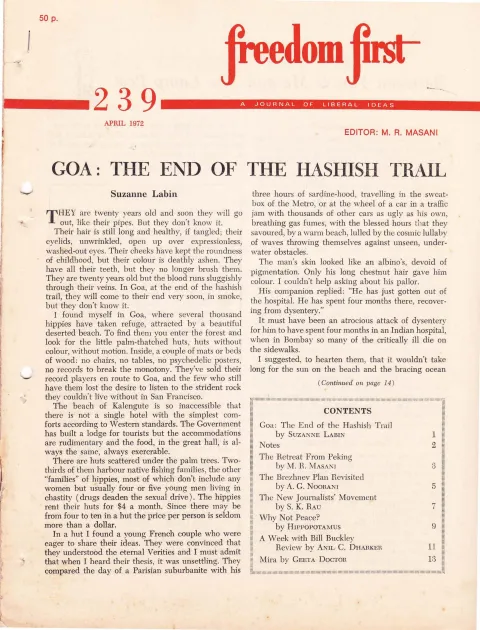
The unsigned ‘Between You & Me and The Lamp Post’ column takes up several current topics: the continued detention of Pakistani prisoners of war in India despite International Commission of Jurists protests and a Times of London editorial urging their release; Indira Gandhi’s comments on ‘black racialism’ regarding Idi Amin and a British Labour MP’s rejoinder about the universality of cruelty; and internal maneuvering within the Jana Sangh (Balraj Madhok’s criticism of a ‘personality cult’ and call for alliance with the Swatantra Party), the Swatantra Party’s uneasy alliance with Biju Patnaik’s discredited Pragati grouping in Orissa, and Patnaik’s failed attempt to recruit Jayaprakash Narayan into a national opposition front, which Narayan publicly declined while issuing a set of principles for opposition unity.
- Criticizes New Delhi for the continued detention of 90,000 Pakistani POWs despite ICJ protests and calls from Senator Edward Kennedy and the Times of London for their release.
- Notes Indira Gandhi’s growing awareness of ‘black racialism’ regarding Idi Amin, and a British Labour MP’s counter that cruelty is universal, not race-specific, citing Northern Ireland and Nigeria-Biafra.
- Reports Balraj Madhok’s public denunciation of a ‘personality cult’ in the Jana Sangh and his call for the party to ally with the Swatantra Party against Congress.
- Criticizes the Orissa Swatantra Party’s opportunistic alliance with discredited politicians Biju Patnaik and Harikrishna Mahtab, contrasting it with a similar failed maneuver in Gujarat.
- Describes Biju Patnaik’s attempt to build a national ‘alternative leadership’ opposition front and his approach to Jayaprakash Narayan, which Narayan declined while laying out principles for legitimate opposition unity.
Day Labour, Light Denied
By Raghunath Rakibe
Raghunath Rakibe, a second-year M.A. student in Political Science at Bombay University who is himself blind, writes a first-person account of the social neglect facing India’s blind population. He describes pervasive pity and condescension from society, the near-total absence of technical education, braille literature, and vocational training, and the fact that only about one percent of India’s blind population has access to educational institutions. He contrasts India’s lack of any constitutional or parliamentary channel for redressing the blind community’s grievances with the provisions that exist for Scheduled Castes/Tribes and Anglo-Indians, and calls for enforceable rights to employment (citing radio announcing jobs in the U.S.A. as a model) rather than continued reliance on charity or self-employment such as lottery-ticket selling.
- The author describes societal pity and condescension toward the blind as more disabling than blindness itself, and notes differing treatment between family, friends, and professors.
- Educational institutions for the blind can accommodate only five to six thousand people, about one percent of the estimated blind population.
- Braille literature, technical education, and music training for the blind are extremely scarce in India, unlike in Western countries.
- Self-employment options like selling State Lottery tickets are described as degrading, and workshop wages for the blind are called very poor.
- The author cites the U.S. practice of employing blind people as radio announcers as a model reform, and criticizes India’s lack of legal enforcement mechanisms for employing the blind.
- Unlike Scheduled Castes/Tribes or the Anglo-Indian community (with dedicated parliamentary representation), the blind have no constitutional channel to voice grievances.
World Liberals Meet
A brief unsigned news report on the Executive Council of the Liberal International (World Liberal Union), which met in Jerusalem on 27-28 January 1973, attended by M. R. Masani representing the Indian Liberal Group. The report summarizes the Council’s statement on European Community expansion, its call for international measures against terrorism (citing the Hague and Montreal treaties), its condemnation of civil-rights denials to Jews in the USSR and their persecution in Syria and Iraq, its position on the Vietnam cease-fire, and its condemnation of the expulsion of Asians from Uganda and criticism of British immigration law splitting affected families.
- The Liberal International’s Executive Council met in Jerusalem, marking only the second time in its 26-year history it met outside Europe.
- M. R. Masani attended representing the Indian Liberal Group, described as a Patron of the Liberal International.
- The Council called for ratification and implementation of the Hague and Montreal treaties against acts of terrorism and piracy.
- The statement condemned denial of civil rights to Jews in the USSR and their persecution in Syria and Iraq, calling for release of prisoners of conscience.
- The Council reiterated condemnation of the expulsion of Asians from Uganda and criticized British immigration law for splitting affected families.
Come All Ye Faithful
By Geeta Doctor
Theatre critic Geeta Doctor writes a comic first-person account of attending a Test match at the Brabourne Stadium in Bombay as a cricket novice. She satirizes the ritualized, quasi-religious devotion of Indian cricket fans — their binoculars, transistor radios, and emotional outbursts — describing the crowd’s behavior in terms of religious congregation and true believers versus non-believers. The piece closes wryly on the mesmerizing, inconclusive nature of Test cricket and the crowd’s reluctance to leave even after play ends.
- The author, a self-described cricket novice, frames Test cricket as a slow-paced ritual suited to what she calls ‘the Oriental ethos.’
- She satirizes fans’ devotional behavior at the Brabourne Stadium — binoculars, transistor radios, chanted cricket commentary — as religious ceremony.
- She distinguishes ‘true believers’ who lead crowd emotion from casual spectators using binoculars for people-watching instead of cricket.
- The essay closes on the crowd’s reluctance to leave the stadium even after the match’s conclusion.
A Case Against the Hippies
By Nissim Ezekiel
Nissim Ezekiel reviews Suzanne Labin’s book Hippies, Drugs and Promiscuity, describing Labin as a seasoned anti-communist political-warfare researcher whose case against the hippie movement, while well-researched, imposes a single narrow viewpoint that treats every hippie trait as sin. Ezekiel argues the sexual revolution, bohemianism, and drug culture have independent causes beyond the hippie movement, defends hippie dress and lifestyle as harmless, and challenges Labin’s claims about hippie anti-intellectualism, commercialism, and moral character, concluding her case is ‘fundamentally unsound’ even while acknowledging a genuine case exists against hippie drug dependence.
- Labin is described as President of the International Conference on Political Warfare, having advised the U.S., Brazil, South Vietnam, and other governments; her book is framed as an exercise in political warfare rather than balanced analysis.
- Ezekiel argues the sexual revolution and bohemian/avant-garde culture have independent origins and would persist even if the hippie movement vanished entirely.
- He rejects Labin’s claim that hippies ‘mistrust all intellectual creation,’ citing hippies’ civil-service exam scores as evidence to the contrary (a fact Labin herself concedes).
- He challenges the claim that hippies are uniquely driven by mass consumption, noting Labin’s own data that hippies live on one-fourth the income of average American workers.
- The essay questions Labin’s citation of the Linda Fitzpatrick and Sharon Tate murders as representative of hippie culture, noting murders occur in ‘straight’ society too.
- Ezekiel concludes that while there is a legitimate case against hippies (particularly drug dependence), Labin’s formulation of that case is fundamentally unsound.
Confessions of a Workaholic (review of Dr. Wayne Oates)
By R. K. Laxman
R. K. Laxman, India’s foremost cartoonist, reviews Dr. Wayne Oates’s book Confessions of a Workaholic, explaining Oates’s coinage of ‘workaholic’ for people whose obsessive relationship to work mirrors alcohol addiction. Laxman summarizes Oates’s typology of workaholics (Dyed-in-the-wool, Situational, Pseudo-Workaholic, among others) and his recommended remedies — shedding excess workload, prioritizing family time, meditation, and rekindling old friendships.
- Oates coined ‘workaholic’ to describe a person whose work involvement resembles drug addiction, with harmful effects on family, health, and colleagues.
- Laxman highlights several of Oates’s workaholic types: the Dyed-in-the-wool Workaholic (a perfectionist, permanently unhappy), the Situational Workaholic (driven by job insecurity), and the Pseudo-Workaholic (the most common, driven by ambition for promotion).
- Oates’s prescribed remedies include recognizing the addiction, shedding excess work, and rebuilding family and social relationships through meditation, walks, and renewed friendships.
Aretino’s Dialogues (review)
By A. H. Desai
A. H. Desai reviews Raymond Rosenthal’s translation of Pietro Aretino’s The Dialogues, describing Aretino as a Renaissance satirist and blackmailer of Italian princes whose Dialogues — structured as conversations among women describing life as wife, whore, or nun — offer a frank but, in Desai’s view, non-pornographic depiction of Renaissance sexual and social mores. The review focuses on the character Nanna’s instruction of her daughter Pippa in the courtesan’s trade, quoting extensively from Nanna’s cynical advice about managing clients’ emotions and flattery.
- Aretino, a figure of the late Italian Renaissance, made his name as a satirist and ‘blackmailer of princes’; The Dialogues is his major surviving work, newly available in complete English translation.
- The book depicts the only three occupations open to Renaissance women — wife, whore, or nun — through frank first-person accounts.
- The review centers on Nanna’s instruction of her daughter Pippa in the courtesan’s trade, including advice on handling clients across nationalities and ages.
- Desai, following the translator, argues the work’s eroticism has ‘the vigour and health of a public spectacle’ rather than the ‘sickly’ character of modern pornography, and concludes it is not pornography despite its frankness.
Sakharam Not a Binder
By J. R. Patel
Associate Editor J. R. Patel reviews Vijay Tendulkar’s controversial play Sakharam Binder, arguing the play’s box-office success owes more to its obscenity prosecution (a police complaint that turned a mediocre commercial play into a ‘cause celebre’) than to its artistic merit. Patel summarizes the plot — a violent, misogynistic bookbinder, Sakharam, and the women he takes in, Laxmi and later Champa, whose escalating cruelty and betrayal drive the play to its tragic end — and criticizes Tendulkar for handling shocking scenes (domestic violence, alcoholic rage) without subtlety, concluding the play would not have succeeded without the obscenity controversy.
- Patel argues Sakharam Binder became a commercial success largely because of an obscenity complaint to police, not its artistic quality, which he considers crude and unoriginal.
- The plot centers on Sakharam (Girish Desai), a violent, misogynistic bookbinder, and the women he takes as live-in companions: the devoted Laxmi (Dina Pathak) and the tougher, dissolute Champa (Tarla Mehta).
- A subplot involves Sakharam’s Muslim friend Dawood, used by Tendulkar to also provoke controversy around religion.
- Patel criticizes Tendulkar for depicting violence, alcoholism, and cruelty without subtlety, arguing the play could have retained its impact with more restraint.
- The review closes with two humorous quoted epigrams about cricket, from Oscar Wilde and George Bernard Shaw, appended as filler under ‘Glorious Cricket.‘
With Many Voices
The closing page ‘With Many Voices’ is an unsigned compilation of quotations drawn from Indian and international press (Times of India, Illustrated Weekly, Hindustan Times, Statesman, Foreign Affairs, and others), touching on Nehru, Marxism-Leninism versus rival nationalist ideologies, race and skin color rhetoric around Krishna and Draupadi, government surveillance of Rajaji, Gandhiji and Minoo Masani, and commentary on foreign policy and ceasefires by Prof. C. Northcote Parkinson, framed by an epigraph from Tennyson.
- The page compiles brief quotations from Indian and international newspapers and magazines on political topics of the day.
- Balraj Madhok is quoted (from the Statesman) describing a ‘crucial battle’ between Marxism-Leninism-Nehruism and the ideology associated with Gandhi, Sardar Patel, Rajendra Prasad, Malaviya, Hedgewar, and Shyama Prasad Mookerjee.
- M. S. Golwalkar is quoted asserting that Krishna and Draupadi were ‘black’ and that ‘we are all blacks.’
- H. V. R. Iyengar is quoted stating the government kept ‘fat dossiers’ on figures including Rajaji, Gandhiji, and Minoo Masani.
- The page closes with Prof. C. Northcote Parkinson’s quoted view (from Foreign Affairs) on the dangers of premature calls for ceasefires in armed conflicts.
Generated by the v1.5 extraction pipeline. Awaiting editorial review.
Essay 10
No summary was extracted for this article. Listed for completeness.
Metadata and summary are AI-extracted from the source PDF and reviewed for editorial accuracy. The original work is available via the Read PDF tab above (where present); paragraph-level citation inside the PDF is deferred to a future engagement.