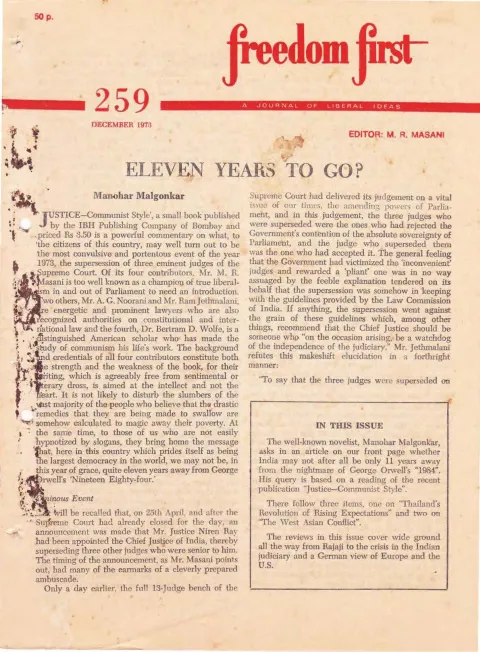
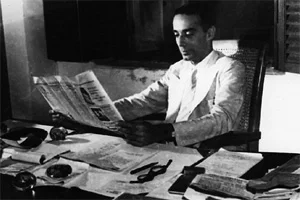
periodical issue
Freedom First
A Journal of Liberal Ideas
By M. R. Masani, V. B. Karnik, A. G. Noorani, Geeta Doctor, A. Chatterjee, K. Vasudeva Rao
Published for the Democratic Research Service by J. R. Patel, Associate Editor, Freedom First at 127, M. Gandhi Road, Bombay 1 ('Phone: 254341) and printed by him at Inland Printers, 55 Gamdevi Road, Bombay 7. · Bombay · 1973
16 pages
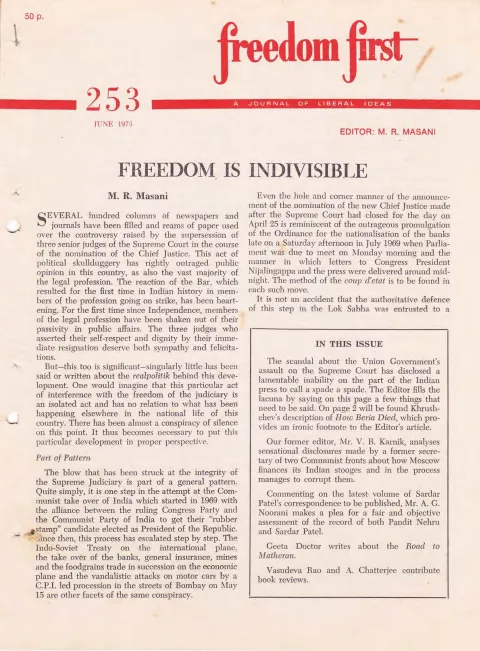
Freedom First
Summary
This is issue No. 253 (June 1973) of Freedom First, the Bombay-based monthly journal of liberal ideas edited by M. R. Masani. The issue opens with Masani’s own editorial, ‘Freedom is Indivisible,’ which reads the supersession of three senior Supreme Court judges in the appointment of the new Chief Justice as part of a wider pattern of Congress-Communist encroachment on Indian institutions, alongside bank nationalisation, the Indo-Soviet Treaty, and the takeover of general insurance, mines, and the foodgrains trade. A reprinted extract, ‘How Beria Died’ (Khrushchev’s own account of Beria’s execution), is placed beside the editorial as an ironic counterpoint. The unsigned column ‘Between You & Me and the Lamp Post’ draws lessons for India from the Watergate scandal (the value of a free press and independent judiciary, and the dangers of concentrated executive power), reviews a slump in Indira Gandhi’s popularity per opinion polling, and comments on AIR’s autonomy debate and a Communist-leaning Congress Parliamentary Party faction. V. B. Karnik’s ‘What Price Afro-Asian Solidarity?’ reports disclosures by a former secretary of the All India Peace Council and the Indian Association for Afro-Asian Solidarity on Soviet financing and misuse of funds by these organisations’ leadership. A. G. Noorani’s ‘Nehru and Patel’ reviews Volume IV of Durga Das’s edited Sardar Patel’s Correspondence, arguing that both Nehru and Patel had serious blind spots (Patel on Muslim minority rights, Nehru on Communism) and that the correspondence reveals the real tensions behind the two men’s later hagiography. Geeta Doctor contributes a light travel essay, ‘The Road to Matheran,’ on the hill station’s toy-train journey and the local controversy over a proposed motor road. The issue closes with two book reviews (of India and the World, an edited seminar volume on Indian foreign policy, reviewed unsigned/by A. Chatterjee; and of Alvin Toffler’s Future Shock, reviewed by K. Vasudeva Rao) and the recurring ‘With Many Voices’ page of quotations on Watergate, Communism, and Indian politics, followed by the subscription form and colophon.
Key points
-
M. R. Masani’s “Freedom Is Indivisible” reads the supersession of three Supreme Court judges as part of a sustained Congress-Communist assault on institutions, alongside bank nationalisation and the Indo-Soviet Treaty.
-
A reprinted extract, “How Beria Died”, recounts Khrushchev’s account of Beria’s summary execution, placed as an ironic counterpoint to the judiciary editorial.
-
The “Notes” column draws lessons from Watergate on the value of a free press and independent judiciary, and reports a sharp fall in Indira Gandhi’s popularity per opinion polling.
-
V. B. Karnik’s “What Price Afro-Asian Solidarity?” reports a former secretary’s disclosures that the All India Peace Council was run as a Soviet-financed racket by a Communist Party faction.
-
A. G. Noorani’s “Nehru and Patel” reviews Volume IV of Patel’s correspondence, arguing Patel was blind to Hindu communalism while Nehru was blind to the Communist danger.
-
Geeta Doctor’s “The Road to Matheran” recounts a toy-train family holiday and local opposition to a proposed motor road into the hill station.
-
Reviews cover a seminar volume on India’s world role, faulted for producing vague political comment, and Alvin Toffler’s “Future Shock” on society’s struggle to keep pace with accelerating change.
Essays
Freedom Is Indivisible
By M. R. Masani
M. R. Masani’s lead editorial argues that the supersession of three senior Supreme Court judges in appointing a new Chief Justice is not an isolated event but one step in a sustained Congress-Communist assault on independent institutions, comparable in method to the surprise bank-nationalisation ordinance of 1969. He traces what he calls a Communist takeover project beginning with the 1969 Congress-CPI alliance around the presidential election, extending through the Indo-Soviet Treaty and nationalisation of banks, insurance, mines, and the foodgrains trade, and culminating in the attack on judicial independence. He singles out Mohan Kumaramangalam’s parliamentary defence of the supersession as an admission of the government’s intent to subordinate the judiciary to a ‘Soviet concept of justice,’ and closes by insisting that freedom is indivisible: the judiciary, press, universities, farmers, workers, traders and businessmen are all threatened by the same encroachment, and only a change of government can restore an independent judiciary.
- Frames the supersession of three Supreme Court judges as political skullduggery, not a routine appointment decision.
- Notes the unprecedented reaction of the Bar, including a strike by lawyers, as a hopeful sign of civic assertion.
- Argues the supersession is one step in a wider pattern: the 1969 Congress-CPI presidential alliance, bank nationalisation, the Indo-Soviet Treaty, and nationalisation of insurance, mines and the foodgrains trade.
- Cites Mohan Kumaramangalam’s parliamentary speech defending the government as an inadvertent admission that Communists in India seek to subvert the Constitution and judicial independence.
- Closes on the aphorism that freedom, like peace, is indivisible, tying the fate of the judiciary to that of the press, universities, farmers, workers and businessmen.
- Calls for lawyers to act as citizens and for a change of government as the only route to restoring judicial independence.
How Beria Died
A short reprinted extract, credited to Nikita Khrushchev’s own narration to French Socialist Senator Pierre Commin in 1956, describing the Soviet Presidium’s decision to try and then summarily execute Lavrenty Beria after Stalin’s death. The editors place it immediately after Masani’s editorial on the Supreme Court supersession, apparently as an ironic illustration of Soviet-style justice without due process.
- Reprinted from Khrushchev and Stalin’s Ghost by Bertram D. Wolfe, translated from Sotsiolisticheskii Vestnik (1956).
- Khrushchev recounts the Presidium’s surveillance of Beria after Stalin’s death, a four-hour cross-examination, and a unanimous decision to execute him without a prior court hearing because ‘juridical evidence’ was lacking.
- Positioned by the editors as an ironic counterpoint to the Editor’s article on the erosion of judicial process in India.
Between You & Me and The Lamp Post
The unsigned ‘Between You & Me and the Lamp Post’ column (the magazine’s recurring editorial-notes feature, historically written by the Editor) draws several lessons from the Watergate scandal for Indian readers: the vital role of a free press (contrasted with what could never be exposed in Moscow, Peking, Cairo, Islamabad or Rangoon), the dangers of concentrated executive power, and the importance of a judiciary that can act without fear of the executive. It then surveys domestic developments: a fall in Indira Gandhi’s popularity per an Indian Institute of Public Opinion poll, her hardening public rhetoric, the dissolution of the Congress Forum for Socialist Action without loosening Communist influence within the Congress Party, a Punjab examination ‘howler’ involving ‘Sarkari kheti’ versus ‘Sahkari kheti,’ and I. K. Gujral’s rejection of AIR autonomy per the Chanda Committee report.
- Uses the Watergate disclosures to argue for the value of a free press, warns against concentration of executive power, and stresses judicial independence from presidential/executive pressure.
- Quotes Walter Lippmann on politicians’ low estimate of human nature and the risks of a ‘Waterloo’ for any politician who relies on cynicism.
- Cites an Indian Institute of Public Opinion poll showing Indira Gandhi’s popularity score falling from a 1972 peak of 260 to 161, back to mid-1969 levels.
- Notes Indira Gandhi’s shift to harsher public rhetoric, including a Gorakhpur speech accepting being ‘branded a dictator’ to secure rights for ‘the teeming millions.’
- Reports that dissolving the Congress Forum for Socialist Action did not dislodge Communist fellow-travellers from the Congress Parliamentary Party executive.
- Recounts a Punjab Higher Secondary Economics exam ‘howler’ in which a printer’s substitution of ‘Sarkari kheti’ (government farming) for ‘Sahkari kheti’ (co-operative farming) is treated as more politically astute than the examiners intended.
- Notes I. K. Gujral’s rejection of the Chanda Committee’s recommendation that AIR become an autonomous corporation.
What Price Afro-Asian Solidarity?
By V. B. Karnik
V. B. Karnik, a former editor of Freedom First, analyses disclosures made by I. S. Dewan, a sixteen-year secretary of the All India Peace Council and the Indian Association for Afro-Asian Solidarity (recently merged into the All India Peace and Solidarity Organisation), after his services were terminated in 1971. Dewan alleged the organisations were run by a PHQ Group of the Communist Party of India led by Chitta Biswas as a racket, financed by the Soviet Union through free air tickets and donations that were misappropriated by group leaders rather than passed on to delegates or accounted for publicly. Karnik details specific incidents cited by Dewan (the 1969 Berlin Peace Congress, the 1971 Budapest Peace Assembly, and payments to a travel agency) and notes that the matter was raised in the Rajya Sabha in March 1973 by Loknath Mishra, prompting a denial from the organisations’ secretariat but no government inquiry.
- I. S. Dewan, sixteen-year secretary of the All India Peace Council and Indian Association for Afro-Asian Solidarity, was terminated in 1971 and began disclosing the organisations’ financial workings.
- Dewan alleges the organisations are run by the ‘PHQ Group’ of the CPI led by Chitta Biswas as a racket, receiving Soviet funding via free air tickets and untaxed donations.
- Details three specific incidents: the 1969 Berlin Peace Congress (unrefunded Rs. 42,048 in air-ticket costs), the 1971 Budapest Peace Assembly, and payments of over Rs. 1,08,521 to Saha & Rai Travels for office-bearers’ tickets.
- The organisations’ secretariat denied the charges in a note calling them ‘utterly and completely false’ without detailed rebuttal, while admitting to receiving pre-paid tickets and donations from international organisations.
- Loknath Mishra raised the charges in the Rajya Sabha on March 20, 1973, and Bhupesh Gupta M.P. tried to stop the reading of Dewan’s letter; the government made no statement and instituted no inquiry.
- Karnik concludes that whether or not every detail is accurate, the admitted acceptance of free passage and donations from a foreign government agency amounts to the organisations acting as agents procuring political goodwill for the Soviet Union.
Nehru and Patel
By A. G. Noorani
A. G. Noorani reviews Volume IV of Durga Das’s edited Sardar Patel’s Correspondence (Navajivan Publishing House), prompted by Indira Gandhi’s participation in Patel’s death-anniversary commemoration. Noorani argues that both Nehru and Patel were ‘truly great men’ with serious blind spots: Patel was blind to Hindu communalism and showed minimal concern for the Muslim minority’s welfare in India even as he pressed hard for Hindu and Sikh minorities’ safety in Pakistan, while Nehru was comparatively blind to the Communist danger. Drawing on 1947 correspondence between Nehru and Patel over Delhi’s administration, refugee resettlement, and the conduct of Chief Commissioner M. S. Randhawa, Noorani shows the Sardar resisting proportional representation for Muslims in services and opposing Nehru’s request to let Muslims resettle in predominantly Muslim localities, while also noting the volume’s material on the Krishna Menon-Sudhir Ghosh correspondence.
- Reviews Volume IV of Sardar Patel’s Correspondence, edited by Durga Das (Navajivan Publishing House, Ahmedabad, Rs. 25).
- Argues Patel was ‘blind to Hindu communalism’ while Nehru was ‘blind to the Communist danger,’ and that followers of each have distorted the historical record by favouring one over the other.
- Cites Patel’s 1947 letter to B. M. Birla rejecting the idea of Hindustan as a Hindu State, alongside evidence that his policies showed ‘a marked bias against the Muslims’ in practice.
- Details a 1947 dispute between Nehru and Patel over Delhi Chief Commissioner M. S. Randhawa’s handling of communal disturbances, and over resettling Muslims in Muslim-majority localities, which Patel opposed.
- Notes the volume also reproduces Nehru-Patel correspondence on Krishna Menon and Sudhir Ghosh, showing Nehru’s defence of Krishna Menon had, in Noorani’s view, ‘tragic consequences for the country.’
- Concludes that liberals must reject both communalism and communism, and that the volume provides valuable primary material dispelling propaganda from both men’s admirers and detractors.
The Road to Matheran
By Geeta Doctor
Geeta Doctor’s light travel essay recounts a family holiday journey up the narrow-gauge toy-train line to Matheran, the Western Ghats hill station discovered in the 1850s by a Mr. Hugh Pointz Mallet. She describes the comic logistics of the trip (excess luggage, a tipsy fellow-passenger, a wayside puja for a railway employee killed on the tracks, monkeys and birds along the route, and an encounter with a shooting for a Hindi film starring Dharmendra), and closes with local controversy over a proposed motor road into Matheran, which residents and a ghoda-wallah (horse-handler) she interviews fear will destroy the hill station’s isolation and character.
- Opens with a whimsical, unverifiable account of Hugh Pointz Mallet’s 1850s ‘discovery’ of Matheran and its transformation into a holiday resort.
- Describes the comic ordeal of preparing for and undertaking the toy-train journey from Neral up to Matheran, including excess luggage and colourful fellow travellers.
- Recounts an encounter en route with a Hindi film shoot featuring actor Dharmendra and an impression-managing, seemingly deaf director.
- Notes local protest signs (‘No tar road in Matheran wanted’) and interviews a ghoda-wallah who opposes the planned motor road despite the potential for more business, out of an inarticulate sense that it would destroy the hill station’s character.
- Closes reflecting that romance and old-fashioned isolation are already receding from small hill towns like Matheran as modernization advances.
Poverty of Political Comment,
An unsigned book review titled ‘Poverty of Political Comment,’ assessing India and the World, edited by A. P. Jain (D. K. Publishing House, Delhi), a volume compiling papers and discussions from a Society for Parliamentary Studies seminar on ‘India and the World Today.’ The reviewer finds the seminar’s broad, unfocused topic produced discussion that reported world events rather than analysing India’s actual interaction with them, criticizes the inclusion of seemingly unrelated Part II papers (on Czechoslovakia and Laos) with no clear link to India, but credits a middle group of five papers with more technical sophistication. The review quotes Dr. Charles Heimsath’s own summary of the South-east Asia discussion as an indictment of the seminar’s lack of analytical framework, and concludes that the book exposes a broader poverty of genuine political analysis in India, where officials’ foreign-policy pronouncements remain vague and secretive.
- Reviews India and the World, edited by A. P. Jain (D. K. Publishing House, Delhi, pp. 392, Rs. 40), a compilation of papers from a Society for Parliamentary Studies seminar held at Vigyan Bhavan.
- Criticizes the seminar’s broad, vague topic for producing discussions that reported on world events rather than analysing India’s actual policy interaction with them.
- Finds no clear connection between Part I of the book and the seemingly unrelated Part II papers on Czechoslovakia and Laos.
- Praises a middle set of five papers for more sophisticated technical analysis, though questions whether they were part of the original seminar or added later.
- Quotes Dr. Charles Heimsath’s own summary of the seminar’s South-east Asia session, in which he notes there was ‘no agreement, or even a definition’ on India’s role in world affairs.
- Concludes the book exposes a broader ‘poverty of genuine political comment’ in India, where officials’ foreign-policy statements remain deliberately vague and much real policy is made in secret.
Reviews: Poverty of Political Comment (India and the World, ed. A. P. Jain)
By A. Chatterjee
A short unsigned closing note appended to the India and the World review, commenting acidly on Watergate-era political euphemisms (‘extenuating circumstances,’ ‘pragmatic assessment,’ ‘inoperative statements’) and on the vacuity of much foreign-policy analysis, illustrated by the example of analysts counting how many times Chou En-lai smiled at Nixon. It is signed ‘A. Chatterjee,’ matching the reviewer credited in the issue’s table of contents for book reviews alongside Vasudeva Rao.
- Comments on new Watergate-era political euphemisms such as ‘extenuating circumstances’ and ‘inoperative statements’ (a term for an earlier statement revealed as false).
- Notes that political analysts resort to counting superficial signals, such as the number of times Chou En-lai smiled at Nixon at an official banquet, calling this ‘the stuff of foreign policy.’
- Signed by A. Chatterjee, one of the two named book reviewers previewed in the issue’s front-page contents note.
The Disease of Change (Future Shock by Alvin Toffler)
By K. Vasudeva Rao
K. Vasudeva Rao reviews Alvin Toffler’s Future Shock (Bantam Books, 561 pages, $1.25), describing it as Toffler’s account of ‘what happens to people when they are overwhelmed by change’ and the adaptive challenges of accelerating social and technological transformation. The review summarizes Toffler’s biography, the book’s six-part, twenty-chapter structure, its core concept (drawing on William Ogburn’s theory of cultural lag) that human adaptive capacity is falling behind the pace of change, and Toffler’s call for a new theory of adaptation to help society ‘come to terms with the future.’ Rao notes the book’s own thesis about the rapid obsolescence of data as something the review itself must reckon with.
- Reviews Alvin Toffler’s Future Shock (Bantam Books, 561 pp., $1.25, New York).
- Describes Toffler’s background as an editor of Fortune and contributor to Life, Horizon, Playboy and academic journals, and author of The Culture Consumers.
- Summarizes the book’s six parts and twenty chapters, including chapters like ‘The Death of Permanence’ and ‘the throw-away society.’
- Explains the core concept of ‘future shock,’ coined by Toffler in a 1965 Horizon article, building on William Ogburn’s theory of cultural lag about uneven rates of change across social sectors.
- Quotes Toffler’s argument that society has not learned to ‘conceive, research, write and publish in real time,’ so readers must focus on general themes over rapidly-obsolescing details.
- Notes the review’s own closing point that the rapidity of change gives the book’s data a ‘special significance’ precisely because it will quickly go out of date, self-verifying its own thesis.
With Many Voices
The recurring ‘With Many Voices’ page, a compilation of quotations from the contemporary press and public figures on Watergate, Communism, Indian politics, and international affairs, drawn from sources including The Economist, Time, President Nixon, Raymond Aron, Girilal Jain, Madhu Limaye, Balraj Madhok, Colonel Gaddafi, and Maharashtra Chief Minister V. P. Naik, framed by an epigraph from Tennyson.
- Compiles brief quotations from international and Indian press and public figures dated April-May 1973.
- Includes comparisons between Watergate-style scandal in the US and routine practices in Communist states, e.g. a Jana Sangh comment likening the domestic ‘Maruti affair’ to Watergate in scale.
- Features quotes from Raymond Aron on Marx’s continuing relevance through his questions rather than his answers, and from Girilal Jain on doubts about centralised planning versus the market mechanism.
- Includes Madhu Limaye’s prediction that the word ‘socialism’ is losing its meaning and will eventually be hated.
- Includes Balraj Madhok’s claim that the slow death of democracy in India began the day Nehru came to power.
- Closes the issue’s editorial content before the subscription form and publication colophon (Freedom First, published for the Democratic Research Service by J. R. Patel at 127 Mahatma Gandhi Road, Bombay 1).
Generated by the v1.5 extraction pipeline. Awaiting editorial review.
Essay 10
No summary was extracted for this article. Listed for completeness.
Metadata and summary are AI-extracted from the source PDF and reviewed for editorial accuracy. The original work is available via the Read PDF tab above (where present); paragraph-level citation inside the PDF is deferred to a future engagement.