periodical issue
Freedom First
A Journal of Liberal Ideas
By A. G. Noorani, Brian Crozier, Manjula Padmanabhan, Geeta Doctor, Geoffrey Noronha, U. H. Easwarasarma, A. G. Noorani
Published for the Democratic Research Service by J. R. Patel, Associate Editor, Freedom First at 127, M. Gandhi Road, Bombay 1 (Phone: 254341) and printed by him at Inland Printers, 55 Gamdevi Road, Bombay 7. · Bombay · 1973
16 pages
Freedom First
Summary
This is issue No. 255 of Freedom First (August 1973), edited by M. R. Masani, a monthly journal of liberal ideas published in Bombay for the Democratic Research Service. The issue opens with a front-page statement by Jayaprakash Narayan and M. R. Masani protesting the arrest of Acharya Kripalani in Haryana and warning of growing intolerance of dissent under Mrs Gandhi’s government, before turning to A. G. Noorani’s comparative essay on the judiciary in the U.K. and U.S. constitutional systems. The editorial column ‘Between You & Me and The Lamp Post’ comments on the launch of J.P. Narayan’s new journal Everyman’s, Andrei Sakharov’s statements on Vietnam, the elevation of a communist-affiliated judge to the Supreme Court, and a rising ‘cult of personality’ around Indira Gandhi among Congress leaders. Brian Crozier contributes a sharp piece arguing that Brezhnev-era detente is a dangerous illusion given continued Soviet subversion abroad. Manjula Padmanabhan writes a personal, humorous account of holding a poster exhibition on a Bombay pavement. The issue also carries book reviews (on the position of women in India, and on British defence policy east of Suez), a heated exchange of letters between U. H. Easwarasarma and A. G. Noorani over Noorani’s earlier review of Sardar Patel’s correspondence and its treatment of communal politics in 1947, and closes with the regular ‘With Many Voices’ page of press quotations.
Key points
-
A joint statement by Jayaprakash Narayan and M. R. Masani protests the arrest of Acharya Kripalani in Haryana as symptomatic of growing intolerance of dissent.
-
A. G. Noorani’s “The Judiciary - U.K. and U.S. Models” compares the two constitutional systems, concluding India’s judiciary carries a heavier burden given its shallower democratic tradition.
-
The “Notes” column criticises the elevation of former Communist minister V. R. Krishna Iyer to the Supreme Court as “packing the court” and attacks a rising personality cult around Indira Gandhi.
-
Brian Crozier’s “Such Men Are Dangerous” argues Nixon-Brezhnev detente is a dangerous illusion given continuing Soviet propaganda, subversion and support for revolutionary movements abroad.
-
Manjula Padmanabhan recounts holding her first poster exhibition on a Bombay pavement outside the Jehangir Art Gallery.
-
Geeta Doctor reviews “The Position of Women in India”, and Geoffrey Noronha reviews Phillip Darby’s study of British defence policy east of Suez.
-
A heated exchange of letters between U. H. Easwarasarma and A. G. Noorani revisits whether Sardar Patel held communal bias against Muslims in 1947.
Essays
The Judiciary - U.K. and U.S. Models
By A. G. Noorani
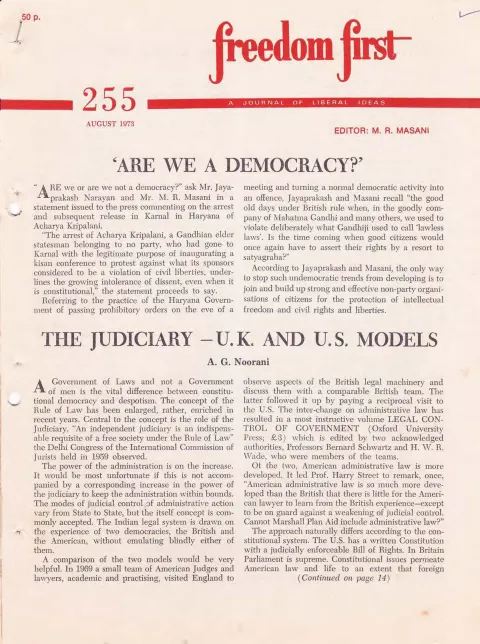
An unsigned front-page news item reporting a joint statement by Jayaprakash Narayan and M. R. Masani on the arrest and release of Acharya Kripalani in Karnal, Haryana, where he had gone to inaugurate a kisan conference protesting a violation of civil liberties. The statement frames the Haryana government’s use of prohibitory orders as part of a growing intolerance of dissent even when constitutional, invokes the memory of civil disobedience under British rule, and calls for citizens to build strong non-party organisations to defend intellectual freedom and civil liberties.
- Acharya Kripalani was arrested and later released in Karnal, Haryana while attempting to inaugurate a kisan conference.
- Jayaprakash Narayan and M. R. Masani issued a joint statement calling the episode symptomatic of growing intolerance of dissent.
- The statement compares present conditions to ‘the good old days’ of deliberately violating ‘lawless laws’ under British rule, alongside Gandhi.
- The two leaders urge citizens to build non-party organisations to defend intellectual freedom and civil liberties.
Such Men Are Dangerous
By Brian Crozier
A. G. Noorani compares the role of the judiciary in the British and American constitutional systems, prompted by a 1969 exchange visit between American judges/lawyers and their British counterparts that produced the volume Legal Control of Government (edited by Bernard Schwartz and H. W. R. Wade). Noorani frames the ‘Rule of Law’ and an independent judiciary as central to the difference between constitutional democracy and despotism, noting the U.S. has a written Constitution with a judicially enforceable Bill of Rights while Britain operates under parliamentary supremacy. Continuing on pages 14-15, he discusses how American judges have taken on a more overtly policy-making, activist role than British judges would countenance, citing landmark Warren Court decisions (reapportionment, right to counsel, school prayer, libel and obscenity law) and noting the backlash this provoked from Congress. He also covers British administrative-law developments (the Parliamentary Commissioner, Lok Ayukta/Lok Pal proposals in India, the Anisminic case) and closes by observing that India’s judiciary bears a heavier burden than its British or American counterparts because democratic tradition and public vigilance are less deeply rooted here.
- The essay compares the British and American judicial systems following a 1969 exchange visit between American and British judges/lawyers.
- The U.S. has a written, judicially enforceable Bill of Rights; in Britain Parliament is supreme, so American administrative and constitutional law is more developed.
- American courts, especially the Warren Court, took on an overtly policy-making, activist role (reapportionment, right to counsel, school prayer, libel/obscenity) that provoked a legislative backlash defeating two Nixon Supreme Court nominations.
- The Burger Court under Warren Burger has broadly maintained the Warren Court’s trend on racial desegregation while showing caution (‘judicial restraint’) elsewhere.
- India’s administrative-law and ombudsman-style institutions (Lok Ayukta, proposed Lok Pal) are modelled on British precedents such as the Parliamentary Commissioner for Administration.
- Noorani concludes that India’s judiciary carries a heavier burden than the U.S. or U.K. judiciary because democratic tradition and public vigilance are less deeply rooted in India.
On Being a Goldfish in a Glass Bowl
By Manjula Padmanabhan
The regular editorial notes column ‘Between You & Me and The Lamp Post’ covers several items: it welcomes Jayaprakash Narayan’s new weekly journal Everyman’s while warning it will need to offer something distinctive to survive in a crowded market; it discusses Andrei Sakharov’s statements on Vietnam and detente, noting a British publication’s observation that Newsweek omitted parts of his views from its published interview; it criticises the elevation of Mr. V. R. Krishna Iyer, a former Communist minister in Kerala, to the Supreme Court, calling it a case of ‘packing the court’; and it attacks a rising ‘cult of personality’ around Mrs Gandhi, quoting Union Minister D. K. Barooah’s remarks in Bombay that she was the only leader, and reports Congress M.P. Shashi Bhushan’s call in Jaipur for a ‘limited dictatorship’.
- Freedom First welcomes Jayaprakash Narayan’s new weekly Everyman’s but warns it faces a crowded market of English-language weeklies.
- The column discusses Andrei Sakharov’s views on Vietnam and notes a discrepancy in how Newsweek reported his comments compared to other outlets.
- It criticises the appointment of V. R. Krishna Iyer, described as a former Communist minister in Kerala, to the Supreme Court as ‘packing the court’.
- It reports Union Minister D. K. Barooah’s Bombay speech asserting Mrs Gandhi as the sole leader and attacks this as a ‘cult of personality’.
- It also reports Congress M.P. Shashi Bhushan calling for ‘limited dictatorship’ in Jaipur, framing both episodes as possible groundwork for authoritarian drift.
Against Becoming a Self Satisfied Pig (review of ‘The Position of Women in India’, ed. Kamla Bhasin)
By Geeta Doctor
Brian Crozier, Director of the Institute for the Study of Conflict in London, argues in this extract (written before Brezhnev’s U.S. visit) that the Nixon-Brezhnev detente is dangerously misunderstood in the West. He contends the world did not become safer after the 1972 agreements, and that the absence of any acute crisis-sense is itself the danger, masking a shift of the Cold War onto more diffuse, internal battlegrounds (Ulster, Paris 1968, Turkey). He shows that Western usage of ‘cold war’ has drifted to match the Soviet definition, so that any criticism of the USSR is now branded ‘cold war’ revivalism, while the actual volume of Soviet propaganda, subversion, espionage and support for revolutionary movements abroad continues undiminished. He cites Soviet ideologist V. N. Egorov’s writings on ‘peaceful coexistence’ to show that official Soviet doctrine still calls for intensifying the ‘struggle of the working classes’ even as it renounces war between states.
- Crozier argues that the 1972 Nixon-Brezhnev agreements merely consecrated changes already underway rather than making the world safer.
- He contends the chief present danger is the total absence of a sense of crisis, in contrast to earlier Cold War flashpoints like the 1948 Berlin airlift.
- Western usage of ‘cold war’ has drifted toward the Soviet definition, so that criticizing Soviet policy is now stigmatized as ‘cold war’ revivalism.
- He documents continuing Soviet propaganda, subversion, espionage, and support for ‘revolutionary processes’ abroad as evidence detente has not ended these activities.
- He quotes Soviet ideologist V. N. Egorov’s book Peaceful Coexistence and the Revolutionary Process to show official doctrine still calls peaceful coexistence a vehicle for intensifying international class struggle.
British Defence Policy (review of ‘British Defence Policy East of Suez 1947-1968’ by Phillip Darby)
By Geoffrey Noronha
Manjula Padmanabhan writes a light, first-person account of holding her first exhibition of decorative posters on the pavement outside the Jehangir Art Gallery in Bombay, after a tip from a bearded artist who annually exhibited there. She describes the bureaucratic complications of getting the informal ‘gallery’ set up, a police interruption two weeks before her debut, and the diverse crowds who came over seven days: idlers, hippies looking for a ‘soul mate’, gypsies, Hijras, foreign travellers, and the ‘Educated Elite’ she sorts into cynical disbelievers, well-meaning critics, and unabashed admirers. She reflects that despite the exposure she had once dreaded, the experience was memorable and worth recommending, even though it was not a financial success.
- Padmanabhan held her first exhibition of decorative posters on the pavement outside the Jehangir Art Gallery in Bombay rather than in a formal gallery.
- The exhibition followed a tip from a bearded artist who annually exhibited on the same pavement, and required navigating an informal, seasonal ‘gallery’ arrangement.
- Police briefly shut down the gallery about a week before her debut, resolved only after intervention with ‘Someone Who Mattered’.
- The crowds included idlers, hippies, gypsies, Hijras, and foreign travellers, alongside the ‘Educated Elite’ she divides into cynics, well-meaning critics, and unabashed admirers.
- She reflects the exhibition was not a financial success but remains one of her most memorable experiences and one she recommends to others.
Injustice to Sardar (Letter)
By U. H. Easwarasarma
Geeta Doctor reviews The Position of Women in India, edited by Kamla Bhasin (Leslie Sawhny Programme of Training for Democracy / Friedrich-Naumann-Stiftung), a book condensed from a seminar on the status of Indian women. The review describes how the seminar, unlike Western Women’s Lib movements, avoided a ‘persecution complex’ and instead sought reform through the participation of both men and women. It summarizes contributions by Dr. Promilla Kapur, Mehra Masani, Dr. C. A. Hate, and Kamladevi Chattopadhyaya, noting statistics on unemployment among educated women and the double standards that grant women equality in principle but withhold it in practice. The review praises the volume as a brisk, thought-provoking step toward addressing the challenges facing Indian women, despite acknowledging its brief and panoramic rather than exhaustive treatment.
- The book reviewed, The Position of Women in India, edited by Kamla Bhasin, condenses the proceedings of a seminar organised by the Leslie Sawhny Programme of Training for Democracy and the Friedrich-Naumann-Stiftung.
- The seminar avoided the ‘persecution complex’ associated with Western Women’s Lib and instead argued liberation must be a movement of both men and women.
- Four main papers were presented, by Dr. Promilla Kapur, Mehra Masani, Dr. C. A. Hate, and Kamladevi Chattopadhyaya.
- Cited statistics show that, per 1971 figures, a majority of unemployed women degree-holders were not even seeking work, versus a much lower rate among men.
- The review frames the book’s central theme as the double standard of granting women formal equality while withholding it in practice.
A Rejoinder
By A. G. Noorani
Geoffrey Noronha reviews British Defence Policy East of Suez 1947-1968 by Phillip Darby (Oxford University Press), a study published under the auspices of the Royal Institute of International Affairs on Britain’s evolving post-colonial defence relationship with India and other former dependencies. The review traces the two decades after independence, including Field Marshal Auchinleck’s sense that Britain remained ‘morally bound’ to aid India and Pakistan, the Dum Dum/Karachi air staging arrangements, British arms aid to India after the 1962 war with China, the 1963 Nassau-linked Kennedy-Macmillan defence aid agreement, the 1965 Indo-Pak war which ended talk of defence collaboration, and Britain’s 1968 decision to withdraw its forces from east of Suez due to resource constraints. Noronha calls the book an excellent survey, faulting only its comparative lack of detail versus a comparable study by Prof. Lorne J. Kuic covering 1947-1965.
- The reviewed book, British Defence Policy East of Suez 1947-1968 by Phillip Darby, covers two decades of Britain’s post-independence defence relationship with India.
- Field Marshal Auchinleck, Britain’s last Commander-in-Chief in India, expressed the view that Britain remained ‘morally bound’ to aid India and Pakistan against an aggressor.
- The review traces British military aid to India after the 1962 Sino-Indian war, including the Kennedy-Macmillan Nassau agreement extending £42 million in military aid.
- The 1965 Indo-Pak war ended talk of continued UK-India defence collaboration, after which India turned toward the USSR, formalized in the 1971 Indo-Soviet Treaty.
- Britain’s January 1968 decision to withdraw defence forces from east of Suez and the Persian Gulf is attributed to ‘lack of resources rather than intellectual rejection’.
With Many Voices (miscellany of quoted press extracts)
A letter to the editor from U. H. Easwarasarma disputes A. G. Noorani’s earlier review (in the June issue) of Sardar Patel’s Correspondence (Vol. IV), arguing that Noorani unfairly portrayed Patel as communally biased against Muslims. Easwarasarma defends Patel’s stance on Muslim over-representation in the Delhi police as motivated by a merit principle rather than communal bias, disputes Noorani’s reading of the Nehru-Patel correspondence on Chief Commissioner M. S. Randhawa’s conduct during the 1947 partition riots, and argues it is unfair to compare Patel unfavourably to Gandhi or Nehru given the absence of any Muslim League leader who approached their stature.
- Easwarasarma challenges Noorani’s review of Sardar Patel’s Correspondence (Vol. IV), which argued Patel held anti-Muslim communal views.
- He argues Patel’s stance on Muslim over-representation in the Delhi Police was about restoring merit-based proportion, not communal bias.
- He disputes Noorani’s reading of the Nehru-Patel exchange over Chief Commissioner M. S. Randhawa’s conduct during the 1947 Delhi riots.
- He cites Patel’s own words to Neogy on the dangers of predominantly Muslim or Hindu areas as evidence of even-handedness.
- He argues it is unfair to compare Patel unfavourably to Gandhi or Nehru, since no Muslim League leader approached their moral stature either.
Essay 9
A. G. Noorani’s rejoinder to Easwarasarma’s letter reaffirms his original critique of Sardar Patel’s handling of communal issues in 1947. Noorani argues Nehru’s letter to Patel on Chief Commissioner Randhawa reflects unease rather than satisfaction, and that Patel’s account of the ‘mass psychology’ building against Muslims in Delhi reflected sympathy with that psychology rather than objectivity. He contends Patel applied a double standard by defending merit-based recruitment in principle while tolerating discriminatory treatment of Muslims in the Delhi police and services, and closes by suggesting Easwarasarma compare the warmth of Patel’s correspondence with M. S. Golwalkar to the coldness of Nehru’s letters to Muslim League-linked figures.
- Noorani argues Nehru’s letter to Patel about Chief Commissioner Randhawa reflects unease and lack of conviction rather than satisfaction.
- He argues Patel’s account of rising ‘mass psychology’ against Muslims in Delhi reflected sympathy with, rather than objective distance from, that sentiment.
- Noorani contends Patel applied a double standard: insisting on merit in recruitment while tolerating discriminatory treatment of Muslims in the Delhi police and other services.
- He points to the Nehru-Patel exchange over resettling Muslims in predominantly Muslim localities as evidence of differing responses to communal questions.
- He suggests comparing the warmth of Patel’s correspondence with M. S. Golwalkar to the iciness of Nehru’s letters to Muslim League-linked figures.
Essay 10
‘With Many Voices’, the issue’s closing page of press quotations, gathers short excerpts from a wide range of public figures and commentators on politics and current affairs in mid-1973, including remarks by Mark Twain, President Georges Pompidou, Edward Heath, Piloo Mody, Nayantra Sahgal, Sheikh Abdullah, Lenin (quoted in Himmat), Regis Debray, N. G. Goray, and Graham Turner. Several quotations comment critically on Mrs Gandhi’s government, Congress politics, and the state of the Indian economy. The page also carries the subscription form for Freedom First, published by the Democratic Research Service.
- The page compiles short quotations from public figures published in various newspapers and magazines during May-July 1973.
- Several quotations are critical of Mrs Gandhi and Congress politics, including remarks by Piloo Mody, Nayantra Sahgal, and N. G. Goray.
- A Lenin quotation on exploiting capitalist countries for raw materials is reprinted from Himmat magazine.
- The page includes the subscription form for Freedom First, published for the Democratic Research Service by J. R. Patel.
Generated by the v1.5 extraction pipeline. Awaiting editorial review.
Metadata and summary are AI-extracted from the source PDF and reviewed for editorial accuracy. The original work is available via the Read PDF tab above (where present); paragraph-level citation inside the PDF is deferred to a future engagement.