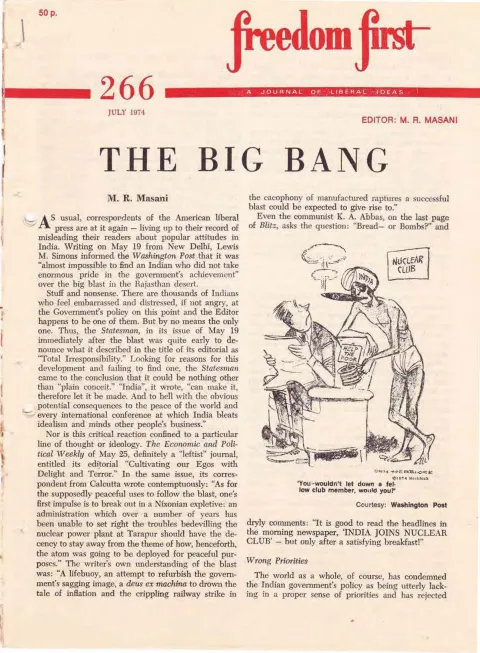
periodical issue
Freedom First
A Journal of Liberal Ideas
By Geeta Doctor, L. H. Gann, M. G. Bailur, M. H. M., Manjula Padmanabhan
Published for the Democratic Research Service by J. R. Patel, Associate Editor, Freedom First at 127, M. Gandhi Road, Bombay 1 ('Phone: 254341) and printed by him at Inland Printers, 55 Camdevi Road, Bombay 7. · Bombay · 1973
16 pages
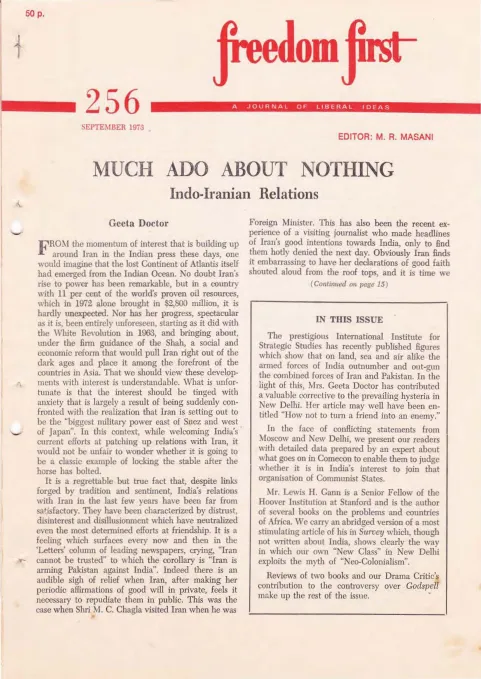
Freedom First
Summary
Freedom First No. 256 (September 1973), edited by M. R. Masani, is a mixed issue of the classical-liberal Bombay journal combining foreign-policy commentary, an economic critique of Comecon, a lengthy essay on neo-colonialism theory, book and theatre reviews, and the magazine’s regular editorial miscellany column. Geeta Doctor opens the issue arguing that India’s anxieties about a rising, rearming Iran are overblown and largely self-inflicted, given India’s own military preponderance in the region and the incoherence of Iranian and Indian mutual signalling. An unsigned staff analysis examines whether India should join Comecon, concluding from trade and growth statistics that the bloc is a Soviet-dominated, economically inefficient arrangement offering little genuine multilateral benefit. The issue’s centrepiece is L. H. Gann’s essay ‘Neo-Colonialism and the New Class,’ an abridged piece (drawn from Survey) that challenges Leninist and dependency-theory accounts of imperialism with investment and trade statistics from Africa, and argues that neo-colonialism theory chiefly serves the material and psychological interests of a new post-colonial administrative and intellectual elite. The regular ‘Between You & Me and The Lamp Post’ column takes aim at price controls, socialism, a Chinese news agency’s approving citation of Masani, and a controversy involving Advocate-General H. M. Seervai’s lecture being co-opted by Communist sympathisers. Review pages cover M. Chalapathi Rau’s official biography of Nehru (harshly assessed by M. G. Bailur as vain and poorly written), Sharu Rangnekar’s management humour book, and Manjula Padmanabhan’s admiring theatre review of the Bombay production of Godspell. The back page carries the ‘With Many Voices’ quotations column and the subscription form.
Key points
-
Geeta Doctor’s “Much Ado About Nothing” argues Indian anxiety over Iran’s rise is overblown, since India’s own military strength exceeds Iran’s and Pakistan’s combined.
-
An unsigned analysis examines whether India should join Comecon, concluding from trade and growth statistics that the bloc is an economically inefficient vehicle for Soviet primacy.
-
L. H. Gann’s “Neo-Colonialism and the ‘New Class’” challenges dependency-theory claims with investment data, arguing neo-colonialism theory chiefly serves a new post-colonial administrative elite’s material interests.
-
The “Between You & Me” column criticises price controls and a controversy over Advocate-General H. M. Seervai’s lecture being co-opted by Communist sympathisers.
-
M. G. Bailur harshly reviews M. Chalapathi Rau’s official Nehru biography as a poorly written “tourist’s-guide” that reveals more about the author’s vanity than his subject.
-
A brief review praises Sharu Rangnekar’s “In the Wonderland of Indian Managers” for its satirical treatment of feudalism and nepotism in Indian management.
-
Manjula Padmanabhan reviews the Bombay production of “Godspell”, finding its first half fully successful but its solemn second half less coherent.
Essays
Much Ado About Nothing: Indo-Iranian Relations
By Geeta Doctor
Geeta Doctor argues that the Indian press’s sudden fixation on Iran’s rise as a regional power — fuelled by oil wealth and the Shah’s economic reforms since the 1963 White Revolution — is disproportionate and reflects a ‘mental block’ that reads every Iranian move only through the lens of Iran’s relations with Pakistan. She notes that international military data show India’s forces outnumber the combined forces of Iran and Pakistan, undercutting alarmist framing. The essay recounts a history of unrealized economic cooperation (steel rail purchases, petrochemical and ammonia deals, the Manali Refinery crude-oil pricing dispute) alongside genuine points of friction, including Iran’s tacit support for Pakistan during the Bangladesh crisis, its opposition to Bangladesh’s creation, and its wariness of India’s tilt toward the Soviet Union and toward Iraq amid Iran-Iraq tension over the Shatt-al-Arab. Doctor concludes that India’s foreign policy on Iran seems driven more by deference to Soviet interests than by India’s own, and questions whether India retains real latitude to set its own course.
- India’s military strength exceeds the combined forces of Iran and Pakistan, per the International Institute for Strategic Studies, undercutting alarm about Iran’s rise.
- Iran’s economic transformation since the 1963 White Revolution, backed by oil revenues ($2,800 million in 1972), is framed as remarkable but not implausible or unexpected.
- Planned Indo-Iranian economic cooperation (steel rails, petrochemicals, ammonia supply) stalled due to bureaucratic disorganisation on the Indian side.
- A pricing dispute over crude oil supplied to the Manali Refinery soured relations, with the Indian press seen as unfairly blaming Iran.
- Iran’s cooling relationship with Iraq over the Shatt-al-Arab and Persian Gulf islands contrasts with India’s own warming ties to Iraq, which Iran reads as hostile.
- The essay concludes that India’s Iran policy is shaped more by alignment with Soviet interests (via the 1971 Indo-Soviet treaty) than by India’s own strategic needs.
Between You & Me and The Lamp Post
An unsigned staff analysis responds to reports that India was considering Comecon membership, examining whether the Council for Mutual Economic Assistance is a sound multilateral grouping worth joining. Using trade and growth statistics — declining shares of world exports and imports, falling ratios of national-income growth to investment across Bulgaria, Czechoslovakia, the GDR, Hungary, Poland and the USSR, and a shrinking share of intra-bloc trade in members’ total trade between 1965 and 1970 — the piece argues that Comecon is economically incoherent and functions chiefly to route trade toward Soviet requirements rather than genuine multinational cooperation. It draws on Soviet-Egyptian and Indo-Soviet agreement texts to show how Comecon-linked technical assistance is structured to preserve Soviet primacy, and cites the Economist’s description of Comecon as ‘little more than a glorified intra-governmental organisation.’ It concludes that Comecon is ‘just another off-shoot of Soviet Russia’s proletarian imperialism.’
- The Slovak Communist paper Pravda reported India was considering Comecon membership, a claim officially denied by Indian sources the next day.
- Comecon’s share of world exports and industrial production declined between 1950 and 1970, and its share of world exports and imports also fell between 1965 and 1970.
- Growth-to-investment ratios declined across every major Comecon member state between 1950-55 and 1961-65, indicating inefficient industrial planning.
- Intra-bloc trade as a share of members’ total trade volume fell from 63.09% (1965) to 60.69% (1970), undercutting the goal of economic integration.
- Agreements such as the 1958 USSR-Egypt pact and the 1959 Indo-Soviet Barauni Refinery agreement show Comecon-style technical cooperation is structured around Soviet primacy, not mutual benefit.
- The Economist is quoted describing Comecon as having ‘hardly any supranational features.‘
Should India Join Comecon?
L. H. Gann’s essay, abridged from Survey, dissects the doctrine of neo-colonialism as it has developed within Leninist and post-Leninist thought, arguing the theory serves ideological rather than empirical purposes. Gann marshals US investment and trade data — total US foreign investment of about $78 billion against a GNP of $974 billion, with only a small fraction placed in Africa or Asia and profits repatriated from Africa amounting to under 1% of US GNP — to argue that the claim of Western capitalism deriving its prosperity from exploiting the developing world is empirically baseless. Drawing on Zambia and Ghana as case studies (citing the economist Peter T. Bauer on Ghana), he shows substantial economic, infrastructural and educational growth under and after colonial rule, challenging the ‘robbery of resources’ narrative. He then traces how Lenin’s and Marx’s failed revolutionary predictions were rescued ideologically by successive theories (the ‘New Imperialism,’ then neo-colonialism), and argues the concept now chiefly serves a new administrative and educated elite in post-colonial states — created by colonial powers to administer, then inheriting the machinery of government — whose material and psychological interests are served by blaming external exploitation for domestic economic and political failures, including justifying nationalization and further concentration of state power.
- US total foreign investment (~$78 billion) was under one-twelfth of US GNP in 1970; African investment was around $3.5 billion, undercutting claims that Western prosperity derives from exploiting the developing world.
- Profits repatriated from Africa to the US (~$680 million in 1970) were a small fraction of the Ford Foundation’s asset holdings, illustrating the scale mismatch in dependency-theory claims.
- Zambia’s economic, technological, and social transformation under British colonial rule (1890s-1964) is presented as evidence against the ‘robbery of resources’ narrative, alongside Peter T. Bauer’s data on Ghana’s cocoa exports and infrastructure growth.
- Neo-colonialism theory functions as an ideological patch that explained away Marx’s and Lenin’s failed predictions of imminent Western capitalist collapse.
- The theory now serves the interests of a new administrative ‘New Class’ elite in post-colonial states, created and trained by former colonial powers, who use anti-colonial and anti-capitalist rhetoric to justify nationalization and expanded state employment.
- Gann warns the ‘young and righteous nations vs ageing capitalist powers’ framing obscures serious intra-Third-World ethnic conflicts (Kurds/Arabs, Ibo/Hausa, Galla/Amhara) and is likely to persist as entrenched post-colonial orthodoxy.
Neo-Colonialism and the ‘New Class’
By L. H. Gann
M. G. Bailur reviews M. Chalapathi Rau’s official, government-commissioned biography Jawaharlal Nehru, judging it a disappointing ‘tourist’s-guide’ rather than a serious biographical study. Bailur is sharply critical of the author’s prose (calling it ‘jejune,’ ‘ungrammatical,’ and full of ‘purple patches’), his reliance on paraphrasing Nehru’s own autobiography rather than original research, and his self-promoting preface, which the reviewer sees as revealing more about Rau’s own vanity and cultivated proximity to Nehru than about its subject.
- Bailur questions Rau’s credibility as biographer given his 27-year editorship of Nehru’s own paper, the National Herald, calling this closeness a liability rather than an asset.
- The book’s first two chapters are described as ‘a mere paraphrasis in bad English’ of Nehru’s own autobiography.
- Bailur cites ungrammatical and gnomic sentences from the preface as evidence of poor craftsmanship.
- The review recounts Rau’s own reputation for self-publicity, including conflicting reports about whether he accepted or rejected the Padma Bhushan award.
- Bailur concludes the preface itself, rather than the biography, is the book’s most revealing feature, exposing Rau’s ‘technique of company-promoting.‘
Reviews — Tourist’s-Guide to Nehru (review of ‘Jawaharlal Nehru’ by M. Chalapathi Rau, Publications Division, Government of India, New Delhi, Price Rs. 15)
By M. G. Bailur
A short, admiring review (initialled M.H.M.) of Sharu Rangnekar’s In the Wonderland of Indian Managers, a book on Indian management culture illustrated with cartoons by Laxman. The reviewer praises its lively, satirical treatment of feudalism and nepotism in Indian industrial management and recommends it to both aspiring and established managers.
- The book is praised for perceptive analysis of management problems in Indian industry, delivered through racy style and anecdotes.
- Laxman’s cartoons are credited with ably complementing the author’s satirical observations.
- The reviewer highlights the book’s exposure of feudalism and nepotism in industrial management as its strongest material.
- The review recommends the book both as a text for aspiring managers and reading for those already at the top.
Reviews — In the Wonderland of Management (review of ‘In the Wonderland of Indian Managers’ by Sharu Rangnekar, Associated Personnel Services, Rs. 30)
By M. H. M.
Manjula Padmanabhan reviews the Bombay production of Godspell, directed by Pearl Padamsee, praising its irreverent, comedic staging of Gospel parables through mime, song and dance performed by a young, exuberant cast. She finds the first half completely successful but judges the second half weaker, arguing the shift to solemnity in the closing scenes never fully coheres with the earlier gaiety, unlike the more consistently modest tone of Jesus Christ Superstar.
- The production restages Gospel parables as comic collage rather than a linear account of Christ’s life, using mime and boisterous group song.
- The young, largely amateur cast is praised for spontaneity and evident enjoyment on stage.
- The reviewer singles out standout moments including the Lazarus scene and the prodigal son sequence.
- The second half is judged weaker, with disconnected added scenes undermining the shift from comedy to tragic solemnity.
- Godspell is favourably contrasted with Jesus Christ Superstar as a quieter, more appropriate handling of the same story.
Generated by the v1.5 extraction pipeline. Awaiting editorial review.
Metadata and summary are AI-extracted from the source PDF and reviewed for editorial accuracy. The original work is available via the Read PDF tab above (where present); paragraph-level citation inside the PDF is deferred to a future engagement.