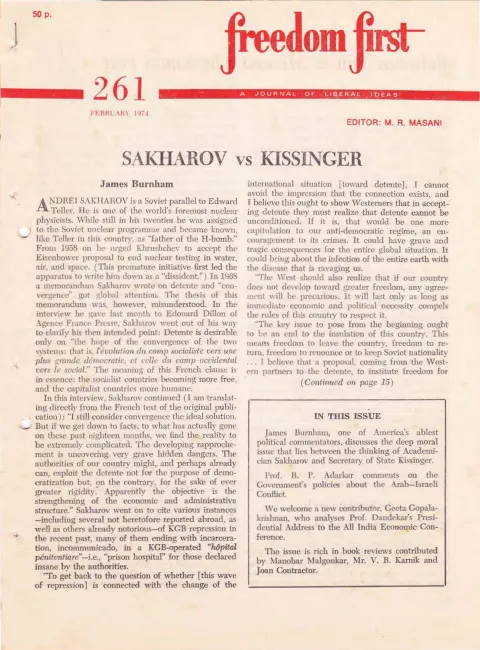
periodical issue
Freedom First
A Journal of Liberal Ideas
Published for the Democratic Research Service by J. R. Patel, Associate Editor, Freedom First at 127, M. Gandhi Road, Bombay 1 ('Phone: 254341) and printed by him at Inland Printers, 55 Gamdevi Road, Bombay 7. · Bombay · 1974
16 pages
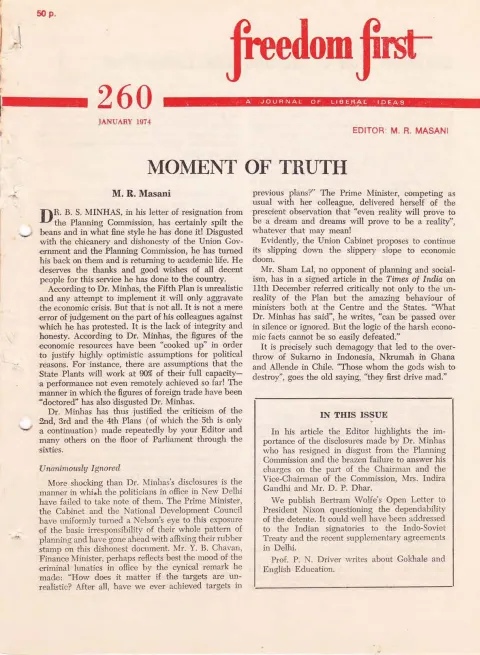
Freedom First
Summary
Freedom First No. 260 (January 1974) is a monthly issue of the Bombay-based liberal journal edited by M. R. Masani, combining editorial commentary, an open letter on Soviet human rights, a two-part historical essay on Gokhale, book and film reviews, a reader letter, and a closing column of quoted opinion. In the rendered pages, editor Masani’s lead editorial excoriates the Union government and the Planning Commission over Dr. B. S. Minhas’s resignation and the ‘doctored’ Fifth Plan figures, while the unsigned ‘Between You & Me and The Lamp Post’ column takes up Indian Airlines Corporation’s labour troubles, petrol-price protests, extra-judicial public shaming of traders in Calcutta, and the treatment of Swatantra Party posters ahead of Brezhnev’s Delhi visit. Bertram D. Wolfe’s open letter to President Nixon presses the case that detente with the Soviet Union cannot be divorced from Soviet treatment of dissidents. P. N. Driver contributes the first half of a two-part essay on Gopal Krishna Gokhale’s advocacy of English-medium western education as a liberating and nation-building force. The issue closes with three book reviews (on Peter Bauer’s development economics, Soviet dissent, and Czechoslovakia’s planned economy), a film review of Last Tango in Paris, a letter protesting the ceremonial welcome given to Brezhnev, and a column of pointed quotations under the heading ‘With Many Voices.‘
Key points
-
M. R. Masani’s editorial “Moment of Truth” hails Dr. B. S. Minhas’s resignation from the Planning Commission as vindicating years of criticism that the government doctored Fifth Plan targets on capacity utilisation and foreign trade, and rebukes the Prime Minister, Cabinet, and Finance Minister Y. B. Chavan for ignoring the disclosure.
-
The unsigned “Between You & Me and The Lamp Post” column defends Air Chief Marshal P. C. Lal’s stand against Indian Airlines Corporation union militancy, attacks calls to restrict private cars after a petrol-price hike as unworkable class-baiting, condemns West Bengal’s and Haryana’s extra-judicial treatment of traders and black-marketeers, and reports the beating of Swatantra Party volunteers postering ahead of Brezhnev’s Delhi visit.
-
Bertram D. Wolfe’s open letter to President Nixon argues, through the history of Hoover’s famine relief, Depression-era industrial aid, and Lend-Lease, that unconditional American generosity has never moderated Soviet repression, and presses for detente to be conditioned on the release of over 600 long-refused emigrants and on the treatment of dissidents Sakharov, Solzhenitsyn, and Amalrik.
-
P. N. Driver’s two-part essay, concluded the following issue, on Gopal Krishna Gokhale credits Gokhale’s advocacy of English-medium western education, alongside mentor M. G. Ranade, with liberating the Indian mind from “old-world ideas” and producing national leaders from Aurobindo to Gandhi and Tilak.
-
Sudha R. Shenoy reviews P. T. Bauer’s Dissent on Development approvingly, crediting Bauer with demolishing the vicious-circle-of-poverty thesis, the presumed necessity of foreign aid, and the case for central planning through evidence from UNCTAD, World Bank, and West African trade studies.
-
V. B. Karnik reviews A. P. Jain’s compilation Dissent in the Soviet Union, which documents the persecution of dissenters Sakharov, Amalrik, Brodsky, and Solzhenitsyn, concluding that superpower status does not confer civilised-state status on a regime that persecutes its own citizens.
-
Deepa Awal reviews Ota Sik’s Czechoslovakia: The Bureaucratic Economy, in which the socialist economist attributes the country’s post-1948 decline to over-centralised planning’s destruction of price signals and argues socialism’s survival there requires restoring a natural market mechanism.
-
Nusrat Tayabali’s review of Bertolucci’s Last Tango in Paris praises Brando’s and Schneider’s performances for lifting the film’s study of an anonymous, doomed relationship above pornography, while P. B. Meckoni’s letter protests the 21-gun ceremonial welcome given to Communist Party chief Brezhnev, a courtesy properly reserved for heads of state.
-
The closing “With Many Voices” column of press quotations touches on capitalism versus socialism, Arab oil wealth, Indira Gandhi’s stalled economic record, and Cold War diplomacy.
Essays
s economic dishonesty. Minhas charged that the Fifth Plan
In this editorial, M. R. Masani hails Dr. B. S. Minhas’s resignation letter from the Planning Commission as a damning indictment of the Union government’s economic dishonesty. Minhas charged that the Fifth Plan’s figures on state-plant capacity utilisation and foreign trade were ‘cooked up’ and ‘doctored’ to justify politically convenient but unrealistic targets, vindicating criticisms Masani says he and others have long made of the Second through Fifth Plans. Masani is equally scornful of the political response: the Prime Minister, Cabinet, and National Development Council rubber-stamped the plan despite the exposure, Finance Minister Y. B. Chavan dismissed the unreality of targets with a flippant remark, and columnist Sham Lal’s critical piece in the Times of India went unanswered. Masani closes by likening the government’s demagogic evasions to the pattern that preceded the overthrow of Sukarno, Nkrumah, and Allende.
- Dr. B. S. Minhas resigned from the Planning Commission, criticising the government for a lack of integrity and honesty rather than mere error.
- Minhas alleged the Fifth Plan’s economic resource and foreign-trade figures were fabricated (‘cooked up’, ‘doctored’) to support optimistic political targets.
- Masani credits Minhas’s resignation as vindicating decades of criticism of the Second, Third, Fourth, and Fifth Plans made by Masani and others in Parliament.
- The Prime Minister, Cabinet, and National Development Council are accused of ignoring the disclosures and approving the plan regardless.
- Finance Minister Y. B. Chavan’s remark that unrealistic targets do not matter is cited as emblematic of official irresponsibility.
- Sham Lal’s Times of India column (11 December) is invoked as an independent, non-partisan voice criticising the same planning failures.
- Masani warns that demagogic dismissal of harsh economic facts historically precedes the fall of leaders like Sukarno, Nkrumah, and Allende.
Moment of Truth
By M. R. Masani
This unsigned editorial notes column opens by defending Air Chief Marshall P. C. Lal’s efforts, as new IAC Chairman, to confront trade-union militancy and government appeasement that has left Indian Airlines Corporation’s productivity far below international carriers’; it criticises Communist MP Raghunatha Reddy for encouraging labour unrest and the Labour Minister for capitulating to union pressure. A second item, ‘Back to the Bullock-Cart?’, attacks commentators — chiefly Times of India Assistant Editor Ajit Bhattacharjea — who responded to a petrol excise hike by calling for restrictions on private car use, arguing that public transport is already in crisis and such proposals are unworkable class-baiting reminiscent of the 19th-century Luddites and of Stalinist hostility to private cars in the USSR. A third item condemns the West Bengal government for publicly parading unconvicted traders in shackles and the Haryana government for detaining alleged black-marketeers without trial, calling this a slide toward ‘People’s Justice’ of the Maoist variety. The final item reports Swatantra MP K. C. Panda’s complaint that party volunteers putting up anodyne pro-sovereignty posters ahead of Brezhnev’s visit were beaten by hooligans, drawing a parallel to Soviet treatment of Red Square dissidents in 1968.
- Air Chief Marshall P. C. Lal, new IAC Chairman, is praised for confronting union militancy and government appeasement that has depressed IAC’s productivity relative to international carriers.
- Communist MP Raghunatha Reddy is criticised for encouraging labour unrest at the IAC; the Labour Minister is faulted for capitulating to union pressure.
- A petrol excise-duty hike triggered protests, but commentators including Ajit Bhattacharjea of the Times of India called instead for restricting private car use, which the column calls incoherent given public transport’s own crisis.
- The column compares anti-car campaigning to 19th-century Luddism and to Stalinist-era hostility toward private car ownership in the USSR.
- West Bengal’s public shackling of unconvicted traders and Haryana’s trial-free detention of alleged black-marketeers are condemned as violations of the presumption of innocence, likened to Maoist ‘People’s Justice’.
- Swatantra MP K. C. Panda reported that volunteers postering anodyne messages ahead of Brezhnev’s Delhi visit were assaulted by hooligans without police protection, which the column likens to Soviet suppression of 1968 Red Square dissidents.
An Open Letter to President Nixon
By Bertram D. Wolfe
Bertram D. Wolfe, writing as a former State Department official and historian of Russia, addresses an open letter to President Nixon questioning whether U.S.-Soviet detente can be trusted absent guarantees on Soviet human rights. He recounts three historical instances of American generosity toward Soviet Russia — Herbert Hoover’s 1921 famine relief (repaid by Lenin’s dissolution of the independent relief committee and death sentences for its members, commuted only by Western pressure), U.S. technical and industrial assistance during Stalin’s forced industrialisation (repaid by the show-trial framing of the engineers who helped build it), and Lend-Lease aid during World War II (concurrent with the Katyn Forest murders and the suppression of Soviet Jewish cultural life) — to argue that unconditional aid and closer ties have never previously moderated Soviet internal repression. He then presses Nixon on why the United States does not link detente to the release and humane treatment of over 600 Americans and their relatives long refused exit permits, and to the plight of dissidents such as Sakharov, Solzhenitsyn, and Amalrik, contrasting American public silence with vocal protests from PEN, publishers’ associations, and European leaders like Willy Brandt.
- Wolfe questions Assistant Secretary John Richardson’s assurance that closer U.S.-Soviet ties will make the USSR more responsive to public concern, asking what evidence supports this given Soviet treatment of its own citizens.
- He recounts Herbert Hoover’s 1921 famine relief effort, which Lenin used as pretext to dissolve Maxim Gorky’s independent relief committee and sentence its members to death (later commuted after Western protest).
- During Stalin’s industrialisation drive, American engineers and technicians (Hugh Cooper, Henry Ford) helped build Soviet industry, which Stalin repaid with show trials framing German and Russian engineers (the Shakhty trial) and fictitious ‘Industrial’ and ‘Peasant’ parties.
- Wartime Lend-Lease aid to Stalin coincided with the Katyn Forest massacre, the framing of the Jewish Anti-Fascist Committee, and mass deportations of ethnic groups.
- Wolfe raises the case of over 600 American citizens and family members who have been refused exit permits from the USSR for as long as 20-25 years despite ‘quiet diplomacy’.
- He invokes Sakharov, Solzhenitsyn, and Amalrik by name as persecuted dissidents whose treatment should factor into detente policy, alongside European leaders’ public warnings (Willy Brandt, Gromyko’s refusal, and protests from the Netherlands, Denmark, and Britain).
- He closes by asking why the U.S. voice on this issue has not matched that of American PEN, publishers, psychiatrists, and the Academy of Sciences.
Gokhale and Western Education in India
By P. N. Driver
In the first half of a two-part essay (continued in the February 1974 issue), Prof. P. N. Driver examines Gopal Krishna Gokhale’s advocacy of English-medium western education as a nation-building force in early 20th-century India. Driver situates Gokhale, alongside his mentor M. G. Ranade, as having accepted British rule as a ‘Providential arrangement’ born of a clear-eyed assessment of India’s social weaknesses — absence of national feeling, entrenched caste divisions, and lack of scientific outlook — set against the disciplined strength of English character and institutions. Gokhale is shown pressing the Indian National Congress toward practical training in self-government and the elevation of the depressed classes and women, while arguing in the 1903 Legislative Council debate on the Indian Universities’ Bill that western education’s chief value lay not in the transmission of knowledge but in liberating the Indian mind from ‘old-world ideas.’ The piece closes by crediting the English-medium education system, contrary to the charge that it produced only ‘clerks,’ with having produced a long line of genuine national leaders from Aurobindo and Gokhale to Gandhi and Tilak.
- Gokhale and his teacher M. G. Ranade regarded the British connection as ‘a Providential arrangement,’ a view Gandhiji is said to have accepted when he tried to join Gokhale’s Servants of India Society.
- Gokhale believed India’s historical weakness lay in the absence of a national feeling and of a love for free institutions comparable to the West, requiring discipline, purification, and training before self-government could work.
- Speaking on the 1903 Indian Universities’ Bill, Gokhale argued that the chief value of western education was ‘the liberation of the Indian mind from the thraldom of old-world ideas,’ not merely the encouragement of learning.
- Gokhale drew a distinction between the systematic, English-medium higher education needed to produce national leadership and the primary education needed for the masses, while wanting both.
- He held up England’s national greatness as a product of the character of its ‘average man and woman,’ and wanted India’s masses similarly elevated, alongside women and the depressed classes.
- Driver credits English-medium education, contrary to the claim it produced only ‘clerks’, with producing a long roll of genuine national leaders across generations, from Aurobindo and Gokhale to Gandhi, Tilak, and Malaviya.
- The essay explicitly notes it is part one of two, with the second half to appear in the February 1974 issue.
Dissent on Development (review of P. T. Bauer’s book)
By Sudha R. Shenoy
Sudha R. Shenoy reviews P. T. Bauer’s Dissent on Development, praising it as a courageous, single-handed challenge to the prevailing development-economics orthodoxy. The review credits Bauer with demolishing, through close analysis of UNCTAD and World Bank reports and case studies of West African trade, the vicious-circle-of-poverty thesis, the presumed necessity of foreign aid, the axiomatic case for central planning, and claims about deteriorating terms of trade for poorer countries. Shenoy summarises Bauer’s argument that developed nations grew without foreign subsidies, that aid effects depend on recipient-government policy, that central planning centralises power without adding resources, and that population-control policies affect income growth only after decades, if at all. The review closes by endorsing Bauer’s view that Western-derived development ideology has been not merely inadequate but positively harmful to the underdeveloped world.
- Bauer’s book is framed as chronicling his persistent, courageous opposition to entrenched development-economics dogmas.
- Shenoy lists the orthodoxy’s key tenets that Bauer disputes: the vicious circle of poverty, the necessity of foreign aid, the case for central planning, and the alleged secular deterioration in terms of trade for poor countries.
- Bauer’s evidence includes UNCTAD and World Bank reports, an empirical study of West African trade and traders, and critical review of Gunnar Myrdal, Lord Balogh, W. A. Lewis, and Benjamin Higgins.
- Developed nations grew historically without foreign aid; aid effectiveness depends on the policies of recipient governments, which are often unwilling to reform.
- Central planning is said to centralise political and economic power without adding to the stock of resources, and tends to attract power-seeking rather than resource-maximising actors.
- Population-control policies are argued to affect income growth, if at all, only after several decades, given that rising population under subsistence agriculture reflects reduced labour shortages rather than pure burden.
Dissent in the Soviet Union (review of A. P. Jain’s compilation)
By V. B. Karnik
V. B. Karnik reviews Dissent in the Soviet Union, a booklet compiled by A. P. Jain surveying the suppression of Soviet dissenters and collecting statements from dissenters themselves, Indian writers, and the foreign press. Karnik praises the compilation for documenting the persecution of world-famous figures such as Andrei Sakharov, Andrei Amalrik, Joseph Brodsky, and Alexander Solzhenitsyn, who Karnik says have done nothing beyond expressing their views yet have suffered imprisonment, internal exile, and confinement in lunatic asylums. He concludes that Russia’s status as a superpower does not entitle it to recognition as a civilized state while it continues to persecute its own outstanding citizens.
- A. P. Jain’s booklet surveys the recent suppression of dissent in the Soviet Union, including statements from dissenters, Indian writers, and foreign press reactions.
- Karnik names Sakharov, Amalrik, Brodsky, and Solzhenitsyn as world-famous dissenters who suffered imprisonment, exile, and confinement to asylums for merely expressing their views.
- Foreign press reactions cited in the booklet range from The Guardian in England to Time in the United States.
- Karnik concludes that superpower status does not equal recognition as a civilized state given continued persecution of dissenters.
Czechoslovakia’s Ailing Economy (review of Ota Sik’s book)
By Deepa Awal
Deepa Awal reviews Ota Sik’s Czechoslovakia: The Bureaucratic Economy, describing Sik as a socialist economist who argues that no economic system, including a socialist one, can function without a price mechanism responsive to supply and demand. The review summarises Sik’s analysis of Czechoslovakia’s post-1948 economic decline, attributing it to over-centralised planning that sets unrealistic targets, destroys the informational and price signals needed for rational allocation, and produces low productivity and inefficiency. Awal notes that Sik does not reject socialism itself but argues that its survival in Czechoslovakia depends on restoring a natural market mechanism for determining demand, supply, and prices, alongside drastic political change.
- Ota Sik, a socialist economist, argues that even socialist economies require a value system responsive to supply and demand to function.
- The book, based on television lectures delivered before the Prague Spring, compares Czechoslovakia’s economy after 1948 to that of the U.S., West Germany, France, Sweden, and Austria.
- Sik attributes Czechoslovakia’s economic ills to over-centralisation of planning, which destroys objective information about needs and potentialities.
- Central planning’s negation of the price/value system is identified as the principal structural drawback, leading to meaningless production and transaction decisions.
- Sik does not attack socialism itself, but believes its survival in Czechoslovakia requires restoring the natural market mechanism and undertaking drastic political and economic changes.
Last Tango in Paris (film review)
By Nusrat Tayabali
Nusrat Tayabali reviews Bernardo Bertolucci’s film Last Tango in Paris, describing the doomed, anonymous sexual relationship between a bereaved middle-aged American, Paul, and a young Parisian woman, Jeanne, as a study of despair, futility, and a ‘minimal relationship’ stripped of ordinary intimacy. The review praises the intensity of Marlon Brando’s and Maria Schneider’s performances and Bertolucci’s camerawork for lending the film an artistic authenticity that lifts it above pornography, ending with Paul’s fatal misstep of falling in love with his amoral partner and being shot by her as their affair collapses.
- The film follows Paul, a recently bereaved middle-aged American, and Jeanne, a young engaged Parisian, who begin an anonymous, purely sexual relationship in an empty apartment.
- Both characters lead separate external lives of quiet futility — Paul with his dead wife’s sordid pension and stifling mother-in-law, Jeanne with a fiance absorbed in shooting a television film about her.
- Bertolucci’s camera work is praised for suffusing the love-making scenes in a luminous, womb-like glow that lends the film artistic authenticity.
- Paul’s fatal error is falling in love with Jeanne, breaking the relationship’s anonymous terms, which leads Jeanne to shoot him when he pursues her outside the apartment.
- Tayabali argues Brando’s and Schneider’s performances and Bertolucci’s mastery are what elevate the film from pornography to art.
Law and Protocol Violated (letter)
By P. B. Meckoni
In a letter to the editor titled ‘Law and Protocol Violated,’ P. B. Meckoni objects to the ceremonial welcome given to Soviet Communist Party General Secretary Leonid Brezhnev at Delhi Airport — a 21-gun salute and inter-service guard of honour normally reserved for a head of state — questioning whether India’s ‘progressive’ establishment would extend the same courtesy to leaders of parties it considers ‘reactionary’, such as the Jan Sangh, Muslim League, or Swatantra Party, and whether agreements signed by Brezhnev in his party capacity carry any standing under international law given he holds no position in the Soviet government.
- Meckoni objects that Brezhnev, as Communist Party General Secretary rather than a head of state, was given a 21-gun salute and inter-service guard of honour at Delhi Airport, a breach of protocol.
- He asks whether India’s ‘progressive’ commentators would tolerate the same honours being extended to leaders of parties they view as ‘reactionary’ — the Jan Sangh, Muslim League, or Swatantra Party — visiting other countries.
- He questions whether agreements Brezhnev enters as Party General Secretary, holding no formal Soviet government position, are legally valid under international law.
Essay 9
No summary was extracted for this article. Listed for completeness.
Essay 10
‘With Many Voices’ is a closing column of pointed quotations drawn from the international and Indian press (The Economist, Economic & Political Weekly, Time, and others), touching on the imperfections of capitalism versus socialism, Arab oil wealth and Western dependence on Middle Eastern goodwill, scepticism about India’s economic outlook, distrust of Congress party insiders, and wry commentary on Cold War diplomacy, detente, and the durability of power. The page also carries the subscription form for Freedom First and the publication’s colophon, naming J. R. Patel as Associate Editor and printer at Inland Printers, Bombay.
- The Economist is quoted contrasting the imperfections of capitalism with those of socialism.
- Colonel Gaddafy is quoted from the Swiss Press Review arguing no Arab country calling on Russian forces merits freedom, and that Israeli colonialism is preferable to Soviet troops in the region.
- Lord Boyd-Carpenter is quoted in the Times of India warning Arab oil states that their newfound wealth depends on continued exploitation of Western skills.
- Economic & Political Weekly contributors (unnamed ‘A M’ and Romesh Thapar) are quoted criticising Indira Gandhi’s distant charm and India’s stalled economic progress (‘like a constipated elephant’).
- I. F. Stone is quoted in The Illustrated Weekly of India making a wry remark about God’s death amid the unresolved Arab-Israeli conflict.
- A Korean proverb quoted in Time and the Shah of Iran’s remark in Time on oil as ‘like bread’ round out the column’s commentary on geopolitics and power.
- The page carries the Freedom First subscription form and colophon: published for the Democratic Research Service by J. R. Patel, Associate Editor, and printed at Inland Printers, Gamdevi Road, Bombay.
Generated by the v1.5 extraction pipeline. Awaiting editorial review.
Metadata and summary are AI-extracted from the source PDF and reviewed for editorial accuracy. The original work is available via the Read PDF tab above (where present); paragraph-level citation inside the PDF is deferred to a future engagement.