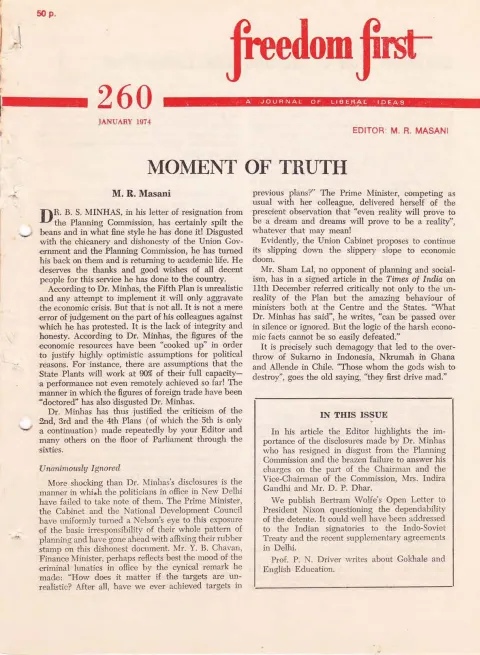
periodical issue
Freedom First
A Journal of Liberal Ideas
By James Burnham, Geeta Gopalakrishnan, B. P. Adarkar, P. N. Driver, Manohar Malgonkar, Joan Contractor, V. B. Karnik
Published for the Democratic Research Service by J. R. Patel, Associate Editor, Freedom First at 127, M. Gandhi Road, Bombay 1 ('Phone: 254341) and printed by him at Inland Printers, 55 Gamdevi Road, Bombay 7. · Bombay · 1974
16 pages
Freedom First
Summary
This is the full 16-page issue of Freedom First No. 261 (February 1974), edited by M. R. Masani, published in Bombay by the Democratic Research Service. The issue leads with James Burnham’s essay ‘Sakharov vs Kissinger,’ contrasting Andrei Sakharov’s warnings about Soviet insularity and repression with Henry Kissinger’s detente diplomacy. The editorial column ‘Between You & Me and The Lamp Post’ comments on the economic cost of Bombay bandhs, praises Air Chief Marshal P. C. Lal’s handling of an Indian Airlines Corporation labour dispute, reports European Liberal International responses to a letter on the Arab-Israeli war, and previews Solzhenitsyn’s forthcoming Gulag Archipelago. Geeta Gopalakrishnan’s ‘Prof. Dandekar’s Utopia’ critiques V. M. Dandekar’s Presidential Address to the All India Economic Conference and its Democratic Socialist Path proposals. B. P. Adarkar’s ‘The Arab-Israeli Conflict: India’s Policy in Retrospect and Prospect’ argues that India’s pro-Arab non-aligned foreign policy is historically and juridically unfounded and contrary to India’s own interests. P. N. Driver’s two-part essay ‘Gokhale and Western Education’ (concluding installment) defends Gopal Krishna Gokhale’s advocacy of English-medium, Western-style education against regional-language nationalism, and situates Gokhale’s stance against Tilak’s, Curzon’s, and Lord Ellenborough’s views. The issue also carries three book reviews (of a published version of Mohan Kumaramangalam’s CPI thesis, Glazer and Moynihan’s ‘Beyond the Melting Pot,’ and A. K. Gopalan’s memoir ‘In the Cause of the People’) by Manohar Malgonkar, Joan Contractor, and V. B. Karnik respectively, a satirical cartoon on newsprint shortages, and the closing ‘With Many Voices’ page of quotations on Cold War and Middle East politics, plus subscription and imprint information.
Key points
-
James Burnham’s front-page essay “Sakharov vs Kissinger” contrasts Andrei Sakharov’s 1974 AFP interview, which conditions detente on Soviet freedom to emigrate and an end to KGB repression and psychiatric internment of dissidents, with Henry Kissinger’s Senate testimony professing to be “deeply moved” yet declining to alter U.S. policy.
-
The unsigned “Between You & Me and The Lamp Post” column disputes the economic logic of the Bombay bandhs, praises Air Chief Marshal P. C. Lal for standing firm against IAC union militancy, reports European Liberal International solidarity with Israel over the 1973 war, calls the Kissinger-Le Duc Tho Nobel Peace Prize “fraudulent” given continued North Vietnamese troop movements, and previews Solzhenitsyn’s forthcoming Gulag Archipelago.
-
Geeta Gopalakrishnan’s critique of V. M. Dandekar’s Presidential Address to the All India Economic Conference, “Prof. Dandekar’s Utopia,” faults his guaranteed rural-employment “Democratic Socialist Path” for glossing over procurement costs and for proposing a workers’ right to strike without a corresponding management right to halt production.
-
B. P. Adarkar’s “The Arab-Israeli Conflict: India’s Policy in Retrospect and Prospect” argues India’s pro-Arab non-alignment lacks historical and juridical grounding, defends Israel’s retention of territory pending Arab recognition, and proposes a seven-point framework including demarcated borders and disbanding the PLO.
-
P. N. Driver’s concluding “Gokhale and Western Education—II” credits Gokhale, Ranade, Agarkar, and Tilak’s generation with a stature unmatched since English-medium instruction gave way to regional languages, and argues Gokhale’s faith in constitutional, gradual self-rule was vindicated by India’s 1947 independence via Act of Parliament.
-
Manohar Malgonkar reviews a published edition of Mohan Kumaramangalam’s confidential CPI strategy thesis, finding the thesis itself dry and laboured but crediting journalist Satindra Singh’s introduction with real insight into the party’s shift from frontal assault to “Trojan Horse” tactics.
-
Joan Contractor reviews Glazer and Moynihan’s Beyond the Melting Pot on New York’s ethnic groups, endorsing its rejection of the assimilationist “melting pot” thesis and its willingness to assign some responsibility for disadvantage to the groups themselves alongside continuing discrimination.
-
V. B. Karnik reviews A. K. Gopalan’s memoir In the Cause of the People, tracing his path from Congress worker to a founding CPM figure and noting the irony of a committed Marxist’s extensive use of Gandhian fasting tactics.
-
The closing “With Many Voices” page compiles Cold War and Middle East quotations from Golda Meir, Gaddafi, Raymond Aron, and William F. Buckley among others, alongside the issue’s subscription form and imprint.
Essays
Sakharov vs Kissinger
By James Burnham
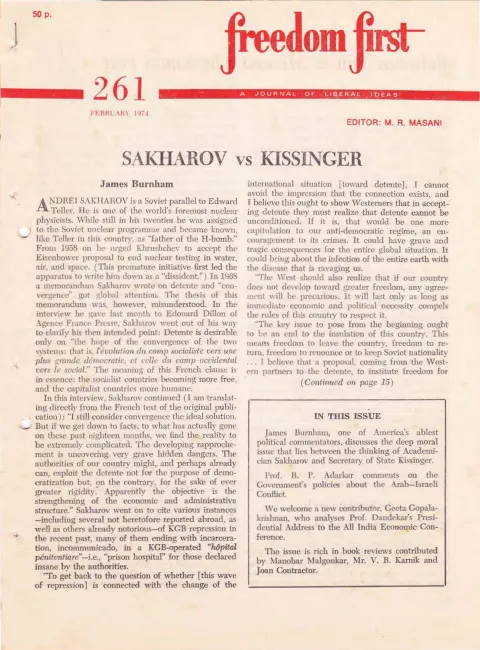
James Burnham’s front-page essay contrasts the moral seriousness of Soviet physicist and dissident Andrei Sakharov with the evasiveness of U.S. Secretary of State Henry Kissinger. Burnham recounts Sakharov’s 1974 interview with Agence France Presse journalist Edouard Dillon, in which Sakharov clarifies his 1968 memorandum on detente: convergence between the Soviet and Western systems is desirable only if it means the socialist countries become freer and the capitalist countries more humane, not merely closer economic ties without political change. Sakharov catalogues continuing KGB repression, incommunicado psychiatric internment of dissidents, and jamming of foreign broadcasts, and insists that freedom to emigrate and travel is a precondition for genuine detente, not a threat to Soviet sovereignty. The essay (continued on page 15) concludes with Kissinger’s Senate testimony, in which he is described as ‘deeply moved’ by Sakharov’s arguments but unwilling to let them alter U.S. policy; Burnham argues Kissinger’s position ignores Sakharov’s specific claim that Soviet foreign policy cannot be trusted without domestic liberalization, and that Sakharov ‘deserves a reply more serious than a routine debater’s evasion.’
- Sakharov is introduced as a Soviet counterpart to Edward Teller, one of the architects of the Soviet H-bomb, who became a dissident after urging Khrushchev to accept a nuclear test ban.
- Sakharov’s 1968 convergence thesis is clarified in a 1974 AFP interview: detente is desirable only as part of a two-way liberalization, not a one-sided accommodation.
- Sakharov details KGB repression, incommunicado confinement in psychiatric ‘prison hospitals,’ and continued jamming of foreign radio broadcasts as evidence the Soviet system has not liberalized.
- Sakharov calls for freedom to emigrate and return as a basic, non-negotiable condition for meaningful detente with the West.
- Kissinger, questioned by the Senate Foreign Relations Committee, says he was ‘deeply moved’ by Sakharov’s statements but frames U.S. policy as pursuing foreign-policy accommodation without seeking to transform Soviet domestic structure.
- Burnham argues this response evades Sakharov’s central claim: that Soviet foreign policy cannot become trustworthy without a change in the regime’s internal character.
Between You & Me and The Lamp Post
The unsigned editorial column ‘Between You & Me and The Lamp Post’ opens by disputing the economic logic of the two Bombay bandhs, arguing that reduced production, not increased production, is what actually drives prices up, and criticizing Rajni Patel for supporting a bandh on the Maharashtra-Karnataka border issue while opposing one aimed at the Congress government. It then praises Air Chief Marshal P. C. Lal, Chairman of Indian Airlines Corporation, for holding firm against a unionised lockout despite criticism from union leader N. C. Mukherjee, contrasting Lal’s stand with the government’s pattern of what the column calls capitulation to trade unions. A section titled ‘Guilty Silence Broken’ reports on European Liberal politicians’ responses (Giovanni Malagodi, John MacCullum-Scott, Hans de Koster, Jeremy Thorpe) to Moshe Kol’s earlier letter to the Liberal International on the Arab-Israeli war, alongside commentary from Italian and Swedish newspapers on the Nobel Peace Prize awarded to Kissinger and Le Duc Tho, which the column calls a ‘fraudulent peace’ given continued North Vietnamese troop movements into the South. The column closes with a report on Solzhenitsyn’s forthcoming book Gulag Archipelago, previewing its comparison of Tsarist and Communist terror and praising Solzhenitsyn’s courage in publishing it.
- The column argues that reduced production during bandhs, not the bandhs’ political aims, is what actually drives up prices, faulting bandh organisers on both sides of the political spectrum for economic illiteracy.
- Air Chief Marshal P. C. Lal is praised for confronting a communist-backed Air Corporation Employees’ Union rather than capitulating, described as a rare example of firm industrial-relations leadership.
- European Liberal International figures’ letters expressing solidarity with Israel over the 1973 war are quoted approvingly, contrasted with those who maintained what the column calls ‘guilty silence.’
- The column condemns the Kissinger-Le Duc Tho Nobel Peace Prize as premature, citing continued North Vietnamese troop buildup in South Vietnam after the ceasefire.
- A preview of Solzhenitsyn’s forthcoming Gulag Archipelago describes its documentation of Stalin-era repression and its argument that Lenin’s dissolution of the Constituent Assembly, not Stalin alone, laid the foundations for Soviet terror.
Prof. Dandekar’s Utopia
By Geeta Gopalakrishnan
Geeta Gopalakrishnan, introduced by the editors as a new contributor, critiques Prof. V. M. Dandekar’s Presidential Address to the 56th All India Economic Conference at Tiruchinapalli (December 27, 1973), which proposed a ‘Democratic Socialist Path’ for the Fifth Five Year Plan. She argues Dandekar’s guaranteed-employment scheme for the rural poor, funded without deficit financing, glosses over the practical costs and administrative burden of procurement, distribution, and coordination across hundreds of districts, especially given existing state failures to meet food-grain procurement targets. She is particularly critical of Dandekar’s proposal to guarantee workers a right to strike without a corresponding right of management to stop production (‘simulated strike’), which she calls ‘a typical example of a hotch potch ideology,’ and closes by noting the irony that Dandekar, while criticizing over-centralized planning, effectively proposes acting as a ‘one-man Planning Commission’ himself.
- The essay reviews Prof. V. M. Dandekar’s Presidential Address proposing a ‘Democratic Socialist Path’ for the Fifth Five Year Plan, delivered at the 56th All India Economic Conference in Tiruchinapalli in December 1973.
- Dandekar’s guaranteed rural wage-employment scheme (aimed at ensuring all able-bodied adults can support a ‘reasonable number of dependents’) is criticized for excluding those with ‘too large a burden of dependents’ from its target population.
- The article questions Dandekar’s claim that an additional Rs. 1,500 crore wage bill can be financed without deficit financing or destabilising prices.
- Nationalisation of wholesale trade and controlled food-grain marketing are flagged as underspecified means to Dandekar’s ends, with no costing of procurement or distribution machinery.
- Dandekar’s proposal to give workers the right to strike without giving management the right to stop production is singled out as internally incoherent (‘a typical example of a hotch potch ideology’).
The Arab-Israeli Conflict: India’s Policy in Retrospect and Prospect
By B. P. Adarkar
B. P. Adarkar argues that India’s foreign policy on the Arab-Israeli conflict is based on insufficient historical and juridical study and has been driven by partisanship rather than India’s own principles of peace, justice, and non-alignment. He contends that Nehru’s backing of Nasser was strategically and morally mistaken, that the question ‘who committed aggression’ is meaningless absent a peace treaty, and that Israel’s retention of certain territories is justified by continued Arab refusal to recognize its existence. Adarkar proposes a seven-point framework for resolution centered on mutual recognition, demarcated and defensible borders, disbanding of the PLO and other guerrilla organisations, UN-led refugee rehabilitation, and international guarantees of territorial inviolability. He concludes that India’s pro-Arab tilt has cost the country dearly, citing the closure of the Suez Canal and the 1970s oil crisis as direct consequences of a foreign policy he calls ‘meaningless and irrational.’ The essay’s text runs from page 5 through the bottom of page 6, and its concluding seven-point list of proposed solutions is printed on page 7 beneath the masthead of the following essay (P. N. Driver’s ‘Gokhale and Western Education—II’), a layout quirk in which the continuation column sits under, rather than beside, the next article’s headline.
- Adarkar argues India’s foreign policy on the Arab-Israeli conflict lacks historical and juridical grounding and does not serve India’s own interests.
- He characterizes the question of ‘who committed aggression’ in the conflict as meaningless in the absence of a signed peace treaty, given four wars since 1948.
- He argues the Arab refusal to recognize Israel’s existence, and the enabling of Arab guerrilla attacks from Syria and Lebanon, justify Israel’s retention of certain territories for self-defence.
- He proposes a seven-point plan: mutual recognition, demarcated defensible borders, Israeli surrender of surplus territories, disbanding of the PLO and other guerrilla groups, UN-led refugee rehabilitation, reopening of the Suez Canal, and international guarantees of territorial inviolability.
- He argues India’s pro-Arab non-alignment has directly harmed India through the closure of the Suez Canal (raising food-import costs) and the oil crisis.
Gokhale and Western Education—II
By P. N. Driver
P. N. Driver’s essay is the concluding installment (‘II’) of a two-part piece on Gopal Krishna Gokhale’s views on Western education. Driver argues that Gokhale, along with contemporaries like Ranade and other Congress stalwarts, valued the best English and Western-educated teachers, and warned that regional-medium education was fragmenting India’s capacity to produce leaders of national stature comparable to Ranade, Gokhale, Agarkar, Tilak, and Telang. Driver recounts Gokhale’s criticism of British colonial administration for underfunding education relative to railways, for failing to honour the 1858 Queen’s Proclamation’s promise of equal treatment, and for excluding educated Indians from senior posts despite training them in liberal Western thought — while nonetheless crediting British rule, through English-language higher education, with fostering the national unity that made Indian independence possible. The essay closes with Driver noting that Tilak, by the end of his life, had come to acknowledge the value of English institutions and liberty, and quotes Gokhale’s 1896 address to Bombay graduates on the centrality of public education to national regeneration.
- Gokhale wanted the best available teachers, including from England, and pushed to have such recruits placed on a par with Civil Service members in pay and promotion (a recommendation Driver dates to 1903).
- Gokhale is credited, alongside Ranade, Agarkar, and Tilak, as part of a generation of Maharashtrian leaders whose stature Driver says has not been matched since regional-medium education replaced English-medium instruction.
- Gokhale criticized British administrators (Lord Dufferin, Lord Harris, Mr. Chatfield) for failures of judgment, jingoism, and resistance to reforming school textbooks, while praising Lord Ripon as ‘the best-beloved of India’s Viceroys.’
- Driver argues Gokhale’s ultimate faith in gradual, constitutional progress toward self-rule under British tutelage was vindicated by India receiving independence through an Act of the British Parliament in 1947, rather than through revolution.
- The essay closes by noting that Tilak, despite earlier opposing Gokhale, came in his 1920 Manifesto to praise English institutions and liberty, and quotes Gokhale’s 1896 address urging Indians to embrace public education as the path to national regeneration.
Reviews — Kumaramangalam’s Thesis
By Manohar Malgonkar
Manohar Malgonkar reviews a published edition of the late Mohan Kumaramangalam’s confidential thesis written for the Communist Party of India, laying out guidelines for a seizure of power, now issued in book form by D. K. Publishing House with a critical introduction by journalist Satindra Singh, a former active communist. Malgonkar finds the thesis itself ‘dry,’ ‘laboured,’ and ‘clumsily put together,’ but credits Singh’s fifteen-page introduction with providing real insight into CPI strategy, including its willingness to switch from frontal assault to ‘Trojan Horse’ tactics when direct confrontation looks hopeless. He criticizes Singh, however, for treating the volume as though it were his own work, noting the dedication ‘To Mrs Indira Gandhi who might benefit’ as presumptuous, while allowing that Kumaramangalam himself might plausibly have dedicated it to Mrs Gandhi in similar terms.
- The review covers a book edition of Mohan Kumaramangalam’s confidential CPI strategy thesis, published by D. K. Publishing House, Delhi.
- Malgonkar finds the thesis itself dry, laboured, and barely readable, its arguments ‘flagrantly twisted to conform to a line of thought.’
- He credits the introduction by journalist Satindra Singh, a former ten-year CPI activist, with real insight into communist strategy, including the shift from frontal assault to ‘Trojan Horse’ tactics.
- He criticizes Singh for treating the entire volume as his own effort and for dedicating it to Mrs Indira Gandhi ‘who might benefit.‘
Reviews — The Melting Pot
By Joan Contractor
Joan Contractor reviews Nathan Glazer and Daniel P. Moynihan’s Beyond the Melting Pot, examining its account of five ethnic groups in 1960s New York City (Negroes, Puerto Ricans, Jews, Italians, and Irish) and its argument that cultural, economic, and political factors have kept the ‘melting pot’ theory of American assimilation from becoming reality. She notes the book’s controversial 1960s-era acknowledgment that different ethnic groups display different attitudinal and cultural characteristics, and its willingness to assign some responsibility for lack of advancement to the groups themselves rather than solely to discrimination, while still recognizing continuing racial discrimination against Black Americans. The review highlights the book’s critique of both Black Americans and the white radical elite (Jews and non-ethnic Protestants) who, in the authors’ account, allied with the underprivileged against a lower middle class disproportionately Italian and Irish — with the update’s sharpened focus on the Irish and Italians as of 1970. Contractor concludes that the book ‘blows a breath of fresh air’ by rejecting the notion that acknowledging ethnic differences is inherently prejudiced.
- The review covers Beyond the Melting Pot by Nathan Glazer and Daniel P. Moynihan (M.I.T. Press), examining five New York City ethnic groups: Negroes, Puerto Ricans, Jews, Italians, and Irish.
- The book argues cultural, economic, and political factors, not just discrimination, have kept the ‘melting pot’ from occurring, a view Contractor calls controversial among 1960s radicals.
- It acknowledges continuing housing discrimination against Black Americans in New York while also attributing some internal, historically-rooted burdens (a legacy of slavery) to the group’s difficulties.
- The 1970 introduction sharpens criticism of the white radical elite (Jews and non-ethnic Protestants) for allying with the underprivileged against a lower middle class disproportionately Italian and Irish.
- Contractor endorses the book’s central claim that distinct ethnic groups are a permanent, legitimate feature of New York City rather than a problem to be dissolved.
Reviews — Dedicated Service (review of In The Cause of The People: Reminiscences by A. K. Gopalan)
By V. B. Karnik
V. B. Karnik reviews A. K. Gopalan’s memoir In The Cause of The People: Reminiscences, describing Gopalan’s fifty years of activism for the peasantry and agricultural labourers of Kerala, including over sixteen years of imprisonment. Karnik traces Gopalan’s political trajectory from Congress worker to Congress Socialist Party member to a founding, prominent figure of the Marxist Communist Party (CPM), noting he was elected to Parliament multiple times and visited China and Russia. Karnik observes that although committed to Marxist philosophy, Gopalan made ample use of Gandhian fasting techniques in his activism, and describes the book as a plain, matter-of-fact diary of meetings, marches, and struggles without much analytical framing, closing with Gopalan’s 1971 mid-term election victory over a combined opposition ‘ranging from the Muslim League to the Jan Sangh.’
- The review covers A. K. Gopalan’s memoir In The Cause of The People: Reminiscences (Orient Longman), covering over fifty years of activism among Kerala’s peasants and agricultural labourers.
- Gopalan’s political path ran from Congress worker, to Congress Socialist Party, to a founding and prominent member of the Marxist Communist Party.
- Karnik notes the irony that although a committed Marxist, Gopalan made extensive use of the Gandhian technique of fasting in his political struggles.
- The book is described as a plain record of meetings, marches, and imprisonments rather than an analytical or reflective memoir.
- The narrative closes with Gopalan’s victory in the 1971 mid-term election over a combined opposition spanning the Muslim League to the Jan Sangh.
With Many Voices
The closing page, ‘With Many Voices,’ is a compilation of short quotations on Cold War, Middle East, and international politics drawn from contemporary newspapers and journals — including Golda Meir, Col. Gaddafi, Irving Kristol, Pierre Hassner, Alexander Dallin, Raymond Aron, and William F. Buckley — framed by an epigraph from Tennyson. It is followed by the Freedom First subscription form and imprint, naming the Democratic Research Service, editor address at 127 Mahatma Gandhi Road, Bombay, and printer details.
- The page compiles short quotations on Cold War and Middle East politics from figures including Golda Meir, Col. Gaddafi, Irving Kristol, Pierre Hassner, Alexander Dallin, Raymond Aron, and William F. Buckley.
- A Czechoslovak writer is quoted via Pierre Hassner on living in ‘a world where madmen put straitjackets on normal people.’
- The page carries a subscription form for Freedom First (Rs. 5 annual, Rs. 3 for students) addressed to the Democratic Research Service, 127 Mahatma Gandhi Road, Bombay.
- The issue’s imprint records J. R. Patel as Associate Editor and Inland Printers, 55 Gamdevi Road, Bombay, as printer.
Generated by the v1.5 extraction pipeline. Awaiting editorial review.
Metadata and summary are AI-extracted from the source PDF and reviewed for editorial accuracy. The original work is available via the Read PDF tab above (where present); paragraph-level citation inside the PDF is deferred to a future engagement.