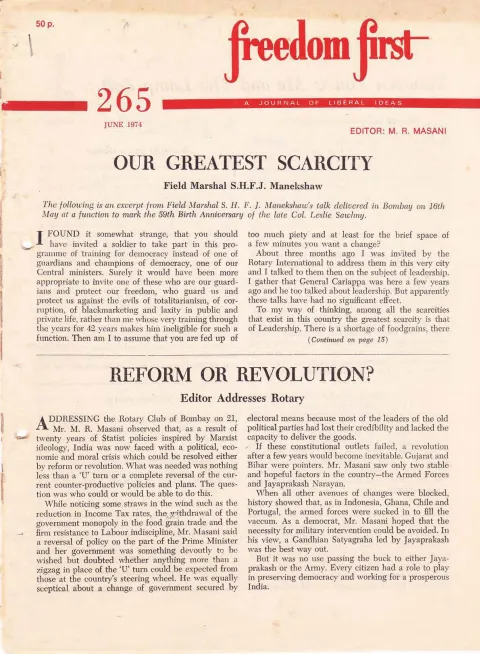
periodical issue
Freedom First
A Journal of Liberal Ideas
By Solzhenitsyn, Manohar Malgonkar, Sharu S. Rangnekar, B. P. Adarkar, S. G. Bailur, Rusi J. Daruwala, G. Gopalakrishnan
Published for the Democratic Research Service by J. R. Patel, Associate Editor, Freedom First at 127, M. Gandhi Road, Bombay 1, and printed by him at Inland Printers, 55 Gandevi Road, Bombay 7. · Bombay · 1974
16 pages
Freedom First
Summary
Freedom First issue 263 (April 1974), edited by M. R. Masani, is a complete 16-page number of the classical-liberal Bombay monthly. Its front page and closing pages carry a translated extract from Aleksandr Solzhenitsyn’s 1973 open letter to the Soviet leadership, presented as a template for Indian readers to reject Marxist ideology and “planning.” The editorial column, “Between You & Me and The Lamp Post,” ranges across the Solzhenitsyn affair, a caution against the army being used to quell civil disturbances, an expose of Nehru’s private disparagement of Indian MPs and newspaper owners (via Mohamed Heikal’s account), a critique of Y. B. Chavan’s inflationary 1974-75 budget, commentary on the hung British general election of February 1974, and a post-mortem on Swatantra Party losses in the U.P. and Orissa assembly elections. The issue’s featured essays are B. P. Adarkar’s comparison of Indian planning failure against the “economic miracles” of Brazil, West Germany and Japan; Sharu Rangnekar’s analysis of Gunnar Myrdal’s “soft state” concept and how to harden it through discipline and reduced controls; Manohar Malgonkar’s critical review of Chester Bowles’ memoir Promises to Keep; and S. G. Bailur’s human-interest piece on a struggling Poona classical musician. Shorter items include a satirical letter imagining gender role-reversal in the year 2074, a book review of an edited volume on the New Left, and a closing page of quoted aphorisms from the world press (“With Many Voices”).
Key points
-
An extract from Aleksandr Solzhenitsyn’s open letter to the Soviet leadership, “‘This Filthy, Sweaty Shirt…,’” argues Marxism has failed to predict any event, survives only through cupidity or a craving for faith, and urges the state to withdraw funding and coercive backing from the ideology and let it survive, if at all, unsubsidised.
-
The “Between You & Me and The Lamp Post” column praises Solzhenitsyn’s courage, cites Mohamed Heikal’s book to reveal Nehru privately scorning the Indian press and Parliament as beholden to big business, criticises Y. B. Chavan’s 1974-75 budget for understated deficit financing, and argues the hung February 1974 British election shows first-past-the-post fails to produce stable government.
-
Manohar Malgonkar reviews Chester Bowles’ memoir Promises to Keep, crediting Bowles’ candour about U.S. policy failures but faulting his wholly uncritical “rose-tinted” silence on Indian planning failures despite Nehru’s squandered promises and the 1962 war debacle.
-
Sharu S. Rangnekar applies Gunnar Myrdal’s “soft state” concept to explain low Indian productivity, blaming lax enforcement, education that rewards credentials over work discipline, and administrative discretion over licenses as an engine of corruption, and concludes hardening the soft state may be impractical.
-
G. Gopalakrishnan’s satirical letter “Men or Wo(e)men — Year 2074” imagines a future gender role-reversal following a fictional “world woman’s bloodless revolution,” mocking contemporary feminist rhetoric via Germaine Greer and Alvin Toffler.
-
B. P. Adarkar’s “The Three Economic Miracles” compares India’s weak Five-Year-Plan growth (3.5% annually, 103rd in world per-capita income) against Brazil, West Germany, and Japan, quoting Milton Friedman’s thesis that those miracles required ending price controls and relying on private enterprise, and argues India may be nearing “take-off” if it eases controls.
-
S. G. Bailur profiles struggling Poona classical musician Nagesh Khalikar, who argues music is a luxury vulnerable to economic downturns and criticises Sangeet Sabhas for favouring established stars over newcomers to protect gate money.
-
Rusi J. Daruwala reviews The New Left: Six Critical Essays (ed. Maurice Cranston), summarising the volume’s case that the New Left substitutes a “politics of experience” and Third World/ghetto revolutionary subjects for orthodox Marxist economic determinism, covering essays on Guevara, Sartre, Marcuse, Fanon, Black Power, and R. D. Laing.
-
The closing “With Many Voices” page quotes Sir Keith Joseph on equality, Edward Luttwak on Indian pseudosecularism, Daniel Moynihan’s quip about renaming the Indian Ocean, and Congress politician C. M. H. N. Bahuguna’s praise of Lenin.
Essays
’This Filthy, Sweaty Shirt…’
By Solzhenitsyn
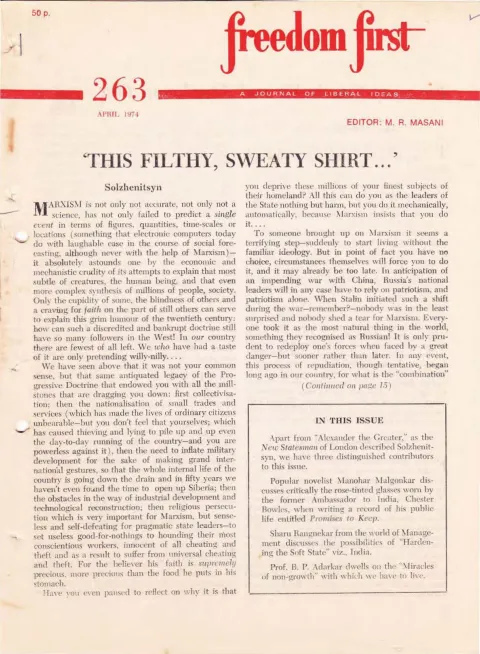
The front-page item, headlined “‘This Filthy, Sweaty Shirt…’”, is an extract from Aleksandr Solzhenitsyn’s letter to the Soviet leadership (first published six months earlier and reprinted here in translation), continued on page 15. It argues that Marxism is neither empirically accurate nor scientific, having failed to predict events, and that the doctrine survives in the West and in countries like India, Ceylon and Chile chiefly through the greed of some, the blindness of others and a residual craving for faith. Solzhenitsyn contends that patriotism and Marxist internationalism are irreconcilable, that Lenin himself admitted Marxism’s anti-patriotic character, and that the Soviet state now sustains the ideology purely as inertia and self-justifying propaganda rather than genuine belief, sapping the nation with institutionalised lies. He closes by urging the leadership simply to withdraw state backing and funding from Marxist ideology and let it survive, if it can, on its own merits outside working hours and off the public purse.
- Solzhenitsyn argues Marxism has failed to predict a single event despite claiming scientific status.
- He says only cupidity, blindness, or a craving for faith explain Marxism’s survival among the discredited.
- He links collectivisation, nationalisation of small trades and services, and militarisation to the everyday suffering of ordinary Soviet citizens.
- He predicts a shift toward patriotism as the state’s real organising principle once war with China looms, exposing Marxist internationalism as expendable.
- The letter (continued on page 15) closes by urging that Marxist ideology be stripped of state salary and state coercion and left to survive, if at all, purely as private, unfunded advocacy.
Between You & Me and The Lamp Post
The signed editorial column “Between You & Me and The Lamp Post” (pp. 2-5) opens by praising Solzhenitsyn’s moral courage and drawing a parallel between Russians unable to see their own unfreedom and Indians similarly numbed to “socialistic” ideology. It commends Field Marshal Manekshaw’s caution against overusing the army to quell civil disturbances, contrasting this with British colonial-era restraint. A section titled “Heikal Exposes Nehru” cites Mohamed Heikal’s book on Nasser to reveal Nehru privately dismissing Indian press criticism of Nasser as bought by big business, wishing he “could close them all,” and disparaging Indian MPs as being on the payroll of “millionaires like Tata.” The column then turns domestic, attacking Y. B. Chavan’s 1974-75 budget as understating deficit financing eightfold against the previous year and ignoring looming public-sector wage demands, citing economist B. P. Minhas and Nani Palkhivala’s call for a policy “U-turn.” A section on the deadlocked February 1974 British general election argues the first-past-the-post system produced an unrepresentative, unstable Parliament and that proportional representation would have given the Liberal Party a fair share of seats, drawing the lesson that India too should abandon the “archaic British electoral system.” The column closes with a post-election review of Swatantra Party losses in Orissa (blamed on an alliance with Biju Patnaik and Harekrushna Mehtab) and the fractured opposition landscape in U.P.
- Endorses Solzhenitsyn’s letter as more relevant to India’s own problems than to Russia’s alone.
- Praises Field Marshal Manekshaw’s and Col. C. L. Proudfoot’s warnings against habitual military deployment to suppress civil unrest.
- Cites Heikal’s Nasser: The Cairo Documents to show Nehru privately scorning the Indian press and Parliament as beholden to big business.
- Criticises Chavan’s 1974-75 budget for understated deficit financing and ignoring inflationary wage pressures, citing B. P. Minhas and N. A. Palkhivala.
- Analyses the hung British general election of February 1974 as proof that first-past-the-post fails to produce stable, representative government, and argues India should adopt a list/PR system.
- Reviews Swatantra Party’s rout in the Orissa assembly elections, attributed to its alliance with Biju Patnaik and Harekrushna Mehtab.
Bowles’ Rose-Tinted Glasses
By Manohar Malgonkar
Manohar Malgonkar reviews Chester Bowles’ memoir Promises to Keep, tracing Bowles’ career from advertising executive to Connecticut governor, U.S. Congressman, twice U.S. Ambassador to India, Assistant Secretary of State, and Kennedy’s roving ambassador. Malgonkar credits Bowles’ industriousness and candour about U.S. politics — his criticisms of arms sales, Vietnam policy, and colleagues — but argues that on India specifically Bowles displays a wholly uncritical, ‘rose-tinted’ devotion, never once asking what went wrong with Nehru’s promises despite a decade of squandered reserves, failed Five-Year Plans, worsening food shortages, and the debacle of the 1962 war with China. The review highlights Bowles’ role in securing a hundred-million-dollar annual U.S. military aid commitment to India after the NEFA defeat, a deal nearly finalised days before Kennedy’s assassination and only concluded six months later under President Johnson.
- Malgonkar frames Bowles as a relentlessly successful, hyper-industrious figure across advertising, politics and diplomacy.
- Bowles served two terms as U.S. Ambassador to India (1951-53 and again under Kennedy/Johnson) and briefly as Assistant Secretary of State.
- The review contrasts Bowles’ willingness to criticise U.S. policy (arms sales, Vietnam, the UN bureaucracy) with his total silence on Indian policy failures.
- Malgonkar cites Bowles’ role in winning Kennedy’s approval for a hundred-million-dollar annual U.S. military aid package to India after the 1962 NEFA defeat.
- The review concludes that Bowles’ enduring, uncritical affection for India amounts to a serious blind spot as an observer of Indian affairs.
Men or Wo(e)men — Year 2074 (letter to the editor)
By G. Gopalakrishnan
A satirical letter by G. Gopalakrishnan, addressed to ‘Mr. Greer’ (evoking Germaine Greer), imagines a reversed gender order in the year 2074, in which men have become the oppressed sex following a ‘world woman’s bloodless revolution’ in 2010. The letter-writer complains, in exaggerated mock-aggrieved tone, of test-tube babies, wives absorbed in careers and seminars, a Parliament dominated by shrill women hurling undergarments instead of shoes, and an all-female police and judiciary, before calling on ‘fellowmen all over the world’ to rise up and reclaim what women have ‘usurped.’ It is a comic piece playing on 1970s feminist debates (name-checking Toffler) rather than a substantive argument.
- The piece is a satirical mock-letter imagining a future in which traditional gender roles are inverted.
- It references a fictional ‘world woman’s bloodless revolution’ of 2010 as the turning point.
- It satirises contemporary feminist rhetoric and 1970s gender-politics debates (invoking Germaine Greer and Alvin Toffler) through exaggerated role reversal.
- The tone is comic and light, ending with a mock call to arms for men to ‘unite’.
The Three Economic Miracles
By B. P. Adarkar
B. P. Adarkar’s essay compares India’s post-independence economic performance against the celebrated ‘economic miracles’ of Brazil, West Germany, and Japan. Citing Paul Samuelson’s remark on ‘miracles of non-growth’ in centrally planned or newly independent economies, Adarkar catalogues India’s weak results across four Five-Year Plans — a per-capita income ranking of 103rd in the world and an average growth rate of only 3.5% over 1951-73, well below contemporaries such as Japan, South Korea, Taiwan, Singapore and Iran. He quotes at length from a Milton Friedman Newsweek article identifying three shared conditions behind the Brazilian, German and Japanese miracles: each followed a period of economic disorganisation caused by price and wage controls; each miracle was made possible by monetary reforms that ended government controls and let market prices operate; and each relied primarily on private enterprise, with government intervention serving as marginal ‘trimming’ rather than the main engine. Adarkar then applies this framework to India, arguing that India’s disorganisation (controls, deficit financing, the failed Wheat Takeover) parallels Brazil’s pre-reform chaos, but that India has not yet undertaken the market-price liberalisation or full reliance on private enterprise that produced the other three miracles. He closes by asserting that India, like Brazil, may be approaching a ‘take-off’ stage, citing economist Colin Clark’s agreement and describing new small-and-medium industry growth visible along the Bombay-Poona rail corridor, currently held back by excessive controls and taxation.
- Cites Paul Samuelson (Economic Times Annual, 1972) on ‘miracles of non-growth’ in planned economies such as Argentina, Chile, Uruguay, Czechoslovakia, Egypt, India, Ghana and Indonesia.
- India’s four Five-Year Plans cost Rs. 42,000 crores yet produced only 3.5% average annual growth (1951-73) and a global per-capita income rank of 103.
- Quotes Milton Friedman’s Newsweek analysis identifying three shared preconditions of the Brazilian, German, and Japanese ‘economic miracles’: prior disorganisation from price/wage controls, monetary reform ending controls, and reliance on private enterprise.
- Argues India shares the first condition (disorganisation from controls, deficit financing, and the failed Wheat Takeover) but has not undertaken the liberalising reforms of the other three countries.
- Cites economist Colin Clark’s view, and Adarkar’s own observation of new small-industry growth on the Bombay-Poona corridor, as evidence India may be reaching a ‘take-off’ stage if government eases controls.
- Quotes D. P. Dhar’s promised 5.5% growth target for the Fifth Plan and Y. B. Chavan’s dismissive remark about unrealistic targets.
Hardening the “Soft State”
By Sharu S. Rangnekar
Sharu S. Rangnekar’s essay applies Gunnar Myrdal’s concept of the ‘soft state’ to explain low productivity in developing countries, including India. He argues that soft states are characterised by lax enforcement of rules, official collusion with powerful interests, and exploitation of laxity for personal gain, all of which discourage efficient resource use regardless of technology levels — industrial units in underdeveloped countries using the same technology as developed ones show markedly lower productivity because of this social indiscipline. Rangnekar criticises education systems in developing countries for emphasising quantity over the qualitative habits (attitude to work) that actually build productive labour, arguing mis-education has produced a large mass of unemployed graduates unwilling to do manual work. He also notes that ‘social justice’ rhetoric is often used to justify controls on the private sector rather than genuine redistribution, and that administrative discretion over licenses, foreign exchange and loans has become an engine of corruption that further degrades productivity. In his conclusion (continued from page 11 onto page 12), Rangnekar argues it may not be possible to ‘harden’ the soft state through discipline given weak enforcement capacity in the developing world, and instead recommends a pragmatic embrace of land reform’s practical limits, favouring incentives for progressive farmers and industrialists, on the view that current pseudo-socialism combines the worst features of capitalism and feudalism.
- Applies Gunnar Myrdal’s ‘soft state’ concept to explain why developing countries achieve low productivity despite modern technology.
- Argues industrial units using identical technology to developed countries still show lower productivity due to social indiscipline and weak enforcement.
- Criticises the emphasis on quantitative rather than qualitative education, blaming it for producing unemployed, work-averse graduates.
- Notes that ‘social justice’ rhetoric is frequently used to justify private-sector controls rather than genuine redistribution.
- Argues administrative discretion over licenses, exchange controls and loans breeds corruption, further reducing productivity.
- Concludes that hardening the soft state may be impractical, recommending instead incentives for progressive farmers and industrialists over land reform and public-sector expansion.
The Trials of a Professional Musician
By S. G. Bailur
S. G. Bailur profiles Nagesh Khalikar, a talented but financially unsuccessful classical musician from Poona, based on an interview at a musical programme marking the third death anniversary of Shivanand Bhavanishankar Bankeshwar, a patron of classical music. Khalikar argues that music is a luxury rather than necessity, so musicians suffer first when the general economy worsens, and that success depends on melodious voice, originality, talent, opportunity, influence and above all luck — criticising Sangeet Sabhas for favouring established stars over promising newcomers purely to protect gate money. The piece recounts an anecdote where Khalikar graciously improvised with amateur accompanists when the scheduled chief guest (singer Ghulam Mustafa) arrived late, out of gratitude to the late Bankeshwar’s patronage. It traces Khalikar’s biography: orphaned young, raised by his mother and grandfather, a disciple of Pandit Vinayakrao Patwardhan and Prof. Deodhar, and a schoolteacher of music for 22 years at New English School, Poona, after his musical career failed to provide financial security despite two devastating setbacks — the Panshet flood disaster and a later midnight dacoity that wiped out his savings.
- Profiles Poona classical musician Nagesh Khalikar, interviewed at a memorial concert for patron Shivanand Bhavanishankar Bankeshwar.
- Khalikar argues music is a ‘luxury’ whose fortunes rise and fall with the general economy, since it depends on mass rather than elite patronage.
- He criticises Sangeet Sabhas for favouring established musicians over promising newcomers, purely to protect gate-money revenue.
- An anecdote describes Khalikar improvising with amateur accompanists when the scheduled celebrity chief guest, Ghulam Mustafa, arrived late.
- His biography includes being orphaned young, training under Pandit Vinayakrao Patwardhan and Prof. Deodhar, 22 years as a school music teacher, and two ruinous financial setbacks (the Panshet flood and a dacoity).
Rationality and Humanity? (review of The New Left: Six Critical Essays, ed. Maurice Cranston)
By Rusi J. Daruwala
A short book review by Rusi J. Daruwala covers The New Left: Six Critical Essays, edited by Maurice Cranston (National Academy, Delhi). The review summarises the volume’s argument that the New Left, unlike orthodox Marxism, has lost confidence in the deterministic ‘movement of history’ and instead champions a ‘politics of experience’, drawing its revolutionary subjects from Third World peasants, U.S. ghetto residents and dropouts rather than Western industrial workers. It surveys the book’s individual essays: Kenneth Minogue on Che Guevara, Francois Bondy on Sartre, Maurice Cranston on contradictions in Herbert Marcuse’s thought, Aristide Zolberg on Frantz Fanon’s advocacy of revolutionary violence, George Feaver on the rise of Black Power out of frustration with Martin Luther King’s moderation, and David Martin’s concluding essay on R. D. Laing. Daruwala recommends the low-priced Indian edition to readers interested in the ideological forces shaping contemporary politics.
- Reviews The New Left: Six Critical Essays, edited by Maurice Cranston, published by National Academy, Delhi at Rs. 5.
- Summarises the book’s thesis that the New Left replaces orthodox Marxist economic determinism with a Marx read as sociologist, and substitutes Third World peasants and U.S. ghetto dwellers for the Western industrial proletariat as its revolutionary subject.
- Surveys individual essays: Minogue on Che Guevara, Bondy on Sartre, Cranston on Marcuse’s inconsistencies, Zolberg on Fanon’s cult of violence, Feaver on Black Power’s emergence from King’s moderate politics, and Martin on R. D. Laing.
- Recommends the volume as a useful, affordable introduction to the ideological currents shaping contemporary radical politics.
With Many Voices
The back-page feature “With Many Voices” is a compilation of quoted aphorisms and press comments from around the world, on themes including Indian public life, non-alignment, U.S. politics and détente, and British coalition politics. Quoted sources include Sir Keith Joseph in The Economist on the impossibility of equality, Edward Luttwak in National Review on Indian pseudosecularism, Senator Barry Goldwater and Howard Flieger in U.S. News & World Report, Ambassador Daniel Moynihan quipping about renaming the Indian Ocean, C. M. H. N. Bahuguna praising Lenin in The Illustrated Weekly of India, and Jeremy Thorpe and Enoch Powell in The Economist and Time on British politics. The page also carries the subscription form for Freedom First (published by the Democratic Research Service) and the masthead identifying J. R. Patel as Associate Editor.
- A curated column of quoted aphorisms from the international press on Indian and world politics, titled ‘With Many Voices’.
- Includes Sir Keith Joseph on equality, Edward Luttwak on Indian pseudosecularism, and Ambassador Daniel Moynihan’s quip about renaming the Indian Ocean.
- Includes Barry Goldwater and Howard Flieger commentary from U.S. News & World Report on Nixon, détente, and Cuba.
- Notably quotes Congress politician C. M. H. N. Bahuguna praising Lenin as an exciting political hero.
- The page doubles as the issue’s masthead and subscription form, naming J. R. Patel as Associate Editor and the Democratic Research Service as publisher.
Generated by the v1.5 extraction pipeline. Awaiting editorial review.
Metadata and summary are AI-extracted from the source PDF and reviewed for editorial accuracy. The original work is available via the Read PDF tab above (where present); paragraph-level citation inside the PDF is deferred to a future engagement.