periodical issue
Freedom First
A Journal of Liberal Ideas
By Field Marshal S.H.F.J. Manekshaw, Manohar Malgonkar, Geeta Doctor, Govind Talwalkar, Manjula Padmanabhan, Thomas Gay, [illegible signature, possibly 'Abu Doctor']
Published for the Democratic Research Service by J. R. Patel, Associate Editor, Freedom First at 127, M. Gandhi Road, Bombay 1. Printed at ... Gamdevi Road, Bombay · Bombay · 1974
16 pages
Freedom First
Summary
Freedom First issue 265 (June 1974), edited by M. R. Masani, is a miscellany typical of the magazine’s format: a lead item excerpting Field Marshal S. H. F. J. Manekshaw’s address on the scarcity of leadership in India, a report of Masani’s own Rotary Club speech warning that only ‘reform or revolution’ can resolve India’s political and economic crisis, the regular ‘Between You & Me and the Lamp Post’ column of wry political commentary (on press freedom in Sri Lanka, Senator Edward Kennedy’s misadventure in Moscow, Willy Brandt’s resignation over the Guillaume spy affair, Watergate, and the Portuguese coup), two book reviews (of D. R. Mankekar’s book on the abolition of the princely order, and of S. P. Aiyar’s essays on modernization), a translated piece by Govind Talwalkar on chronic delay in India’s law courts, and two personal essays, Geeta Doctor’s comic account of train travel in India and Manjula Padmanabhan’s memoir of a childhood tonsillectomy in a Soviet-run hospital in Tehran. The issue closes with a review of a seminar volume on centre-state relations, satirical and earnest letters to the editor, and the magazine’s regular page of quotations, ‘With Many Voices.’ Across these disparate items the throughline is a classical-liberal skepticism of state power, whether expressed as criticism of Indira Gandhi’s government, of judicial and bureaucratic inefficiency, or of authoritarian tendencies abroad.
Key points
-
An excerpt from Field Marshal S. H. F. J. Manekshaw’s “Our Greatest Scarcity” address argues India’s most acute shortage is not food or fuel but leadership, spread across politics, industry, trade unions, bureaucracy and the armed forces, citing the 1971 war victory as proof Indians perform well under good leadership.
-
A report on M. R. Masani’s Rotary Club address, “Reform or Revolution?,” warns that twenty years of Marxist-inspired statist policy have produced a crisis resolvable only by a complete policy reversal, and names the Armed Forces and Jayaprakash Narayan as the country’s only stable, hopeful factors.
-
The “Between You & Me and the Lamp Post” column contrasts Indian and Sri Lankan press freedom, praises Willy Brandt’s resignation over the Guillaume spying affair as a model of accountability against Nixon and Wilson, and notes the Indian left’s double standard in cheering the Portuguese coup after condemning Chile’s.
-
Manohar Malgonkar reviews D. R. Mankekar’s Accession to Extinction, faulting its imbalance and dated coverage but agreeing that the princes were stripped of privileges more to burnish the ruling Congress party’s image than from principle.
-
Geeta Doctor’s comic “Sermon on a Train” recounts intrusive fellow-passenger encounters and a conductor’s extended defence of “baksheesh” as gratitude rather than corruption, comparing it to America’s tolerance of Watergate.
-
Govind Talwalkar’s “Justice Delayed” attacks Maharashtra Law Minister Antulay’s proposal for a new committee on court delay, arguing an existing 1972 Justice J. C. Shah committee report already diagnosed the causes, and marshals caseload statistics to show judges are overworked rather than “shirkers.”
-
Manjula Padmanabhan’s memoir “The Doctor Said ‘Nyet’” recounts her tonsillectomy at the Russian Hospital in Tehran, conducted through an interpreter and remembered chiefly for being denied the customary post-operative ice-cream.
-
Thomas Gay reviews S. P. Aiyar’s Modernization of Traditional Society, summarising its warning that Indian-style socialism risks becoming a bureaucratic “dictatorship over the proletariat” and its contrast of Sivaswamy Aiyer, Nehru, and Rajaji as three types of liberal.
-
A review of A. G. Noorani’s edited Centre-State Relations in India reports the seminar’s conclusions that federalism is inseparable from democracy, that states need an assured resource formula free of Union discretion, and that All India Radio should be freed from government control; the issue closes with letters (one praising Indira Gandhi’s midnight railway-strike speech, another satirising bureaucratic expansion) and the “With Many Voices” quotations page.
Essays
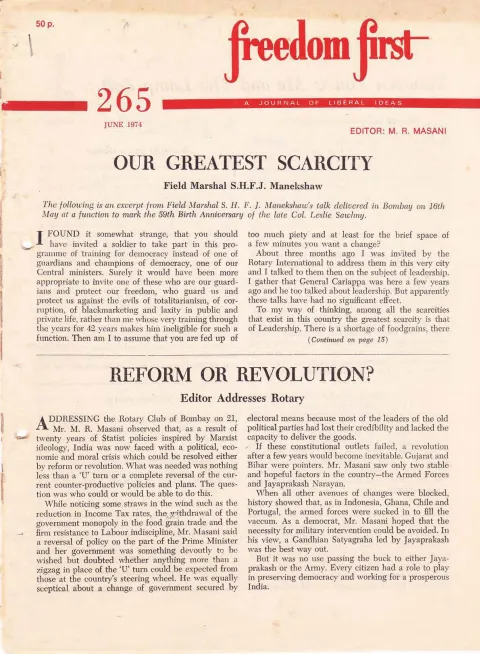
Our Greatest Scarcity
By Field Marshal S.H.F.J. Manekshaw
An excerpt from Field Marshal S. H. F. J. Manekshaw’s talk delivered in Bombay on 16 May at a function marking the 59th birth anniversary of the late Col. Leslie Sawhny. Manekshaw opens by professing surprise at being invited to address a training-for-democracy programme rather than a political guardian of democracy, then pivots to his real subject: among all the scarcities afflicting India (foodgrains, fuel, oil, coal, cement, steel, butter, milk), the most acute is a scarcity of leadership. He extends the charge beyond politicians to industry, trade unions, the bureaucracy, and the armed forces, insisting all Indians share responsibility for the current state of affairs, and argues that a properly led India can ‘deliver the goods,’ citing the recent military victory (the 1971 war) as proof that Indians perform well under good leadership.
- Manekshaw calls the scarcity of leadership India’s single greatest scarcity, worse than any material shortage.
- He locates failures of leadership across politics, industry, trade unions, bureaucracy, and the armed forces, not just among politicians.
- He rejects the fashionable move of blaming industrialists and capitalists alone for the country’s ills.
- He cites the ‘signal military victory’ of two and a half years earlier, achieved under the Prime Minister’s leadership, as evidence that Indians perform well when properly led.
- The piece is framed as an excerpt from a talk honouring the memory of Col. Leslie Sawhny, connected to the Leslie Sawhny Programme of Training for Democracy.
Reform or Revolution? (Editor Addresses Rotary)
A report of M. R. Masani’s address to the Rotary Club of Bombay on 21 [May], summarizing his view that twenty years of statist, Marxist-inspired policy have brought India to a political, economic, and moral crisis resolvable only by ‘reform or revolution’ — a complete reversal of current policy. Masani notes small hopeful signs (income tax cuts, withdrawal of the foodgrain trade monopoly, resistance to labour indiscipline) but doubts the government will manage more than a ‘zigzag.’ He is equally skeptical that constitutional, electoral change is possible given the discredited state of the old political parties, and warns that if constitutional outlets fail, a revolution becomes inevitable, pointing to Gujarat and Bihar as portents. He identifies the Armed Forces and Jayaprakash Narayan as the only two stable, hopeful factors in the country, and states his preference for a Gandhian satyagraha led by JP over military intervention, while insisting every citizen bears responsibility for preserving democracy.
- Masani argues twenty years of Marxist-inspired statist policy have produced a political, economic, and moral crisis in India.
- He calls for a ‘U-turn’ or complete reversal of current government policy, doubting more than a ‘zigzag’ will occur.
- He is skeptical that change can come through ordinary electoral means because the old political parties have lost credibility.
- He warns that failure of constitutional outlets could make revolution inevitable, citing unrest in Gujarat and Bihar and historical parallels in Indonesia, Ghana, Chile, and Portugal where armed forces stepped into a vacuum.
- He names the Armed Forces and Jayaprakash Narayan as the only two stable, hopeful factors in the country, and favours a Gandhian satyagraha led by JP as the best way out.
Between You & Me and The Lamp Post
The unsigned ‘Between You & Me and the Lamp Post’ column runs through several items of political commentary. It contrasts India’s press freedoms unfavourably with Sri Lanka only to conclude Sri Lanka is worse, mocking the Bandaranaike government’s press restrictions via a government newspaper’s own accidental parody obituary for ‘Democracy.’ It recounts Senator Edward Kennedy’s ill-fated attempt to discuss Soviet military spending with a Moscow University audience, cut short by his hosts. It praises Willy Brandt’s resignation over the Guenther Guillaume espionage affair as a model of ministerial responsibility, contrasting it with Nixon’s clinging to office amid Watergate and with Harold Wilson’s ‘fish-n-chips’ version of the Marcia Williams scandal. It credits the American press with exposing Watergate and criticizes British Fleet Street’s timidity by comparison. Finally it needles Indian left-wing and communist press for celebrating the Portuguese coup while having condemned the similar 1973 Chilean coup, concluding sardonically that a military coup is apparently ‘bad’ when it suppresses communists and ‘good’ when it legalises them.
- The column contrasts Indian press conditions with Sri Lanka’s, where opposition papers have been seized and press freedom curtailed under the Bandaranaike government.
- It recounts Senator Edward Kennedy’s failed attempt to discuss Soviet military spending openly with a Moscow University audience.
- It praises Willy Brandt’s resignation over the Guenther Guillaume spying affair as a model of political accountability, unfavourably contrasting Nixon and Wilson.
- It credits the American press’s Watergate coverage with influencing British press behaviour in the Marcia Williams/Wilson affair.
- It criticizes Indian left-wing press for cheering the Portuguese military coup after condemning the 1973 Chilean coup, calling out the double standard.
Extinction Through Accession
By Manohar Malgonkar
Manohar Malgonkar reviews D. R. Mankekar’s newly published book ‘Accession to Extinction: The Story of Indian Princes’ (Vikas). Malgonkar, a fellow journalist, faults Mankekar for dwelling too long on the ‘Accession’ half of the story and giving only ninety pages to the ‘Extinction’ half, and for failing to bring the account up to date (it stops with the 26th Constitutional Amendment and omits the subsequent Supreme Court ruling on Parliament’s amending powers and the supersession of judges). He credits Mankekar with strong research, including personal interviews with several princes and ministers Y. B. Chavan and K. C. Pant, but says readers hoping for real ‘inside dope’ will be disappointed. Malgonkar’s chief point is that the book convincingly shows the princes were sacrificed less for principle than to burnish the ruling Congress party’s image, and he closes by comparing the government’s rhetoric about doing ‘a good turn’ to the princes by stripping their privileges ‘for their own good’ to the language historically used by colonial rulers and, more recently, by the Soviet Union.
- Malgonkar reviews D. R. Mankekar’s ‘Accession to Extinction: The Story of Indian Princes’ (Vikas, Rs. 35).
- He criticizes the book’s imbalance (most pages on ‘Accession,’ only ~90 on ‘Extinction’) and its failure to update the account past the 26th Amendment.
- He credits Mankekar’s research, including interviews with princes and ministers Y. B. Chavan and K. C. Pant, but says the book lacks real insider revelations.
- The review argues the princes were sacrificed more for the ruling party’s image than for any hallowed principle.
- Malgonkar closes by likening the government’s paternalistic justification for stripping princely privileges to colonial and Soviet rhetoric of ruling ‘for their own good.‘
Sermon on a Train
By Geeta Doctor
Geeta Doctor’s comic personal essay recounts an Indian train journey in which she, travelling alone, is repeatedly drawn into conversation and minor social dramas with fellow passengers. A South Indian gentleman insists his son give up his berth for her; an Iyer family interrogates her about her background; a conductor forces her out of the ladies’ compartment; a Poona family with three children take over her berth; and finally a new conductor delivers a long, colourful monologue justifying petty bribery (‘baksheesh’) as simply a normal expression of gratitude rather than corruption, comparing it to America’s tolerance of Nixon’s Watergate scandal despite the moon landing. The essay is a wry slice-of-life sketch of Indian train travel and popular attitudes toward corruption.
- The narrator recounts a train journey marked by intrusive but well-meaning fellow-passenger interactions, including an Iyer family and a family that fills her compartment at Poona.
- A conductor evicts her from the ladies’ compartment despite her holding a First Class ticket, and she declines to assert her rights when challenged by fellow passengers.
- A different conductor delivers an extended argument that giving conductors five or ten rupees is not corruption but simply a way of expressing gratitude, since ‘no country is free of corruption.’
- The conductor cites the American moon landing and Watergate as evidence that even ‘the greatest country in the world’ has corruption, and argues corruption ‘is the most natural thing.’
- The essay closes with wry commentary that the conductor’s rationalization could serve as a novel defence for President Nixon.
Justice Delayed
By Govind Talwalkar (abridged from the original in Marathi by courtesy of Maharashtra Times)
Govind Talwalkar’s essay, abridged from the Marathi original in Maharashtra Times (translated by Sujata Manohar), attacks Maharashtra Law Minister Antulay’s claim that judicial delay can be solved merely by appointing another committee. Talwalkar notes that a Central Government committee under former Chief Justice J. C. Shah already investigated the causes of court delay and issued a 1972 report with fourteen reasons and recommendations, which Antulay ignores. He argues the real causes are the state government’s failure to raise judges’ pay and perquisites to match ministers’, chronic non-appointment or delayed appointment of judges (citing the Sholapur district judge vacancy left unfilled for six months after a sudden death), and the state’s own multiplication of new legislation (such as Rent Act amendments) that swells caseloads without corresponding increases in judicial strength. He marshals detailed caseload statistics for Bombay’s magistrates, the City Civil and Sessions Court, and the Small Causes Court to argue that judges already handle far more work than the Ayyar Committee’s benchmark of 450 suits per judge per year, and that blaming judges as ‘shirkers’ is unjust. He closes by urging Chief Minister Vasantrao Naik to rein in Antulay’s misleading, contempt-adjacent rhetoric about the judiciary.
- Talwalkar argues Law Minister Antulay’s proposal for a new committee on judicial delay ignores an existing 1972 report by a Justice J. C. Shah-led committee that already studied the problem.
- He attributes delay chiefly to inadequate judicial pay/perquisites, slow and understaffed judicial appointments (e.g., a Sholapur district judgeship left vacant six months after the judge’s sudden death), and ever-increasing legislation like Rent Act amendments that swell caseloads.
- He cites detailed statistics: Bombay magistrates dispose of ~6 lakh cases yearly, a Bombay High Court judge disposes of an average of 1,200 suits per year versus the Ayyar Committee’s suggested norm of 450, and Small Causes Court filings/disposals for 1971-73.
- He rejects Antulay’s characterization of judges as men of ‘limited intelligence’ and ‘shirkers,’ arguing the numbers show judges are overworked, not underworked.
- He calls on Chief Minister Vasantrao Naik to check ministers’ unfounded, potentially contemptuous rhetoric about the judiciary and to focus instead on implementing the Shah Committee’s recommendations.
The Doctor Said ‘Nyet’
By Manjula Padmanabhan
Manjula Padmanabhan’s personal essay recounts, in a wry, self-deprecating voice, her tonsillectomy at age fifteen and a half at the Russian Hospital in Tehran, where her parents were stationed. She describes the disorienting experience of being treated in Russian (with the help of an Embassy interpreter and a nurse), an encounter with a young ‘Sikh boy’ patient who turns out to be an Arabian girl in disguise-like circumstances, the surgery itself (rendered in comic, faintly gothic detail — the vinyl bib, the gauze mask, the anesthetic and the operation happening while she sat upright), her disappointment at being denied the traditional post-tonsillectomy ice-cream, and a final Russian folk remedy of hot cupping (‘bottles’) applied to her back for a cold. The piece is a light memoir rather than a polemical essay, though it touches lightly on East-West cultural contrasts via the setting of a Soviet-run hospital abroad.
- Padmanabhan recounts her tonsillectomy at fifteen and a half at the Russian Hospital in Tehran, where her parents were stationed, communicated through an Embassy interpreter and nurses who spoke limited English.
- She describes an odd episode involving a young patient believed to be a Sikh boy who turns out to be an Arabian girl, part of a wing reserved for patients with an unspecified ‘nervous disorder.’
- The operation itself is recounted in vivid, semi-comic detail: floor-length vinyl bib, full gauze head covering, and remaining conscious/upright rather than being ‘put under.’
- Her greatest disappointment was being denied the ice-cream she associated with tonsil removal, receiving instead sago-porridge, broth, and raw eggs.
- The essay ends with an old Russian cupping (‘bottles’) remedy applied to her back for a cold, and a description of visitors and the loss of contact with the Arabian girl patient when her mother intervened.
Reviews: A Changing Society (Modernization of Traditional Society by S. P. Aiyar)
By Thomas Gay
No summary was extracted for this article. Listed for completeness.
Reviews: Significant Counsel (Centre State Relations in India, ed. A. G. Noorani)
By [illegible signature]
Thomas Gay reviews S. P. Aiyar’s ‘Modernization of Traditional Society’ (Macmillan India), a collection of essays written between 1965 and 1973 and organized into three parts: modernization and liberalism, administration and development, and education and national development. The review praises the book as thoughtful and quotable despite its high price and lack of dating for individual essays, and summarizes Aiyar’s critical stance toward Indian planning, over-development of politics, and both socialism and Indian socialists, whom Aiyar warns risk producing a ‘dictatorship over the proletariat’ with the added defect of bureaucratic inefficiency. It covers Aiyar’s treatment of Gandhi and Gokhale, of Sivaswamy Aiyer, Nehru, and Rajaji as three types of ‘liberal,’ his critique of the ICS-to-IAS continuity and civil-service/political tensions, and his views on university education, plagiarism, textbook writing, and language policy. The reviewer notes a printing error on p.221 and counts some sixty printing errors across 300 pages, closing with a mild jab at Indian proofreaders.
- Thomas Gay reviews S. P. Aiyar’s essay collection ‘Modernization of Traditional Society’ (Macmillan India, Rs. 60, pp. 320), assembled from pieces written 1965-1973.
- Aiyar criticizes Indian planning and ‘over-development of politics,’ and warns that Indian-style socialism risks becoming a ‘dictatorship over the proletariat’ with added bureaucratic inefficiency.
- The book contrasts three ‘liberal’ figures — the ‘rational traditionalist’ Sivaswamy Aiyer, the ‘charismatic’ Nehru, and the ‘conservative-rebel-progressive’ Rajaji.
- Aiyar praises the ICS-to-IAS continuity (comparing it favourably to Sardar Patel’s view) while criticizing generalist-specialist tensions and civil servant-politician relations.
- The review flags roughly sixty printing errors across 300 pages, including a data error on p.221 regarding the proportion of IAS candidates.
Letters: Prime Minister Shines at Midnight
By No Admirer
A short review (byline appears to read ‘Amita Doctor’ at the foot of the review, partially obscured) of ‘Centre-State Relations in India,’ a compilation edited by A. G. Noorani for the Leslie Sawhny Programme of Training for Democracy (1972), collecting papers from a seminar on Centre-State relations. The review summarizes the range of contributors and topics — constitutional and political perspectives on federalism, problem areas like Kashmir, the Eastern states, and Sikh separatism — and highlights the seminar’s conclusions: that Indian federalism is inextricably linked with democracy, that special regions like Kashmir and Nagaland test the health of that federalism, that states need an assured, formula-based flow of resources free of Union discretion, that the President should act as impartial umpire and the Governor should not be reduced to a mere agent of the Union, that AIR should be freed from government control and made an autonomous corporation, and that English should be retained as the language of higher education until an Indian language is ready to replace it.
- The review covers ‘Centre-State Relations in India,’ edited by A. G. Noorani (Leslie Sawhny Programme of Training for Democracy, 1972), a seminar-paper compilation.
- Contributors examined centre-state relations from constitutional (Noorani), political (S. P. Aiyar), and state-versus-centre perspectives (Phul Chand; G. R. S. Rao), plus problem areas: Kashmir, the Eastern states, and Sikh separatism.
- The seminar concluded Indian federalism is inextricably tied to democracy and that special regions like Kashmir and Nagaland are tests of emotional integration.
- It urged an assured, criterion-based flow of resources to states free of Union discretion, and called for the President to act as an impartial umpire and the Governor not to act merely as an agent of the Union.
- It recommended All India Radio be freed from government control as an autonomous corporation, and that English be retained as the medium of higher education until an Indian language can replace it.
Letters: Bizarre Situations Require Weird Remedies
By H. R. Pasricha
Two letters to the editor. The first, signed ‘No Admirer,’ unexpectedly praises Prime Minister Indira Gandhi’s midnight Lok Sabha speech of 9 May on the railway strike as courageous and reasonable, while also praising her rebuke of the Swatantra Party spokesman for appealing to her to end the strike rather than opposing it on principle. The second, ‘Bizarre Situations Require Weird Remedies’ by H. R. Pasricha, is a satirical proposal responding to India’s population growth: it ‘recommends,’ with heavy irony, multiplying the number of peons and chaprasis assigned to officials, doubling clerks and ministers’ entitlements, and expanding courts and police to absorb surplus labour, plus linking permitted polygamy to wealth-tax brackets as a way of dealing with surplus unmarried women — a mock-serious send-up of India’s expanding bureaucracy and state employment as an unofficial safety valve.
- A letter signed ‘No Admirer’ praises Indira Gandhi’s midnight Lok Sabha speech on the railway strike as courageous, and praises her criticism of the Swatantra Party for appealing to her rather than opposing the strike outright.
- The same letter suggests the Prime Minister could usefully hold future policy announcements at midnight, when she is apparently ‘at her best.’
- A second letter by H. R. Pasricha satirizes India’s expanding bureaucracy as an implicit response to population growth, proposing (satirically) to multiply peons, chaprasis, clerks and ministerial entitlements to absorb surplus labour.
- The satire extends to proposing a High Court in every district and a Supreme Court in every state, and linking permitted polygamy to wealth-tax brackets to address a surplus of unmarried women.
- The letters page also includes a short un-attributed epigram, ‘A Fool Satisfied,’ quoting John Stuart Mill on the superiority of a dissatisfied Socrates to a satisfied fool.
With Many Voices
The regular ‘With Many Voices’ quotations page, prefaced with an epigraph from Tennyson, gathers short quoted excerpts from world figures and periodicals on contemporary political themes: Golda Meir on wanting to skip her diary; A. P. Sharma on the railwaymen and Communist party respectability; an Indian Express editorial on Congress Party introspection; Konrad Adenauer on man’s stupidity outpacing his intelligence; James Burnham on detente as a ‘longer, larger war’; Prince Sihanouk on being used and discarded by the Khmer communists; Lawrence Fertig on free-market economists; Romesh Thapar on Parliament’s wasted time; A. B. Shah on Stalinism’s survival; D. R. Mankekar on press freedom without independence; commentary on Enoch Powell and immigration; observations on President Marcos, de Gaulle, and Indira Gandhi; and a closing note from a retired army colonel on patriotism. The page closes with the issue’s subscription form and imprint details (Registered No. MH By South/264; published by I. R. Patel for Democratic Research Service).
- The ‘With Many Voices’ page compiles brief quotations from Golda Meir, Konrad Adenauer, James Burnham, Prince Sihanouk, Lawrence Fertig, Romesh Thapar, A. B. Shah, D. R. Mankekar, and others on contemporary politics.
- Several quotations concern detente and the Cold War (Burnham), Stalinism’s afterlife in the USSR (A. B. Shah), and press freedom without independence (Mankekar).
- Prince Sihanouk is quoted comparing his treatment by the Khmer communists to being ‘spit out like a cherry-pip’ once no longer useful.
- The Economist is quoted twice, on Enoch Powell and immigration and on Charles de Gaulle’s essential Frenchness.
- The page carries the issue’s subscription form for Freedom First, published by the Democratic Research Service, Mahatma Gandhi Road, Bombay.
Generated by the v1.5 extraction pipeline. Awaiting editorial review.
Metadata and summary are AI-extracted from the source PDF and reviewed for editorial accuracy. The original work is available via the Read PDF tab above (where present); paragraph-level citation inside the PDF is deferred to a future engagement.