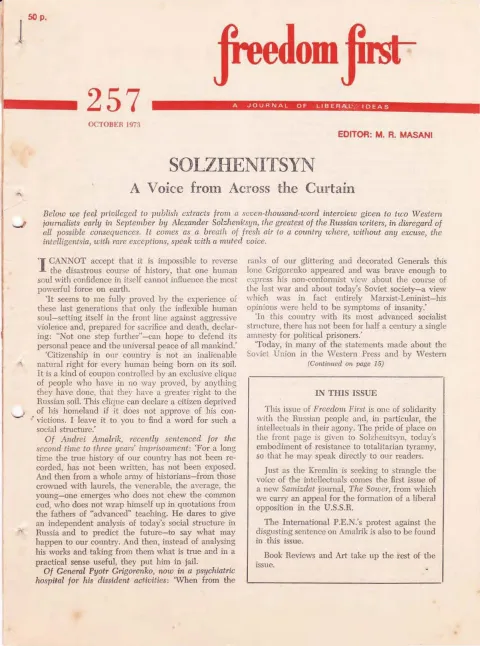
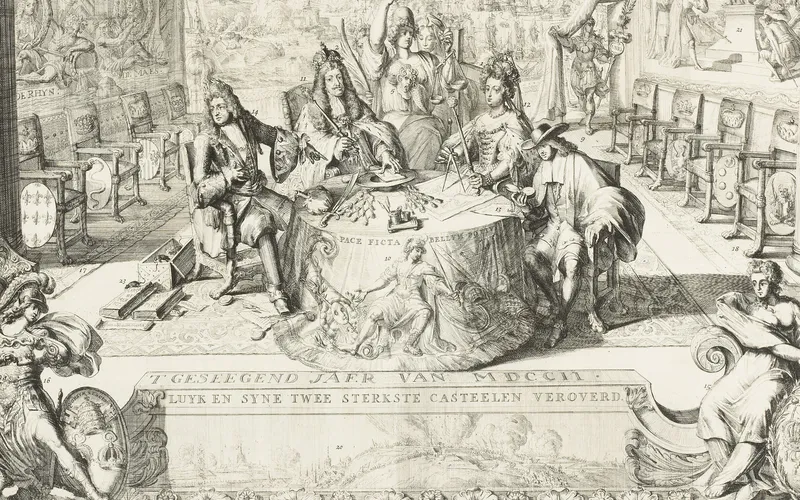
periodical issue
Freedom First
A Journal of Liberal Ideas
By M. R. Masani, Eugene Lyons, Geeta Doctor, Feroza Paymaster
Published for the Democratic Research Service by J. R. Patel, Associate Editor, Freedom First at 127, M. Gandhi Road, Bombay 1 (Phone: 254341) and printed by him at Inland Printers, 55 Gamdevi Road, Bombay 7. · Bombay · 1974
16 pages
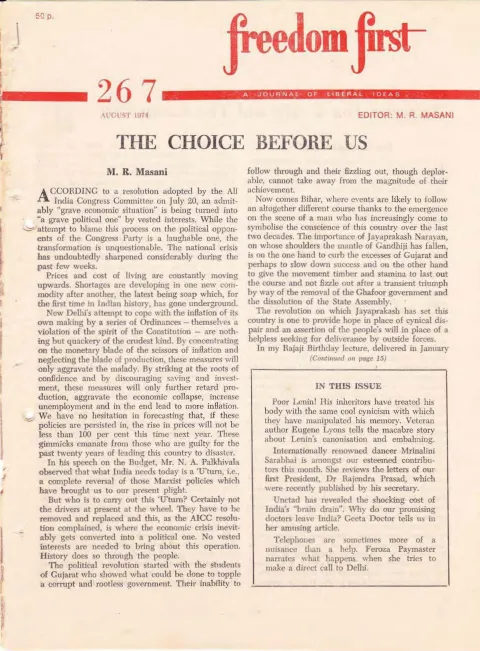
Freedom First
Summary
Freedom First No. 267 (August 1974), edited by M. R. Masani, is a monthly issue of the Bombay-based journal of liberal ideas published for the Democratic Research Service. The issue opens with Masani’s editorial on India’s deepening economic and political crisis and the rise of Jayaprakash Narayan’s movement, continues with the regular ‘Between You & Me and The Lamp Post’ column commenting on Sikkim, Soviet detente, Solzhenitsyn’s Gulag Archipelago, student hooliganism against Bombay’s Oberoi Sheraton, and the Indian cricket team’s conduct in England, and includes an open letter from British academics to Yugoslav President Tito protesting the suppression of Yugoslav scholars. Eugene Lyons contributes a long essay on the political theatre surrounding Lenin’s embalmed body fifty years after his death, and Geeta Doctor writes on the ‘brain drain’ of Indian doctors and the structural failures of the medical training and hospital system. A lighter Feroza Paymaster piece satirises the state of Indian telephone trunk-dialling. Three book reviews follow (letters of Dr. Rajendra Prasad; a Samizdat/Chronicle of Current Events volume; and a textbook on fiscal economics), then a reader’s letter on the illusion of Indian democracy, a news note on the ‘Citizens for Democracy’ committee formed under Jayaprakash Narayan’s chairmanship, the conclusion of Masani’s editorial, and a closing page of quotations (‘With Many Voices’) on communism, detente, and world affairs.
Key points
-
M. R. Masani’s “The Choice Before Us” editorial argues India’s economic crisis is being deliberately turned into a political one by vested Congress interests, endorses Palkhivala’s call for a policy “U-turn,” and frames Jayaprakash Narayan’s Bihar movement as a historic chance for hope while dismissing the proposed Swatantra merger as strategically hollow.
-
The “Between You & Me and The Lamp Post” column accuses India of hypocrisy for absorbing Sikkim while condemning imperialism, calls the Nixon-Brezhnev detente hollow given Sakharov’s hunger strike, reports customs seizing 7,000 copies of Solzhenitsyn’s Gulag Archipelago, and describes student mob vandalism at Bombay’s Oberoi Sheraton under an “anti-luxury” banner.
-
Fourteen British professors’ open letter to Yugoslav President Tito protests renewed, intensified repression of Yugoslav academics and asserts the international intellectual community’s right to protest violations of academic freedom.
-
Eugene Lyons’s “The Body in Lenin’s Tomb” recounts his 1930 visit to view Lenin’s embalmed corpse and argues Stalin orchestrated Lenin’s posthumous deification as a calculated act of political theatre and personal revenge against a leader he had contemptuously undermined while dying.
-
Geeta Doctor’s “Doctors in Distress” documents the “brain drain” of Indian doctors through testimony on bureaucratic obstruction of equipment imports, a torchlit operation amid power failures, a doctor transferred after exposing toxic adulterated dhal, and rural postings avoided for safety and infrastructure reasons, proposing a two-tier training system modelled on China’s barefoot doctors.
-
Feroza Paymaster’s comic “Tooh…Tooh…Tooh…” satirises the dysfunction of Indian trunk-dialling telephone service through an hour-long failed attempt to call Delhi from Bombay.
-
Book reviews cover a collection of Dr. Rajendra Prasad’s letters revealing his engagement with student indiscipline and educational decline, Peter Reddaway’s Uncensored Russia documenting the underground Chronicle of Current Events bulletin’s coverage of Sinyavsky, Daniel and Solzhenitsyn, and K. P. M. Sundharam’s Fiscal Economics textbook.
-
A reader’s letter argues genuine democracy has never existed in India given an “illiterate and immature electorate,” while a news item reports the new Citizens for Democracy organisation, chaired by Jayaprakash Narayan, appointing a Citizens’ Ombudsman to investigate official corruption.
-
The closing “With Many Voices” page quotes Herbert Spencer on the “divine right of parliaments” and closes with satirical items on Communist regimes.
Essays
The Choice Before Us
By M. R. Masani
M. R. Masani’s editorial argues that India’s ‘grave economic situation’ is being deliberately turned into a political crisis by vested interests entrenched in the Congress Party, pointing to runaway inflation, commodity shortages (including an underground market in soap), and the government’s ordinance-based response as mere ‘quackery’ that will worsen the economic collapse. Masani cites N. A. Palkhivala’s call for a ‘U-turn’ away from Marxist economic policy and argues the current rulers cannot be the ones to execute it. The bulk of the piece turns to Jayaprakash Narayan’s emerging movement, born from the Gujarat student agitation and now spreading to Bihar, which Masani frames as a historic chance to replace ‘cynical despair’ with hope. The piece concludes (on p.15) with sharp criticism of the Swatantra Party’s proposed dissolution to merge with a new opposition front including politicians like Biju Patnaik, Raj Narain, and Charan Singh, which Masani dismisses as strategically hollow and likely to repel rather than attract genuine liberal and democratic support.
- Frames the 1974 economic crisis as manufactured into a political crisis by vested interests within the ruling Congress Party
- Criticizes New Delhi’s anti-inflation ordinances as violating the spirit of the Constitution and worsening the underlying malady
- Forecasts price rises of 100 percent within a year if current policies persist
- Endorses N. A. Palkhivala’s call for a complete ‘U-turn’ from Marxist economic policy
- Presents Jayaprakash Narayan’s Bihar movement as the successor to the Gujarat student agitation and a vehicle of hope for the country
- Criticizes the proposal for the Swatantra Party to dissolve itself into a broader opposition front alongside politicians like Biju Patnaik and Charan Singh, calling it strategically self-defeating
Between You & Me and The Lamp Post
This unsigned recurring column covers several short topics: it accuses the Indian government of hypocrisy for criticizing ‘imperialism’ abroad while absorbing Sikkim and reducing its Chogyal to a figurehead, contrasting this with Peking’s own annexation of Tibet. It mocks the ‘detente’ achieved during President Nixon’s Moscow visit as hollow given Andrei Sakharov’s open letter demanding rights for Soviet prisoners of conscience. It reports on Indian customs seizing 7,000 copies of Solzhenitsyn’s Gulag Archipelago, attributing this to fear of offending Russia. It describes a mob (linked to the National Student Union of India and Congress politician R. Kumaramangalam) vandalising the Oberoi Sheraton Hotel in Bombay in the name of an ‘anti-luxury drive’ while chanting ‘Indira Gandhi Zindabad’, and calls this campaign a form of domestic ‘apartheid’ dressed up as socialism. Finally, it derides an Air India hoarding boasting of cricket ‘world champions’ given the Indian team’s recent thrashing and its players’ poor sportsmanship and petty theft (of socks from Marks & Spencer) while touring England, contrasting this with the good conduct of the Amritraj brothers at Wimbledon.
- Criticizes India’s absorption of Sikkim as a form of the same imperialism India condemns elsewhere, comparing it to China’s annexation of Tibet
- Calls the Nixon-Brezhnev ‘detente’ hollow, citing Andrei Sakharov’s open letter and hunger strike demanding basic rights for Soviet prisoners of conscience
- Reports Indian Customs seizing 7,000 copies of Solzhenitsyn’s Gulag Archipelago in Calcutta, attributed to fear of offending Moscow
- Describes student/youth mob violence at Bombay’s Oberoi Sheraton Hotel under an ‘anti-luxury’ banner, while shouting pro-Indira slogans
- Labels the campaign against ‘black moneywallahs’ patronizing luxury hotels as a form of apartheid rebranded as socialism
- Mocks the Indian cricket team’s poor discipline and a shoplifting incident in England, contrasting it with the sportsmanship of the Amritraj tennis brothers
Open Letter to Tito
This item reproduces extracts from an open letter sent by Nenad Petrovic, signed by fourteen eminent British professors, to Yugoslav President Tito. The letter expresses ongoing concern about repressive measures taken against Yugoslav academics since 1972, notes that the pressure against these scholars has been renewed with greater intensity, and asserts the international intellectual community’s right and duty to protest violations of academic freedom and the UN Charter on Human Rights, warning that continued repression will compel wider protest in academic institutions worldwide.
- Fourteen British professors, via Nenad Petrovic, address an open letter to President Tito of Yugoslavia
- The letter follows up on a 1972-73 protest about repressive measures against Yugoslav scholars
- It reports renewed and intensified pressure against Yugoslav academics
- It asserts the international intellectual community’s right to protest violations of academic freedom and the UN Charter on Human Rights
- It frames culture and science as universal human achievements that belong to all mankind and can develop only in freedom
The Body in Lenin’s Tomb
By Eugene Lyons
Eugene Lyons examines the strange fate of Lenin’s embalmed corpse, on permanent display in Moscow’s Red Square mausoleum for fifty years despite Lenin’s own writings against the ‘canonisation’ of revolutionaries and despite the horrified objections of his wife Nadezhda Krupskaya and other Bolshevik leaders. Lyons recounts his own 1930 visit to the crypt as part of a press corps shown the embalmers’ handiwork, describes recurring rumors that the display is a wax effigy, and details the physical and psychological toll of Lenin’s final years — strokes, isolation, and Stalin’s calculated cruelty as Lenin lay dying and increasingly powerless to block Stalin’s rise. Lyons argues that Stalin engineered Lenin’s posthumous deification as a deliberate act of political theatre and personal revenge, exploiting Russian religious mysticism to build his own cult of infallibility while having contemptuously undermined and mocked Lenin in his final months.
- Lenin’s body has been on display in a Red Square mausoleum for fifty years despite ongoing rumors it may be a wax effigy
- Lyons recounts his 1930 visit as part of a foreign press delegation shown the corpse and the embalming process by the original embalmers
- Lenin’s own writings (State and Revolution) warned against the posthumous canonisation of revolutionaries, a prophecy Lyons says was fulfilled ironically in his own case
- Lenin’s wife Nadezhda Krupskaya, his sisters, and other Bolshevik leaders including Trotsky and Bukharin opposed the embalmment as a violation of his materialist beliefs and aversion to personal glorification
- Lyons details Lenin’s final two years of strokes, isolation, and psychological suffering, and Stalin’s calculated undermining of the dying leader
- Argues Stalin orchestrated the deification of Lenin’s body as a deliberate act of political theatre and personal revenge, exploiting Russian religious mysticism
Doctors in Distress
By Geeta Doctor
Geeta Doctor writes acidly on the ‘brain drain’ of Indian doctors, opening with heavy irony that if the state has decided not to invest further in encouraging doctors to stay, India might as well close its medical colleges and revert to herbalists and faith healers. She then presents first-person testimony from several unnamed doctors: an eye surgeon in Madras who now advises people never to return to India, citing bureaucratic obstruction of equipment imports; a young surgeon frustrated by having to operate ‘by torchlight’ amid power failures and red tape and by his own chief in a private hospital taking credit and refusing fair payment; another doctor transferred out of Madras after exposing adulterated dhal (with toxic Kesari dhal) supplied to a government hospital by a politically protected contractor; and a young woman doctor explaining why newly qualified doctors avoid rural postings, citing lack of urban amenities, safety concerns for women, and the government’s failure to supply villages with adequate medicines and facilities. The essay closes with Doctor’s own proposal: train two tiers of doctors, with a mass tier given short, intensive rural-focused training (citing China’s barefoot doctor model), and require doctors trained at public expense who emigrate to reimburse part of the state’s investment in their training.
- Opens with biting irony that India might as well shut its medical colleges given official indifference to the doctor exodus
- Cites a UNCTAD estimate that India loses Rs. 3,50,000 for every doctor who emigrates
- Presents testimony from a Madras eye surgeon who now discourages colleagues from returning to India due to import restrictions on equipment
- Recounts a doctor’s transfer after exposing a hospital contractor supplying dhal adulterated with toxic Kesari dhal
- A young woman doctor explains structural and safety-related reasons newly qualified doctors avoid rural postings
- Proposes training two grades of doctors: a mass tier with short, intensive rural training modeled on China’s barefoot doctors
- Proposes that doctors trained at public expense who settle abroad should reimburse part of the state’s training investment
Tooh…Tooh…Tooh…
By Feroza Paymaster
Feroza Paymaster contributes a comic first-person account of attempting to place a long-distance Subscriber Trunk Dialling call from Bombay to Delhi, satirizing the dysfunction of the Indian telephone system. Repeated dialling attempts yield only busy tones, wrong connections, and unhelpful or confused operators, and after nearly an hour of effort she is told the direct-dial line has been out of order since the afternoon and a booked trunk call could take up to four hours. She concludes wryly that next time she wants to communicate with Delhi, she will simply write a letter.
- A humorous first-person account of trying to place an STD trunk call from Bombay to Delhi
- Documents repeated failures: busy tones, wrong numbers, and confused telephone operators
- After nearly an hour, is told the line has been out of order since the afternoon
- Booking a trunk call is quoted as taking two to four hours
- Closes with the wry conclusion that a letter would have been faster than the phone
Reviews: Presidential Missives (Portrait of a President: Letters of Dr Rajendra Prasad written to Mrs. Gyanvati Darbar)
By Mrinalini V. Sarabhai
A book review by Mrinalini V. Sarabhai of ‘Portrait of a President: Letters of Dr. Rajendra Prasad written to Mrs. Gyanvati Darbar’ (Vikas Publishing House). The review praises the letters for revealing India’s first President as immersed in Hindu philosophy, simple in habits, yet deeply engaged with the political and economic problems of the young republic, quoting his 1956 observations on student indiscipline, educational decline, and the risks of inflation under an ambitious Five Year Plan. The reviewer highlights his humor about the Speaker Ananthasayanam Ayyengar, his frustration at the constraints of the presidency (‘am I a President or a prisoner’), and his quotation of Urdu poet Iqbal in a personal letter, concluding that Gyanvati Darbar has done a service in sharing the president’s reflections.
- Reviews a published collection of Dr. Rajendra Prasad’s letters to Mrs. Gyanvati Darbar
- Highlights Prasad’s 1956 comments on student indiscipline and declining educational standards as still relevant
- Notes his growing concern with parliamentary democracy and the practical application of political conventions
- Cites his humor about the long-winded Lok Sabha Speaker Ananthasayanam Ayyengar
- Notes a letter in which Prasad questions whether he is ‘a President or a prisoner’ given the restrictions on his movements
- Quotes Prasad’s citation of the Urdu poet Iqbal in a personal letter
Reviews: Chronicle Reappears (Uncensored Russia: The Human Rights Movement in the Soviet Union)
By Rusi J. Daruwala
A book review by Rusi J. Daruwala of ‘Uncensored Russia: The Human Rights Movement in the Soviet Union’, edited, introduced and translated by Peter Reddaway (National Academy), covering the underground Samizdat bulletin ‘Chronicle of Current Events’. The review situates the Chronicle within a long Russian tradition of underground publishing going back to Alexander Herzen, explains the origin of the term ‘Samizdat’ and its offshoots ‘tamizdat’ and ‘gosizdat’, and describes the volume’s reproduction of Chronicle issues 1 to 11, covering the cases of Sinyavsky and Daniel, Galanskov, Solzhenitsyn, and the persecution of Soviet Jews, Ukrainians, and Crimean Tartars. The reviewer notes the Chronicle’s plain, unliterary style but calls it one of the most important documents of human freedom, illustrating the gap between actual conditions in Soviet Russia and how the Soviet government projects itself to Western eyes.
- Reviews ‘Uncensored Russia’, Peter Reddaway’s edited and translated volume on the Soviet Chronicle of Current Events
- Traces the tradition of underground Russian publishing to Alexander Herzen’s 1865 writings
- Explains the coinage and meaning of ‘Samizdat’, ‘tamizdat’, and ‘Gosizdat’
- Notes the volume reproduces Chronicle issues 1-11, covering Sinyavsky, Daniel, Galanskov, Solzhenitsyn, and persecution of Jews, Ukrainians, and Crimean Tartars
- Calls the Chronicle’s plain style unliterary but the document itself one of the most important records of human freedom
Reviews: Public Finance in India (Fiscal Economics by K. P. M. Sundharam)
By Indu Kale
A book review by Indu Kale of the second edition of ‘Fiscal Economics’ by K. P. M. Sundharam (Sultan Chand & Sons). The review describes the textbook as a welcome, low-priced addition to the literature on Indian public finance suitable for undergraduate students, praising its clear explanation of theory alongside practical Indian examples, its coverage of the Raj Committee’s recommendations on agricultural taxation and the Wanchoo Committee Report, and its three-part structure covering general public expenditure and revenue theory, practical budgetary and debt matters, and specific types of finance (local, railway, war, and corporate). The reviewer’s main criticism is the absence of footnotes and references, limiting its use for students who wish to pursue the subject beyond the undergraduate level.
- Reviews the second (1973) edition of K. P. M. Sundharam’s ‘Fiscal Economics’ textbook
- Praises its clear, accessible explanation of public finance theory using Indian examples
- Notes inclusion of the Raj Committee’s recommendations on agricultural taxation and the Wanchoo Committee Report
- Describes the book’s three-part structure: general theory, practical/budgetary aspects, and specific finance types
- Criticizes the lack of footnotes and references, limiting its use beyond undergraduate level
Letter: Then and Now
By V. T. Sreenivasan
A reader’s letter titled ‘Then and Now’ by V. T. Sreenivasan of Bangalore argues that genuine democracy has never existed in India, that Western-style democracy is foreign to Indian soil, and that adult franchise with an ‘illiterate and immature electorate’ has made democracy ‘a farce’. The letter recalls a discussion at the time of Mountbatten’s viceroyalty in which playwright T. P. Kailasam predicted India would get ‘Demonocracy’ rather than democracy, criticizes the alliance between the ruling Congress and the Communist Party of India despite the CPI’s professed disbelief in democracy, and concludes that character, integrity, and discipline — not mere institutional form — are what any country needs for real democracy to flourish, framing the JP-led Bihar agitation as a possible ‘desperate remedy’ for a ‘desperate situation’.
- Argues genuine democracy has never existed in India and that Western-style democracy is foreign to the country
- Recalls playwright T. P. Kailasam’s prediction at the time of Mountbatten’s viceroyalty that India would get ‘Demonocracy’ rather than democracy
- Criticizes the close alliance between the ruling Congress Party and the Communist Party of India (CPI) despite the CPI’s professed disbelief in democracy
- Argues adult franchise with an illiterate electorate has made Indian democracy ‘a farce’
- Frames Jayaprakash Narayan’s Bihar agitation as a possible ‘desperate remedy’ for a ‘desperate situation’
Citizens for Democracy
A short news item reports that the ‘Citizens for Democracy’ organisation, at a National Executive Council meeting in Bombay on 13 July 1974 chaired by Jayaprakash Narayan, decided to appoint a Citizens’ Ombudsman to investigate corruption complaints against high public officials, and to set up civil rights sub-committees in Bombay, Delhi and Ahmedabad comprising advocates and journalists to protect civil liberties and fundamental rights. Jayaprakash Narayan is quoted saying the time had come for public-spirited citizens to act on their own to restore integrity in national life; office-bearers elected include Vice-Presidents S. M. Joshi and N. A. Palkhivala, Honorary Secretary V. M. Tarkunde, and Honorary Treasurer Sevakram, with M. R. Masani among the participants in the discussion.
- Citizens for Democracy’s National Executive Council met in Bombay on 13 July 1974 under Jayaprakash Narayan’s chairmanship
- Decided to appoint a Citizens’ Ombudsman to investigate corruption complaints against high public officials
- Set up civil rights sub-committees in Bombay, Delhi, and Ahmedabad staffed by advocates and journalists
- Elected S. M. Joshi and N. A. Palkhivala as Vice-Presidents, V. M. Tarkunde as Honorary Secretary, and Sevakram as Honorary Treasurer
- M. R. Masani is listed among participants in the discussion
With Many Voices
The closing page, ‘With Many Voices’, is a compilation of quotations from international press and public figures on communism, detente, and world politics, epigraphed with a Tennyson line about seeking ‘a newer world’. It juxtaposes remarks from The Economist, Time, National Review, and other outlets — including comments from Herbert Spencer, Barry Goldwater, Senator Henry Jackson, Idi Amin Dada, Jayaprakash Narayan, and James Burnham — on themes ranging from the absence of Soviet-style dissent in China, the illusory nature of detente, and inflation-driven political instability, to satirical jabs about Communist regimes and brainwashing.
- A curated compilation of quotations from international press (The Economist, Time, National Review) and public figures
- Epigraphed with a Tennyson quotation about seeking ‘a newer world’
- Includes Herbert Spencer’s comparison of the divine right of kings to the modern ‘divine right of parliaments’
- Includes Jayaprakash Narayan’s quoted remark on being nearer the CPI(M) than the CPI
- Closes with satirical items on Communist regimes, including a joke about brainwashing
Generated by the v1.5 extraction pipeline. Awaiting editorial review.
Metadata and summary are AI-extracted from the source PDF and reviewed for editorial accuracy. The original work is available via the Read PDF tab above (where present); paragraph-level citation inside the PDF is deferred to a future engagement.