periodical issue
Freedom First
A Journal of Liberal Ideas
By Manjula Padmanabhan, "Junius", A.D. Gorwala, Vrunda Moghe-Dev, V. B. Karnik, S.R.M.D., Greta Doctor, P. N. Driver
Published for the Democratic Research Service by J. R. Patel, Associate Editor, Freedom First at 127, M. Gandhi Road, Bombay 1 (Phone: 254341) and printed by him at Inland Printers, 55 Gamdevi Road, Bombay 7. · Bombay · 1974
16 pages
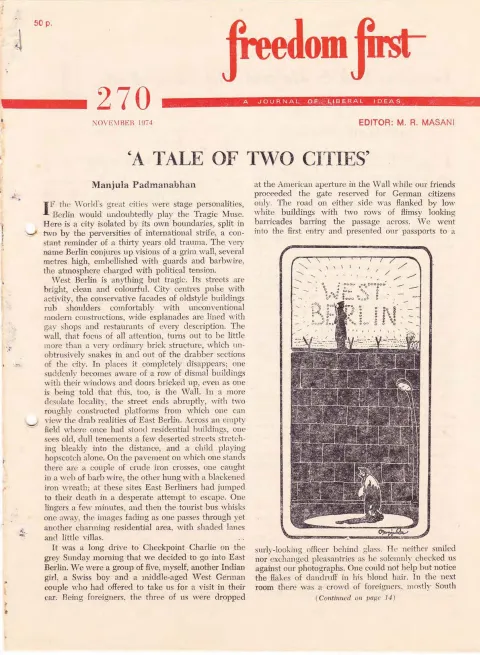
Freedom First
Summary
Freedom First No. 270 (November 1974), edited by M. R. Masani for the Democratic Research Service, Bombay, is a miscellany issue combining a travel essay, editorial commentary, book reviews, and a poem-review. Manjula Padmanabhan’s cover feature ‘A Tale of Two Cities’ recounts a visit to divided Berlin, contrasting the bright commercialism of the West with the surveilled austerity of the East. The editorial column ‘Between You & Me and The Lamp Post’ comments on the Portuguese revolution’s leftward slide, the British general election, the annexation of Sikkim into the Indian Union, Soviet suppression of an unofficial Moscow art show, an ‘unmitigated disaster’ verdict on the World Population Conference in Bucharest, and the Dadabhoy Naoroji Award going to A. D. Gorwala. A long unsigned review-essay by ‘Junius’ assesses Ronald Hingley’s biography Joseph Stalin: Man and Legend. A reprinted A. D. Gorwala piece indicts the posthumous whitewashing of V. K. Krishna Menon by public figures including Jayaprakash Narayan and Acharya Kripalani. Vrunda Moghe-Dev writes on the collapse of integrity in Bombay University’s examination system. A reviews section covers books on Indian trade unions (by M. R. Masani, reviewed by V. B. Karnik), Indian labour history (by V. B. Karnik, reviewed by S.R.M.D.), and human rights theory (Maurice Cranston, reviewed by P. N. Driver). Greta Doctor contributes a light verse-review of Nissim Ezekiel’s children’s book The Actor. The issue closes with ‘With Many Voices,’ a column of quoted aphorisms from the international press.
Key points
-
Manjula Padmanabhan’s “A Tale of Two Cities” contrasts bright, commercial West Berlin with the surveilled, threadbare austerity of East Berlin, closing with a visit to the “House at Checkpoint Charlie” museum documenting escape attempts through tunnels and hidden car compartments.
-
The “Between You & Me and The Lamp Post” column condemns the 36th Constitutional Amendment’s absorption of Sikkim as a betrayal of the Chogyal, criticises Indira Gandhi’s dismissive stance on population policy at the Bucharest conference, and notes the Dadabhoy Naoroji Award going to A. D. Gorwala.
-
A review signed “Junius” of Ronald Hingley’s biography Joseph Stalin: Man and Legend argues Stalin’s deliberate cultivation of mediocrity lulled rivals like Trotsky into fatal underestimation, and that his later atrocities were a natural extension of his early methods rather than an aberration.
-
A. D. Gorwala’s reprinted “To Say Good of the Evil Dead Is to Do Evil to the Living Good” criticises Jayaprakash Narayan’s and Acharya Kripalani’s posthumous tributes to V. K. Krishna Menon, whom Gorwala calls “a Crypto-Communist, a Misuser of Public Funds, a Destroyer of Service Morale.”
-
Vrunda Moghe-Dev’s “University Examinations: A Point of No Return?” documents leaked question papers, bribe-taking “black sheep” examiners, and Bombay University’s refusal to make internal assessment compulsory despite evidence it improves outcomes.
-
V. B. Karnik reviews M. R. Masani’s booklet Indian Trade Unions and Society, agreeing that Indian unions have failed to build sound organisation over sixty years but arguing Masani overlooks structural obstacles like slow industrial growth and labour surplus.
-
S.R.M.D. reviews V. B. Karnik’s own Indian Labour: Problems and Prospects, crediting its relatively unbiased account of the movement’s weaknesses while arguing these are consequences of a feudal-paternalistic managerial culture rather than root causes.
-
Greta Doctor’s playful verse-review of Nissim Ezekiel’s children’s book The Actor notes the irony of a non-actor writing about acting and praises Kavita Sahni’s illustrations as “alarming in their ferocity.”
-
P. N. Driver reviews Maurice Cranston’s What Are Human Rights?, endorsing its distinction between universal political/civil rights and variable economic/social rights, and citing Soviet suppression of Sinyavsky, Daniel, Pasternak and Solzhenitsyn as illustrations of totalitarian exploitation of that confusion.
Essays
’A Tale of Two Cities’
By Manjula Padmanabhan
Manjula Padmanabhan’s travel essay contrasts West and East Berlin during a group visit in 1974. West Berlin is depicted as bright, commercial, and only lightly marked by the Wall, which ‘unobtrusively snakes in and out’ of the city. The crossing into East Berlin through Checkpoint Charlie is rendered as bureaucratic and tense, with passport checks, dandruff-flecked border guards, and empty boulevards that feel frozen twenty-five years in the past. The piece (continued on pages 14-15) describes East Berlin’s threadbare shop displays, a rose garden, an elderly woman’s wartime memories of fleeing to the West, and a visit to ‘The House at Checkpoint Charlie’ museum, whose photographs and artefacts of escape attempts — tunnels, car-seat hideouts, underwater swimming gear — leave the author reflecting on the Wall as a symptom of ‘old bitterness and irreconciled differences’ rather than mere Cold War theatre.
- West Berlin is described as bright, colourful, and commercially unremarkable despite the Wall running through it.
- The border crossing into East Berlin at Checkpoint Charlie involved multiple passport checks and a visibly tense atmosphere.
- East Berlin’s streets are described as clean but empty, with shop displays that are ‘threadbare and dull’ despite fine craftsmanship, since goods are exported rather than sold locally.
- An elderly East German woman recounts being expelled from her home near the end of the war and fleeing to West Germany with only what she could carry.
- The essay describes a Western-run exhibition, ‘It Happened at the Wall,’ documenting escape attempts and deaths at the border.
- The author concludes that the Wall represents deep, unresolved historical bitterness rather than a simple Cold War symbol.
Between You & Me and The Lamp Post (incl. ‘Kerensky with a Monocle’, ‘Britain in “Lollipop Land”’, ‘Sikkim Annexed’, ‘A Russian Woodstock’, ‘An Unmitigated Disaster’, ‘Dadabhoy Naoroji Award’)
The unsigned editorial column, in the editor’s voice, comments on several current events of late 1974: the collapse of Portugal’s post-revolution government into what the London Economist called ‘Kerensky with a Monocle,’ President Spinola’s fall and the communist consolidation of power; the British general election, which gave Harold Wilson’s Labour Party a wafer-thin majority and prompted Liberal leader Jeremy Thorpe to call the electoral system ‘obscene’; India’s completion of Sikkim’s absorption via the 36th Constitutional Amendment, criticized as a betrayal of the Chogyal and the people of Sikkim; a Soviet crackdown on an unofficial Moscow art exhibition that was later permitted after public pressure, drawing more than 10,000 visitors and being dubbed a ‘Russian Woodstock’; the World Population Conference in Bucharest, at which the Indian government’s rejection of birth control in favour of economic development is criticized, alongside Indira Gandhi’s remark that she was ‘not worried about the population problem in India’; and the awarding of the Dadabhoy Naoroji Award to A. D. Gorwala.
- Criticizes President Spinola’s naivety in allowing communist infiltration of Portugal’s army and government after the 1974 revolution.
- Argues a majority Labour government under Harold Wilson is economically the ‘worst of all possible solutions’ for Britain, citing Lord Robens.
- Calls for electoral reform with proportional representation, noting the British-derived system produces ‘bogus’ majorities.
- Condemns the 36th Amendment absorbing Sikkim into India as a breach of faith with the Chogyal and a betrayal of Sikkimese freedom.
- Reports that Soviet authorities initially suppressed then permitted an open-air modern art show in Moscow after international attention.
- Criticizes Indira Gandhi’s dismissive stance on India’s population problem, contrasted with Khushwant Singh’s report calling the Bucharest population conference ‘an unmitigated disaster.’
- Notes the Dadabhoy Naoroji Memorial Trust’s award to A. D. Gorwala.
Joseph Stalin: Man and Legend
By “Junius”
Writing under the pseudonym ‘Junius,’ the author reviews Ronald Hingley’s biography Joseph Stalin: Man and Legend, praising it as among the best recent studies of Stalin. The review traces Stalin’s rise from an obscure, thuggish revolutionary organizer — a ‘grey blur’ who deliberately cultivated mediocrity to avoid appearing a threat — to absolute dictator, arguing that his lack of towering intellect was itself an asset that lulled rivals like Trotsky into fatal underestimation. It credits Hingley with correcting earlier biographers who treated Stalin as a passive creature of events, and with showing that Stalin’s atrocities (collectivization, the Gulag, the Great Terror) were not an aberration but the natural extension of the same ruthless, patient method he used to climb to power. The review closes by praising Hingley’s fairness even toward Stalin’s economic record, while still condemning the human cost of his policies and warning contemporary Indian socialists not to overlook ‘the price the Russian people had to pay.’
- Frames Stalin’s obscurity and ‘mediocrity’ as a deliberate strategy that let him outmanoeuvre more talented rivals such as Trotsky.
- Argues Hingley’s biography corrects earlier accounts that saw Stalin as a mere creature of circumstance rather than an active moulder of history.
- Credits Hingley for showing Stalin’s later atrocities were consistent with, not a departure from, his early character and methods.
- Notes Hingley’s even-handed treatment, acknowledging Stalin’s political shrewdness and even conceding some of his economic ‘successes’ while condemning the brutality of achieving them.
- Warns that Indian admirers of socialism should reckon with the human cost documented in the book, including the deaths of forced labourers in the Kolyma permafrost mines.
- Concludes that some good (e.g., concessions to workers under capitalism) inadvertently flowed from fear of the ‘Stalin bogey,’ the sole positive effect the reviewer attributes to his era.
To Say Good of the Evil Dead Is to Do Evil to the Living Good (reprinted from A.D. Gorwala’s Opinion, October 15, 1974)
By A.D. Gorwala
This reprint of an A. D. Gorwala piece from Opinion (October 15, 1974) argues that Indians’ cultural reluctance to speak ill of the dead has produced a dishonest rehabilitation of V. K. Krishna Menon’s reputation after his death. It contrasts Voltaire’s maxim — that only the living deserve consideration, judgement only the dead — with the Indian practice of forgetting a prominent person’s sins once he dies. The piece singles out Jayaprakash Narayan’s tribute calling Menon ‘a most distinguished servant and patriot’ and Acharya Kripalani’s similarly generous eulogy, arguing both men know better given Menon’s record as, in the author’s words, ‘A Crypto-Communist, a Misuser of Public Funds, a Destroyer of Service Morale.’ The essay closes with an extended meditation on whether love of one’s own country is compatible with serving a foreign ideological cause, concluding that of the dead ‘one should say nothing but the good… and yet it is not thought desirable to make public the bad too… The whole truth would be best, but if not that, then nothing.’
- Opens with Voltaire’s maxim that the living, not the dead, deserve consideration and judgement.
- Criticizes the Indian tendency to forget a public figure’s faults and invent virtues once he has died.
- Cites Jayaprakash Narayan’s and Acharya Kripalani’s tributes to Krishna Menon as examples of this distorting effect of death on judgement.
- Recalls the author’s own earlier warning, made while Menon was still Defence Minister, that Indians could have no confidence in India’s defence under him.
- Extends the analysis to ask whether Stalin, Ulbricht, and Gomulka could be called patriots despite serving the Soviet system, concluding love of country can take a ‘sadistical’ or misguided form.
- Ends on the maxim that of the dead one should say nothing, since saying only good while suppressing the bad misleads the living.
University Examinations: A Point of No Return?
By Vrunda Moghe-Dev
Vrunda Moghe-Dev examines the deterioration of examination integrity at the University of Bombay, arguing the institution is approaching ‘a point of no return.’ The piece situates the crisis within a broader critique of Indian higher education’s expansion for its own sake, at the expense of primary education, and recalls the author’s own 1972 Freedom First article on mass copying and smuggled answer papers during exams. It details systemic failures: predictable, leaked question papers; under-resourced, careless grading exposing ‘black sheep’ examiners accused of taking bribes to pass weak candidates; the absence of any means for students to seek redress against unjust grading; and the University’s continuing refusal to make internal assessment (as opposed to a single final exam) compulsory despite evidence it improves outcomes.
- Argues that Indian education policy has over-emphasized university-level access at the cost of primary education, producing many unemployed graduates.
- Recalls the author’s 1972 Freedom First article on smuggled answer papers and mass copying during exams as an examination supervisor.
- Describes how question papers become predictable ‘important questions’ well before exams due to overlapping paper-setters and moderation practices that preserve 85-90% of original content.
- Reports allegations that some examiners (‘black sheep’) accept bribes to pass students, while diligent students suffer from careless, high-volume grading.
- Notes Bombay University’s internal-assessment reform (60% coursework / 40% final exam) was made optional and thus little used, unlike Poona University’s stronger reassessment mechanisms.
- Concludes that without reform, Bombay University risks reaching ‘a point of no return.‘
Reviews: Vision & Reality (Indian Trade Unions and Society, M.R. Masani)
By V. B. Karnik
V. B. Karnik reviews M. R. Masani’s booklet Indian Trade Unions and Society, based on a B. P. Wadia Memorial Lecture, which assesses the present state of the Indian trade union movement against the vision of pioneer B. P. Wadia. Karnik summarizes Masani’s argument that Indian unions have failed to build sound organisation or protect workers’ real interests over sixty years, while crediting Masani’s explicit support for free trade unionism as a necessary complement to free enterprise. Karnik pushes back, arguing Masani overlooks two major structural obstacles beyond unions’ control — slow, unsteady industrial growth and a vast labour surplus — and that real if incomplete progress has occurred (shorter hours, paid leave, retrenchment compensation) for which unions deserve some credit. He also disputes Masani’s criticism of union opposition to automation, framing it as a legitimate response to unemployment rather than mere obstruction, and closes by cautioning against Masani’s conclusion that ‘sixty years have been wasted.’
- Masani’s booklet assesses Indian trade unionism against B. P. Wadia’s founding vision, though Wadia’s direct involvement with unions was brief.
- Masani states he is ‘a believer’ in free trade unionism as a necessary counterpart to free enterprise.
- Karnik argues Masani ignores two objective causes of union weakness: slow industrial growth and surplus manpower.
- Karnik credits unions with real gains since Wadia’s time: an eight-hour day, a one-hour midday recess, paid annual leave, and retrenchment/gratuity benefits.
- Karnik notes India still lacks a law compelling employers to recognise majority unions, unlike the US Wagner Act model that Indian unions have long sought.
- Karnik disputes Masani’s criticism of union resistance to automation, calling it a legitimate response to unemployment rather than blind obstruction.
Reviews: Indian Labour (Indian Labour - Problems and Prospects, V.B. Karnik)
By S.R.M.D.
S.R.M.D. reviews V. B. Karnik’s Indian Labour: Problems and Prospects, a collection of essays drawing on Karnik’s 37 years in the Indian labour movement. The review praises the book’s relative lack of partisanship and its systematic account of the labour movement’s structural weaknesses — among them poor union membership discipline, lack of recognition arrangements, rivalries, and reliance on outside agencies — while arguing that Karnik treats these as causes when they are better understood as consequences of deeper problems, including a persistent feudal-paternalistic approach among Indian decision-makers and the continuation of a colonial-era posture toward labour as a constituency. The review credits Karnik’s handling of contemporary conflicts, such as the Godrej strike, but faults the book for not departing from traditional remedies on wage fixation and bonus disputes, and closes by judging the Rs. 39 price a likely deterrent to readers who would benefit from the book.
- Karnik’s book surveys the Indian labour movement over roughly four decades and is judged to show relatively little partisan bias.
- The book lists eight causes of labour-movement weakness (membership apathy, lack of recognition arrangements, rivalries, reliance on outside agencies, etc.).
- The reviewer argues these are consequences rather than root causes, pointing instead to a feudal-paternalistic managerial culture and a continuation of colonial attitudes toward labour.
- Credits Karnik’s treatment of contemporary disputes such as the Godrej strike accompanied by violence.
- Faults the book for not proposing remedies beyond traditional approaches on wage fixation and bonus, and for not crediting the International Labour Organization’s role in securing benefits for Indian labour.
- Notes the Rs. 39 price is likely to deter potential readers who would benefit most from the book.
Reviews: The Actor (review-poem of The Actor by Nissim Ezekiel, illustrated by Kavita Sahni)
By Greta Doctor
Greta Doctor contributes a short verse-review of The Actor, a children’s book with words by Nissim Ezekiel and illustrations by Kavita Sahni. Written playfully in free verse, the review notes the gentle irony of a poet, playwright, editor, and teacher — ‘but Not an actor’ — writing a simple story about an actor, and praises Sahni’s illustrations as ‘alarming in their ferocity.’ It closes by posing the review’s central question as a joke: whether the book is meant ‘for a child with an adult’s brain or an adult with a child’s brain.’
- Reviews The Actor, words by Nissim Ezekiel with illustrations by Kavita Sahni, published by India Book House.
- Written as a playful free-verse review rather than prose criticism.
- Notes the irony that Ezekiel — ‘a poet, playwright, editor, teacher but Not an actor’ — wrote a story about acting.
- Praises Kavita Sahni’s illustrations as ‘alarming in their ferocity.’
- Closes with a joking question about the book’s intended audience: a child with an adult’s brain, or an adult with a child’s brain.
Reviews: Human Rights (What are Human Rights? by Maurice Cranston)
By P. N. Driver
P. N. Driver reviews Maurice Cranston’s What Are Human Rights?, praising it as an accessible, high-quality book that clarifies the confusion between universal moral/political rights and economic or social rights. The review summarizes Cranston’s argument that totalitarian states exploit this confusion to suppress basic civil and political freedoms while claiming to grant ‘economic rights,’ citing Soviet censorship and the imprisonment of writers such as Sinyavsky, Daniel, Pasternak, and Solzhenitsyn as examples. It notes Cranston’s qualified agreement with Mill that preventing harm to others can justify some censorship, his discussion of Judge Lauterpacht’s proposal for an international court to protect individual rights against states, and closes by quoting Cranston’s view that a person’s just claims to economic and social rights vary by circumstance, whereas political and civil rights remain universal regardless of station.
- Cranston’s book distinguishes universal moral/political rights from economic and social rights, a distinction the reviewer says is widely confused, especially in India.
- Argues totalitarian states destroy basic human rights by making people ‘live for and by bread alone,’ citing the suppression of Sinyavsky, Daniel, Pasternak, and Solzhenitsyn as examples.
- Notes Cranston’s qualified agreement with Mill that preventing harm to others can justify some censorship, while denying justification for political censorship of the Soviet type.
- Discusses Cranston’s treatment of Judge Lauterpacht’s idea for an international court to protect individual rights against states.
- Quotes Cranston’s conclusion (p.70) that economic and social rights vary by a person’s circumstances while political and civil rights are held equally by all.
- Commends the National Academy, Delhi for publishing the book at an accessible price.
Generated by the v1.5 extraction pipeline. Awaiting editorial review.
Metadata and summary are AI-extracted from the source PDF and reviewed for editorial accuracy. The original work is available via the Read PDF tab above (where present); paragraph-level citation inside the PDF is deferred to a future engagement.