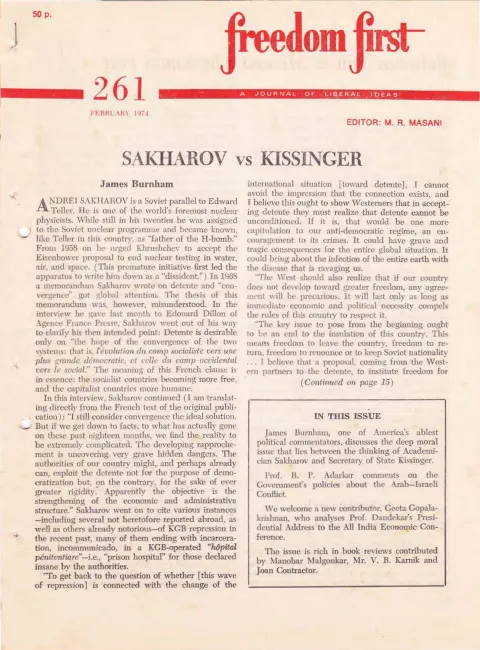
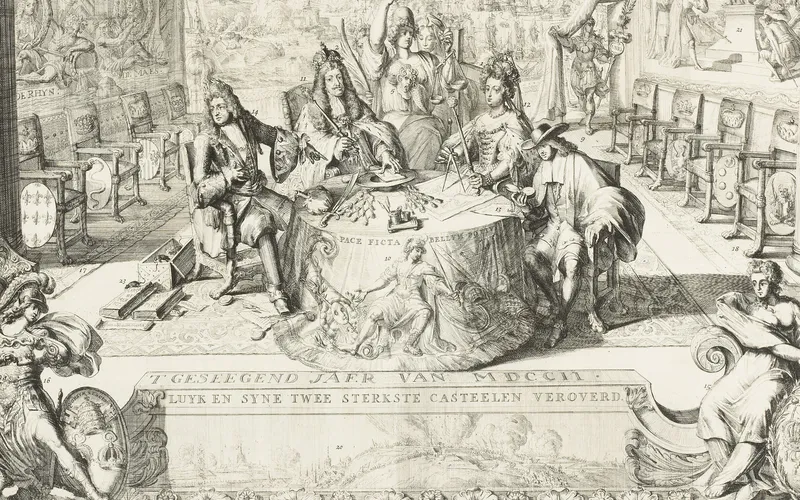
periodical issue
Freedom First
A Journal of Liberal Ideas
By S. V. Raju
Published for the Democratic Research Service by J. R. Patel, Associate Editor, Freedom First at 127, M. Gandhi Road, Bombay 1 ('Phone: 254341) and printed by him at Inland Printers, 55 Gamdevi Road, Bombay 7. · Bombay · 1974
16 pages
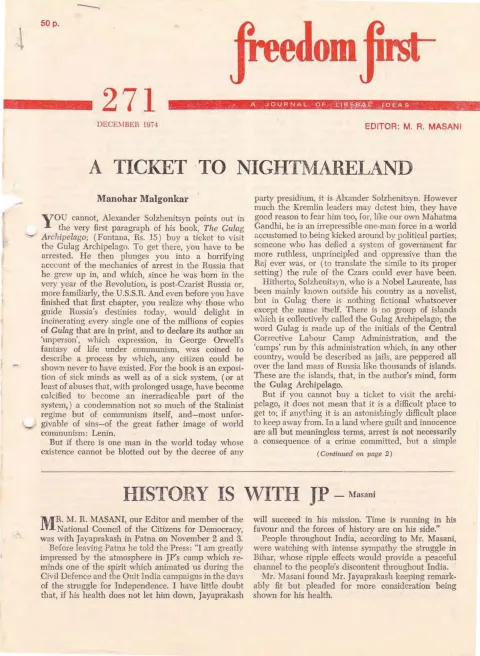
Freedom First
Summary
This is issue No. 271 (December 1974) of Freedom First, the Bombay-based monthly journal of liberal ideas edited by M. R. Masani. The issue opens with Manohar Malgonkar’s extended review essay on Alexander Solzhenitsyn’s The Gulag Archipelago, using the book as an occasion to indict the Soviet penal and surveillance system and to praise Solzhenitsyn as a singular figure of moral resistance. A short news item records Masani’s meeting with Jayaprakash Narayan in Patna during the Bihar movement. A. G. Noorani reviews a compilation of major international treaties, using it to reflect on how treaties reflect and are outlived by political realities. A. K. Das contributes a polemical essay on the failures of Indian planning, population policy, and governance since Independence. George Meany, president of the AFL-CIO, delivers a sharply critical address on the substance of US-Soviet detente, arguing it has been a one-sided arrangement benefiting Moscow. A letter from Sheila Sumant criticizes Danial Latifi’s uncritical account of China. Ya’acob Caroz contributes a detailed essay distinguishing the Palestinian population from the PLO, disputing the latter’s claim to sole representation and outlining the PLO’s rejectionist charter. The issue closes with three book reviews (on a Parkinson/Rustomji management book, Peter Brent’s Godmen of India, and Harry Goldberg’s essays on communism and culture) and a page of miscellaneous quotations, ‘With Many Voices.‘
Key points
-
Manohar Malgonkar’s review essay on Solzhenitsyn’s The Gulag Archipelago catalogues the sweeping Article 58 of the Soviet Criminal Code and the corrupt, terror-based culture of the secret police “Organs,” likening Solzhenitsyn to a Gandhi-like figure of moral resistance the Kremlin cannot silence.
-
A news item reports M. R. Masani’s November 1974 meeting with Jayaprakash Narayan in Patna, where Masani compared the atmosphere in JP’s camp to the spirit of the Quit India campaign and expressed confidence “the forces of history are on his side.”
-
A. G. Noorani reviews J. A. S. Grenville’s compilation of major international treaties, arguing treaties survive only as long as the political conditions that produced them, illustrated by NATO’s endurance versus SEATO’s collapse after the Sino-Soviet split.
-
A. K. Das’s polemical essay indicts 27 years of Indian governance for leaving the children of cobblers and sweepers trapped in poverty despite the “Garibi Hatao” slogan, arguing the country has specialised in “decontrolling control” even while demanding ever more sacrifice from citizens.
-
George Meany’s address as AFL-CIO president argues US-Soviet detente has been a one-sided arrangement benefiting Moscow, criticising the Nixon administration’s silence on the arrest of Soviet Jews and detailing a proposed jet-technology transfer deal that would aid Soviet aerospace capability.
-
Sheila Sumant’s letter mocks Danial Latifi’s uncritical praise of China’s supposedly thief-free, unemployment-free society, citing a recent pickpocketing of her own and a Chinese visitor’s warning to guard belongings.
-
Ya’acob Caroz’s essay disputes the PLO’s claim to sole representation of Palestinians, arguing Jordan has the stronger historical claim and that the PLO’s 1968 Palestinian National Treaty denies Israel’s right to exist and treats terrorism as the only path to liberation.
-
Book reviews cover a lightweight management primer, Peter Brent’s Godmen of India on the Guru-shishya relationship, and Harry Goldberg’s Communism and Culture on Communist states’ subordination of science and the arts to Party control.
Essays
A Ticket to Nightmareland
By Manohar Malgonkar
Manohar Malgonkar’s review essay on Alexander Solzhenitsyn’s The Gulag Archipelago opens the issue. Malgonkar summarizes the book’s account of the Soviet arrest, interrogation, and camp system, describing the sweeping Article 58 of the Russian Criminal Code, the culture of the secret police (‘the Organs’ and its SMERSH cadres), and the routine use of torture. He frames Solzhenitsyn as a singular, Gandhi-like figure of moral resistance whom the Kremlin cannot silence by ‘unpersoning.’ The essay (continued on page 15) closes by praising Solzhenitsyn’s stamina and integrity as a researcher and stylist, and by noting his anger at the Western allies for repatriating Soviet POWs to Stalin after the war, contrasted with his sympathetic, if bewildered, portrait of ordinary Russians and even of Stalin’s targets.
- The Gulag Archipelago is described as an exposition of a ‘sick system’ and of the crime of Stalinism and, ultimately, Leninism, rather than just individual abuses.
- Article 58 of the Soviet Criminal Code is presented as so broad that almost any act or omission could be prosecuted, with standard sentences of ten or twenty-five years.
- The ‘Organs’ (secret police) and SMERSH are depicted as a privileged, corrupt caste modeled on loyalty and terror rather than law.
- Malgonkar likens Solzhenitsyn to Mahatma Gandhi as an ‘irrepressible one-man force’ that authoritarian power cannot suppress.
- The essay recounts Solzhenitsyn’s own 1945 arrest as a decorated artillery captain, arrested for criticizing Stalin in a private letter.
- Solzhenitsyn is portrayed as condemning the Western Allies, including Churchill, for forcibly repatriating Russian POWs and Cossacks to Soviet hands after World War II.
- The review treats the book as unmatched in scale and moral seriousness, calling it a product of ‘a dozen writers of extraordinary literary brilliance.‘
History is with JP
By Masani
A brief unsigned news item, bylined ‘Masani,’ reports that Freedom First editor M. R. Masani, a member of the National Council of the Citizens for Democracy, met with Jayaprakash Narayan in Patna on November 2 and 3, 1974. Masani told the press he was impressed by the atmosphere in JP’s camp, comparing it to the spirit of the Civil Defence and Quit India campaigns, and expressed confidence that JP would succeed in his mission given the momentum of history and public sympathy for the Bihar movement.
- M. R. Masani visited Jayaprakash Narayan’s camp in Patna on November 2-3, 1974.
- Masani compared the atmosphere in JP’s camp to the spirit of the Quit India and Civil Defence campaigns.
- Masani expressed confidence that ‘time is running in his favour and the forces of history are on his side’ regarding JP’s movement.
- The item notes people across India were watching the Bihar struggle with sympathy as a peaceful channel for discontent.
- Masani found JP physically fit but appealed for more consideration of his health.
The Politics of Treaties
By A. G. Noorani
A. G. Noorani reviews Prof. J. A. S. Grenville’s The Major International Treaties 1914-1973: A History and Guide with Texts, praising it as a labour of love and a uniquely usable one-volume collection with the texts of major treaties together with narrative surveys of each historical phase. Noorani uses the review to argue that treaties are transient instruments whose survival depends on whether the underlying political conditions that produced them persist — NATO endures because the perceived threat remains, while SEATO died once the Sino-Soviet split fractured its rationale. He illustrates the gap between treaty language and political reality with the case of the 1971 Soviet-Egyptian Treaty, whose socialist language did not prevent Sadat from later expelling Soviet advisers.
- Grenville’s compilation spans treaties from 1914 to Brandt’s 1973 Prague visit normalising West German-Czechoslovak relations, including the 1973 Indo-Pak POW repatriation agreement.
- Noorani argues treaties ‘reflect a political situation and cannot survive a change which goes far beyond their structure.’
- NATO is cited as surviving because both sides still perceive the same threat, while SEATO is described as effectively dead after the Sino-Soviet split.
- Khrushchev’s 1959 Leipzig speech is quoted: treaties reflect ‘an established balance of forces resulting from victory or capitulation in war.’
- The 1971 Soviet-Egyptian Treaty’s reference to Egypt ‘reconstructing society along socialist lines’ is discussed as a clause later effectively abandoned when Sadat expelled Soviet advisers.
- Noorani stresses that treaty language matters because it can shape future policy, but ‘only reality matters more.‘
For Whom the Bull Toils
By A. K. Das
A. K. Das’s essay indicts the Indian state’s record of governance 27 years after Independence, arguing that despite a nuclear explosion and grand rhetoric, ordinary Indians — especially the children of cobblers, sweepers, porters, and pedlars — remain trapped in poverty. Das criticizes the electoral system for diffusing accountability, laments the gap between the promise of ‘Garibi Hatao’ and its failure to touch endemic poverty, and surveys a cascade of policy failures: population growth outpacing family planning, hyper-inflation, hoarding, black money, and a general collapse of ‘good sense’ in public life. He closes by arguing that India has specialised in ‘decontrolling control’ in vital areas of national life even as it demands ever more control and sacrifice from ordinary citizens.
- Das argues nine of ten children born to cobblers, sweepers, porters, and pedlars are nearly destined for a life of poverty despite 27 years of independence.
- He criticizes India’s electoral laws for giving ‘too wide a berth’ to relegate responsibility and accountability to the back bench.
- The ‘Garibi Hatao’ (‘Remove Poverty’) slogan is described as a fashionable phrase that could not survive contact with entrenched poverty.
- The essay cites hyper-inflation, hoarding, and the failure of the Green Revolution alongside urban migration as symptoms of policy failure.
- Das laments a pervasive breakdown of ‘good sense,’ citing the mockery of the Constitution, injury to the judiciary, and reliance on ordinances.
- The essay closes with the image of the nation as having specialised in ‘decontrolling control’ even while professing to need more of it.
Let the Debate Begin
By George Meany
George Meany, president of the AFL-CIO, delivers a sharply critical address on US-Soviet detente, arguing that American labour will not leave foreign policy to the experts because Soviet-American arrangements affect workers directly. He recounts a $300 million wheat deal, Soviet oil-linked pressure, and the export of American jobs and technology as costs borne by ordinary Americans. He criticizes the Nixon administration’s silence over the arrest of Soviet Jews and the Soviet jamming of American broadcasts about Andrei Sakharov, contrasts democracy and totalitarianism, and questions whether detente has produced any real reciprocity, citing Soviet conduct in the Yom Kippur War and the flow of American technology and credit to a struggling Soviet economy.
- Meany argues detente has so far been a one-way arrangement in which American taxpayers, consumers, and workers bear the costs.
- He criticizes the Nixon administration’s silence when Soviet Jews were arrested and jailed around the time of Nixon’s Moscow visit.
- Meany insists there ‘is a difference between democracy and totalitarianism’ and rejects the idea that the two systems are morally equivalent.
- He argues the Soviet Union incited and armed the Egyptian-Syrian attack on Israel and then used the crisis to extract US concessions.
- The essay claims the Soviet consumer economy has been ‘strangled’ for nearly fifty years by military spending, driving Soviet requests for Western credit and technology.
- Meany details a proposed $500 million wide-bodied jet deal with Boeing, Lockheed, and McDonnell-Douglas that would require co-production in the USSR and transfer of US aerospace technology.
- He raises the transfer of ‘voice print recorder’ police technology to the USSR as a threat to dissidents like Sakharov and Soviet Jews maintaining contact with the West.
Letter: Latifi Robbed of Brains by China
By Sheila Sumant
A letter to the editor from Sheila Sumant of Bombay criticizes Danial Latifi, a Supreme Court advocate, for an uncritical talk to the Indian Council of World Affairs praising conditions in China — including claims of no thieves, no unemployment, no flies, and universal happiness among 800 million people. Sumant, herself a recent victim of a pickpocket, argues Latifi’s rosy portrayal amounts to Chinese propaganda having ‘robbed him of his brains,’ and cites a report from an overseas Chinese visitor warning tourists to guard their belongings as evidence against Latifi’s claims.
- Danial Latifi told the Indian Council of World Affairs there are no thieves, pickpockets, or unemployment in China and that all 800 million people are happy.
- Sumant, having recently been a pickpocket victim herself, mocks Latifi’s claims as either naive or condescending to his audience.
- She notes Latifi does not know Chinese and drew his conclusions via Hindi or English interpretation.
- The letter cites overseas Chinese visitor Frank Ching’s warning that hotel staff in China advise visitors to guard money and documents, contradicting Latifi’s claims.
- Sumant argues Latifi’s uncritical enthusiasm does a ‘disservice to Sino-Indian friendship.‘
Palestinians, Yes; P.L.O., No
By Ya’acob Caroz
Ya’acob Caroz’s essay argues that ‘Palestinians’ and the PLO are not synonymous, disputing the widespread impression that Palestinians are simply the residents of Lebanese refugee camps represented by the PLO. Tracing the demography of Palestinian Arabs since the 1948 Mandate partition, Caroz argues UNRWA’s own reporting casts doubt on inflated refugee counts, and that Jordan — not the PLO — has the stronger historical claim to represent Palestinians given decades of shared nationality and governance. He then details the PLO’s 1968 Palestinian National Treaty, arguing it denies Israel’s right to exist, treats ‘armed struggle’ (i.e., terrorism) as the only path to Palestinian liberation, and was never chosen by Palestinians themselves but imposed by the Arab League. Caroz concludes the PLO seeks a ‘final solution’ for the Jewish state comparable to what Hitler sought for the Jewish people.
- Caroz distinguishes the Palestinian population (about 2.36 million by his count) from the PLO, which he says was never elected by Palestinians.
- He cites a 1972-73 UNRWA report questioning the number of ‘registered refugees’ versus actual camp residents, arguing the true refugee count is much smaller than commonly claimed.
- Jordan’s claim to represent West Bank and Gaza Palestinians is presented as stronger than the PLO’s, given Jordanian citizenship and governance ties predating 1967.
- The Palestinian National Treaty (as amended 1968) is described as denying Israel’s right to exist and framing ‘Fedayeen activity’ (terrorism) as the only path to liberation.
- The PLO’s founding is attributed to the Arab League’s 1964 initiative and the 1973 Algiers summit recognition, not to any Palestinian election.
- Caroz argues the PLO’s ultimate objective, alongside destroying Israel, is the ‘annihilation of Jordan.’
- The essay closes by comparing the PLO’s aim for Israel to Hitler’s ‘final solution’ for the Jewish people.
Reviews: How to Get to the Top (Management Oversimplified)
By S. V. Raju
Three brief book reviews appear under the ‘Reviews’ heading. S. V. Raju reviews How to Get to the Top by C. Northcote Parkinson and M. K. Rustomji, dismissing it as an oversimplified management ‘quickie’ composed mostly of illustrations, useful perhaps for supervisors but not serious literature on management. Aruna Thosar reviews Peter Brent’s Godmen of India, describing its survey of Guru-shishya relationships across Indian sects and its author’s candid, if sometimes over-generalizing, attempt to explain the phenomenon to spiritually bewildered Western youth. V. B. Karnik reviews Harry Goldberg’s Communism and Culture, a short essay collection on how Communist states subordinate science and the arts to Party control, noting Solzhenitsyn as a recent example of intellectual dissent against this suppression.
- S. V. Raju criticizes How to Get to the Top as a lightweight, illustration-heavy management book that oversimplifies its subject and never states its intended audience.
- Raju suggests the book has some practical use for supervisors dealing with workplace tension but is not serious management literature.
- Aruna Thosar’s review of Godmen of India credits author Peter Brent with covering the background, forms, and meaning of the Guru-shishya relationship across Vedic, Jnana, and Bhakti traditions.
- Thosar notes Brent’s self-aware admission of feeling ‘so unqualified to stand critically aloof’ when documenting his encounters with Indian gurus.
- Thosar reports Brent’s explanation of the Guru-shishya bond as rooted in emotional and sexual repression in Hindu society, paralleling it to relationships between lovers.
- V. B. Karnik’s review of Communism and Culture frames the book as a collection of essays on how Communist states control science, music, and drama, citing Solzhenitsyn as a recent dissenting spirit.
Generated by the v1.5 extraction pipeline. Awaiting editorial review.
Metadata and summary are AI-extracted from the source PDF and reviewed for editorial accuracy. The original work is available via the Read PDF tab above (where present); paragraph-level citation inside the PDF is deferred to a future engagement.