periodical issue
Freedom First
A Journal of Liberal Ideas
By Bernard Levin, Mehra Masani, R. Srinivasan, Gopal Mittal
Published for the Democratic Research Service by J. R. Patel, Associate Editor, Freedom First, 127, M. Gandhi Road, Bombay 1, and printed by him at Inland Printers, Gamdevi Road, Bombay 7 · Bombay · 1976
16 pages
Freedom First
Summary
Freedom First issue 280 (March 1976), edited by M. R. Masani, is dominated by the aftermath of the Emergency-era censorship battle between the journal and the government censor. The lead item reproduces, in extended summary, the Bombay High Court Division Bench judgement (Justices D. P. Madon and M. H. Kania) upholding Justice R. P. Bhatt’s earlier ruling against the censor in nine of eleven disputed items, with a writ of mandamus issued in the Editor’s favour — a judgement the issue frames as a major vindication of press freedom and the rule of law during the Emergency. The regular ‘Between You and Me and the Lamp Post’ column comments on Christiaan Barnard’s visit to India, Margaret Thatcher’s anti-Soviet ‘Iron Lady’ speech and its reception, British debates over corporal punishment and sex-discrimination in schools, and Communist media attacks on Agatha Christie and Jean-Paul Sartre. The issue reprints a Bernard Levin column from The Times eulogising outgoing US Ambassador to the UN Daniel Moynihan as a lone truth-telling voice against Third World and Soviet hypocrisy. Two book reviews follow — Mehra Masani on Collins and Lapierre’s Freedom at Midnight, and R. Srinivasan on Dharma Vira’s Memoirs of a Civil Servant — along with a reader’s letter on the origins of fascism and a compilation of news items and court proceedings (‘At Last You Can Read This’) that had earlier been suppressed by the censor, including material on Nasser’s Egypt, Amnesty International, and the Madras High Court’s admission of a writ from Swarajya’s publisher against a censorship order. The back page carries the recurring ‘With Many Voices’ anthology of quotations and the journal’s ownership statement and subscription form.
Key points
-
The Bombay High Court’s Division Bench (Justices Madon and Kania) dismissed the Emergency censor’s appeal on 10 February 1976, upholding Justice Bhatt’s ruling on nine of eleven disputed Freedom First items and issuing a writ of mandamus, holding that Emergency provisions suspend restrictions on state power, not citizens’ underlying common-law free-speech rights.
-
The “Between You & Me and The Lamp Post” column praises Margaret Thatcher’s “Iron Lady” anti-Soviet speech, reports Tass’s aggrieved response to British “misconceptions” of the USSR, and notes Chinese state media blaming Brezhnev personally for a poor Soviet grain harvest.
-
A reprinted Bernard Levin column eulogises outgoing US Ambassador to the UN Daniel Moynihan for bluntly calling out regimes like Idi Amin’s Uganda as racist and murderous despite Amin’s OAU standing, framing liberalism’s chief weakness as a shortage of adherents as single-minded as its enemies.
-
Mehra Masani reviews Collins and Lapierre’s Freedom at Midnight, praising its dramatised account of the Gandhi-assassination conspiracy while criticising “gimmicky” digressions on the princes and Gandhi’s sex life.
-
R. Srinivasan reviews Dharma Vira’s Memoirs of a Civil Servant, ranking it below classics of the genre but praising its candid account of his governorships of Punjab, West Bengal and Karnataka through the jeep and tractor scandals.
-
A reader’s letter, “The Original Fascist,” argues that if corporatism is inherently fascist, the true father of fascism is Lenin rather than Mussolini, drawing the editor’s one-word retort “Touche.”
-
“At Last You Can Read This” compiles previously censor-blocked items, including June 1975 Cairo trial testimony branding Nasser a unilateral dictator, an Amnesty International resolution on police duty to disobey torture orders, and the Madras High Court’s admission of a Swarajya publisher’s writ against a censorship deletion.
Essays
Court Upholds Press Freedom / Rule of Law Prevails (Bombay High Court judgement summary re: censorship of Freedom First, continued on page 14 as ‘Nine out of Eleven’)
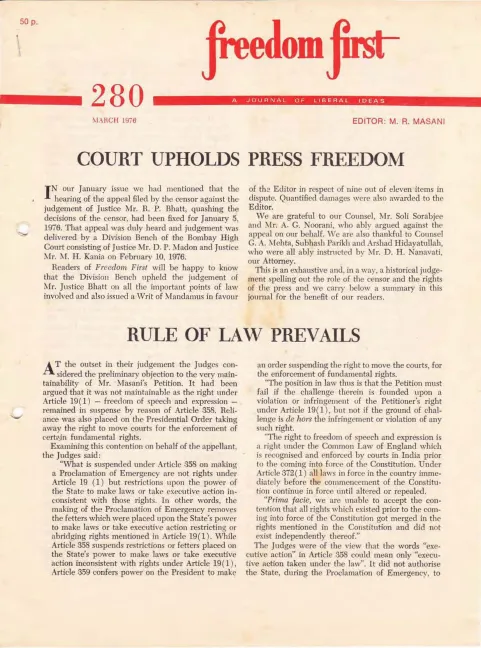
This unsigned lead item reports that the Bombay High Court’s Division Bench (Justices D. P. Madon and M. H. Kania), ruling on 10 February 1976, dismissed the censor’s appeal against Justice R. P. Bhatt’s earlier judgement quashing censorship of Freedom First. The court upheld Bhatt J. on all major points of law and issued a writ of mandamus in the Editor’s favour on nine of eleven disputed items, while reversing him on the remaining two. The accompanying ‘Rule of Law Prevails’ summary of the judgement’s reasoning covers: the maintainability of Masani’s petition despite Articles 358 and 359 of the Constitution; the court’s holding that Emergency provisions suspend only restrictions on state power, not citizens’ pre-existing common-law rights to speak and act freely so long as they do not break the law; the grounds on which a censor’s discretionary order can be judicially reviewed (non-application of mind, mala fide exercise, irrelevant considerations, etc.); and the court’s emphasis that press freedom underpins a ‘free clearing-house’ of competing ideologies essential to democracy, that the censor is ‘the nurse-maid of democracy and not its grave-digger’, and that courts should strongly deprecate suppression of court-case reporting merely because it embarrasses officialdom. The piece explicitly thanks the paper’s counsel Soli Sorabjee and A. G. Noorani (for the appeal) and G. A. Mehta, Subhash Parikh and Arshad Hidayatullah (instructed by D. H. Nanavati) for the original matter.
- Division Bench of Justices D. P. Madon and M. H. Kania delivered judgement on 10 February 1976 dismissing the censor’s appeal.
- The court upheld Justice R. P. Bhatt’s judgement on all major points of law and issued a writ of mandamus for the Editor on 9 of 11 disputed items.
- The court held that Emergency proclamations under Article 358/359 suspend restrictions on state power, not citizens’ underlying common-law rights to free speech.
- A censor’s order can be struck down for non-application of mind, mala fide exercise of power, reliance on irrelevant grounds, or if no reasonable person could reach that conclusion.
- The judges described the censor as bound by section 38 and the censorship order’s stated purposes, unable to issue guidelines beyond the scope of the statutory order.
- The court strongly deprecated the practice of banning republication of court judgements merely because they are unpalatable to an officer or the Government.
- The judges characterised the censor’s role as preserving ‘a fine balance’ — not stifling all dissent, but preventing incitement to subversive activity.
Between You & Me and The Lamp Post (editorial column: Barnard’s Big Heart; Britain’s New Amazon; Daniel Leaves the Den; Equality Ad Absurdum; Debunking - Communist Style; Buns or Loaves?)
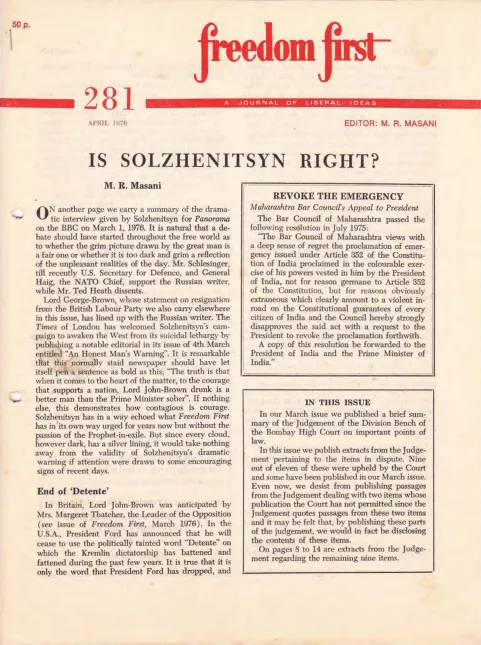
The regular ‘Between You & Me and the Lamp Post’ column runs through several short, satirical items. ‘Barnard’s Big Heart’ mocks South African surgeon Christiaan Barnard’s self-regarding remarks during an Indian visit and his views on apartheid and Angola. ‘Britain’s New Amazon’ and the following item praise Margaret Thatcher’s hawkish anti-Soviet ‘Iron Lady’ speech, note Harold Wilson’s surprising partial endorsement of it, and recount Tass’s aggrieved commentary on British ‘misconceptions’ about the USSR, including a Sheffield factory worker’s quip about Pravda. ‘Buns or Loaves?’ cites a Chinese news agency broadcast blaming Brezhnev personally for a poor Soviet grain harvest. An editorial box, ‘In This Issue’, explains the issue’s heavy focus on the censorship judgement and notes the paper is still barred from publishing a Maharashtra Bar Council resolution pending a Supreme Court appeal by the censor. ‘Daniel Leaves the Den’ pays tribute to departing US Ambassador to the UN Daniel Moynihan, quoting President Ford’s praise of him and introducing the reprinted Bernard Levin piece. ‘Equality Ad Absurdum’ recounts British schools’ debates over caning parity between sexes following the Sex Discrimination Act. ‘Debunking — Communist Style’ reports Chinese and Soviet media denunciations of Agatha Christie and Jean-Paul Sartre, the latter downgraded in the Great Soviet Encyclopaedia for criticising the 1968 invasion of Czechoslovakia and calling for greater Soviet human rights.
- Satirises Christiaan Barnard’s self-important comments on his meeting with Indira Gandhi and his views on apartheid and Angola.
- Praises Margaret Thatcher’s anti-Soviet ‘Iron Lady’ speech and notes Harold Wilson’s grudging partial agreement with it.
- Reports Tass’s complaints about British ‘misconceptions’ of the USSR, including a factory worker’s joke about Pravda being the only newspaper.
- Cites Chinese state media blaming Brezhnev’s leadership for a poor 1975 Soviet grain harvest.
- Pays tribute to outgoing UN Ambassador Daniel Moynihan as a fighter for free nations against hypocrisy.
- Covers a British debate on caning parity for schoolgirls under the new Sex Discrimination Act.
- Notes Chinese and Soviet media attacks on Agatha Christie and Jean-Paul Sartre for insufficient ideological conformity.
In This Issue (editorial note)
A reprint, courtesy of The Times of London, of Bernard Levin’s column eulogising Daniel Moynihan, the outgoing US Ambassador to the United Nations, as one of the few statesmen willing to name hypocrisy plainly. Levin argues that liberalism’s central weakness is a shortage of adherents willing to be as hard and single-minded as its enemies, and praises Moynihan for refusing the ‘abject posture’ of apologetic Western diplomacy — for calling out regimes such as Idi Amin’s Uganda as racist and murderous even while, as titular head of the Organization of African Unity, Amin postures as an anti-colonial leader, and for pointing out the double standards by which the Soviet Union and Third World dictatorships denounce Western nations for far lesser offences than their own record of political imprisonment. Levin closes by asking whether the West’s long habit of appeasing hostile rhetoric has made freedom stronger or weaker over the preceding decade, and credits Moynihan with sounding a ‘trumpet to end the long retreat’.
- Levin praises Daniel Moynihan as uniquely willing to state hard truths bluntly as US Ambassador to the UN.
- Argues liberalism’s greatest weakness is a shortage of adherents as hard and single-minded as its illiberal enemies.
- Contrasts Moynihan’s approach with the ‘abject posture’ of contemporary British government policy under Ivor Richard.
- Cites Moynihan calling Idi Amin a racist murderer despite Amin’s position as head of the Organization of African Unity.
- Highlights the hypocrisy of Third World and Soviet-bloc denunciations of Western nations for offences dwarfed by their own record of political imprisonment.
- Frames the piece around whether appeasing hostile rhetoric has left the West’s democratic hold stronger or weaker.
A Lone Voice That Should Stop Us All In Our Tracks
By Bernard Levin
Under the ‘Reviews’ heading, Mehra Masani reviews Larry Collins and Dominique Lapierre’s Freedom at Midnight (Vikas, 474 pp., Rs. 45), praising its vivid, dramatized retelling of the transfer of power and partition — especially its account of the conspiracy to assassinate Gandhi — while criticising its ‘gimmicky’ inclusions on the Indian Princes and Gandhiji’s attitude to sex as unnecessary concessions to popular taste. The review discusses the book’s sympathetic portrayal of Mountbatten as hero and Jinnah as villain, its debunking picture of Nehru and Patel as ‘chastened school-boys’ unable to control post-Partition violence, and praise for Rajaji’s statesmanship, closing by quoting the book’s tribute to Gandhi’s global legacy.
- Praises the book’s vivid, well-researched dramatization of the transfer of power and partition, especially the Gandhi-assassination conspiracy narrative.
- Criticises ‘gimmicky’ digressions on the Indian Princes and Gandhiji’s sex life as concessions to popular taste that undercut authorial sincerity.
- Notes the book casts Mountbatten as hero and Jinnah as rigid villain, raising the unresolved question of whether Jinnah’s intransigence made partition inevitable.
- Highlights the book’s debunking portrayal of Nehru and Patel as unable to control post-Partition violence without Mountbatten.
- Praises the book’s treatment of Rajaji’s statesmanship as a rare positive exception among Gandhi’s lieutenants.
Reviews: Freedom at Midnight (by Larry Collins and Dominique Lapierre)
By Mehra Masani
R. Srinivasan reviews Dharma Vira’s Memoirs of a Civil Servant (Vikas, 1975, 154 pp., Rs. 35), situating it among a growing genre of Indian civil-service memoirs but ranking it below classics such as K. P. S. Menon’s My Several Worlds, Mangat Rai’s Commitment My Style, and Bonnerjea’s Under Two Masters. The review highlights Dharma Vira’s account of pre-independence administration and handling political agitators, his achievements as a civil servant (building airstrips, refugee rehabilitation), his experiences as Ambassador to Czechoslovakia, and especially his tenure as Governor of Punjab, West Bengal and Karnataka during periods of political instability, including the jeep scandal, tractor scandal, and Krishna Menon’s controversial tenure at the Indian High Commission.
- Ranks the memoir below classics of the genre such as My Several Worlds, Commitment My Style, and Under Two Masters, though still readable.
- Praises insight into pre-independence civil service handling of political agitators and post-independence achievements like airstrip building and refugee rehabilitation.
- Highlights Dharma Vira’s account of his ambassadorship to Czechoslovakia as unusually candid about East European democratic pretence.
- Details his governorship of Punjab, West Bengal and Karnataka, covering the jeep scandal, tractor scandal, and Krishna Menon’s tenure at the Indian High Commission.
- Frames the book as illustrating the demoralization of Indian democratic politics and the burdens placed on Governors during coalition instability.
Reviews: Memoirs of a Civil Servant (by Dharma Vira)
By R. Srinivasan
A reader’s letter, ‘The Original Fascist’ by Gopal Mittal, responds to a February 1976 Freedom First quotation from a Times of London editorial defining corporatism as inherently fascist because it transfers rights from the individual to corporate bodies and the state. Mittal argues that if this description is correct, fascism originated not in Italy but in Russia, with Lenin rather than Mussolini as its true father. The editor appends a one-word retort: ‘Touche’.
- Responds to a February 1976 Times of London quotation defining corporatism as inherently fascist.
- Argues fascism’s true origin lies in Leninist Russia rather than Mussolini’s Italy.
- The editor’s terse reply, ‘Touche’, endorses the letter’s point.
Statement About Ownership and Other Particulars of Freedom First (Form IV, See Rule 8)
‘At Last You Can Read This’ compiles news items previously blocked from publication by the censor. It reports on the June 1975 Cairo trial testimony of former Nasser aides Abdel Latif Bahdady and Kamal Hussein branding Nasser a dictator and communist who ruled unilaterally; former President Mohamed Naguib’s remarks on the 1952 coup; a June 1975 Amnesty International meeting in The Hague affirming police officers’ duty to disobey orders to torture; a July 1975 Indian Express report on a Madras High Court writ from Swarajya publisher T. S. Sadashivam challenging the Deputy Secretary’s order deleting a passage from a 20th-anniversary review article, with Justice Ramanujam finding the censorship order lacked authority for such deletions; and quotations from Daniel Moynihan and the Swiss Press Review criticising excessive American self-recrimination (‘It is time we ceased to apologise for an imperfect democracy… Find its equal’).
- Reports June 1975 Cairo trial testimony branding Nasser a unilateral dictator turning Egypt communist, from former aides Bahdady and Hussein.
- Notes former President Naguib’s comment that Nasser’s revolution ‘offended the Egyptian people more than it benefitted them’.
- Covers a June 1975 Amnesty International meeting affirming police officers’ duty to disobey torture orders.
- Details the Madras High Court’s admission of a writ petition from Swarajya’s publisher against a Deputy Secretary’s censorship deletion order.
- Quotes Daniel Moynihan urging Americans to stop apologising for an imperfect democracy and to ‘find its equal’.
Generated by the v1.5 extraction pipeline. Awaiting editorial review.
Metadata and summary are AI-extracted from the source PDF and reviewed for editorial accuracy. The original work is available via the Read PDF tab above (where present); paragraph-level citation inside the PDF is deferred to a future engagement.