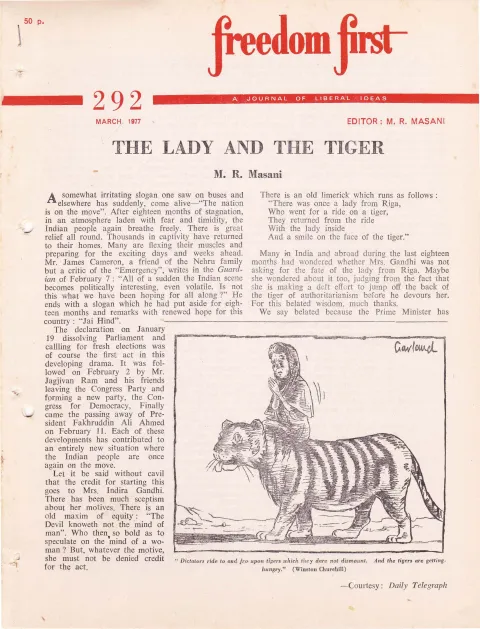
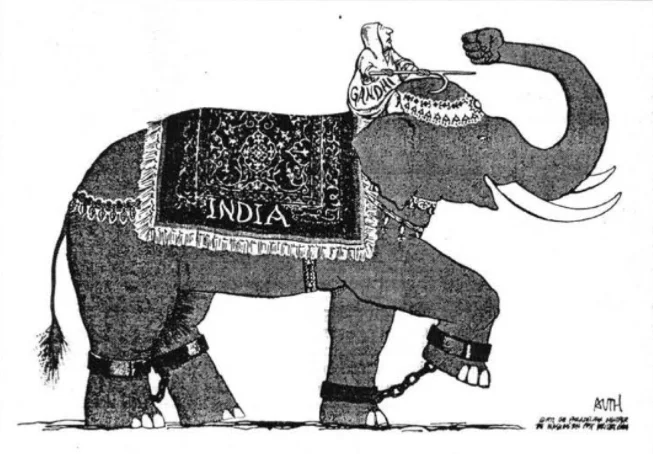
periodical issue
Freedom First
A Journal of Liberal Ideas
By M. R. Masani, Nitin G. Raut, M. R. Masani, A Media Man, S. S. Bankeshwar
Published for Democratic Research Service by J. R. Patel, Associate Editor, Freedom First at 127, M. Gandhi Road, Bombay 400023 (Phone: 273914) and printed by him at Mohan Mudranalaya, Acme Estate, Sewri (East), Bombay 400015 · Bombay · 1977
16 pages
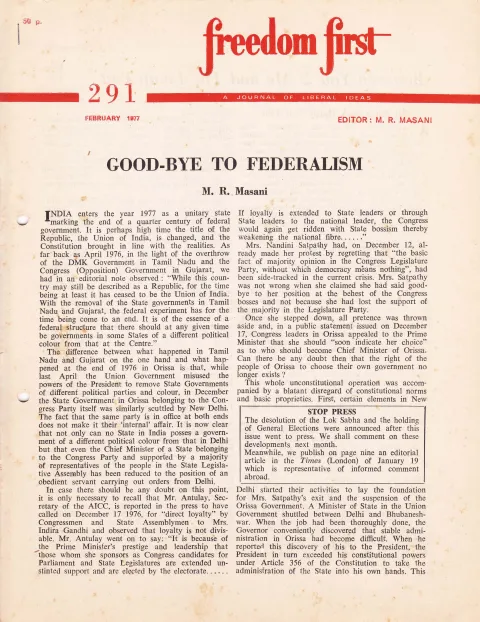
Freedom First
Summary
Issue 291 of Freedom First (February 1977) is a compact 16-page number of the Bombay-based liberal monthly, edited by M. R. Masani. The issue is dominated by the fallout of the Emergency-era dismissal of the Congress state government in Orissa, which the editor’s front-page piece “Good-bye to Federalism” treats as the final blow to India’s federal structure, alongside a boxed Stop Press note that the Lok Sabha had been dissolved and General Elections called just as the issue went to press. The regular “Between You & Me and The Lamp Post” column runs a set of short items on the Bukovsky-Corvalan prisoner exchange, Brezhnev’s cult of personality, the ‘rupee countries’ trade racket, and Ho Chi Minh’s Vietnam. Nitin G. Raut contributes a historical essay on the Lebanese civil war, and Masani reports as a delegate on the 41st International P.E.N. Congress in London. A reprinted Times of London editorial welcomes the announcement of Indian elections, and a two-page “World News” digest of wire and press clippings covers Cold War dissidents, Idi Amin and Bokassa, Trotskyist infiltration of the British Labour Party, and the Rhodesian conflict. The issue closes with readers’ letters, book reviews (of Mehra Masani’s broadcasting study and Ram Swarup’s Foundations of Maoism), a short piece questioning whether anti-communism is a mistake, and the recurring quotations page “With Many Voices.”
Key points
-
M. R. Masani’s “Good-Bye to Federalism” argues India effectively ceased to be a federal republic after the December 1976 removal of Nandini Satpathy’s Orissa government, quoting Ambedkar’s Constituent Assembly warning against over-centralising the Centre, with a Stop Press note announcing the Lok Sabha’s dissolution and General Elections.
-
The “Between You & Me and The Lamp Post” column celebrates Vladimir Bukovsky’s release in exchange for Chilean communist Luis Corvalan as a Soviet propaganda defeat, satirises the personality cult around Brezhnev’s 70th birthday, and accuses Ho Chi Minh’s Western sympathisers, including Nehru and Jayaprakash Narayan, of naivety about his Communist allegiance.
-
Nitin G. Raut’s essay on the Lebanese civil war traces the 1943 National Charter’s confessional power-sharing formula and its erosion, arguing Syria’s intervention serves pan-Arab strategy against Israel rather than protecting Lebanese Christians, and concluding the country is already de facto partitioned.
-
M. R. Masani reports as P.E.N. delegate on the 41st International P.E.N. Congress in London, covering Mario Vargas Llosa’s election as President, a resolution condemning the imprisonment of writers (including in India) opposed only by East German delegates, and Arthur Koestler’s protested keynote address.
-
A reprinted Times of London editorial welcomes Indira Gandhi’s announcement of March elections as a limited step back toward parliamentary democracy while doubting the Emergency’s censorship will genuinely relax, noting friction between Sanjay Gandhi’s anti-communist rhetoric and the government’s pro-Soviet posture.
-
A “World News” digest covers Jean-Bedel Bokassa’s self-coronation as Emperor of the Central African Empire, a Social Democratic Alliance dossier naming 33 Trotskyist-sympathising Labour MPs, and a Rhodesian guerrilla massacre of 26 black tea-estate workers.
-
Reader letters include Meanjin editor J. H. Davidson’s salute to Freedom First’s decision to cease publication rather than accept censorship, and K. S. Venkateswaran’s argument that the “bread versus freedom” framing used to justify constitutional amendments is a false dichotomy.
-
A review of Mehra Masani’s Broadcasting and the People calls for decentralising Indian radio via low-power local transmitters, while S. S. Bankeshwar reviews Ram Swarup’s Foundations of Maoism, endorsing its call for India to develop political-warfare and ideological counter-strategy against China rather than relying solely on territorial defence.
Essays
Good-Bye to Federalism
By M. R. Masani
M. R. Masani’s front-page editorial argues that with the removal of the Orissa state government by the Centre in December 1976, India has effectively ceased to be a federal republic. He traces a pattern from the April 1976 dismissals of the DMK government in Tamil Nadu and the Congress opposition government in Gujarat through to the Orissa case, arguing that even a Congress-affiliated Chief Minister with a legislative majority (Nandini Satpathy) could be removed at Delhi’s will. He quotes Ambedkar’s Constituent Assembly warning against over-centralising strength at the Centre, cites contemporary press commentary on the dangers of unitary rule in a large heterogeneous country, and closes by invoking the Constituent Assembly’s original consensus (naming Rajendra Prasad, Nehru, and Patel) that federalism was essential to Indian unity, warning that current developments may disrupt that unity over time. A Stop Press box notes that the Lok Sabha’s dissolution and the calling of General Elections were announced after the issue went to press.
- Argues India has become a unitary state in practice by early 1977, ending ‘a quarter century of federal government’
- Cites the precedent-setting removal of DMK (Tamil Nadu) and Congress-opposition (Gujarat) governments in April 1976
- Treats the December 1976 ouster of Nandini Satpathy’s Orissa government as proof that even Congress state governments answer to Delhi, not their legislatures
- Quotes B. R. Ambedkar’s Constituent Assembly caution against over-strengthening the Centre
- Cites a J. A. Naik Indian Express article arguing dictatorships last longer in smaller, homogeneous countries
- Frames the developments as a threat to the stability and unity of India, invoking the Constituent Assembly’s original design
- Notes via Stop Press that the Lok Sabha was dissolved and elections called after the issue went to press
Between You & Me and The Lamp Post
The recurring ‘Between You & Me and The Lamp Post’ column (unsigned, editorial voice) opens with a piece welcoming the release of Soviet dissident Vladimir Bukovsky in exchange for Chilean Communist leader Luis Corvalan, framing it as a moral defeat for Soviet propaganda that had long denied holding political prisoners; it continues the federalism editorial (page 2), then moves to short items: a wry account of the international committee protesting Bukovsky’s earlier mistreatment; a satirical piece, ‘Mr. Brezhnev, Beware,’ comparing Brezhnev’s birthday tributes to those once paid to Khrushchev before his fall, and to Stalinist-era title inflation (‘Vozhd’); an item welcoming the winding-down of the ‘rupee countries’ barter-trade racket with Eastern Europe; a piece, ‘Uncle Ho’s Tricks,’ arguing that Western sympathisers (including Jawaharlal Nehru and Jayaprakash Narayan, named as having been fooled) wrongly saw Ho Chi Minh as a nationalist rather than a communist, and denouncing Western anti-Vietnam-war protesters (naming Allen Ginsberg and Joan Baez) as naive about postwar Vietnamese repression; and a closing note on Amnesty International’s designation of 1977 as International Prisoners of Conscience Year, plus a lighter item, ‘A Strange Bureaucrat,’ about a West German civil servant who sued for being paid to do nothing.
- Celebrates Vladimir Bukovsky’s release from Soviet custody in exchange for Chilean communist Luis Corvalan as a propaganda defeat for the USSR
- Mocks the Soviet leadership’s own admission, via the exchange, that it holds political prisoners
- Satirises the personality cult around Brezhnev’s 70th birthday, drawing a parallel to the similar tributes paid to Khrushchev before his fall and to Stalin-era honorifics
- Welcomes the apparent decline of the ‘rupee sources’/barter trade racket with Hungary and other East European states, referencing the editor’s own past parliamentary criticism of it
- Accuses Ho Chi Minh’s Western sympathisers, including named Indian and American figures, of having been naive about his Communist allegiance
- Reports Amnesty International’s declaration of 1977 as International Prisoners of Conscience Year and a London Times petition signed by prominent figures
- Includes a light human-interest item about a West German bureaucrat suing over having no work to do
The Lebanese Crisis
By Nitin G. Raut
Nitin G. Raut’s essay traces the historical roots of the Lebanese civil war, situating the Christian-Muslim conflict within the broader framework of intra-Arab rivalries. He surveys the sectarian demographic balance since the 1920 French mandate, the 1943 National Charter’s confessional power-sharing formula, the erosion of that formula from the late 1950s as Nasserism and Ba’athism gained ground among Muslims, and the destabilising role of the PLO after its 1970 expulsion from Jordan. The essay analyses Syria’s intervention as driven by pan-Arab strategy against Israel rather than sectarian sympathy, and concludes that the country faces an effective partition with no resolution in sight short of further bloodshed, since neither side will accept the other’s core demands.
- Frames the Lebanese civil war as one flare-up within recurrent Christian-Moslem rivalry dating back to the Crusades and the 1860 Druze massacres of Christian Maronites
- Explains the 1943 National Charter’s confessional power-sharing (six Christians to five Moslems in the Chamber of Deputies) and its erosion by the late 1950s
- Details how the PLO, expelled from Jordan in 1970 by King Hussein, entrenched itself in southern Lebanon and exacerbated the sectarian balance
- Argues Syria’s intervention under President Assad serves pan-Arab strategic goals against Israel rather than protecting Lebanese Christians
- Concludes the country is already de facto partitioned and predicts continued bloodshed absent a genuine settlement
International P.E.N. Congress — A Report
By M. R. Masani
M. R. Masani’s report as official delegate of the P.E.N. All-India Centre covers the 41st International P.E.N. Congress held in London, August 23-28, 1976. He describes Executive Committee proceedings, the unanimous election of Mario Vargas Llosa as President, discussion of the Writers in Prison Committee’s report, and a controversy in which the South African Centre successfully defended itself against apartheid-collaboration charges. The report covers a contentious resolution (opposed only by East German delegates) condemning the imprisonment of writers across many named countries including India, a defection by East German Vice-President Stephen Hermlin from his own delegation’s position, a dispute over holding a Writers-in-Exile conference in Hamburg due to East German objections to keynote speaker George Mikes, and closes with a summary of Arthur Koestler’s non-political keynote address, which East German delegates nonetheless protested.
- Reports the unanimous election of Mario Vargas Llosa as PEN International President in absentia
- Describes the Writers in Prison Committee’s discussion and a resolution condemning imprisonment of writers in numerous countries, including India, carried against only East German opposition
- Highlights East German PEN Vice-President Stephen Hermlin’s public break from his delegation to support the resolution, met with applause
- Recounts the South African PEN Centre’s successful rebuttal, via Gerald Gordon Q.C., of apartheid-collaboration charges
- Covers the dispute over East German objections to a planned Hamburg Writers-in-Exile conference over keynote speaker George Mikes
- Notes Arthur Koestler delivered the non-political keynote address, which East German delegates protested anyway, terming him a ‘notorious cold warrior’
Essay 5
A reprinted Times of London editorial (January 19, 1977), also flagged in the Stop Press box on page one as representative of informed comment abroad, welcomes the announcement of Indian elections in March as a step to restore Mrs. Gandhi’s government’s legitimacy after the Emergency, while expressing skepticism about how genuinely the Emergency’s censorship and repression will be relaxed. It cites internal Congress tension over Sanjay Gandhi’s anti-communist positioning, the banning of political debate in the Indian press, and questions whether the government’s claims of Emergency-era achievement (curbing inflation, stabilising prices) reflect reality.
- Welcomes Mrs. Gandhi’s announcement of March elections as a step, though a limited one, back toward parliamentary democracy
- Expresses doubt about the promised relaxation of Emergency censorship given the Indian press’s continued inability to report on internal Congress political conflict
- Notes friction between Sanjay Gandhi’s anti-communist, right-leaning rhetoric and the government’s pro-Soviet posture
- Questions whether Emergency claims of economic improvement for the masses are borne out
- Frames the opposition parties’ unity, including the Jan Sangh, as significant given its larger northern Indian mass base
World News
The ‘World News’ section reprints short wire-service and press items on international affairs: President-elect Carter’s pledge of full NATO support relayed via Kissinger; imprisoned Yugoslav dissident Mihajlo Mihajlov’s hunger strike; Jean-Bedel Bokassa’s self-proclamation as Emperor of the Central African Empire; dissident writer Andrei Amalrik’s first U.S. visit and meeting invitation to Carter; a Social Democratic Alliance dossier alleging 33 Trotskyist-sympathising Labour MPs and criticising the Labour Party’s National Executive Committee for tolerating totalitarian entryism; British envoy Ivor Richard’s tense negotiating session with Ian Smith over Rhodesia; a Rhodesian guerrilla massacre of 26 black tea-estate workers; and Henry Miller’s report on black Rhodesians’ fears of factional violence under a future ‘Zimbabwe.’
- Carter pledges full US support for NATO in a message delivered by Kissinger to alliance foreign ministers
- Mihajlo Mihajlov, imprisoned Yugoslav dissident, goes on total hunger strike over lack of political-prisoner rights
- Jean-Bedel Bokassa crowns himself Emperor of the Central African Empire, having converted to Islam
- Andrei Amalrik makes his first US public appearance and offers Carter a chance to meet him to ‘rehabilitate the presidency’
- SDA dossier names 33 Labour MPs it says have shown sympathy to Trotskyist entryism, criticising NEC figures including Ron Hayward for associating with totalitarian regimes
- British negotiator Ivor Richard has a tense session with Ian Smith over a Rhodesian interim settlement; guerrillas massacre 26 black tea-estate workers
- Henry Miller reports fear among Rhodesian blacks of future factional violence under black rule
Essay 7
The Letters page carries four reader/correspondent contributions: a warm note from J. H. Davidson, editor of the Australian journal Meanjin, saluting Freedom First’s decision to cease publication rather than accept censorship, and announcing Meanjin’s intention to reprint the ‘offending’ editorial that triggered the closure; a letter from R. R. Patil disputing Dr. F. P. Antia’s earlier pro-euthanasia letter on religious and medical grounds; and a letter from K. S. Venkateswaran praising a recent Freedom First editorial (‘Bread or Freedom?’) and arguing that the ‘bread versus freedom’ framing used to justify constitutional amendments is a false dichotomy, since both are indispensable to human survival and progress.
- J. H. Davidson of Meanjin (Australia) salutes Freedom First’s closure decision as a matter of principle and announces plans to reprint its final controversial editorial
- R. R. Patil argues against euthanasia on religious (‘a human being comes into the world alone and goes alone’) and medical-research grounds
- K. S. Venkateswaran praises the editorial ‘Bread or Freedom?’ and argues the bread-versus-freedom framing used to justify constitutional amendments is a false choice
- The letters reflect on themes of press freedom (Meanjin/Quest) and constitutional rights debates connected to the Emergency era
Review: Broadcasting and the People (Mehra Masani)
By A Media Man
A review, bylined ‘A Media Man,’ of Mehra Masani’s Broadcasting and the People (National Book Trust, 1976). The reviewer praises the book as the most knowledgeable and stimulating study of Indian broadcasting to date, noting Mehra Masani’s personal irony as a former Deputy Director General of All India Radio who might have led AIR had merit governed appointments. The review summarises her arguments for decentralising radio to serve local and rural needs via low-power transmitters rather than centralised programming, her critique of the government’s failure to separate didactic and entertainment broadcasting goals, her account of policy confusion over television’s role, and her argument that AIR’s credibility is eroded by its function as a government department rather than an independent public broadcaster.
- Praises Mehra Masani’s Broadcasting and the People as the most knowledgeable book yet on Indian broadcasting
- Notes the irony that Masani, a former Deputy Director General of AIR, was never made Director General despite deserving it on merit
- Summarises her call for a decentralised, local rural radio service using roughly 250 low-power medium-wave transmitters
- Reports her critique of AIR’s confused, under-examined role for television versus radio in education
- Details her argument that centralisation weakens specialised news coverage and that professionalism is stifled by AIR’s status as a government department
- Notes the book was completed before the Emergency but the reviewer finds its arguments unaffected by ‘transient developments’
Review: Foundations of Maoism (Ram Swarup)
By S. S. Bankeshwar
A review by S. S. Bankeshwar of Ram Swarup’s Foundations of Maoism (Jyotina Prakashan, foreword by Gen. K. M. Cariappa). The reviewer praises the book as a rare in-depth study of Maoist ideology, tactics, and organisation, contrasting it favourably with shallow accounts by India’s ‘China experts.’ The review quotes Ram Swarup extensively on Maoism’s Marxist-Leninist-Stalinist character, its reliance on organised confession and psychological terror against intellectuals, its doctrine of aggression as indispensable to Chinese military culture, and its combination of external military threat with internal subversion. The reviewer endorses Ram Swarup’s call for India to develop political-warfare strategy and counter-ideology rather than relying solely on territorial defence against China.
- Praises Ram Swarup’s Foundations of Maoism as a uniquely deep study compared to superficial ‘China expert’ commentary
- Summarises Ram Swarup’s argument that Maoism is Marxist-Leninist-Stalinist in essence with only a Chinese ‘garb’
- Details the book’s account of organised confession, humiliation, and psychological subjugation of intellectuals under Maoism
- Describes Maoism’s doctrine linking military aggression abroad with subversion at home, per Mao’s own ‘ten against one’ formulation
- Endorses Ram Swarup’s call for India to develop political-warfare and ideological counter-strategy against China, not just territorial defence
- The review is followed by a short unsigned Economist reprint, ‘Is Anti-Communism a Mistake?’, questioning the case for abolishing the CIA
Is Anti-Communism a Mistake?
A short unsigned item reprinted from The Economist (December 18, 1976), ‘Is Anti-Communism a Mistake?’, challenges critics who denounce the CIA as a ‘new Gestapo,’ arguing that anti-communism cannot be dismissed as a crime given the realities of communist-dominated life, and citing an estimate by Mr. Cline that the communist bloc’s intelligence forces number as high as half a million people.
- Pushes back on critics who liken the CIA to a ‘new Gestapo’ and call for its abolition
- Argues anti-communism cannot reasonably be treated as morally equivalent to communism given communist-dominated life’s realities
- Cites an estimate (attributed to ‘Mr. Cline’) that the communist bloc’s intelligence forces number as many as half a million people
- Questions whether it serves anyone’s advantage but the communists for the US to operate internationally without adequate intelligence capacity
With Many Voices
The back-page ‘With Many Voices’ feature, a recurring collage of short quotations drawn from world press and public figures, opens with an epigraph from Tennyson and gathers items from Sri Lankan opposition leader J. R. Jayewardene, Egyptian President Anwar Sadat on Gaddafi, journalists and commentators (Times, Guardian, National Review, International Herald Tribune) on subjects ranging from Yugoslav dissent to Rhodesia to the Labour Party, and closes with a subscription form for Freedom First and the publication’s colophon naming J. R. Patel as Associate Editor and Democratic Research Service as publisher, with the printer’s imprint.
- Recurring quotations page collects short press excerpts from global sources under the Tennyson epigraph ‘Come, my friends, ‘Tis not too late to seek a newer world’
- Includes Anwar Sadat’s remark doubting Muammar Gaddafi’s sincerity, and J. R. Jayewardene’s reflection on the pleasures of political opposition
- Includes commentary from David T. Llewellyn (Times) on Marxist regimes’ record of concentration camps, censorship, and privileged new elites
- Carries the Freedom First subscription form (Rs. 5.00 annual) and the publication’s colophon: published for Democratic Research Service by J. R. Patel, Associate Editor, at 127 M. Gandhi Road, Bombay
Generated by the v1.5 extraction pipeline. Awaiting editorial review.
Metadata and summary are AI-extracted from the source PDF and reviewed for editorial accuracy. The original work is available via the Read PDF tab above (where present); paragraph-level citation inside the PDF is deferred to a future engagement.