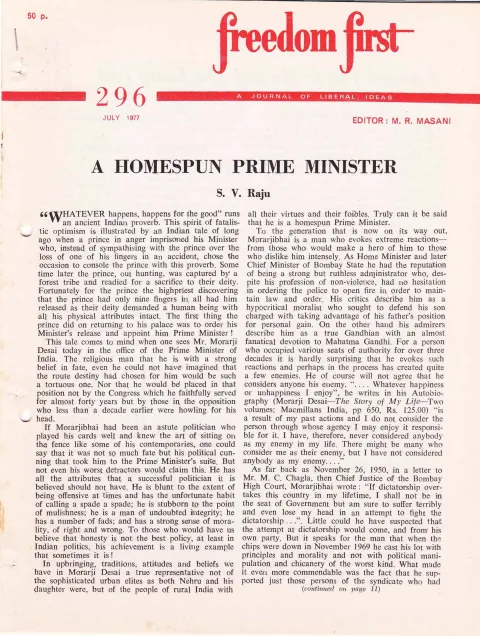
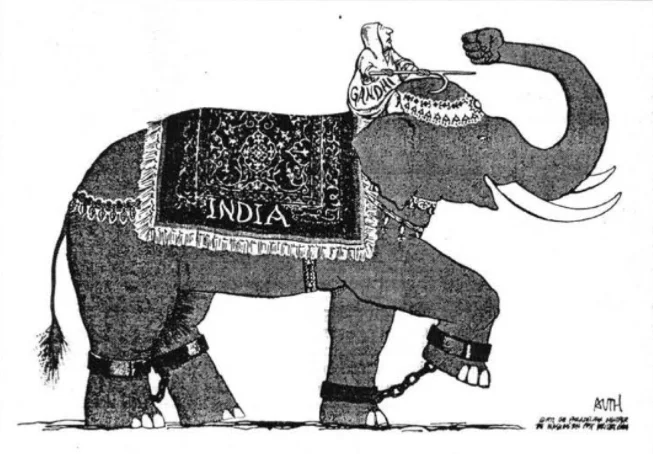
periodical issue
Freedom First
A Journal of Liberal Ideas
By S. V. Raju, M. R. Pai
Published for the Democratic Research Service by J. R. Patel, Associate Editor, Freedom First at 127, M. Gandhi Rd., Bombay 400 023 (Phone: 273914) and printed by him at States' People Press, Ghoga Street, Fort, Bombay-400 001. · Bombay · 1978
16 pages
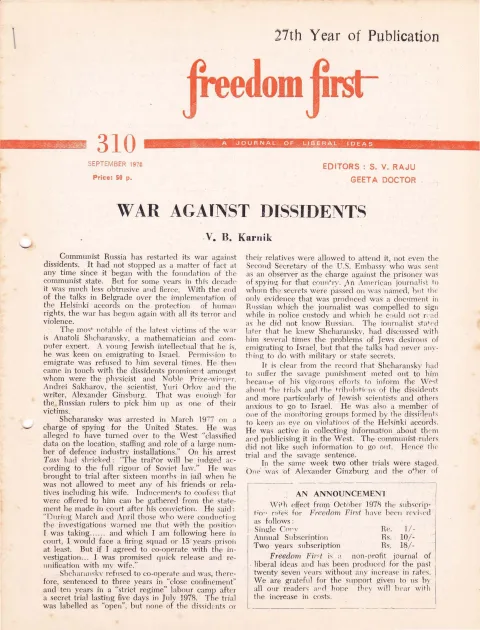
Freedom First
Summary
This is the September 1978 issue (No. 310, 27th year of publication) of Freedom First, the Bombay-based journal of liberal ideas edited by S. V. Raju and Geeta Doctor. The issue opens with V. B. Karnik’s account of renewed Soviet repression of dissidents (Shcharansky, Ginzburg, Orlov, Podrabinek) following the Belgrade review of the Helsinki accords, situating the persecution within the broader human-rights politics of the Cold War. The editorial column ‘Frankly Speaking’ comments on student unrest at Bombay University, the Korchnoi-Karpov chess championship as Cold War theatre, an Arunachal Pradesh anti-conversion bill criticised as illiberal, censorship of Irving Wallace’s The R Document during the Emergency, and lighter miscellany on animals and language policy. The centrepiece is Bernard Levin’s three-part extract on the Shah Commission’s findings on the Emergency, methodically documenting the fabricated grounds for its declaration, press censorship, propaganda use of state media, and illegal arrests and detentions under Indira Gandhi’s government. Other contributions include K. S. Venkateswaran’s anthology of legal wit and courtroom anecdotes; S. V. Raju’s exposé of the pay and perquisites enjoyed by Indian MPs (‘India’s New Princes’); Col. H. R. Pasricha’s polemic against prohibition, built around Samuel Butler and Aldous Huxley epigraphs; a film review of Des Pardes by Meenakshi Rao; four book reviews covering management, Arab-Israeli strategy, a critical study of Nehru’s China policy, and a novel about post-Independence India; M. R. Pai’s practical advice to telephone subscribers on fighting billing disputes; and the ‘With Many Voices’ page of press quotations on Indian and world politics of the day.
Key points
-
V. B. Karnik’s “War Against Dissidents” surveys renewed Soviet repression in 1978, detailing the fabricated espionage trial of Anatoli Shcharansky, the show trial of Helsinki-monitoring founder Yuri Orlov, and psychiatric abuse campaigns, predicting the dissident movement will survive despite state repression.
-
Bernard Levin’s three-part extract on the Shah Commission’s Emergency findings dismantles Indira Gandhi’s official justifications for the 1975 proclamation, documenting that arrests and press-suppression plans predated the declaration, that electricity was cut to newspaper offices to enforce censorship, and that detainees like Bhim Sen Sachar were jailed merely for writing an open letter.
-
The “Frankly Speaking” column condemns the Arunachal Pradesh Freedom of Indigenous Faith Bill as illiberal anti-Christian legislation and exposes Emergency-era Indian-edition censorship of passages in Irving Wallace’s novel The R Document referencing the Emergency itself.
-
K. S. Venkateswaran offers a light anthology of courtroom wit from British judicial history, while S. V. Raju’s “India’s New Princes” itemises Indian MPs’ pay and perquisites, totalling roughly Rs. 33,228 a year per member.
-
Col. H. R. Pasricha argues against prohibition as inherently corrupting to enforce and a “dictatorship” of one man’s moral preference imposed on the nation’s private habits.
-
Book reviews cover Yehoshafat Harkabi’s Arab Strategies and Israel’s Response, H. V. Kamath’s The Last Days of Jawaharlal Nehru, and Nayantara Sahgal’s novel A Situation in New Delhi.
-
M. R. Pai gives telephone subscribers practical advice for disputing inflated bills, urging citizens to assert their right to be served by, rather than serve, the Telephone Department.
-
Meenakshi Rao reviews the Hindi film Des Pardes, criticising Hindi cinema’s structural inability to reconcile serious social themes about illegal immigrants with its commercial conventions of music and melodrama.
Essays
War Against Dissidents
By V. B. Karnik
V. B. Karnik surveys a renewed Soviet campaign against dissidents in 1978, arguing that repression eased only briefly around the Belgrade talks reviewing the Helsinki accords before resuming with full force. He details the arrest and secret trial of Anatoli Shcharansky, a mathematician and computer expert who sought to emigrate to Israel and was linked to Sakharov, Orlov, and Ginzburg; his conviction for ‘spying’ rested on a document he could not read. The essay covers parallel trials of Alexander Ginzburg and Viktoras Pektus, the harassment of cellist Mstislav Rostropovich and singer Galina Vishnevskaya, the stripping of General Grigorenko’s citizenship, and the show trial of Dr. Yuri Orlov, founder of the Helsinki-monitoring groups, whom international observers including the Herald Tribune described as being prosecuted to ‘annihilate dissidence in the Soviet Union.’ The piece closes (in its continuation on page 12) by invoking Solzhenitsyn’s description of psychiatric incarceration as ‘a variation of the gas chamber’ and predicting that international human-rights pressure will sustain the dissident movement despite Soviet efforts to crush it.
- Documents the March 1977 arrest and 1978 secret trial of Anatoli Shcharansky on fabricated espionage charges tied to his advocacy for Jewish emigration and Helsinki-accord monitoring.
- Describes parallel trials of Alexander Ginzburg (linked to a Solzhenitsyn-administered fund for political prisoners) and Lithuanian Catholic/nationalist activist Viktoras Pektus.
- Notes harassment of prominent artists (Rostropovich, Vishnevskaya) and General Pyotr Grigorenko for supporting dissidents.
- Covers the prosecution of Dr. Yuri Orlov, founder of the Helsinki-monitoring groups, and international condemnation of his trial by Western governments and the press.
- Reports on Alexander Podrabinek’s campaign against Soviet psychiatric abuse of political prisoners and a London tribunal investigating the practice.
- Frames Soviet dissidents as spanning many social classes and predicts the movement’s survival despite state repression.
Frankly Speaking
The ‘Frankly Speaking’ editorial column runs several short unsigned/initialed pieces. ‘Romantic and Revolutionary’? criticises 150 students who seized Bombay University’s administration building over fee increases, arguing the fee protest was a cover for broader disruptive demands including scrapping exams and switching the medium of instruction to Marathi, and faults the Vice-Chancellor and Chief Minister for tolerating the occupation. ‘Media Wars’ satirises global media coverage of the Korchnoi-Karpov world chess championship at Baguio as Cold War theatre, complete with claims of KGB-rigged chairs and hypnosis, and recounts a historical anecdote about a chess-playing automaton built by a rebel Russian noble to escape Catherine the Great’s court. ‘An Obnoxious Measure’ condemns the Arunachal Pradesh Freedom of Indigenous Faith Bill, 1978 as illiberal and anti-Christian legislation aimed at suppressing missionary conversion activity, arguing it targets ethnic estrangement in the northeast rather than addressing it. ‘The R Document Uncensored’ reveals that the Indian edition of Irving Wallace’s novel The R Document, serialized during the Emergency, had sentences censored that referenced the 1975 Emergency and suspension of civil liberties in India. Further short pieces in the continuation on page 8 include ‘It’s a Dog’s World After All’ (a light essay on national character and animal treatment), ‘A Stupid Decision’ (criticising Bombay University’s move to make English optional), ‘Sound Advice’ (on Vinoba Bhave’s advice to Mrs Gandhi), and ‘No More Preference’ (welcoming the withdrawal of price preference for public-sector undertakings).
- Criticises the student occupation of Bombay University’s administration building as agitation that outstripped the underlying fee-rise grievance.
- Uses the Korchnoi-Karpov chess championship at Baguio to satirise Cold War media sensationalism, with a historical digression on an 18th-century chess automaton built by a dissident Russian noble.
- Condemns the Arunachal Pradesh Freedom of Indigenous Faith Bill 1978 as illiberal, anti-Christian legislation targeting religious conversion.
- Exposes Indian-edition censorship of passages in Irving Wallace’s The R Document that referenced the 1975 Emergency.
- Criticises a Bombay University decision to make English an optional B.A. subject as harmful to students and English teachers alike.
- Notes Vinoba Bhave’s advice to Mrs Gandhi to renounce politics, with a critical aside about Bhave’s own conduct during the Emergency.
”Frightening, Yet Invaluable”
By Bernard Levin
Bernard Levin’s three extracted columns present a detailed reading of the Shah Commission’s findings on Indira Gandhi’s Emergency. The first extract dismantles the two claims in Mrs Gandhi’s letter to the President seeking the Emergency’s declaration: that internal disturbance posed an imminent threat to security, and that there was no time to consult the Cabinet. Levin quotes the Commission’s finding that economic and law-and-order indicators showed nothing alarming, and that plans to arrest opposition leaders and suppress newspapers were already under preparation before the Emergency was proclaimed, proving the official justification fraudulent. The second extract, ‘How Mrs Gandhi Gagged the Press by the Flick of a Switch,’ documents how the government cut electricity to newspaper offices to enforce a media blackout, imposed formal censorship policy explicitly designed to ‘keep the public in ignorance and instil fear,’ and used All India Radio and government film units to propagandize for the Congress Party and for Sanjay Gandhi personally. The third extract, ‘Jail Without Trial,’ details how detention orders were issued without valid grounds, sometimes backdated, and how detainees such as Bhim Sen Sachar were imprisoned for the ‘crime’ of writing an open letter, with the Commission concluding this constituted a totalitarian abuse of the law. Levin closes by praising the Indian electorate’s rejection of the 1977 election gamble as proof that Indians, offered a real choice between democracy and dictatorship, chose democracy.
- Refutes the two central justifications in Mrs Gandhi’s letter requesting Emergency proclamation, citing the Shah Commission’s finding that economic and law-and-order conditions were not alarming.
- Shows that arrests of opposition leaders and press suppression measures were being prepared before the Emergency was formally declared, undercutting the claim of urgency.
- Documents the shutting off of electricity to newspaper offices as an illegal means of enforcing censorship.
- Cites Commission evidence that state media (AIR, Films Division) were used to propagandize for the Congress Party and to build a personal image for Sanjay Gandhi.
- Details cases of detention without valid grounds, including the imprisonment of Bhim Sen Sachar and seven others solely for writing an open letter.
- Concludes that the Indian electorate’s 1977 rejection of authoritarianism vindicates democratic choice and should strengthen resolve against any future repetition.
Humour in Law
By K. S. Venkateswaran
K. S. Venkateswaran offers a light anthology of courtroom humour and legal wit from British judicial history, aiming to counter the notion that law and humour are incompatible. The piece recounts anecdotes involving Judge Greenberg’s sardonic exchanges with juries and defendants, Lord Darling’s cross-talk with counsel (including puns on Lyons Corner House and George Robey), Lord Bowen’s quip about judges’ ‘manifold defects,’ Lord Coleridge’s remark on musical taste, a solicitor’s overly candid telegram exchange with a client, and Lord Chief Justice O’Brien’s courtroom flirtations, closing with Robert Houdin’s account of an 18th-century chess-playing automaton operated by a legless Russian revolutionary.
- Argues that the Victorian and Edwardian legal profession produced a rich tradition of courtroom wit, contrary to popular assumptions about law’s dullness.
- Recounts several anecdotes of judges (Greenberg, Darling, Bowen, Coleridge, O’Brien) engaging in humour with juries, counsel, and witnesses.
- Notes a solicitor’s telegram exchange as an example of unexpectedly blunt communication in legal practice.
India’s New Princes
By S. V. Raju
S. V. Raju, prompted by a report of Enoch Powell opposing an MPs’ pay rise in the British House of Commons, examines the pay and perquisites of Indian Members of Parliament as detailed by a Lok Sabha publication and reported in India Today. He itemises salary, housing and secretarial allowances, session attendance pay, free air travel and rail passes, telephone facilities, subsidised accommodation, medical benefits, and a newly introduced pension scheme, totalling roughly Rs. 33,228 a year in direct and indirect benefits per MP, alongside a proliferating ‘privy pension’ cost to the exchequer. The essay closes by asking whether taxpayers should demand restraint from India’s ‘new princes’ as the next budget approaches.
- Contrasts Enoch Powell’s principled opposition to a British MPs’ pay rise with Indian MPs’ array of perquisites.
- Itemises Indian MPs’ salary, allowances, travel, telephone, accommodation, medical, and pension benefits based on Lok Sabha data reported by India Today.
- Estimates an MP’s annual value of pay and perquisites at roughly Rs. 33,228, excluding pension costs.
- Notes the pension scheme for MPs will cost the exchequer Rs. 30 lakhs in its first year, rising by Rs. 10 lakhs annually.
- Questions whether India’s legislators, dubbed ‘new princes,’ should show restraint given taxpayer funding of their benefits.
Musings on Prohibition
By Col. H. R. Pasricha (Retd.)
Col. H. R. Pasricha (Retd.) argues against prohibition, opening with epigraphs from Samuel Butler and Aldous Huxley on the entangled nature of virtue and vice, and on alcohol’s psychological function. He contends that enforced prohibition is unenforceable without rampant corruption, that it is a form of dictatorship for one man’s conception of virtue to be imposed on a nation’s private habits, and that Indian leaders who champion prohibition misunderstand both democracy and human nature.
- Uses Samuel Butler’s and Aldous Huxley’s writings on virtue, vice, and alcohol to frame an argument against prohibition.
- Argues that enforcement of prohibition is inherently corrupting because the implementing agency is already compromised.
- Frames state-imposed prohibition as a negation of democratic freedom and a dictatorship of personal moral preference.
- Criticises ‘Khaddar clad leaders’ for invoking spiritual heritage to justify prohibition while ignoring the authors’ actual arguments.
Film Review: Des Pardes—An Extravaganza of the Senses
By Meenakshi Rao
Meenakshi Rao reviews the Hindi film Des Pardes, describing it as a socially aware but ultimately conventional melodrama about illegal immigrants in the UK, centred on Sameer Sahni’s murder and his brother Dev Anand’s revenge. The review is critical of Hindi cinema’s inability to reconcile serious social themes with its flamboyant commercial conventions of music, romance, and spectacle, concluding that despite its flaws the film’s exuberant energy retains a certain charm.
- Summarises the plot of Des Pardes: a pub owner’s murder by criminals involved in an illegal immigrant racket, and his brother’s revenge.
- Criticises the film’s superficial treatment of the ‘plight of illegal immigrants’ theme, subordinated to melodrama and spectacle.
- Argues that popular Hindi cinema structurally cannot accommodate ‘the darker side of life’ due to its commercial and stylistic conventions.
- Concludes on a note of qualified affection for Hindi cinema’s ‘bubbling, irrepressible energy’ despite its artistic limitations.
Book Review
Four short book reviews appear on pages 13-14. An unsigned review (EDS) of William B. Given Jr.’s How to Manage People finds it commonsensical but derivative, cautioning that its North American perspective needs adaptation to the Indian business environment. Nitin G. Raut reviews Yehoshafat Harkabi’s Arab Strategies and Israel’s Response, summarising its ‘iceberg’ model of Arab policy toward Israel, in which shifting diplomatic tactics conceal an unchanged underlying commitment to Israel’s destruction. KVP reviews H. V. Kamath’s The Last Days of Jawaharlal Nehru, criticising it as a slim, padded collection of previously published articles that fails to substantiate its thesis that Nehru’s China policy blunders caused his death. K. S. Hebbar reviews Nayantara Sahgal’s novel A Situation in New Delhi, describing it as populated by indistinct, poorly motivated characters and criticising its vague treatment of a post-Independence ‘crisis’ centred on the death of a Shivraj-like leader figure.
- Reviews How to Manage People as useful but unoriginal, requiring adaptation from its American context to Indian business realities.
- Summarises Harkabi’s argument that Arab diplomatic ‘warming’ toward Israel is superficial, with the underlying national position still committed to Israel’s elimination.
- Criticises The Last Days of Jawaharlal Nehru as padded and insufficiently substantiated regarding Nehru’s China policy and death.
- Criticises A Situation in New Delhi for vague characterisation and an unclear central thesis about post-Independence political drift.
Tips for Telephone Subscribers
By M. R. Pai
M. R. Pai gives telephone subscribers practical advice for disputing inflated bills, recommending meticulous record-keeping of calls, retention of correspondence, cutting off STD access to remove one excuse for high bills, prompt payment while formally contesting excess charges, and, if necessary, resorting to a court of law, framing the effort as citizens asserting their right to be served rather than to serve the bureaucracy.
- Advises subscribers to keep detailed logs of every call made, including date, time, and person contacted.
- Recommends disconnecting STD facility to eliminate one excuse offered by the Telephone Department for high bills.
- Suggests paying only the average of the previous four quarters’ bills when an excessive bill arrives, with a written objection.
- Frames going to court as an expensive but sometimes necessary last resort against an obstinate Telephone Department.
- States the underlying democratic principle that the Department exists to serve subscribers, not vice versa.
With Many Voices
The ‘With Many Voices’ page collects short quotations from Indian and international newspapers and public figures on current events of mid-1978, including remarks by B. C. Cariappa, Charan Singh, Menachem Begin, Morarji Desai, Devraj Urs, Roy Wilkins, Karpoori Thakur, S. Nijalingappa, and press commentary from The Economist on comparisons between Sanjay Gandhi and Kanti Desai.
- Quotes B. C. Cariappa describing India as ‘a nation of a bunch of thugs’ pending proof of individual honesty.
- Includes Charan Singh’s remark that Gandhism and Nehruism ‘can’t be together.’
- Cites The Economist’s comparison of Kanti Desai to Sanjay Gandhi as a ‘second’ influential prime ministerial relative.
- Includes commentary from Motif on Morarji Desai’s governing style, likening it to a ‘modern-day Godman’ combined with Mughal ‘arrogance.’
Generated by the v1.5 extraction pipeline. Awaiting editorial review.
Metadata and summary are AI-extracted from the source PDF and reviewed for editorial accuracy. The original work is available via the Read PDF tab above (where present); paragraph-level citation inside the PDF is deferred to a future engagement.