periodical issue
Freedom First
A Journal of Liberal Ideas
By S. V. Raju
Published for the Democratic Research Service by J. R. Patel, Associate Editor, Freedom First at 127, Mahatma Gandhi Road, Bombay 400 023 (Phone: 273914) and printed by him at Commercial Printers & Stationers, 525 S. Bapat Marg, Dadar, Bombay-400 028 · Bombay · 1979
16 pages
Freedom First
Summary
This August 1979 issue of Freedom First (No. 321, 28th year of publication) opens with editor S. V. Raju’s editorial ‘Back to Square One’, a bleak assessment of the collapse of the Janata experiment and the return of India’s politics to instability after the Emergency interlude. The ‘Of Cabbages & Kings’ column (signed G.D.) takes up the politicisation of humanitarian aid and the breakdown of civic order and public services in Bombay. The issue’s reprinted pieces survey the wider world: Ross H. Munro’s Time dispatch profiles Sri Lanka’s turn from socialism to market liberalisation under President Jayawardene; P. M. Kamath analyses Richard Nixon’s portrayal of India and Indira Gandhi in his memoirs; Robin Gordon-Walker’s Topical Commentary piece covers the Vietnamese boat-people refugee crisis; and a World News page carries Guardian pieces on African civil wars and the Soviet bloc’s embrace of blue jeans. The book review section assesses Manohar Malgonkar’s The Men Who Killed Gandhi, two competing Garhwal Himalaya mountaineering books (Nilakantha and Of Gods and Glaciers), and a Jim Corbett anthology. The issue closes with the ‘With Many Voices’ page of topical quotations and the publication colophon.
Key points
-
S. V. Raju’s “Back to Square One” surveys the collapse of the Janata experiment, arguing its constituent parties never truly merged and have reverted to pre-Emergency squabbling, with either Morarji Desai or Charan Singh likely to head a fragile minority government dependent on Mrs Gandhi’s tacit support.
-
Geeta Doctor’s column questions whether humanitarian aid agencies can stay free of politics, citing a Western charity’s cut to Madras slum food aid after India’s 1974 nuclear test and UNICEF aid reportedly reaching Southern African guerrilla movements.
-
Ross H. Munro’s reprinted Time dispatch describes Sri Lanka’s rapid liberalisation under President Jayawardene since 1977, dismantling price controls and courting foreign investment, which rose thirteenfold, though at the cost of inflation near 17%.
-
P. M. Kamath analyses Richard Nixon’s memoirs, tracing Nixon’s lasting anti-Indian bias from his 1953 meeting with Nehru through the 1971 Bangladesh crisis, contrasted with his deep admiration for C. Rajagopalachari, whom he called “infinitely wise”.
-
Robin Gordon-Walker’s piece surveys the Vietnamese “boat people” crisis, describing Hanoi’s systematic expulsion of over a million ethnic Chinese and its lucrative gold-payment trafficking scheme, with as many as two-thirds of refugees estimated to die at sea.
-
A World News digest covers Africa’s roughly 40 wars since 1945 and the Soviet Union’s decision to license Levi Strauss and other Western firms to manufacture blue jeans domestically amid intense underground demand.
-
Muriel Wasi reviews Manohar Malgonkar’s The Men Who Killed Gandhi, finding it vivid but unduly sympathetic to Godse’s conspirators and comparatively unsympathetic to Gandhi.
-
Maj. Gen. E. D’Souza and Lorraine D’Souza review two competing Garhwal Himalaya mountaineering books and a Jim Corbett hunting anthology, the latter praising Corbett’s ethic of killing only proven man-eaters.
Essays
Back to Square One
By S. V. Raju
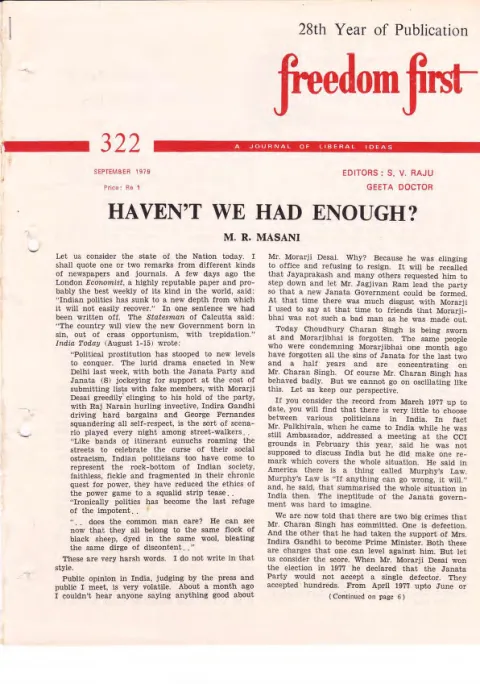
S. V. Raju’s editorial surveys the wreckage of the Janata Party’s two years in power, arguing that the parties that united to defeat Indira Gandhi in 1977 never integrated into a genuine single party and have now fractured into the same squabbling and power-broking that characterised Indian politics before the Emergency. He catalogues the hypocrisy of the Rajghat pledge, the casteist and communal habits persisting among ordinary Indians and politicians alike, and the emerging prospect that either Morarji Desai or Charan Singh will head a fragile minority government dependent on Mrs. Gandhi’s tacit support, with an early general election likely within six months.
- The Janata Party was a united front of convenience, not a genuine merger, and its parties are now reverting to old rivalries.
- Raju calls the political mood ‘back to square one’: the lessons of the Emergency appear to have been forgotten.
- Both possible successor governments (Desai or Charan Singh) would be minority governments dependent on unstable coalition support.
- An early general election is anticipated, possibly within six months.
- The piece questions whether voters have any real alternative given the discredited state of all major parties.
Of Cabbages & Kings (How Human is Humanitarian?; Betrayed by Whom?)
By G.D.
A two-part ‘Of Cabbages & Kings’ column signed G.D. The first item, ‘How Human is Humanitarian?’, questions whether international charities and aid agencies (Oxfam, Christian Aid, War on Want, UNICEF) can keep humanitarian relief free of political entanglement, citing a Western agency cutting food aid to Madras slum children after India’s 1974 nuclear test, and UNICEF aid reaching Southern African guerrilla movements; it closes by turning to relief efforts after a cyclone in Andhra Pradesh and urging systematic disaster-proofing over ad hoc aid. The second item, ‘Betrayed by Whom?’, uses a Bombay newspaper shutdown (from a printers’/unions’ dispute) as a springboard for a meditation on ordinary Indians’ sense of betrayal by politicians, arguing that citizens’ own petty prejudices, opportunism, and passivity (illustrated by an anecdote of an elderly woman jostled at a bus stop) mirror the very failings they accuse their leaders of.
- Charitable and humanitarian aid organisations struggle to keep their work free of political pressure and controversy.
- A Western charity cut food aid to Madras slum children after India’s nuclear test on the reasoning that a nuclear-capable country could feed its own poor.
- UNICEF was reported to have supplied aid to guerrilla movements including the Patriotic Front, SWAPO, PAC, and ANC in Southern Africa.
- Bombay’s newspaper industry was disrupted by a labour dispute, leaving the Times of India on indefinite holiday and the Free Press Journal’s office having burnt down.
- The column argues that Indians’ own casteism, communalism, and passivity mirror the failings they attribute to politicians, and that the ‘betrayal’ cuts both ways.
- It warns that if no credible, courageous political alternative emerges, the risk is a slide toward dictatorship, as in the Weimar Republic.
A Country on its Way Up
By Ross H. Munro
Ross H. Munro’s Time magazine dispatch (reprinted, dated June 25) describes Sri Lanka’s rapid turn away from decades of socialist planning under President J. R. Jayawardene’s government, which since 1977 has dismantled price controls, cut import duties and business taxes, reduced subsidised food distribution, and courted foreign investment (up thirteenfold), while establishing a free-trade zone near Colombo. The piece credits the reforms with reviving the economy but notes side effects: inflation near 17%, and civil-service bloat and social costs inherited from the earlier welfare state. It frames Sri Lanka as an extreme case of a global drift away from nationalisation and planning, alongside Britain, France, Peru, and Algeria.
- Sri Lanka under President Jayawardene has liberalised the economy since defeating Sirimavo Bandaranaike’s socialist government in 1977.
- Reforms include eliminating licenses and permits, cutting price controls, reducing import duties and business/export taxes, and privatising management of state corporations.
- Foreign investment rose to about $40 million a year, thirteen times the level under the previous government.
- A free-trade zone north of Colombo offers tax and duty exemptions to investors; garment factories are being set up partly due to the absence of US import quotas on Sri Lankan garments.
- Costs of the transition include inflation near 17% and continued unemployment despite high literacy and education levels.
- Two forthcoming tests of the reform program are cited: a $2 billion dam and reservoir project to fight unemployment, and the new free-trade zone’s success in attracting investment.
India in Nixon’s Memoirs
By P. M. Kamath
P. M. Kamath analyses how India is portrayed in Richard Nixon’s memoirs (RN: The Memoirs of Richard Nixon, 1978), arguing Nixon held a lasting anti-Indian bias rooted in his 1953 tour, when he found Jawaharlal Nehru the ‘least friendly leader’ he met and resented Nehru’s advocacy for the developing world. The essay traces this hostility through Nixon’s handling of the 1971 Bangladesh crisis, his assessment of Indira Gandhi as duplicitous while overlooking Yahya Khan’s brutality, his dispatch of the USS Enterprise task force into the Bay of Bengal to intimidate India, and his claim (quoting Kissinger) that the US had no real choice but to back Pakistan given China’s stakes in the relationship. Kamath contrasts this hostility with Nixon’s marked admiration for C. Rajagopalachari (Rajaji), whom Nixon calls ‘infinitely wise’ and records having spent a memorable afternoon with, discussing the atom bomb, communism, and predestination.
- Nixon’s memoirs describe Nehru as the ‘least friendly leader’ he met on his 1953 tour of Asia, criticising Nehru for positioning himself as a Third World spokesman.
- Nixon’s anti-Indian tilt intensified during the 1971 Bangladesh crisis, when he accused Indira Gandhi of duplicity while ignoring Yahya Khan’s suppression of human rights in East Pakistan.
- Nixon ordered a naval task force including the carrier USS Enterprise into the Bay of Bengal as a show of force against India during the war.
- Nixon’s China opening, facilitated in part through Pakistan, shaped his administration’s strategic tilt toward Pakistan over India.
- In contrast to his view of Indian leaders generally, Nixon expresses deep personal admiration for C. Rajagopalachari, calling him ‘infinitely wise’ and quoting Paul Hoffman’s description of him as ‘one of the world’s most gifted men.‘
Tragedy of the Boat People
By Robin Gordon-Walker
Robin Gordon-Walker’s Topical Commentary piece (No. 030/79) surveys the escalating Vietnamese ‘boat people’ refugee crisis of 1979, describing Hong Kong’s overwhelmed reception camps, the Vietnamese government’s systematic expulsion of its ethnic-Chinese population (over one million people) through job dismissals, business closures, and forced relocation to ‘New Economic Zones’, and the lucrative, state-organised trafficking of refugees for gold payments. It surveys the burden-sharing failures among wealthy nations, noting only China, the US, and France have taken substantial numbers, and reports on Margaret Thatcher’s push for a UN Special Conference on Indo-China refugees, welcomed by UN Secretary-General Kurt Waldheim.
- Vietnam is depicted as systematically driving out its ethnic-Chinese population of over one million through job dismissal, business closure (30,000 in Cholon alone), and threats.
- Refugees are charged roughly £1,500 in gold by the Vietnamese government to arrange departure, making the exodus a major foreign-exchange earner for Hanoi.
- As many as two-thirds of boat refugees are estimated to die at sea in overloaded, unseaworthy vessels.
- More than 200,000 refugees are also encamped in Thailand having fled fighting in Cambodia and Laos.
- Only a handful of countries — China, the US, and France — have absorbed the bulk of the roughly 553,000 Indo-Chinese refugees resettled since the Vietnam War’s end.
- Margaret Thatcher proposed a UN Special Conference on the refugee crisis on 31 May, a call welcomed by UN Secretary-General Kurt Waldheim.
World News (Africa’s Endless Strife; A Capitalist Craze in the Kremlin)
By Frank Barnaby, The Guardian / Hella Pick, The Guardian
A ‘World News’ digest reprinting two Guardian pieces. Frank Barnaby’s ‘Africa’s Endless Strife’ (June 18) analyses the continent’s roughly 40 wars since 1945 (of a global 125), mostly civil conflicts, and finds Africa’s military spending growing faster than any region except the Middle East, with the former colonial powers, the superpowers, and China all vying for regional influence. Hella Pick’s ‘A Capitalist Craze in the Kremlin’ (July 11) reports, with wry humor, on the Soviet Union’s decision to license Levi Strauss, Bluebell (Wranglers), and VF Corporation to help manufacture blue jeans domestically, driven by intense underground demand among Soviet youth, noting Hungary’s head start via a Levi Strauss partnership.
- An estimated 125 wars have been fought globally since 1945, with 40 of them in Africa, three-quarters of these being civil wars over regime control, tribal, religious, or minority issues.
- African military spending is rising faster than in any region except the Middle East, and per-capita military spending in Africa (
$30) exceeds that in Asia ($10) though it trails the Near East (~$350). - The former colonial powers (UK, France), the US, USSR, and China are all described as vying to strengthen influence in parts of Africa.
- The Soviet Union has decided to authorise domestic jeans production, inviting Levi Strauss, Bluebell (Wranglers), and VF Corporation to help manufacture them.
- Hungary was first among Communist-bloc countries to partner with Levi Strauss, producing jeans that are the focus of envy elsewhere in the bloc.
Book Review: The Men Who Killed Gandhi (Manohar Malgonkar); Nilakantha (Col. Narinder Kumar) and Of Gods and Glaciers (Lt. Col. M.M. Sharma); Jim Corbett’s India (selected by R.E. Hawkins)
By Muriel Wasi / Maj. Gen. E. D’Souza (Retd.) / Lorraine D’Souza
The Book Review section (pages 11-15) carries three reviews. Muriel Wasi reviews Manohar Malgonkar’s The Men Who Killed Gandhi (Macmillan, 1978), praising its vivid, readable narrative and access to surviving conspirators but faulting it for lacking historical depth and appearing, on balance, unduly sympathetic to Nathuram Godse and the conspirators, while being comparatively unsympathetic to Gandhi; she quotes extensively from the book’s account of the conspirators’ final hours. Maj. Gen. E. D’Souza reviews two competing Garhwal Himalaya mountaineering books, Col. Narinder Kumar’s Nilakantha and Lt. Col. M. M. Sharma’s Of Gods and Glaciers, preferring Kumar’s book as focused, gripping mountaineering narrative over Sharma’s, which he criticises for excessive religious digression and poor treatment of the NCC Girls’ expedition. Lorraine D’Souza reviews Jim Corbett’s India (stories selected by R. E. Hawkins, OUP), an anthology of Corbett’s hunting narratives, praising its vivid depiction of a vanishing India of forests and man-eating tigers and Corbett’s ethic of killing only proven man-eaters.
- Muriel Wasi finds Malgonkar’s The Men Who Killed Gandhi vivid and well-researched but lacking scholarly depth, and detects an unspoken sympathy for Godse’s ‘heroism’ alongside skepticism toward Gandhi’s stature.
- The review notes Malgonkar’s extensive, largely unquestioning interviews with surviving conspirators including Godse’s associates.
- Maj. Gen. D’Souza judges Narinder Kumar’s Nilakantha superior to Sharma’s Of Gods and Glaciers as pure mountaineering narrative, criticising the latter for excessive references to gods and religion at the expense of substantive coverage of the NCC Girls’ mountaineering team.
- D’Souza notes a factual dispute recorded in Nilakantha over who actually reached the peak’s summit (a panel concluded it was Sarin, O.P. Sharma, Phurba Lobsang and Lhakpa Lama, not team leader ‘Bull’ Kumar).
- Lorraine D’Souza’s review of Jim Corbett’s India frames Corbett as an ethical hunter who killed only confirmed man-eating tigers and leopards, distinguishing him from trophy hunters, and situates the anthology within contemporary wildlife-conservation concerns.
With Many Voices
The closing ‘With Many Voices’ page collects short topical quotations from Indian and international newspapers and public figures on the political and economic events of mid-1979, including remarks on Morarji Desai’s resignation, Skylab’s re-entry, British politics, and Bombay Dyeing’s export record, followed by a ‘To Our Readers’ note on the monsoon and Bombay’s ongoing power and coal shortages, and the issue’s publication colophon (published by J. R. Patel for the Democratic Research Service).
- The quotations page juxtaposes remarks from Indian politicians (A. R. Antulay, Raj Narain, C. M. Stephen, Priyaranjan Das Munshi) with international commentary from the Daily Telegraph, The Observer, and Time on the fall of Morarji Desai’s government.
- One quoted item, from Himmat (Neerja Chowdhury), marks Morarji Desai’s resignation as Prime Minister on 20 July 1979.
- The ‘To Our Readers’ note explains that Bombay’s chronic coal-to-power supply bottleneck (mined coal not reaching state-owned power stations via state-owned railways) has delayed the magazine’s production.
- The issue’s colophon records it as published for the Democratic Research Service by J. R. Patel, Associate Editor, at 127 Mahatma Gandhi Road, Bombay 400 023.
Generated by the v1.5 extraction pipeline. Awaiting editorial review.
Metadata and summary are AI-extracted from the source PDF and reviewed for editorial accuracy. The original work is available via the Read PDF tab above (where present); paragraph-level citation inside the PDF is deferred to a future engagement.