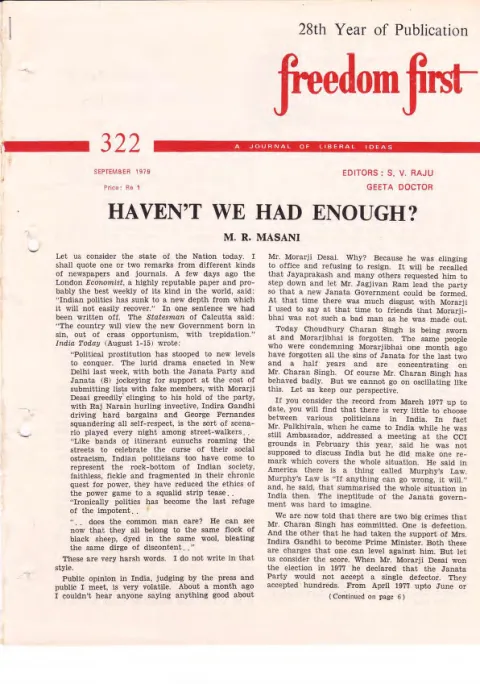
periodical issue
Freedom First
A Journal of Liberal Ideas
Edited by S. V. Raju
Published for the Democratic Research Service by J. R. Patel, Associate Editor, Freedom First at 127, Mahatma Gandhi Road, Bombay 400023 (Phone: 273914) and printed by him at Commercial Printers & Stationers, 525 S. Bapat Marg, Dadar Bombay-400 028. · Bombay · 1979
16 pages
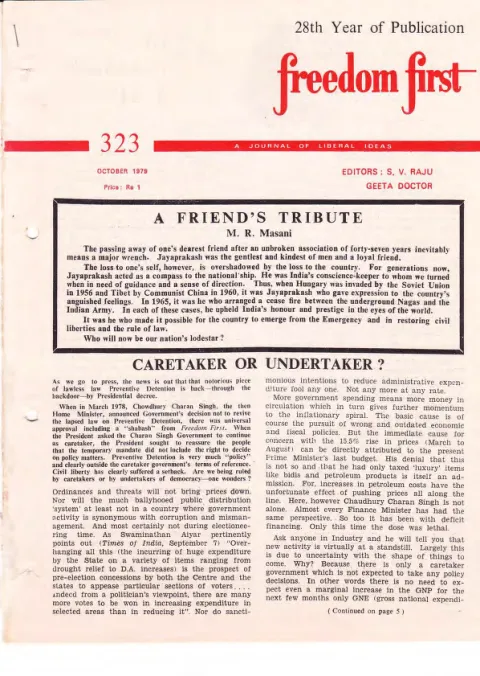
Freedom First
Summary
Freedom First No. 323 (October 1979, 28th Year of Publication), priced Re 1, edited by S. V. Raju and Geeta Doctor, opens with M. R. Masani’s tribute to the recently deceased Jayaprakash Narayan and an unsigned editorial, “Caretaker or Undertaker?”, attacking the Charan Singh caretaker government’s revival of Preventive Detention and its handling of inflation. The regular “Of Cabbages & Kings” column runs several short, satirical items on the Santa Cruz airport fire, the Lok Dal’s rhetoric, party-funding loopholes, film stars entering politics, and the government’s chronic public-sector losses. Feature articles cover neurologist William Gooddy on the dangers of cognitive decline (“brain failure”) in powerful public figures; a reflective personal account by Vrunda Moghe Dev of working with abandoned and adopted babies at a Bombay hospital; Khozema Mansure’s first-person account of volunteering after the Machhu Dam/Morvi flood disaster of August 1979; and a reprinted profile of Friedrich Hayek (“A Time for Vindication”) on his resurgent influence following Margaret Thatcher’s election and his Nobel Prize. A “World News” digest reprints pieces on Tibetan refugee testimony, Yugoslav President Tito’s estranged wife, and the informal private-plot economy sustaining Soviet agriculture. The issue closes with a book review of Ladislas Farago’s “Aftermath” on Martin Bormann, a Letters page (on the Panvel Avro air crash, Sri Lankan liberalism, and Vajpayee’s call to intellectuals), and the “With Many Voices” quotations column. The issue is fully rendered (all 16 pages of a 16-page issue).
Key points
-
M. R. Masani’s “A Friend’s Tribute” marks the death of Jayaprakash Narayan after a 47-year friendship, casting him as India’s “conscience-keeper” for speaking out on Hungary, Tibet, and the Naga ceasefire, and for his central role in ending the Emergency.
-
The unsigned lead editorial “Caretaker or Undertaker?” attacks the Charan Singh caretaker government for reviving Preventive Detention by presidential decree without a policy mandate, and blames deficit financing and loose monetary policy, not just oil prices, for a 15.5% price rise between March and August 1979.
-
The “Of Cabbages & Kings” column uses the Santa Cruz airport fire to argue Indian institutions are complacent about safety, dismisses the newly formed Lok Dal’s invocation of Gandhi as empty rebranding, and compares Indian film stars entering politics to Hitler’s mastery of image and mass media.
-
Neurologist William Gooddy’s “Brain Failure” argues that holders of the highest offices should face regular cognitive screening, citing Chamberlain negotiating with Hitler while suffering bowel cancer and the ailing leaders at the 1945 Yalta conference as historical warnings.
-
Vrunda Moghe Dev recounts visiting a Bombay hospital ward for abandoned babies, describing Indian adoptive families’ discriminatory preference for lighter-skinned children and the practice of sending unwanted infants abroad, chiefly to Sweden, for adoption.
-
Khozema Mansure gives a first-person account of travelling to Morvi after the 12 August 1979 Machhu Dam flood disaster, finding entry restricted to volunteers willing to remove mutilated corpses and praising RSS volunteers who undertook that work.
-
John M. Geddes profiles Friedrich Hayek’s resurgence following Margaret Thatcher’s public admiration and his 1974 Nobel Prize, summarising The Road to Serfdom and Hayek’s argument that Keynesian remedies for unemployment have failed.
-
A World News digest carries Tibetan refugee Tsultrim Tersey’s testimony of food rationing and forced sterilisations under Chinese rule, and an Economist piece noting nearly a third of Soviet food is grown on small private plots despite official ideological hostility to non-collective farming.
-
Maj. Gen. E. D’Souza reviews Ladislas Farago’s Aftermath: Martin Bormann and the Fourth Reich, summarising its thesis that Bormann survived the fall of Berlin to help Nazi exiles pursue a “Fourth Reich” in South America.
Essays
A Friend’s Tribute
By M. R. Masani
M. R. Masani’s tribute marks the death of Jayaprakash Narayan after a 47-year friendship, casting JP as India’s ‘conscience-keeper’ who spoke out over Hungary (1956), Tibet (1960), and the Naga ceasefire (1965), and who was instrumental in ending the Emergency and restoring civil liberties and the rule of law.
- Written as a personal tribute by M. R. Masani on Jayaprakash Narayan’s death.
- Frames JP as a moral compass for the nation across three decades of crises.
- Credits JP with brokering peace between the underground Nagas and the Indian Army in 1965.
- Credits JP with a central role in ending the Emergency and restoring the rule of law.
- Closes with a rhetorical question about who will now serve as the nation’s moral guide.
Caretaker or Undertaker?
No summary was extracted for this article. Listed for completeness.
Of Cabbages & Kings: Airport 1979
By GD
This unsigned lead editorial (continued from page 1 to page 5, likely by S. V. Raju given the ‘SVR’ signature on the continuation) criticizes the caretaker Charan Singh government for reviving Preventive Detention through presidential decree despite having no policy mandate, and argues that the government’s own fiscal mismanagement, not just external shocks, is driving the 15.5% price rise reported for March-August 1979.
- Attacks the caretaker government’s revival of Preventive Detention as an overreach of its limited mandate.
- Notes universal praise, including from Freedom First, when the law had earlier been allowed to lapse.
- Cites Swaminathan Aiyar (Times of India) on pre-election spending pressures distorting fiscal policy.
- Blames deficit financing and loose monetary policy, not just oil price rises, for inflation.
- Concludes elections are likely in early the new year but expects continued chaotic economic conditions until then.
There’s Plenty Where It Comes From
By SVR
The regular satirical column “Of Cabbages & Kings” (initialled variously GD and SVR) runs five short pieces: “Airport 1979” on the Santa Cruz airport fire and chronic mismanagement of Indian airports; “Words, Words, Words” mocking the Lok Dal’s invocation of Gandhi as empty rhetoric; “There’s Plenty Where It Comes From” on the futility of ordinances curbing black money in party funding; “Twentieth Century Soap Opera” on Indian film stars founding political parties, likened to Hitler’s mastery of image and mass media; and “A Hardy Annual” mocking the government’s yearly, toothless exhortations to public sector enterprises to improve performance.
- Airport 1979 (GD) uses the Santa Cruz airport fire to argue Indian institutions are complacent about basic safety standards.
- Words, Words, Words (SVR) dismisses the newly formed Lok Dal’s invocation of Gandhi as an empty rebranding by politicians who ‘betrayed the people’s faith’ after 1977.
- There’s Plenty Where It Comes From (SVR) argues ordinances against corporate funding of elections barely touch the much larger flow of black money to parties.
- Twentieth Century Soap Opera compares Indian film stars entering politics to Hitler’s pioneering use of film and image for political manipulation.
- A Hardy Annual mocks the government’s recurring, ineffectual calls for public sector enterprises to perform better.
A Hardy Annual
By SVR
No summary was extracted for this article. Listed for completeness.
Brain Failure
By William Gooddy M.D. FRCP
Neurologist William Gooddy writes on ‘brain failure’ — the cognitive and behavioural decline that can afflict powerful people in public life — cataloguing its symptoms (loss of concentration, poor judgement, personality change) and arguing that just as pilots and train drivers face mandatory fitness checks, holders of the highest offices (cabinet ministers, judges, legislators) should face regular, purely preventive medical/cognitive screening, since history offers repeated examples (Chamberlain’s cancer, the ailing leaders at Yalta) of critically ill men making momentous decisions.
- Defines ‘brain failure’ broadly, covering loss of concentration, judgement, insight, and personality changes.
- Argues brain failure is often concealed by patients themselves due to loss of insight, making external monitoring necessary for those in power.
- Cites Chamberlain negotiating with Hitler while suffering bowel cancer, and the ailing leaders (Churchill, Roosevelt, Stalin) at the 1945 Yalta conference, as historical warnings.
- Proposes CAT-scanning members of the Commons and instituting statutory retirement or mandatory medical surveillance for the powerful, modelled on professions like airline pilots and train drivers.
- Frames the goal as strictly preventive, not punitive, since many causes of brain failure are treatable or avoidable if caught early.
Essay 5
Vrunda Moghe Dev recounts her experience visiting a Bombay hospital’s ward for abandoned and orphaned babies, describing the mixed reactions of staff and patients, the naming and care of infants (often named after Hindu deities by a religious-minded matron), the discriminatory preference of Indian adoptive families for lighter-skinned, ‘unblemished’ children, and the emotional toll of sending healthy but unwanted infants abroad (chiefly to Sweden) for adoption.
- Describes a hospital ward for abandoned babies attached to a well-known Bombay women’s hospital.
- Notes Indian couples’ adoption preferences discriminate by skin tone and physical appearance, treating adoption ‘like choosing a dress in a shop.’
- Describes babies rejected by Indian families, including dark-skinned twins, being sent to Swedish adoptive families instead.
- Recounts letters from a Swedish adoptive mother describing the adopted Indian child, Prachi, thriving.
- Reflects on the emotional cost to hospital staff of repeated attachment and separation as babies arrive, are cared for, and leave for adoption.
Essay 6
Khozema Mansure gives a first-person account of travelling with a friend to Gujarat after the Machhu Dam collapse flooded Morvi on 12 August 1979, killing thousands. Finding on arrival at Rajkot that survivors had already been evacuated to transit camps and that only volunteers willing to help remove badly mutilated corpses were being allowed into Morvi, the author (unable to face that work) praises the RSS volunteers who undertook the grim task, and returns to Bombay work unresolved and shaken.
- Describes deciding, on impulse with a friend, to travel to Morvi after the 12 August 1979 Machhu Dam flood disaster.
- Notes entry to Morvi was restricted to those willing to help clear corpses, and the author found the physical/psychological task unbearable.
- Praises RSS volunteers as the ones engaged in the arduous corpse-removal work, calling it ‘humane and difficult.’
- Describes the disaster as a rare instance where abstract discussion of rural hardship became a concrete, immediate moral choice.
- Ends on an unresolved, guilty note on returning to ordinary office work in Bombay.
About Abandoned Children
By Vrunda Moghe Dev
John M. Geddes profiles Friedrich Hayek’s resurgence, noting Margaret Thatcher’s public admiration for him, his 1974 Nobel Prize (shared with Gunnar Myrdal), and quotes from Hayek on ‘The Road to Serfdom,’ his long unpopularity among fellow economists, his disputes with Keynes, and his continued argument that welfare-state economics and Keynesian remedies for unemployment have failed and made things worse.
- Notes Hayek, at 80, is ‘back in fashion’ with Margaret Thatcher as a prominent supporter of his views.
- Recounts Hayek’s biography: University of Vienna, Austrian Institute of Economic Science, LSE from 1931, University of Chicago, then Freiburg from 1972.
- Summarises ‘The Road to Serfdom’ (1944) as arguing that centralized planning leads to loss of freedom and eventual totalitarianism.
- Describes Keynes’s sympathetic but critical response to the book, and Hayek’s 1974 Nobel Prize shared with the socialist economist Gunnar Myrdal.
- Quotes Hayek arguing Keynesian remedies for unemployment have failed, leading to both inflation and unemployment rising together, and that trade unions and misused monetary policy — not capitalism — are responsible for current economic problems.
Morvi - A Personal Response
By Khozema Mansure
The ‘World News’ digest reprints three pieces: an account by Tibetan refugee Tsultrim Tersey (via Algernon Rumbold, President, Tibet Society of the United Kingdom, The Daily Telegraph) of hardship and repression witnessed on a visit to Lhasa; Michael Dobbs’s Guardian report on the reappearance of Tito’s estranged wife Jovanka after a two-year disappearance; and an Economist piece on how small private plots sustain a large share of Soviet food production despite decades of ideological hostility to non-collective farming.
- Tsultrim Tersey’s testimony describes food rationing, forced sterilizations, and suppression of Dalai Lama loyalty in Tibet under Chinese rule.
- The Tito item reports his estranged wife Jovanka reappeared publicly after nearly two years, with her disgrace’s cause still unexplained.
- The Soviet agriculture piece states nearly a third of Russia’s food is grown on small, privately tilled plots despite official ideological discomfort with the practice.
- Notes Brezhnev’s public acknowledgment that ‘ancillary farming’ plays a useful economic role despite communist ideology.
- All three items are reprints/credited to external outlets (Daily Telegraph, Guardian, Economist) rather than original Freedom First reporting.
A Time for Vindication
By John M. Geddes
Maj. Gen. E. D’Souza reviews Ladislas Farago’s ‘Aftermath: Martin Bormann and the Fourth Reich’ (Pan Books, 1976), summarising Farago’s thesis that Bormann survived the fall of Berlin and helped Nazi exiles in South America pursue a ‘Fourth Reich’ under an anti-communist banner, praising the book’s documentation while questioning whether Farago’s persistence stems from genuine conviction or personal obsession.
- Summarises Farago’s argument that Martin Bormann did not die in Berlin in 1945 as commonly believed.
- Notes Farago’s extensive research across multiple continents (Europe and South America) tracking Nazi fugitives.
- Recounts Holocaust atrocities described in the book as context for why hunting war criminals like Bormann mattered.
- Quotes Farago on the 25 years it took to bring Klaus Stangl to justice as illustrative of government reluctance to pursue Nazi war criminals.
- The reviewer praises the book as ‘compelling’ and ‘well worth reading’ while questioning the author’s underlying motives.
World News (Impressions of a Visitor to Tibet; Titos Missing Mrs. Gets an Airing; Peasant Proprietorship - Soviet Style)
The Letters page carries three items: a protest by four readers over the Panvel Avro air crash, criticizing government and airline indifference toward victims’ families; a letter from A. E. Gunawardena (President, Ceylonese Liberal Party) contrasting authoritarian rule in Sri Lanka under Mrs. Bandaranaike (1970-77) with India’s experience; and a letter from B. M. Baliga (reprinted from The Hindu) on Vajpayee’s call for intellectuals to enter politics, arguing the Janata government failed to honour intellectuals like Minoo Masani and Balraj Madhok during its own tenure.
- The Panvel Aircrash letter criticizes IAC and government officials for indifference to the AVRO crash victims, contrasting it with J.R.D. Tata’s personal response to an earlier Air India crash.
- A. E. Gunawardena’s letter argues Sri Lanka’s 1972 constitution undermined the sovereignty protections of the earlier Soulbury Constitution, enabling more authoritarian rule than contemporary India.
- B. M. Baliga’s letter (from The Hindu) faults the Janata Party for failing to give due place to intellectuals like Minoo Masani and Balraj Madhok despite Vajpayee’s later call for intellectuals to contest elections.
- All three letters engage with themes of governance accountability and the treatment of civil liberties/intellectual participation in politics.
Book Review: “Aftermath” Martin Borman and the Fourth Reich by Ladislas Farago
By Maj. Gen. E. D’Souza (Retd.)
The closing ‘With Many Voices’ page collects short quotations from various sources (N. A. Palkhivala, Daniel Moynihan, Hyman Rickover, Arun Shourie, and others) on bureaucracy, law, and politics in the US and India, framed by an epigraph from Tennyson, followed by the issue’s publication colophon naming J. R. Patel as printer/associate editor for the Democratic Research Service.
- Opens with a Tennyson epigraph (‘Tis not too late to seek a newer world’).
- Collects aphoristic quotations on bureaucracy and law, largely reprinted from Bhavan’s Journal, August 12 issue.
- Includes Arun Shourie’s quip (Indian Express) on politicians and ‘the law shall take its course.’
- Closes with the issue’s registration/colophon: published for the Democratic Research Service by J. R. Patel, Associate Editor, at 127 Mahatma Gandhi Road, Bombay.
Generated by the v1.5 extraction pipeline. Awaiting editorial review.
Metadata and summary are AI-extracted from the source PDF and reviewed for editorial accuracy. The original work is available via the Read PDF tab above (where present); paragraph-level citation inside the PDF is deferred to a future engagement.