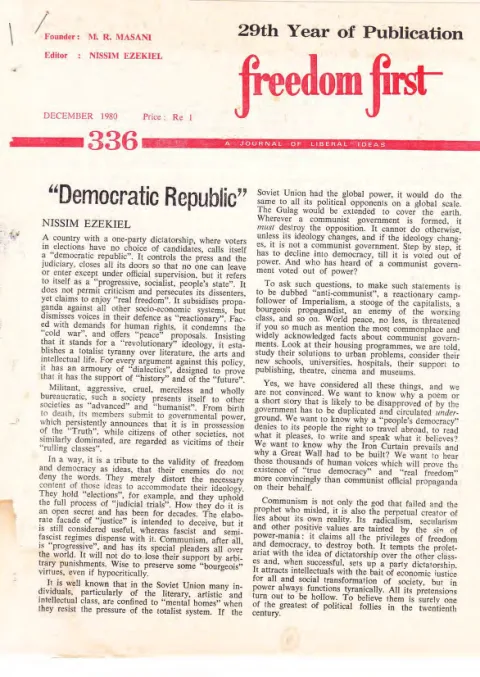
periodical issue
Freedom First
A Journal of Liberal Ideas
By S. V. Raju
Published for the Democratic Research Service by J. R. Patel, Associate Editor, Freedom First at 127, Mahatma Gandhi Road, Bombay 400 023 (Phone: 273914) and printed by him at Kaiser-E-Hind Publishers & Printers 300, Perin Nariman Street Bombay 400 001 · Bombay · 1980
16 pages
Freedom First
Summary
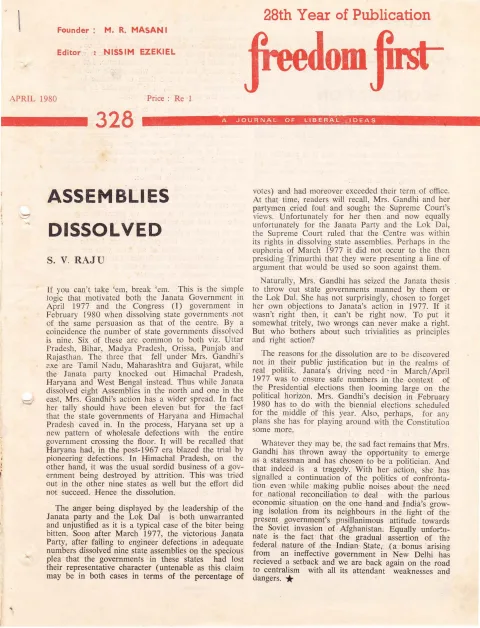
Freedom First No. 328 (April 1980), edited by Nissim Ezekiel and founded by M.R. Masani, opens with S. V. Raju’s editorial-style piece on the dissolution of nine state assemblies by both the Janata government (1977) and Mrs. Gandhi’s Congress (I) government (1980), arguing that Mrs. Gandhi has repeated the very abuse of power she once condemned. A separate blueprint from the Hindustani Andolan lays out conditions for national reconciliation across law and order, rising prices, family planning, and corruption. The issue’s regular ‘Voices’ column carries three short first-person pieces: Nissim Ezekiel on the failure of Indian intellectual and institutional life to translate ferment into real change; Preethi Biddapa on the global revival of Islam and its geopolitical stakes after the Iranian revolution and Soviet invasion of Afghanistan; and Shama Futehally’s critique of a Bombay junior-college English textbook for privileging moralising content over literary style. V. B. Karnik contributes a long analysis of the challenges facing Indian trade unions in the 1980s, urging a shift from confrontation to constructive, broad-based engagement with unorganised and rural labour. Geeta Doctor’s satirical column ‘Encounters of the Southern Kind’ recounts anecdotes about non-voting elites, iconic politics around Tamil Nadu’s former chief minister (MGR), and an absurd case of police overreach in Madras. The World of Books section reviews five titles: Jatindra Nath Mukherjee’s ‘Forward with Nature’ (reviewed by Laeeq Futehally), Sean Kelly’s ‘Access Denied: The Politics of Press Censorship’ (Sandhya Bordewekar), Jamila Verghese’s ‘Her Gold and Her Body’ on dowry (Lalita Chandrasekhar), Mario Miranda and Rajan Narayan’s ‘Elections Indian Style’ (Santan Rodrigues), and Jagjit Singh Anand’s ‘Indo-Soviet Relations: A More Glorious Future’, reviewed critically by ‘P.I.B.’ as one-sided Soviet apologia. The issue closes with a press statement from the Liberal International’s 104th Executive Committee meeting in Messina condemning the Soviet invasion of Afghanistan and the banishment of Andrei Sakharov.
Key points
-
S. V. Raju’s “Assemblies Dissolved” accuses Mrs. Gandhi’s Congress (I) government of repeating, in 1980, the same dissolution of nine opposition-ruled state assemblies that Janata had used against its opponents in 1977, exploiting a Supreme Court precedent Janata itself had set.
-
The Hindustani Andolan’s “Blue-Print for National Reconciliation” sets out preconditions for cross-party reconciliation, including depoliticised justice, decontrol of production, a non-partisan family-planning effort, and a crackdown on election-expense-driven corruption.
-
Three “Voices” pieces cover Nissim Ezekiel’s confession that decades of intellectual ferment have not translated into real institutional change, Preethi Biddapa’s survey of the global revival of Islam as a reaction to Western-linked modernisation, and Shama Futehally’s critique of a Bombay textbook that favours moralising content over literary merit.
-
V. B. Karnik’s “Our Trade Unions” urges Indian unions to abandon confrontational militancy for negotiation, coalition-building and outreach to unorganised and rural labour, citing the British Social Contract and US AFL-CIO accord as models.
-
Geeta Doctor’s satirical “Encounters of the Southern Kind” recounts Madras elites boasting of never voting, women reportedly given sarees to skip voting for outgoing chief minister MGR, and a servant boy wrongfully detained by police and released only after a bribe-like payment.
-
The World of Books section reviews five titles including Sean Kelly’s Access Denied on press censorship, Jamila Verghese’s Her Gold and Her Body on dowry, and Mario Miranda and Rajan Narayan’s cartoon book Elections Indian Style, alongside a sharp critique of Jagjit Singh Anand’s pro-Soviet Indo-Soviet Relations.
-
The issue closes with the Liberal International’s Messina statement condemning the Soviet occupation of Afghanistan and the internal exile of Andrei Sakharov as violations of the Helsinki Agreements.
Essays
Assemblies Dissolved
By S. V. RAJU
S. V. Raju argues that both the Janata government in 1977 and Mrs. Gandhi’s Congress (I) government in February 1980 dissolved state assemblies not of their own political persuasion, using nearly identical specious justifications. He notes the Supreme Court had upheld the Centre’s right to dissolve assemblies when Janata did so, a precedent Mrs. Gandhi has now exploited despite her own party’s objections in 1977. Raju calls this a tragedy of confrontational politics at a moment when India faces a fraught economic situation and diplomatic isolation over its muted response to the Soviet invasion of Afghanistan.
- Nine state assemblies were dissolved by Janata in 1977 and nine (effectively) by Congress (I) in 1980.
- The Supreme Court had ruled the Centre was within its rights to dissolve assemblies, a precedent set under Janata now used against them.
- Mrs. Gandhi is accused of hypocrisy for repeating an action she once condemned.
- The real motive is attributed to electoral timing (looming Presidential and biennial elections) rather than stated justifications.
- Raju frames the episode as a missed opportunity for statesmanship amid rising regional and international tension.
A Blue-Print for National Reconciliation
By Hindustani Andolan
An unsigned position paper from the Hindustani Andolan, addressed to all national political parties, sets out preconditions for genuine ‘national reconciliation’: agreement that democracy (however imperfect) is the best form of government; that democracy and human values are inseparable; that formal freedoms (speech, dissent, strike, franchise) do not by themselves create a free society without responsible exercise; and that checks and balances, a healthy opposition, and press freedom must be protected. It then addresses specific problems — law and order, rising prices, family planning, and corruption — calling for depoliticised administration of justice, decontrol of production, a national (non-partisan) family planning effort, and a crackdown on election-expense-driven corruption.
- Sets four foundational principles for national reconciliation, including that discipline and democracy cannot coexist as an excuse for authoritarian rule.
- Calls for political parties to stop interfering in the administration of justice and for judicial reforms.
- Attributes rising prices partly to bottlenecks, excessive controls/taxation, and the embedded cost of corruption in the price of goods.
- Argues family planning should be a national, non-partisan effort rather than a party program.
- Identifies election expenses (estimated Rs 400-500 crore in the last election) as a chief breeding ground of corruption, funded by black money from businessmen and industrialists.
- Warns that failure to act risks handing the country to a ‘mafia-like coalition of corrupt politicians, businessmen and industrialists.‘
Voices
Under the ‘Voices’ rubric, three brief first-person columns appear back to back. Nissim Ezekiel’s ‘A Sense of Failure’ argues that despite a lively ferment of ideas, study groups, journals and public debate in India, none of it has translated into real transformation of education, planning, science policy, housing, or urban reconstruction; he confesses to a sense of futility in his own decades of committee and seminar work. Preethi Biddapa’s ‘Revival of Islam’ surveys the global resurgence of Islam as a reaction to Western-associated modernisation, discusses Saudi Arabia, Egypt’s Sadat, the Iranian revolution and Khomeini, and argues the Soviet invasion of Afghanistan was partly enabled by this Islamic resurgence, closing with a call for a moderate Islamic ‘modus vivendi’ among Third World nations bordering the Indian Ocean. Shama Futehally’s ‘The English Textbook’ critiques a Bombay junior-college English syllabus for choosing extracts on the basis of moral and patriotic instruction (a Browning biography instead of Browning’s own poetry, a Nehru speech) rather than literary merit, arguing this fails to teach the ‘life-education’ proper literature provides.
- Ezekiel: ferment of ideas among the intelligentsia has not produced real change in education, planning, housing, or urban development over the last twenty years.
- Ezekiel warns against dogmatic and pseudo-ideological thinking that produces rules and committees adding up to nothing.
- Biddapa: Islam is the world’s second-largest religion (750 million adherents) and its revival is a reaction against disruptive, Western-linked industrialisation.
- Biddapa argues the Soviet invasion of Afghanistan was encouraged by the growing Islamic resurgence among Afghan mujahidin and the Iranian revolution.
- Biddapa calls Islamic revivalism part of a cyclical pattern common to religious traditions confronting modernisation, not unique to Islam.
- Futehally: a Bombay Std. XI/XII English textbook selects prose/poetry extracts for moral and patriotic content rather than literary style, undermining genuine literary education.
Our Trade Unions: Will They Face the Challenge of the Eighties?
By V. B. KARNIK
V. B. Karnik assesses the challenges Indian trade unions face in the 1980s: a slowing economy, rising unemployment, heavier taxation and deficit financing to fund development, and growing pressure on workers’ living standards. He argues unions face a strategic choice between confrontational militancy (which he considers self-defeating and liable to alienate public opinion) and a more prudent path of negotiation, coalition-building and widening their base to include unorganised urban and rural labour. Karnik urges unions to shift from purely monetary demands to long-term non-monetary ones (housing, education, pensions) and to take on a constructive, less combative role, criticising both government and employers for entrenching inter-union rivalry and calling for secret-ballot recognition of representative unions and legal reform of collective bargaining.
- A new decade poses more pressing versions of familiar challenges: slower growth, unemployment, taxation and deficit financing burdens.
- Unions face a dilemma between constant confrontation (heroic but self-defeating) and prudent negotiation-based strategy.
- Unions must extend organisation to unorganised urban workers and rural agricultural labourers to remain relevant and avoid being dismissed as a privileged class.
- Government has a dual, sometimes conflicting, role as employer and sovereign authority and should model good labour practice.
- Cites the British ‘Social Contract’ and the US AFL-CIO/government ‘National Accord’ as models India could adapt.
- Recommends secret ballot recognition of representative unions and legal provision for check-off and union shop to reduce inter-union rivalry.
Encounters of the Southern Kind
By Geeta Doctor
Geeta Doctor’s satirical column recounts two anecdotes from South India. In ‘How the South was Won,’ she describes upper- and middle-class Madras residents who proudly claim they never vote while a poor coolie’s wife reports that women were given sarees to stay home on election day rather than vote for the departing chief minister MGR (a former film star). In ‘Cops and Robbers,’ she recounts the absurdly oversized khaki shorts worn by Madras policemen and a farcical episode in which her uncle’s servant boy was wrongfully rounded up in a crime sweep and released only after a lawyer intervened and the family paid the police ‘sixty rupees for their kindliness.’
- Wealthy Madras elites boast of never voting even in India, while a matron credits her temple offerings, not her vote, for Indira’s win.
- Coolie wives report being given sarees instead of being encouraged to vote, ending their support for the former chief minister (MGR).
- Following the state assembly’s dissolution, the former chief minister was reported to be returning to his film career, to fans’ relief.
- Doctor mocks the exaggerated width of Madras policemen’s shorts as a running joke tied to rising theft rates.
- An anecdote describes a servant boy wrongly detained overnight by police and released only after a bribe-like payment of sixty rupees.
The World of Books
The World of Books section carries five reviews. Laeeq Futehally reviews Jatindra Nath Mukherjee’s ‘Forward with Nature,’ finding its case for tree farming and social forestry buried under an overambitious, breathless survey of global technology, energy and agricultural problems in just 112 pages. Sandhya Bordewekar reviews Sean Kelly’s ‘Access Denied: The Politics of Press Censorship,’ praising its detailed cataloguing of press-censorship methods (visa restrictions, harassment of correspondents, UNESCO’s shifting stance) while noting its American-centric bias. Lalita Chandrasekhar reviews Jamila Verghese’s ‘Her Gold and Her Body’ on the dowry system, calling it an eye-opener let down by an overly global, unfocused scope. Santan Rodrigues reviews Mario Miranda and Rajan Narayan’s cartoon book ‘Elections Indian Style,’ praising Miranda’s satirical caricatures of politicians like Devraj Urs, Y. B. Chavan and Mrs. Gandhi despite some repetitive effects. Finally, a reviewer signing as ‘P.I.B.’ sharply criticises Jagjit Singh Anand’s ‘Indo-Soviet Relations: A More Glorious Future’ as one-sided Soviet propaganda that ignores Soviet expansionism in Eastern Europe and the invasion of Afghanistan.
- Mukherjee’s ‘Forward with Nature’ is faulted for an unfocused, breathless survey that buries its genuinely useful tree-farming/social-forestry argument.
- Kelly’s ‘Access Denied’ is praised for detail on press censorship methods but critiqued for an America-centric viewpoint.
- Verghese’s ‘Her Gold and Her Body’ is praised as an eye-opener on dowry practices but critiqued for losing focus by covering ‘the whole world and all of time.’
- Miranda and Narayan’s ‘Elections Indian Style’ is praised for sharp political caricature (Devraj Urs, Y.B. Chavan, Mrs. Gandhi) though called repetitive at times.
- Anand’s ‘Indo-Soviet Relations’ is condemned as unbalanced Soviet apologia that omits Soviet invasions of Czechoslovakia, Poland, Hungary and, most recently, Afghanistan.
The Liberal International View
A short unsigned report, ‘The Liberal International View,’ summarises the press statement issued after the Liberal International’s 104th Executive Committee meeting in Messina, Sicily (26-27 January 1980). The statement expresses grave concern over the deterioration of East-West relations caused by the Soviet occupation of Afghanistan and the internal exile of Andrei Sakharov, condemning both as violations of international norms and the Helsinki Agreements, and calls for continued detente alongside firm Western resistance to further Soviet military intervention, while also noting the LI’s undecided position on an Olympic boycott.
- The Liberal International condemns the Soviet invasion of Afghanistan as a threat to regional security and a violation of peaceful international relations.
- It strongly condemns the banishment of Andrei Sakharov as a violation of the Helsinki Agreements and calls for his immediate release and reinstatement of civil rights.
- The LI had not yet reached a common position on boycotting the Moscow Olympics as of the meeting.
- The statement urges continued detente alongside firm resistance to further Soviet military intervention.
- It welcomes the upcoming EEC-ASEAN treaty (due 7 March 1980) as part of stabilising international relations.
Generated by the v1.5 extraction pipeline. Awaiting editorial review.
Metadata and summary are AI-extracted from the source PDF and reviewed for editorial accuracy. The original work is available via the Read PDF tab above (where present); paragraph-level citation inside the PDF is deferred to a future engagement.