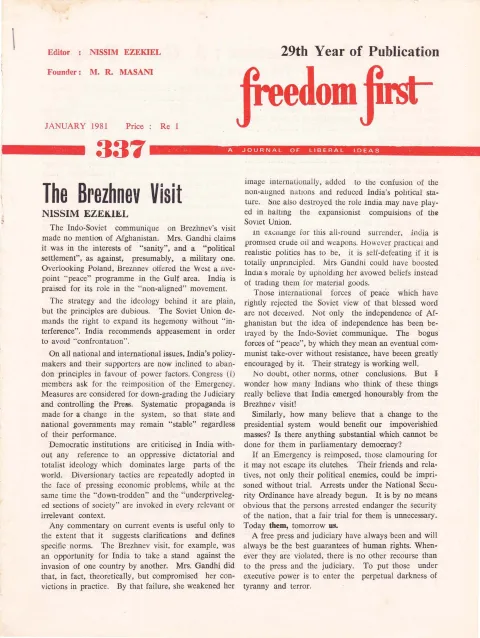
periodical issue
Freedom First
A Journal of Liberal Ideas
Published for the Democratic Research Service by J. R. Patel, Associate Editor, Freedom First at 127, Mahatma Gandhi Road, Bombay 400 023 (Phone: 273914) and printed by him at Kaiser-E-Hind Publishers & Printers 300, Perin Nariman Street, Bombay 400 001. · Bombay · 1980
16 pages
Freedom First
Summary
This is issue No. 336 of Freedom First (December 1980), a Bombay-based monthly journal of liberal ideas founded by M. R. Masani and edited by Nissim Ezekiel, published for the Democratic Research Service. The issue opens with Ezekiel’s own editorial denouncing the Soviet-style “democratic republic” as a totalitarian sham, followed by a two-part critique of Supreme Court Justice V. R. Krishna Iyer’s judicial rhetoric by K. S. Venkateswaran, an essay by Milovan Djilas on Eurocommunist confusion over the Soviet invasion of Afghanistan, an address by Cushrow Irani (as chairman of the International Press Institute) on press freedom versus government-controlled media, a short report on the founding of the JP Forum for Total Revolution, a Radical Humanist Association conference resolution criticizing both the Janata and Congress governments, three “Voices” reader columns (on xenophobia toward and by foreign visitors to India, on unaccounted foreign fund flows into Indian organisations, and on a Films Division documentary on public sanitation), several book reviews (on P. S. Jha’s political economy of Indian stagnation, Henry Scott Stokes’s biography of Yukio Mishima, Asghar Ali Engineer’s history of Islam, and a Nehru Memorial Museum symposium volume on Gandhi and Nehru), and a two-part feature on the chaos of Maharashtra’s college admissions process for I.C.S.E. students. The issue closes with commercial advertisements (Raymond suitings, Bombay Dyeing, Lakshmi Mills, Orient Fans, Jyoti Ltd., Silvicrete cement) and the printing colophon.
Key points
-
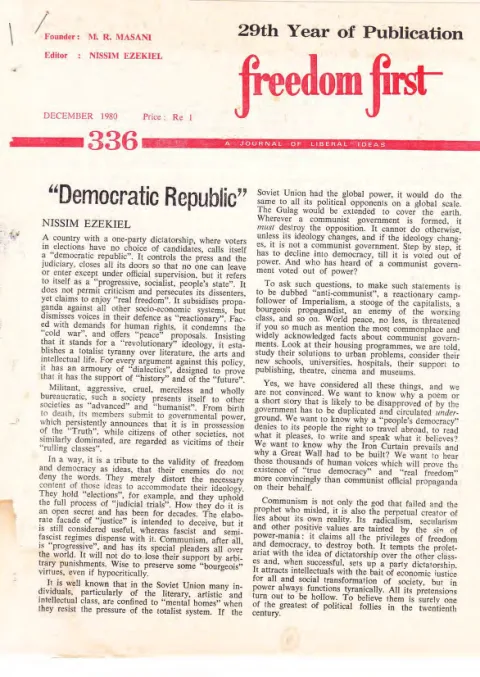
Nissim Ezekiel’s editorial “Democratic Republic” argues that one-party states appropriating the language of democracy suppress dissent and control press and judiciary to preserve their monopoly on “truth,” and that citing social achievements like housing and health does not answer the denial of basic civil liberties.
-
K. S. Venkateswaran’s two-part “Justice Krishna Iyer” accuses the recently retired Supreme Court judge of substituting florid rhetoric for judicial restraint, quoting H. M. Seervai’s charge that Iyer’s concept of the judicial function was “subversive” of the Constitution.
-
Milovan Djilas’s “Eurocommunist Delusions” criticises Enrico Berlinguer and Santiago Carrillo for equating the Soviet invasion of Afghanistan with alleged US misdeeds, and extends the critique to Yugoslav officials who, fearing Soviet reprisal, adopt a similarly evasive “non-aligned” framing.
-
Cushrow Irani’s UNESCO address, “Free Press Or Enslaved Press?”, argues against the MacBride Commission’s proposed “new information order” for wrongly linking press freedom to economic development and risking government control of journalism.
-
Short reports announce the founding of the JP Forum for Total Revolution at Rajghat, Varanasi, and a Radical Humanist Association resolution criticising both Janata and Congress governments for failing to solve poverty and warning against a drift toward presidential dictatorship.
-
Three “Voices” pieces cover a satire on shifting Indian attitudes to foreign visitors, a warning about opaque, poorly-regulated foreign fund flows into Indian associations, and a critique of a Films Division documentary that trivialises India’s sanitation crisis.
-
Book reviews cover P. S. Jha’s political economy of Indian stagnation, Henry Scott Stokes’s biography of Yukio Mishima, Asghar Ali Engineer’s history of Islam, and a Nehru Memorial Museum symposium volume comparing Gandhi and Nehru’s economic thought.
-
Two companion essays on “The Educational Mess” describe the bureaucratic ordeal facing Maharashtra parents reconciling the I.C.S.E. and state education boards, and criticise Indian universities as impersonal “graduate-producing factories” lacking a unifying purpose.
Essays
”Democratic Republic”
By NISSIM EZEKIEL
Nissim Ezekiel’s editorial “Democratic Republic” argues that one-party states which call themselves “democratic republics” or “people’s states” invert the meaning of freedom: they suppress dissent, control press and judiciary, and export their model coercively, as the Soviet Union does through the Gulag and its client states. He contends communism functions as a substitute religion whose radical and secular pretensions mask an underlying will to power, and that its apparent achievements in housing, health and education do not offset its denial of basic civil liberties such as free travel, speech and publication.
- One-party states appropriating the language of democracy (“democratic republic”, “people’s state”) systematically deny real political choice.
- Communist governments must suppress opposition because ideological legitimacy depends on maintaining a monopoly on ‘truth’ and ‘history’.
- Critics of communism are pre-emptively discredited as reactionary, imperialist stooges or capitalist propagandists.
- Citing social achievements (housing, health, education) does not answer the denial of civil liberties.
- Communism’s claims to secularism and radicalism are undercut by its own dependence on a cult of power.
Justice Krishna Iyer 1: Judge As Rhetorician / 2: Exercises in Demagogy
By K. S. VENKATESWARAN
K. S. Venkateswaran’s two-part piece “Justice Krishna Iyer” opens with “1: Judge As Rhetorician”, a critical reappraisal of the recently retired Supreme Court judge V. R. Krishna Iyer, accusing him of substituting florid rhetoric and ideological posturing for judicial restraint. The author cites Justice V. D. Tulzapurkar’s own on-the-bench remarks lamenting excessive judicial verbosity, and quotes critics, including H. M. Seervai, who called Iyer’s approach to the judicial function ‘subversive’ of the Constitution. Part 2, “Exercises in Demagogy”, argues Iyer’s exhortations for radical restructuring of the legal profession (breaking up the ‘status quo’ of costly legal services, disciplining the Bar into a new order) are naive, populist, and inconsistent with his professed admiration for the Soviet legal system, which the author contrasts unfavourably with the ‘intrinsic fairness’ of India’s Anglo-Saxon-derived jurisprudence.
- Justice Krishna Iyer is criticized as a ‘windbag’ whose judgments are cluttered with rhetorical flourish rather than plain legal reasoning.
- Fellow Justice V. D. Tulzapurkar publicly rebuked excessive judicial verbosity in terms read as aimed at Iyer.
- Constitutional expert H. M. Seervai called Iyer’s concept of the judicial function ‘subversive’ of the law and Constitution.
- Iyer’s 1972 Expert Committee report on legal aid (‘Processual Justice to the People’) is described as pompous and self-perpetuating rather than genuinely reformist.
- Iyer’s calls to dismantle the legal profession’s ‘status quo’ are called dangerously naive exercises in demagogy, drawing a parallel to Emergency-era rhetoric.
- The author contrasts Iyer’s admiration for Soviet jurisprudence with the comparative fairness of India’s inherited Anglo-Saxon legal system.
Eurocommunist Delusions / Yugoslav Errors
By MILOVAN DJILAS
Milovan Djilas’s essay “Eurocommunist Delusions”, reprinted from The New Leader, criticizes the muddled response of Italian and Spanish Eurocommunist leaders (Enrico Berlinguer and Santiago Carrillo) to the Soviet invasion of Afghanistan. Though they condemned the takeover, Djilas argues they equated Soviet aggression with alleged US misdeeds, a false symmetry rooted in residual Leninist thinking about a world divided into imperialist blocs. A companion section, “Yugoslav Errors”, extends the critique to Yugoslav Communist officials who, out of fear of provoking Moscow, similarly downplay the invasion and cling to a naive ‘non-aligned’ framing that blames both superpowers equally.
- Berlinguer and Carrillo condemned the Soviet ‘intervention’ in Afghanistan but still framed it as symmetrical with US actions and Cold War bloc rivalry.
- Djilas argues this false equivalence stems from residual Leninist categories the Eurocommunists have not fully discarded.
- The Yugoslav Communist Party’s leadership, fearing Soviet reprisal, adopts a similarly evasive ‘non-aligned’ framing that assigns blame evenly to both superpowers.
- Djilas contends Soviet expansionism (illustrated by the Afghan invasion) targets control of Middle Eastern oil and Indian Ocean access, not merely ideological solidarity.
- He calls for a militarily strong, united Europe capable of resisting Soviet expansion rather than pursuing illusory detente.
Free Press Or Enslaved Press?
By CUSHROW IRANI
Cushrow Irani’s address to the 21st General Conference of UNESCO in Belgrade, delivered as Chairman of the International Press Institute, argues against UNESCO’s expanding mandate over global communications policy (via the MacBride Commission report) on the grounds that it conflates human rights with levels of economic development and risks handing government’s more control over the press. He insists a free press, independent of and often at odds with government, is a basic human right not contingent on economic progress, and warns that UNESCO’s proposed International Programme for the Development of Communications would mainly benefit government-controlled propaganda machinery rather than genuine journalism, using his own country’s experience of press equipment restrictions as an example.
- Irani argues UNESCO’s MacBride Commission report wrongly links press freedom to economic development, a connection he says is unsupported by evidence.
- He distinguishes sharply between a free press working independently of government and a press functioning as a tool of state propaganda.
- He warns training and equipment initiatives proposed by UNESCO could as easily produce propagandists as trained journalists.
- He cites his own country’s press being denied modernised printing equipment while the government acquires computer systems for propaganda purposes.
- The International Press Institute commits to defending free press globally and improving journalistic conduct without accepting government control as the price of aid.
JP Forum For Total Revolution
A short unsigned report announces the founding of the JP Forum for Total Revolution, established on Jayaprakash Narayan’s 78th birthday by close associates to carry forward his idea of ‘total revolution’ (a synthesis of limited, responsive state power and organised, enlightened people’s power). The Forum, headquartered at Rajghat, Varanasi, aims to coordinate individuals and groups associated with JP’s work, interpret current events through his framework, and remain aloof from party politics; over a hundred sponsors are listed, including Minoo Masani and other prominent Gandhian and socialist figures.
- The JP Forum for Total Revolution was formed on Jayaprakash Narayan’s 78th birthday by his associates.
- It aims to translate JP’s ‘total revolution’ ideas into practice via a decentralised network rather than party politics.
- The Forum will interpret national and international events through the lens of JP’s thought.
- Its headquarters is at Rajghat, Varanasi, pending relocation to a more suitable site.
- Over 100 sponsors are named, including Minoo Masani, Hari Vishnu Kamath, and Brahmanand Mishra.
Conference Resolution: Radical Humanist Association
A conference resolution of the Radical Humanist Association (All-India Conference, Jaipur, 18-19 Oct 1980) surveys the failures of successive Indian governments — Congress, the Janata Party, and Indira Gandhi’s returned government — to solve poverty, unemployment, and inequality. It criticizes Mrs. Gandhi’s post-1980 return to power for reviving repressive measures reminiscent of the Emergency, including the National Security Ordinance and attempts to concentrate constitutional power, and warns of possible drift toward a presidential system that could degenerate into dictatorship. The resolution calls for decentralisation of political and economic power and active civic engagement rather than reliance on any single government.
- No Indian government since independence — Congress, Janata, or the restored Gandhi government — has solved poverty, unemployment or inequality.
- Mrs. Gandhi’s government is accused of reviving Emergency-style repression via laws like the National Security Ordinance.
- The resolution warns that a shift toward a presidential system risks degenerating into dictatorship, citing other Third World examples.
- The Association argues no government alone, and no single party, can solve India’s structural problems.
- It calls for decentralisation of political and economic power combined with active people’s power, echoing Jayaprakash Narayan’s formula.
Voices 1: A Touch Of Xenophobia
Geeta Doctor’s ‘Voices’ column “A Touch Of Xenophobia” is a satirical piece on the changing dynamics between foreign visitors and Indians — from the credulous, gift-bearing Peace Corps era to the disdainful, hygiene-obsessed backpackers of 1980, alongside newly arrived Islamic ‘rebels’ fleeing unrest in the Middle East. The essay mocks both the foreigners’ romanticised, condescending view of India (‘Culture Indica’) and Indians’ own eager self-abasement before foreign visitors, arguing that mutual admiration has curdled into mutual contempt.
- Contrasts the 1960s Peace Corps era, when foreigners were welcomed with wide-eyed hospitality, with 1980s backpacker tourists who openly disdain Indians.
- Satirises Western visitors who claim to love ‘Indian culture’ in the abstract while despising India and Indians in practice.
- Notes the emergence of a new class of visitor: Islamic rebels taking refuge in India from unrest in the Middle East.
- Criticises Indians’ own servility toward foreign visitors, citing an anecdote of priests giving tourists special treatment at a Jaipur temple.
- Frames the overall dynamic as one of mutual illusions collapsing into mutual contempt.
Voices 2: Foreign Fund Flows
By J. G. TIWARI
J. G. Tiwari’s ‘Voices’ column “Foreign Fund Flows” argues that the Indian government’s opacity about foreign money entering the country is dangerous given evidence of undisclosed, poorly regulated inflows. Citing a 1978 Home Ministry report that Rs. 297 crores in foreign contributions reached about 4,700 associations, the piece contends the 1976 law regulating foreign funds is toothless in practice, with no serious inspection of how organisations use the money, and flags clandestine channels including trade deals with Eastern Bloc states, embassy-funded publication work, and lavish embassy functions as likely conduits for funding political activity.
- Rs. 297 crores in foreign contributions reached roughly 4,700 associations in 1978 per Home Ministry figures.
- The 1976 law on foreign funds creates only an ‘illusion’ of regulation; inspections are perfunctory and unfollowed-up.
- Suspected clandestine channels include Soviet-bloc trade deals with Indian state trading agencies, publication work funded by foreign governments, and embassy functions.
- Then-Home Minister Y. B. Chavan had earlier acknowledged in Parliament that the flow of foreign money into India was a serious concern.
- The author calls for stronger legislative procedures to curb and track foreign money flowing into Indian political and civic life.
Voices 3: The Butt Of Ridicule
By SANDHYA BORDEWEKAR
Sandhya Bordewekar’s ‘Voices’ column “The Butt Of Ridicule” criticises a Films Division documentary on public sanitation and open defecation for trivialising a serious social issue into farce. Rather than sensitively addressing the absence of clean, private sanitation for millions of Indians, the film mocks a fictional office-goer’s frantic search for a urinal across Bombay, undermining the potential for the documentary to seriously engage the poor, slum-dwellers and working people whose testimony appears only briefly near the end.
- The reviewed Films Division documentary on ‘Evacuation’ addresses the lack of clean, private sanitation for millions of Indians.
- The film is criticised for treating a serious subject as slapstick comedy rather than analysis.
- A recurring fictional storyline follows a middle-class office-goer’s comic search for a urinal across Bombay.
- Brief, more serious interviews with sweepers, slum-dwellers and working people appear only near the film’s end.
- The reviewer argues the subject deserved a sensitive analysis of India’s sanitation crisis rather than ridicule.
The World Of Books: India: A Political Economy Of Stagnation (review of P. S. Jha)
By BRAHM PRAKASH
Brahm Prakash reviews P. S. Jha’s ‘India: A Political Economy of Stagnation’ (Oxford University Press, 1980), which attributes India’s 1966-78 economic stagnation to manipulation by an ‘intermediate class’ of market-oriented peasant proprietors, small manufacturers and traders who captured political power and the underground economy. The reviewer finds the book’s core argument — building on Kalecki’s concept of the intermediate class — persuasive and well-substantiated in Part II, but criticises Part I’s agricultural chapter as dated and Part III’s proposed alternative development strategy as incoherent and lacking a clear ideological or theoretical framework.
- Jha attributes India’s 1966-78 economic stagnation to capture of policy by an ‘intermediate class’ (peasant proprietors, small manufacturers, traders).
- The book builds on economist Michal Kalecki’s concept of the intermediate class controlling the economy through political and bureaucratic leverage.
- The reviewer finds Part II (the core thesis) well-substantiated with empirical detail.
- Part I’s agriculture chapter is criticised as outdated, reusing older material without updating for 1980.
- Part III, proposing alternative development approaches, is judged incoherent, rambling and lacking a clear ideological perspective.
The Life And Death Of Yukio Mishima (review of Henry Scott Stokes)
By RASHIDA GHADIALI
Rashida Ghadiali reviews Henry Scott Stokes’s ‘The Life And Death Of Yukio Mishima’ (Piper Books), which examines the Japanese novelist’s life and his 1970 ritual suicide (hara-kiri) after a failed coup attempt with his private militia, the Tatenokai. The review traces Mishima’s childhood under a domineering grandmother, his fascination with death, blood and violence, his wartime association with Japanese Romantic nationalists, and Stokes’s suggestion that Mishima’s suicide with his companion Morita was a ‘shinju’ (lovers’ suicide) reflecting a homosexual relationship, while judging the biography repetitive and lacking the precision a novelist might bring to such a complex figure.
- Mishima, author of 104 books, died by ritual suicide (hara-kiri) in 1970 after a failed coup attempt at a military base.
- Stokes traces the roots of Mishima’s fascination with death and violence to his childhood, dominated by his grandmother Natsuko.
- Mishima organised his own private army, the Tatenokai, viewed by the reviewer and contemporaries as one of his eccentricities.
- Stokes suggests Mishima’s suicide alongside Tatenokai leader Morita was a ‘shinju’ (lovers’ suicide), pointing to a homosexual relationship.
- The reviewer finds the biography’s achievement impressive but ultimately repetitive and lacking the precision of fictional characterisation.
The Origin And Development Of Islam (review of Asghar Ali Engineer)
By LAEEQ FUTEHALLY
Laeeq Futehally reviews Asghar Ali Engineer’s ‘The Origin And Development Of Islam’ (Orient Longman), praising the author, a Muslim scholar, for avoiding both an apologetic defensiveness about Islam and a mechanical Marxist reductionism, and for candidly examining how tribal social structures and property relations in pre-Islamic Mecca shaped the emergence of Koranic teachings on individual responsibility as against collectivism.
- Engineer’s book focuses strictly on the historical conditions and circumstances that shaped Islam’s emergence, not on Islamic culture broadly.
- The reviewer praises Engineer’s willingness to face unpalatable truths about his own faith’s history, a trait she finds rare among Muslim scholars.
- Engineer’s approach is neither defensively apologetic nor dogmatically Marxist, per his own stated method.
- The book situates the Koran’s individualist ethical teachings (personal responsibility for one’s own soul) against the backdrop of Meccan tribal collectivism.
- The reviewer, describing herself as a lay Muslim reader, finds the book full of insights that clarify standard beliefs she had struggled to reconcile.
Gandhi And Nehru (review of B. R. Nanda, P. C. Joshi, Raj Krishna)
By V. B. KARNIK
V. B. Karnik reviews ‘Gandhi And Nehru’ by B. R. Nanda, P. C. Joshi and Raj Krishna (Oxford University Press, 1979), a small volume drawn from a Nehru Memorial Museum symposium. The review summarises the contributors’ account of Gandhi and Nehru’s three-decade ‘working partnership’ despite real disagreements (over the Chauri Chaura aftermath, the Gandhi-Irwin Pact, separate electorates for untouchables, Quit India, and Partition), and highlights economist Raj Krishna’s argument that the two leaders’ economic differences were of degree and proportion rather than fundamentally opposed extremes.
- The book compiles simplified versions of talks from a Nehru Memorial Museum and Library symposium.
- Historian B. R. Nanda describes Gandhi and Nehru’s relationship as ‘a working partnership’ spanning about three decades.
- Specific documented disagreements include the 1922 Chauri Chaura aftermath, the 1931 Gandhi-Irwin Pact, the 1932 fast against separate electorates for untouchables, 1942 Quit India, and Partition.
- Economist Raj Krishna argues the two leaders’ economic policy differences were matters of proportion, not fundamentally opposed extremes.
- Raj Krishna attributes some failures of Indian planning to a failure to organise and mobilise the masses, a point the reviewer flags as important but undiscussed further.
The Educational Mess 1: College Admissions
By INDU SARAIYA
Indu Saraiya’s essay “An Experience And A Point Of View: 1: College Admissions” recounts the bureaucratic ordeal facing Maharashtra parents whose children, having passed the I.C.S.E. (rather than the state S.S.C.) exam, seek admission to junior college. She details the maze of eligibility certificates, migration certificates from Delhi, verification queues, and fees required to reconcile the state’s H.S.C. system with the I.C.S.E. system, portraying it as a demoralising bureaucratic ordeal for parents navigating overlapping, uncoordinated education boards.
- Maharashtra’s 10+2+3 education system creates conflict between the state S.S.C. board and the Delhi-based I.C.S.E. board for students entering junior college.
- I.C.S.E.-passed students require an Eligibility Certificate from the Maharashtra State Board and a Migration Certificate from the I.C.S.E. Board, both slow and bureaucratically fraught to obtain.
- The author vividly describes the queueing process at the Bombay Regional Office of the H.S.C. Board, including multiple fees and verification steps.
- Colleges further complicate matters by inconsistently accepting I.C.S.E. students, closing junior college sections, or redirecting suburban candidates.
- The essay closes on the parent, having secured a Temporary Eligibility Certificate, now facing the separate ordeal of junior college admission itself.
The Educational Mess 2: A Question Of Aims
By ANITA GUPTA
Anita Gupta’s companion essay “2: A Question Of Aims” broadens the education debate to ask what Indian higher education is actually for, arguing that universities have become impersonal ‘graduate-producing factories’ disconnected from a unifying sense of purpose or national culture. She criticises untrained, disengaged teachers, the English-medium/vernacular-medium divide, and the brain drain of talented Indians abroad, calling for renewed faith, quality control and a reconnection between education and community rooted in a sense of life’s meaning rather than mere job credentialing.
- Indian universities are criticised as impersonal ‘graduate-producing factories’ lacking a unifying purpose.
- The ‘planned drift’ of higher education policy is blamed for enabling mass production of under-qualified graduates.
- Teachers are criticised for entering the profession by default, without training or a shared intellectual tradition.
- The English-medium versus non-English-medium divide is cited as deepening confusion and polarisation at the college level.
- The essay calls for renewed ‘faith’, quality control, and a sense of purpose to link higher education back to community and national culture.
- It notes that talented Indians abroad remain willing to contribute to national development but receive little response from the Indian bureaucracy.
Generated by the v1.5 extraction pipeline. Awaiting editorial review.
Metadata and summary are AI-extracted from the source PDF and reviewed for editorial accuracy. The original work is available via the Read PDF tab above (where present); paragraph-level citation inside the PDF is deferred to a future engagement.