periodical issue
Freedom First
A Journal of Liberal Ideas
By Nissim Ezekiel, Pran Nath Lekhi, Edwina Baher, N. K. Ganapaiah, Mehra Masani, Nimmoo Kinger, Lina Mayadas, K. Balasubramaniyan, P. M. Kamath, (DR.) JOHN OLIVER PERRY, A Correspondent
Published for the Democratic Research Service by J. R. Patel, Associate Editor, Freedom First at 127, Mahatma Gandhi Road, Bombay 400023 (Phone: 273914) and printed by him at Kaiser-E-Hind Publishers & Printers 300, Perin Nariman Street, Bombay-400 001. · Bombay · 1981
16 pages
Freedom First
Summary
This issue of Freedom First (No. 337, January 1981) opens with editor Nissim Ezekiel’s editorial condemning the Indo-Soviet communique on Brezhnev’s December 1980 visit to India as a betrayal of principle, followed by Pran Nath Lekhi’s analysis of the ‘Brezhnev Doctrine’ as a strategic grand design masking Soviet expansionism in Afghanistan and the Persian Gulf. A news section covers M. R. Masani’s 75th birthday felicitation and Liberal International’s 1981 plans, then a report on the founding of the People’s Union of Civil Liberties (PUCL) at a contentious Delhi conference chaired by V. M. Tarkunde. Two reader-contributed ‘Voices’ pieces address the neglect of the cerebrally palsied (‘The Spastics’) and a rural-development action agenda. A substantial ‘World of Books’ review section covers five titles: M. Hidayatullah’s memoir My Own Boswell, an anthology Indian Verse by Young Poets, Jayana Sheth’s Munshi: Self-Sculptor, P. G. Mavalankar’s Emergency-era Parliament speeches No, Sir., and a piece on the Soviet bloc’s network of friendship treaties. The issue closes with P. M. Kamath’s analysis of the 1979-80 political crisis as a ‘de facto Presidential government’ in India, and a call for submissions of poetry written during the Emergency.
Key points
-
Nissim Ezekiel’s editorial “The Brezhnev Visit” condemns the Indo-Soviet communique following Brezhnev’s December 1980 visit for omitting any mention of Afghanistan, arguing Mrs. Gandhi traded India’s non-aligned credibility for Soviet oil and arms.
-
Pran Nath Lekhi’s “The Brezhnev Doctrine: A Grand Design?” traces Soviet doctrine from the 1968 justification of the Czechoslovakia invasion through the 1978 Soviet-Afghan Treaty to Brezhnev’s Persian Gulf “peace” proposal, questioning its selective application.
-
A report describes the founding of the People’s Union of Civil Liberties at a contentious Delhi conference chaired by V. M. Tarkunde, which passed resolutions against the National Security Ordinance and preventive detention.
-
Two “Voices” pieces cover the neglect of India’s cerebrally palsied population and an eight-point programme for rural development and decentralisation.
-
The World of Books reviews M. Hidayatullah’s reticent memoir My Own Boswell, an uneven poetry anthology, a study of K. M. Munshi, and P. G. Mavalankar’s Emergency-era Parliament speeches.
-
An analytical piece catalogues the USSR’s network of friendship treaties with Third World states from Egypt and India (1971) to South Yemen (1979), reading their “consultation” clauses as echoing Warsaw Pact obligations.
-
P. M. Kamath’s “De Facto Presidential Government in India” argues President Sanjiva Reddy’s handling of the July 1979-January 1980 political crisis, including Charan Singh’s unconfirmed caretaker premiership, amounted to an unaccountable de facto presidential system.
Essays
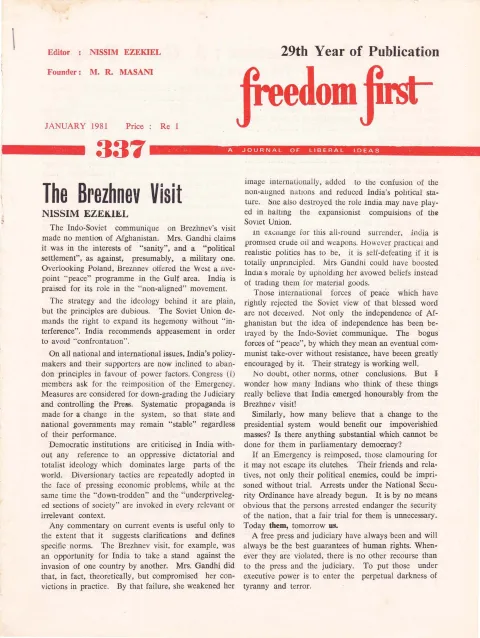
The Brezhnev Visit
By Nissim Ezekiel
Nissim Ezekiel’s editorial ‘The Brezhnev Visit’ argues that the Indo-Soviet communique following Brezhnev’s visit made no mention of Afghanistan and represented a capitulation of Indian principle to power politics. He contends Mrs. Gandhi traded India’s moral standing and non-aligned credibility for promises of crude oil and weapons, while at home Congress (I) members pushed for reimposition of the Emergency, curbs on the judiciary, and press controls. The piece closes by warning that a free press and judiciary are the only real guarantees of human rights.
- The Indo-Soviet communique omitted any reference to Afghanistan.
- Mrs. Gandhi framed her stance as ‘sanity’ and a ‘political settlement’ rather than principled opposition to invasion.
- India accepted Soviet arms and oil in what the author calls a self-defeating, unprincipled bargain.
- Domestic warning signs include calls to reimpose the Emergency and to curb the judiciary and the press.
- The National Security Ordinance is cited as already enabling arrests without trial.
The Brezhnev Doctrine: A Grand Design?
By Pran Nath Lekhi
Pran Nath Lekhi’s ‘The Brezhnev Doctrine: A Grand Design?’ traces the lineage of Soviet doctrine from the 1968 Brezhnev Doctrine (justifying the invasion of Czechoslovakia via the concept of ‘limited sovereignty’) through the 1978 Soviet-Afghan Treaty to Brezhnev’s five-point ‘peace’ proposal for the Persian Gulf delivered before the Indian Parliament. He raises pointed questions about why the principles apply selectively to Gulf states, why sea lanes are invoked without evident threat, and whether Russia would give up its own Indian Ocean bases. He concludes that Afghanistan was the first non-aligned nation invaded by Russia and that the new doctrine is inconsistent with genuine respect for sovereignty.
- Traces the Brezhnev Doctrine’s origin to Pravda’s 1968 justification of the Czechoslovakia invasion via ‘limited sovereignty’.
- Finds a dangerous similarity between the 1971 Indo-Soviet Treaty and the 1978 Soviet-Afghan Treaty’s ‘consultation’ clauses and the Warsaw Pact treaty.
- Lists Brezhnev’s five ‘peace’ principles for the Persian Gulf and raises six critical questions about their selectivity and sincerity.
- Notes the Soviet veto in the UN Security Council on the non-aligned resolution on Afghanistan as evidence of insincerity.
- Argues Afghanistan was the first non-aligned nation attacked by Russia, inviting the question of who actually ‘invited’ Soviet troops in.
s 1981 agenda, including a September Spoleto congress to adopt a new
A news brief reports the Rajaji Forum of Madras’s felicitation of M. R. Masani on his 75th birthday, with speeches by P. C. Satagopan and C. R. Narasimhan praising his role in the Swatantra Party (1959-1971) and his opposition to totalitarian and socialist trends in Congress. A companion item previews Liberal International’s 1981 agenda, including a September Spoleto congress to adopt a new ‘Liberal Appeal 1981’ document and spring seminars in Hong Kong and on US-Western European relations.
- M. R. Masani, Freedom First’s founder, was felicitated on his 75th birthday by the Rajaji Forum of Madras.
- Speakers credited Masani with resisting totalitarian trends in Congress and the ‘socialist myth’ via the Swatantra Party.
- Liberal International plans a September 1981 congress in Spoleto, Italy to adopt ‘Liberal Appeal 1981’, following the 1947 Manifesto and 1967 Declaration of Oxford.
- Liberal International also plans spring seminars in Hong Kong and on US-Western Europe relations.
The New Information Order: Threat to Freedom
An unsigned editorial piece, ‘The New Information Order: Threat to Freedom’, criticises UNESCO’s proposed ‘new information order’ as a UN-sanctioned justification for state censorship, framed against the backdrop of Mrs. Gandhi’s government pushing for such measures internationally while curbing press freedom domestically via the National Security Ordinance. The piece contrasts the 1948 Universal Declaration of Human Rights, adopted by a UN with a built-in democratic majority, against 1980’s UNESCO debates, now shaped by a bloc of dictatorships, and closes citing a Swiss Press Review analysis defending unconditional press freedom worldwide.
- UNESCO’s ‘new information order’ is criticised as prioritising what governments believe people ‘need’ over freedom of expression guaranteed by Article 19 of the Universal Declaration of Human Rights.
- Mrs. Gandhi’s government is cited as a leading advocate of the new order internationally, despite India’s own history of press suppression during the Emergency and continuing threats via the National Security Ordinance.
- Argues that today’s UN and UNESCO have a built-in majority of dictatorships compared to 1948’s democratic majority.
- Piece is reprinted or adapted from the Swiss Press Review, No. 21.
- Followed by a short unrelated item on the Statesman’s Rural Reporting awards given at Agra in December 1978, listing prize-winners including Rajnarayan Mishra of Desh Bandhu and Kishore Shah and Gobind Thukral of The Indian Express.
STATESMAN Awards For Rural Reporting
By A Correspondent
No summary was extracted for this article. Listed for completeness.
People’s Union of Civil Liberties
A report on the founding conference of the People’s Union of Civil Liberties (PUCL), held November 22-23, 1980 at the Aiwan-e-Ghalib and Gandhi Peace Foundation in Delhi. V. M. Tarkunde presided; Arun Shourie welcomed delegates and read messages from Acharya Kripalani, M. C. Chagla, and Nani Palkhivala. The session was disrupted when part of the audience heckled Congress (I) General Secretary Shyamsunder Mahapatra, preventing him from completing his speech, which he later publicly denounced as politically partisan. The conference adopted a constitution, elected Tarkunde as President and Arun Shourie as General Secretary, and passed resolutions against the National Security Ordinance and preventive detention, and in support of civil liberties in Assam, Bhagalpur (blindings), Narasempet, and for Kim Dae Jung and Nagabhushan Patnaik.
- PUCL founded at a two-day Delhi conference, November 22-23, 1980, chaired by V. M. Tarkunde.
- Political leaders who addressed the conference included Charan Singh, Y. B. Chavan, E. M. S. Namboodiripad, Bhupesh Gupta, Ram Jethmalani, and H. N. Bahuguna.
- A faction of the audience heckled Congress (I)‘s Shyamsunder Mahapatra, who was prevented from finishing his address; he later called the conference a partisan attack on the Prime Minister.
- V. M. Tarkunde elected President and Arun Shourie General Secretary for the organisation’s first term.
- Resolutions passed condemned the National Security Ordinance and preventive detention, and called for release of Kim Dae Jung and Nagabhushan Patnaik, and against police atrocities in Bhagalpur and Narasempet.
Voices-1: The Spastics
By Edwina Baher
Edwina Baher’s ‘Voices-1: The Spastics’ surveys the neglect of cerebrally palsied Indians, noting India’s estimated 8 million cerebral palsy cases and the fact that they were recognised as a disabled category by the government only in October 1980. The piece describes systemic failures in special education (only since 1973, via the Spastics Society of India), employment quotas that exclude the multiple-handicapped in practice, inadequate healthcare, and minimal state economic support, closing on the psychological toll of exclusion and stigma linked to beliefs about karma.
- An estimated 24 babies with cerebral palsy are born daily in India; roughly 8 million cerebrally palsied persons nationwide.
- Government recognition of the cerebrally palsied as a disabled group entitled to assistance came only in October 1980.
- 60% of cerebrally palsied children have average or above-average intelligence, yet special education only began in 1973 via the Spastics Society of India.
- Employment quotas (3% of openings) exist on paper but the multiple-handicapped are often barred from even registering with employment bureaus.
- Author argues society reinforces belief in ‘karma’ as a rationale for neglecting the disabled, compounding despair and hopelessness.
Voices-2: Rural Growth
By N. K. Ganapaiah, Secretary-General, The Farmers Federation Of India
N. K. Ganapaiah’s ‘Voices-2: Rural Growth’ lays out an eight-point programme for rural development: intensive training in comprehensive rural development at block levels; proper farmer/artisan surveys by panchayats; state-level Agro-Industries Corporations; simplified administration; decentralisation of power to district level; panchayat responsibility for forestry and ecological programmes; need-based education; and priority for rural health and family planning given continued 2.2% population growth.
- Calls for intensive Rural Development training at block level to stem urban migration.
- Recommends state-level Agro-Industries Corporations with grass-roots branches.
- Advocates decentralisation of power to the district level, then further, with panchayats given implementation responsibility.
- Calls for need-based education from primary schools to adult education centres.
- Flags population growth of 2.2% as undermining any development progress absent family planning priority.
The World of Books: My Own Boswell (review of M. Hidayatullah’s autobiography)
By Mehra Masani
The ‘World of Books’ section opens with Mehra Masani’s review of M. Hidayatullah’s memoir My Own Boswell, criticising the former Chief Justice of India for confining his account almost entirely to legal and judicial matters while omitting substantive commentary on major political events of his lifetime — Partition, Gandhi, Nehru, Sardar Patel, the Emergency, and the pressures exerted on the judiciary. The review contrasts this reticence unfavourably with US Supreme Court Justice William Douglas’s outspoken memoirs.
- My Own Boswell by M. Hidayatullah is criticised as confined to legal/judicial anecdote with little on wider political events.
- Notable omissions include Gandhiji, Nehru’s premiership, Sardar Patel, Rajaji, Partition, and especially the Emergency.
- Reviewer contrasts Hidayatullah’s reticence with US Justice William Douglas’s outspoken memoirs on the same period (1939-1975).
- Reviewer concludes the author was unwilling to speak on controversial issues despite his prominent constitutional position.
The World of Books: Indian Verse By Young Poets (review)
By Nimmoo Kinger
Nimmoo Kinger reviews Indian Verse by Young Poets, edited by Dr. Pranab Bandyopadhyaya, sharply criticising the anthology for weak selection standards, poor English, and inclusion of poets chosen for institutional prestige (judges, award-winners) rather than quality, concluding the collection is ‘extremely annoying’ due to printing errors and mediocre verse.
- The anthology of 122 poets out of 300 submissions is judged as poorly curated, with ‘dull, banal, uninspiring’ poems dominating.
- Reviewer objects to inclusion of poets on the basis of professional prestige (Supreme Court judges, award winners) rather than poetic merit.
- Cites specific examples of clumsy language and unpolished English throughout the collection.
- Criticises numerous printing errors compounding the anthology’s weaknesses.
The World of Books: Munshi: Self-Sculptor (review of Jayana Sheth’s book)
By Lina Mayadas
Lina Mayadas reviews Jayana Sheth’s Munshi: Self-Sculptor, describing it as two works in one — a critical biographical study linking K. M. Munshi’s life to his historical plays and novels, and a translation of his play Dhruvaswaminidevi. The review praises the biographical analysis of Munshi’s paradoxical feminism-in-theory-conservatism-in-practice but finds the translated play’s language stilted and its literary merit doubtful.
- The book combines a critical/biographical study of K. M. Munshi with a translation of his play Dhruvaswaminidevi.
- Munshi is described as espousing feminist ideals in his writing while living a more conservative personal life.
- Reviewer questions whether Dhruvaswaminidevi (dealing with Chandragupta and his brother’s wife) rises to literature given its stilted, embarrassing translated dialogue.
- Cites Lilavati Munshi’s own assessment of her husband as combining ‘great capacity of provoking hearts and minds’ with ‘unconcealed egotism’.
The World of Books: No, Sir. (review of P.G. Mavalankar’s speeches)
By K. Balasubramaniyan
K. Balasubramaniyan reviews P. G. Mavalankar’s No, Sir., a compilation of about twenty Emergency-era Parliament speeches (July 1975-November 1976) by the Independent MP and Harold Laski Institute Founder-Director. The review highlights Mavalankar’s opposition to the Emergency proclamation, his rhetorical clashes with Speaker G. S. Dhillon, and draws a parallel between the Emergency-era climate and contemporary developments such as the National Security Ordinance and preventive detention acts.
- No, Sir. compiles roughly twenty Parliament speeches delivered by P. G. Mavalankar during the Emergency, July 1975-November 1976.
- Mavalankar, son of first Lok Sabha Speaker G. V. Mavalankar, opposed the Emergency’s proclamation on the floor of Parliament.
- He sparred with Emergency-era Speaker G. S. Dhillon over time allotted for his speeches.
- Reviewer draws a direct parallel between the Emergency period and the contemporary (1981) National Security Ordinance and preventive detention measures.
Soviet Bloc Network of Friendship Treaties
By Background Brief, Foreign Office, London
An unsigned analytical piece, ‘Soviet Bloc Network of Friendship Treaties’, catalogues the USSR’s friendship and cooperation treaties with Third World countries from 1971 (Egypt, India) through 1979 (South Yemen), noting which have since been abrogated (Egypt, Somalia). It analyses the treaty language, particularly the ‘consultation’ clauses that echo Warsaw Pact obligations, situates the Afghanistan and Vietnam treaties as most binding, and surveys parallel friendship treaties concluded by other Warsaw Pact states (Bulgaria, Czechoslovakia, East Germany, Hungary) with Third World nations, closing with an East German official’s statement that these treaties extend socialist influence globally.
- Lists USSR friendship treaties with Egypt (1971, abrogated 1976), India (1971), Iraq (1972), Somalia (1974, abrogated 1977), Angola (1976), Mozambique (1977), Vietnam (1978), Ethiopia (1978), Afghanistan (1978), and South Yemen (1979).
- The Vietnam treaty is unique in invoking mutual ‘internationalist duty’ to defend ‘Socialist gains’, paralleling Warsaw Pact obligations.
- The Afghanistan treaty’s Article 4 ‘consultation’ clause is compared to the Czechoslovakia occupation-era treaty language.
- Analyses the historical justification via the 1968 Brezhnev Doctrine and its citation to justify the Afghanistan invasion.
- Notes parallel treaties by Bulgaria, Czechoslovakia, East Germany, and Hungary with Third World states, quoting East German Foreign Minister Oskar Fischer on their purpose of extending ‘the influence of the Socialist community of States on world events’.
De Facto Presidential Government in India
By P. M. Kamath
P. M. Kamath’s ‘De Facto Presidential Government in India’ argues that during the political crisis of July 1979-January 1980 — following the collapse of the Janata government and Charan Singh’s minority caretaker premiership — President Sanjiva Reddy effectively exercised presidential-style discretionary power beyond his constitutional role, most notably by simultaneously inviting Charan Singh and Morarji Desai to prove majority support and by allowing Charan Singh to remain in office without ever facing a Lok Sabha vote of confidence. Kamath contends this was a de facto Presidential system exercised without constitutional or electoral accountability.
- Argues that President Sanjiva Reddy’s actions between July 1979 and January 1980 amounted to a de facto Presidential government in India.
- Notes Charan Singh became PM on July 17, 1979 after the President’s own inquiries found he had more support than Morarji Desai, but Charan Singh never faced the Lok Sabha.
- Criticises the President for simultaneously inviting two contenders (Desai and Singh) to submit supporter lists, calling this a departure from precedent of inviting only the single largest party’s leader.
- Argues Charan Singh’s caretaker government, which never faced a vote of confidence, was the longest-lived caretaker government in India up to that point.
- Piece continues (on page 16, likely by the same author) examining whether the President was bound to accept Charan Singh’s advice to dissolve the Lok Sabha, and criticises invocation of ‘conscience’ as justification lacking constitutional basis.
WANTED: Poems of the Emergency
By (Dr.) John Oliver Perry, Dept. of English, Tufts University
A short notice, ‘WANTED: Poems of the Emergency’, by Dr. John Oliver Perry of Tufts University, appeals for help locating poetry written during the 1975-77 Emergency in any Indian language, as part of a joint Indo-US project to publish an anthology with a critical essay symposium. Perry describes prior fieldwork collecting material in 1978 and forthcoming previews in US literary journals, and lists existing regional-language collections he has gathered in Hindi, Marathi, Malayalam, and Kannada.
- Dr. John Oliver Perry (Tufts University) seeks contemporary Indian poetry responding to the Emergency (1975-77) for a joint Indo-US anthology project.
- Plans include a symposium of critical essays and publication in India, the US, and possibly Britain.
- US journals Literature East and West and Journal of South Asian Literature will preview 30-poem selections.
- Existing collections gathered include Hindi (via Baldev Vanshi), Marathi (Dr. Arun Limaye), Malayalam (K. Ayyappa Paniker), and Kannada (Chadrashekhar Patil).
Generated by the v1.5 extraction pipeline. Awaiting editorial review.
Metadata and summary are AI-extracted from the source PDF and reviewed for editorial accuracy. The original work is available via the Read PDF tab above (where present); paragraph-level citation inside the PDF is deferred to a future engagement.