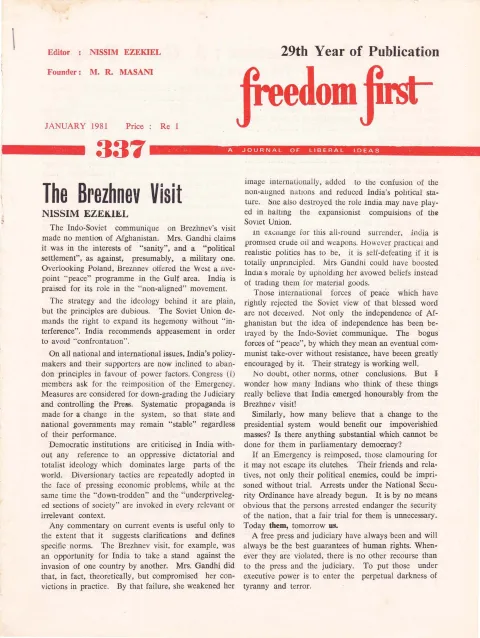
periodical issue
Freedom First
A Journal of Liberal Ideas
By NISSIM EZEKIEL, K. V. SUBRAMANYAM, ZENA SORABJEE, RASHMI TANEJA, SAMPATH S. IYENGAR, P. M. KAMATH, PREETHI BIDDAPA, HUTOXI MEHENTI
Published for the Democratic Research Service by J. R. Patel, Associate Editor, Freedom First, at 127, Mahatma Gandhi Road, Bombay 400 023 (Phone: 273914) and printed by him at The Bombay Chronicle Press, Bombay 400 001. · Bombay · 1981
16 pages
Freedom First
Summary
Freedom First issue 344 (August 1981), the magazine’s 30th year of publication, edited by Nissim Ezekiel and founded by M. R. Masani, opens with Ezekiel’s own editorial denouncing the Maharashtra government’s plan to build 204 costly ‘Martyrs’ Memorials’ while pavement-dwellers are being evicted, reading it as a symptom of arbitrary, personality-driven governance. The issue’s news and opinion pieces range widely over Cold War and human-rights themes: K. V. Subramanyam dissects Soviet ‘switch trade’ and mica/oilcake exploitation of India as a form of neo-colonialism; an unsigned report summarises Amnesty International’s decade-long campaign against Vietnam’s ‘re-education’ camps; Zena Sorabjee documents the escalating persecution of Baha’is in revolutionary Iran; Rashmi Taneja assesses the Solidarity-era crisis in Poland and Brezhnev’s dilemma; and P. M. Kamath analyses Indo-Pak relations against the backdrop of the Soviet occupation of Afghanistan and US arms sales to Pakistan. Domestically, the issue carries a full set of resolutions from the People’s Union for Civil Liberties (PUCL) condemning preventive detention, attacks on judicial independence, press intimidation, and postal interception, alongside a note on the newly formed Society for the Right to Die with Dignity (chaired by M. R. Masani). A ‘World of Books’ section reviews Mary Carras’s biography of Indira Gandhi and a Shashi Deshpande short-story collection, and Sampath S. Iyengar contributes an essay on moral versus purely economic approaches to development, invoking E. F. Schumacher and Robert McNamara. The volume is published for the Democratic Research Service by J. R. Patel.
Key points
-
Nissim Ezekiel’s “Martyrs of Maharashtra” attacks the state government’s plan for 204 costly Martyrs’ Memorials while pavement-dwellers are evicted during the monsoon, calling the Chief Minister’s style “management by muddle.”
-
K. V. Subramanyam’s “The Ways of Soviet Neo-colonialism” traces Soviet “switch trade” extraction of Indian mica, groundnut oil-cake, tobacco and foodgrains via non-convertible rupee balances back to Hjalmar Schacht’s Nazi-era trade methods.
-
An unsigned report on Amnesty International’s engagement with Vietnam’s “re-education” camps describes 20,000 prisoners still held as of September 1980 and details individual cases of indefinite detention without trial.
-
Zena Sorabjee’s “Persecution of the Baha’is in Iran” documents intensifying state-backed persecution of Iran’s roughly 500,000-strong Baha’i community, including the destruction of its holiest shrine in Shiraz and executions for “teaching the Baha’i Faith.”
-
Rashmi Taneja’s “Russia’s Dilemma” analyses the Solidarity-driven crisis in Poland, framing Brezhnev’s choice between military intervention and tolerating reform as a catch-22 given uncertain army loyalty.
-
PUCL resolutions condemn rising preventive detention, attacks on judicial independence, press intimidation and Karnataka’s interception of citizens’ postal mail.
-
Sampath S. Iyengar’s “Unemphasized Issues in Economics” argues decades of Indian planning failed to reduce poverty because markets structurally favour those with prior capital and power, invoking Schumacher’s critique of economics based on “envy and greed.”
-
P. M. Kamath’s “Indo-Pak Relations” surveys India-Pakistan relations through superpower rivalry, concluding India needs Pakistan as a buffer state and should offer a no-war pact contingent on Pakistan accepting India’s position on Kashmir.
Essays
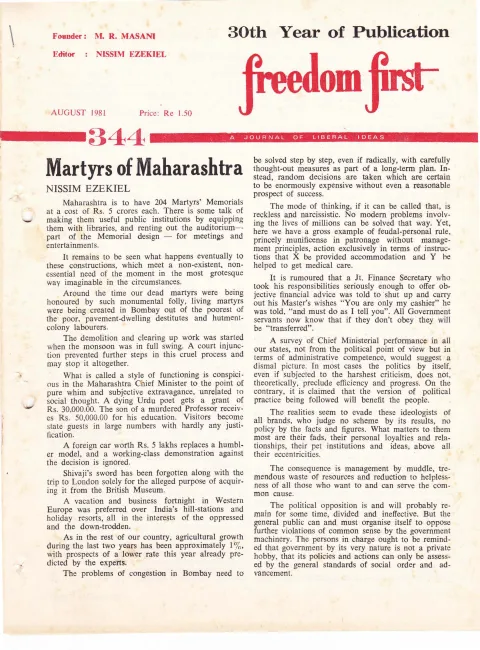
Martyrs of Maharashtra
By NISSIM EZEKIEL
Nissim Ezekiel’s editorial ‘Martyrs of Maharashtra’ attacks the state government’s plan to build 204 Martyrs’ Memorials at Rs. 5 crores each while, at the same time, pavement-dwellers and hutment-colony labourers are being evicted from Bombay in the middle of the monsoon. He characterises the Chief Minister’s style as whimsical and personality-driven government by patronage rather than policy, citing a large grant to a dying Urdu poet, funds for a murdered professor’s son, and lavish treatment of state guests as examples of ‘management by muddle.’ He calls for the public to organise against such abuses since the political opposition remains weak and divided.
- 204 Martyrs’ Memorials are planned at Rs. 5 crores each, of doubtful public utility
- Pavement-dwellers and hutment-colony labourers were being evicted during the monsoon around the same time
- The Maharashtra Chief Minister’s governing style is described as whimsical, personality-driven patronage rather than policy
- Examples cited include a large grant to a dying Urdu poet and funds for a murdered professor’s son
- The author calls the situation ‘management by muddle’ and urges public organisation against such governance
The Ways of Soviet Neo-colonialism
By K. V. SUBRAMANYAM
K. V. Subramanyam’s ‘The Ways of Soviet Neo-colonialism’ argues that the Soviet Union has replicated older imperial patterns of resource extraction dressed up in socialist rhetoric. Drawing on D. P. Sharma’s investigative reporting in the Times of India and Economic & Political Weekly, he traces the origins of ‘switch trade’ to Hjalmar Schacht’s financing of Nazi Germany and its perfection by Anastas Mikoyan, then describes how the USSR uses non-convertible rupee balances to extract Indian mica, groundnut/oil-cake, tobacco, and foodgrains cheaply while India is left short of foreign exchange and edible oils. He situates this within a broader claim that the Soviet Union, as the last surviving empire, pursued a Cold War strategy of gaining political and economic control over newly independent nations of Africa and Asia.
- Article traces ‘switch trade’ methodology from Hjalmar Schacht’s Nazi-era trade practices to Anastas Mikoyan’s Soviet adaptation
- Describes Soviet exploitation of India’s rupee trade, citing D. P. Sharma’s investigative journalism in the Times of India and EPW
- Mica, groundnut/oil-cake, tobacco, and foodgrains are cited as commodities extracted from India via non-convertible currency arrangements
- The 1971 Indo-Soviet protocol is described as trading Indian raw materials for Soviet metals and machinery without earning India free foreign exchange
- Frames the USSR as the sole surviving empire pursuing political control over newly independent Afro-Asian states after WWII
Call for End to “Re-education” Camps in Viet Nam
This unsigned report, ‘Call for End to “Re-education” Camps in Viet Nam,’ summarises Amnesty International’s multi-year engagement with the Vietnamese government following a December 1979 fact-finding mission. It recounts AI’s 18 recommendations submitted after visiting three re-education camps, the Vietnamese government’s official justification of continued detention on grounds of ‘national treason,’ and specific individual cases (a former South Vietnamese diplomat and a writer of children’s stories) held without trial. The piece situates the camps as holding tens of thousands of former military, civilian, and political figures of the defeated South Vietnamese government since 1975, and describes AI’s push for inspections, published camp lists, abolition of the death penalty, and ratification of international human-rights covenants.
- AI’s December 1979 mission to Vietnam produced 18 recommendations to the government, exchanged over 10 months
- As of September 1980 the Vietnamese government reported 20,000 prisoners still held in re-education camps
- The Vietnamese government justifies detention on the basis of a 1967 ordinance covering ‘national treason’
- AI documents individual cases including a former South Vietnamese diplomat (Buu Huang) and writer Duyen Anh, held without formal charges
- AI’s report calls for camp inspections, published prisoner lists, abolition of the death penalty, and ratification of human rights covenants
The Society for the Right to Die with Dignity
By M. R. Pai
A brief notice announces the founding of the Society for the Right to Die with Dignity, headquartered in Bombay with a Bengal branch, aimed at building public support for legislation permitting terminally ill and suffering patients to end their lives under appropriate safeguards. M. R. Masani chairs the Society; Dr. Fredoon P. Antia is vice-chairman; Mr. G. G. Mehta and Mr. P. C. Manaktala serve as honorary secretaries; and Mr. A. N. Parakh is honorary treasurer. The Society intends to appoint a working group including a doctor and lawyer to draft a model bill for public discussion and submission to the Union Government and Parliament.
- The Society for the Right to Die with Dignity is newly established with headquarters in Bombay and a branch in Bengal
- M. R. Masani chairs the Society; other officers include Dr. Fredoon P. Antia, Mr. G. G. Mehta, Mr. P. C. Manaktala, and Mr. A. N. Parakh
- The Society plans to draft a model bill on euthanasia/right-to-die legislation for public and parliamentary consideration
Persecution of the Baha’is in Iran
By ZENA SORABJEE
Zena Sorabjee’s ‘Persecution of the Baha’is in Iran’ documents the intensifying, government-backed persecution of Iran’s roughly 500,000-strong Baha’i community following the Islamic Revolution. She traces episodic persecution back to the faith’s 1844 origins in Iran and earlier confirmations by orientalists such as Count Gobineau and Lord Curzon, then details contemporary charges against Baha’is (heresy, ‘spreading prostitution,’ Zionism), the confiscation of Baha’i institutions, exclusion of Baha’i youth from universities, destruction of the holiest Baha’i shrine in Shiraz, and executions under Islamic Revolutionary Courts on charges of ‘teaching the Baha’i Faith.’
- Iran’s Baha’i community, founded in 1844 and numbering nearly 500,000, faces a new wave of state-backed persecution post-revolution
- Charges against Baha’is include heresy, promoting ‘prostitution’ (via women’s education), and being ‘Zionists’ due to the faith’s Haifa headquarters
- Government teachers, doctors and officials who are Baha’i have been purged from their posts
- Baha’i universities access is barred; only officially recognised religions (Islam, Zoroastrianism, Judaism, Christianity) are admitted
- The holiest Baha’i shrine in Shiraz was destroyed while ostensibly under government protection; loyalty to the faith is now a capital offence
Russia’s Dilemma (Poland)
By RASHMI TANEJA
Rashmi Taneja’s ‘Russia’s Dilemma’ analyses the year-long Solidarity-driven crisis in Poland, describing the concessions won by Polish workers (independent unions, right to strike, press relaxation) and the reformist mandate given to Stanislaw Kania and General Jaruzelski at the Polish Communist Party’s Ninth Congress. She frames Brezhnev’s choice as a catch-22: military intervention risks a bloody, Czechoslovakia-1968-style repression with uncertain army loyalty, while tolerating reform risks further liberalisation spreading across the Soviet bloc.
- Polish strikes since Gdansk have won independent trade unions, the right to strike, relaxed press censorship, and a five-day work week
- The Polish Communist Party’s Ninth Congress (July 1981) used Eastern Europe’s first secret ballot to elect a reform-oriented central committee
- The author compares the Polish crisis to Czechoslovakia in 1968, noting Poland’s stronger grassroots and institutional base (Catholic Church, private sector)
- Brezhnev faces a dilemma: military intervention risks uncertain army loyalty and severe cost, while tolerance risks further bloc-wide liberalisation
Essay 7
This unsigned set of resolutions from the People’s Union for Civil Liberties (PUCL), adopted at a National Council meeting in Bombay on 4th July 1981, addresses alarming increases in preventive detention, attacks on judicial independence, intensified attacks on the press, and interception of postal communications. It catalogues government tactics against the press (pre-censorship in Assam, abuse of journalists by ministers such as Gundu Rao and Antulay, newsprint denial, planting sympathisers), calls on the press to resist and publicise such encroachments, and condemns the Karnataka government’s interception of citizens’ mail as defended by Union Communications Minister C. M. Stephen.
- PUCL condemns the growing use of the National Security Act (NSA) and preventive detention laws by central and state governments
- Resolution criticises denigration of the judiciary by ministers and calls for judicial appointments free of political influence
- Details systematic government pressure on the press including pre-censorship (Assam), abusive rhetoric from ministers Gundu Rao and Antulay, and threats to deny newsprint
- Condemns Karnataka government’s interception of citizens’ postal mail, defended by Central Minister Stephen as a ‘constitutional obligation’
- PUCL membership and constitution available via Arun Shourie at the New Delhi address given
People’s Union for Civil Liberties — Resolutions
Preethi Biddapa reviews Mary Carras’s biography ‘Indira Gandhi In the Crucible of Leadership,’ praising its unusually objective, factual analysis of Mrs. Gandhi’s life and the events leading to the Emergency. The review highlights Carras’s critical assessment of both Mrs. Gandhi (her ad hoc rather than systematic approach to social reform) and Jayaprakash Narayan’s movement (its ambivalence in justifying sedition and ‘total revolution’), as well as her treatment of the Shah Commission’s findings that no genuine emergency situation existed in 1975.
- Mary Carras’s biography of Indira Gandhi is praised as unusually objective compared to prior hagiographic or condemnatory accounts
- Carras attributes pre-Emergency instability partly to Mrs. Gandhi’s own policies rather than external conditions alone
- The review notes Carras’s critical assessment of JP’s movement as ambivalent about sedition and violent versus non-violent revolution
- Discusses the Shah Commission’s finding, per Justice Khandalawala and Ram Jethmalani, that no law-and-order emergency existed at the time of declaration
- Concludes with Mrs. Gandhi’s own remarks defending the Emergency by pointing to Mujib’s assassination and Bandaranaike’s lack of comparable measures
The World of Books (reviews of Indira Gandhi In the Crucible of Leadership and a Shashi Deshpande story collection)
By PREETHI BIDDAPA; HUTOXI MEHENTI
Hutoxi Mehenti reviews Shashi Deshpande’s short-story collection (A Writer’s Workshop Greenbird Book), praising its exploration of loneliness, guilt, and the fragility of emotional needs within middle-class Indian domestic life. The review highlights stories such as ‘The Dim Corridor,’ ‘The Eternal Theme,’ ‘A Liberated Woman,’ ‘The Intrusion,’ and ‘Rain,’ each examining constraints placed on women within patriarchal family structures, and praises Deshpande’s simple, energetic prose style suited to spoken Indian English.
- The collection has ten stories with a preface by G. S. Amur of Marathwada University
- Major themes identified are loneliness, loss of privacy, guilt, and fragility of emotional needs within family relationships
- Stories discussed include ‘The Dim Corridor,’ ‘The Eternal Theme,’ ‘A Liberated Woman,’ ‘The Intrusion,’ and ‘Rain’
- The reviewer highlights Deshpande’s critique of patriarchal norms constraining women’s choices in marriage and widowhood
- Praises the prose style as simple and energetic, well suited to spoken Indian English
Unemphasized Issues in Economics
By SAMPATH S. IYENGAR
Sampath S. Iyengar’s ‘Unemphasized Issues in Economics’ argues that decades of Indian planning have failed to meaningfully reduce poverty because market mechanisms inherently favour those with prior endowments of capital, education, or power. Drawing on E. F. Schumacher’s critique of economics based on envy and greed, and on historical moral safeguards against inequality (such as ancient prohibitions on permanent land alienation and slavery), he calls for economics to be infused with moral values, citing Robert McNamara and Willy Brandt’s appeals to a moral basis for development, and invoking Buddha, Ashoka, and Mahatma Gandhi as exemplars of a morally grounded economic order.
- India’s economy has averaged only 3.5% annual growth and 1.3% per capita growth over 30 years, with benefits poorly distributed to the poor
- The market mechanism is said to structurally exclude those lacking initial endowments of capital, education, or power
- E. F. Schumacher’s critique of economics based on ‘envy and greed’ and his call for ‘meta economics’ are discussed at length
- Historical examples of built-in moral constraints on inequality (land reversion, five-year slave redemption, fallow-field rules) are cited approvingly
- Robert McNamara and Willy Brandt are quoted on the moral (not merely economic) case for aiding the poor; Buddha, Ashoka and Gandhi are cited as advocates of a morally grounded economic order
Indo-Pak Relations
By P. M. KAMATH
P. M. Kamath’s ‘Indo-Pak Relations’ surveys the history of India-Pakistan relations through the lens of superpower rivalry, from Pakistan’s Cold War alliances and India’s 1971 Peace and Friendship Treaty with the USSR, through the brief thaw following Pakistan’s 1979 non-aligned turn, to the renewed Cold War tension caused by the Soviet invasion of Afghanistan. He argues Pakistan may be preparing a pre-emptive strategy against India exploiting superpower rivalry, and closes by arguing India needs Pakistan as a buffer state and should offer a no-war pact, though this depends on Pakistan accepting India’s position on Kashmir and abandoning its quest for parity with India.
- Pakistan’s post-independence insecurity led it into US-led anti-communist military alliances, drawing India toward the Soviet Union
- The 1971 Bangladesh war and Pakistan’s 1979 non-aligned turn briefly raised hopes for bilateral India-Pakistan relations free of superpower rivalry
- The Soviet invasion of Afghanistan reintroduced superpower rivalry into the region, with the US agreeing to $3 billion in military/economic aid to Pakistan
- The author suggests Pakistan may be preparing a pre-emptive military strategy against India, exploiting potential Soviet-Afghan involvement
- Concludes that India needs Pakistan as a buffer state and should offer a no-war pact, contingent on Pakistan accepting India’s position on Kashmir
Generated by the v1.5 extraction pipeline. Awaiting editorial review.
Essay 11
No summary was extracted for this article. Listed for completeness.
Metadata and summary are AI-extracted from the source PDF and reviewed for editorial accuracy. The original work is available via the Read PDF tab above (where present); paragraph-level citation inside the PDF is deferred to a future engagement.