periodical issue
Freedom First
A Journal of Liberal Ideas
By A. Solomon
Published for the Democratic Research Service by J. K. Patel, Associate Editor, Freedom First at 127, Mahatma Gandhi Road, Bombay 400023 (Phone: 273914) and Printed by him at Commercial Printers & Stationers, 525 S. B. Marg, Dadar, Bombay-400 028. · Bombay · 1981
16 pages
Freedom First
Summary
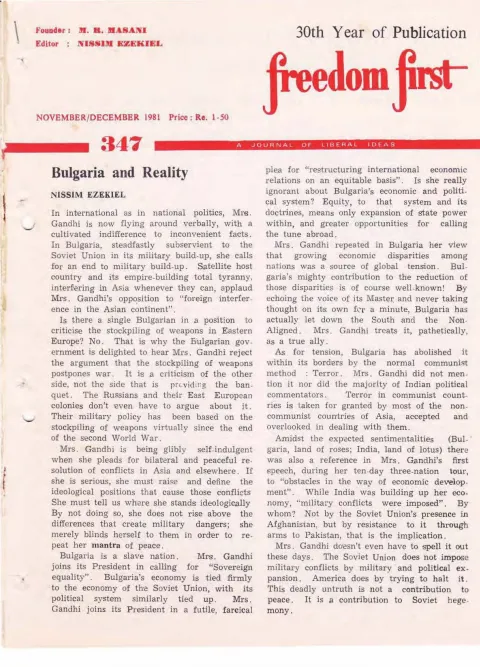
Issue 347 of Freedom First (November/December 1981), edited by Nissim Ezekiel, opens with an editorial attacking Indira Gandhi’s foreign-policy rhetoric on a visit to Bulgaria, followed by K. S. Venkateswaran’s regular “A Variety of Comment” column on Soviet law, India’s West Asia diplomacy, and Soviet restrictions on scientists. The issue’s central feature is a two-part response to Anwar Sadat’s assassination: Rashmi Taneja traces the political causes of his fall, and Arvind A. Deshpande criticizes Indira Gandhi’s public remarks about Sadat. Other contents include two film/theme reviews under “Voices” (a review of the film 36 Chowringhee Lane, and a reader’s letter on euthanasia invoking Hindu scripture), a condolence tribute to the humanist scholar A. B. Shah, two book reviews under “The World of Books,” and a substantial analytical essay by P. M. Kamath on over-centralization in Indian federalism under Congress (I) rule. The volume’s argumentative center is a defence of liberal-democratic and constitutionalist values against both authoritarian foreign models (the Soviet bloc) and domestic centralization of power under Mrs. Gandhi.
Key points
-
Nissim Ezekiel’s “Bulgaria and Reality” accuses Indira Gandhi of ideological evasiveness on her Bulgaria visit, arguing her calls for “sovereign equality” ignore Bulgaria’s total subservience to Soviet power.
-
K. S. Venkateswaran’s “A Variety of Comment” criticises praise for Soviet legal “efficiency,” endorses Subramaniam Swamy’s charge that India’s West Asia policy is self-defeating hypocrisy, and reports the unexplained absence of a Soviet physicist from an international conference as evidence of restricted academic freedom.
-
Rashmi Taneja’s “Why Sadat Was Killed” traces the political causes of Anwar Sadat’s assassination to his economic liberalisation, the Camp David accords’ isolation of Egypt from the Arab world, and a crackdown that swept up 1,500 people a month before his death.
-
A companion piece by Arvind A. Deshpande criticises Indira Gandhi’s description of Sadat as an “unpopular” Western-propped leader as ungracious toward a courageous ally.
-
A review of Aparna Sen’s directorial debut 36 Chowringhee Lane reads Jennifer Kendal’s portrayal of an ageing Anglo-Indian schoolteacher as a meditation on loneliness and the community’s post-independence decline.
-
Praja R. Parekh argues, citing the Ramayana, Mahabharata and figures like Adi Shankaracharya, that India’s law criminalising suicide reflects Macaulay’s Christian assumptions rather than Hindu tradition, which he says has never condemned voluntary death.
-
A. Solomon’s tribute to the late humanist scholar A. B. Shah praises his fearless critical study of Islam, motivated by a desire for Muslims’ social emancipation rather than hostility.
-
P. M. Kamath’s essay on Indian federalism argues over-centralisation, not federal structure itself, is the core problem, tracing it to Mrs. Gandhi’s dual role as Prime Minister and Congress(I) party president.
Essays
Bulgaria and Reality
By Nissim Ezekiel
In this editorial, Nissim Ezekiel accuses Indira Gandhi of ideological evasiveness on her tour of Bulgaria, arguing that her calls for an end to military build-up and for “sovereign equality” ignore Bulgaria’s total subservience to Soviet military and economic power. He contends that her rhetoric of peace and non-alignment obscures the real source of Asian tension, which he locates in Soviet expansionism (via arms to Pakistan and presence in Afghanistan) rather than in American resistance to it.
- Criticizes Mrs. Gandhi’s calls for ‘sovereign equality’ and an end to military build-up as hollow given Bulgaria’s total subservience to Soviet power.
- Argues Bulgaria’s economy and politics are tied to the Soviet Union, making its support for ‘restructuring international economic relations’ hypocritical.
- Notes that Terror as a method of political control is taken for granted in communist states and goes unmentioned by Mrs. Gandhi.
- Frames Soviet arms to Pakistan and presence in Afghanistan, not American resistance, as the true source of Asian military tension.
- Accuses Mrs. Gandhi of blinding herself to ideological differences in order to repeat a ‘mantra of peace’.
A Variety of Comment (1. Soviet Law; 2. India and West Asia; 3. The Missing Scientist)
By K. S. Venkateswaran
K. S. Venkateswaran’s regular column offers three short items. “Soviet Law” criticizes the Indian Law Minister’s praise for the speed of Soviet justice, arguing that Soviet legal ‘efficiency’ comes at the cost of subordinating law to political expediency, unlike Britain’s independent judiciary. “India and West Asia” endorses Janata MP Subramaniam Swamy’s criticism that India’s public support for the Arab cause alongside private sympathy for Israel constitutes diplomatic dishonesty that has cost India credibility without gaining reciprocal Arab support. “The Missing Scientist” reports on the unexplained absence of Soviet physicist Prof. L. B. Okunn from an international physics conference, reading it as further evidence of Soviet restrictions on academic freedom, and asks why Indian scientists have not protested such restrictions.
- Criticizes the Union Law Minister’s praise for the Soviet legal system’s ‘speed’ as ignoring its subordination of law to political expediency.
- Contrasts Soviet legal practice unfavorably with Britain’s fiercely independent judiciary despite institutional shortcomings.
- Endorses Subramaniam Swamy’s charge that India’s West Asia policy of public pro-Arab posture plus private sympathy to Israel is self-defeating hypocrisy.
- Notes that in every India conflict, the Arab vote has sided with India’s opponent despite India’s consistent pro-Arab diplomacy.
- Reports the unexplained non-appearance of Soviet physicist Prof. L. B. Okunn at a Wisconsin physics conference as a symptom of Soviet restriction on scientific freedom.
- Challenges the Indian scientific community to protest Soviet restrictions on intellectual freedom.
Why Sadat Was Killed
By Rashmi Taneja
Rashmi Taneja’s feature traces the political trajectory that led to Anwar Sadat’s assassination: his consolidation of power after succeeding Nasser, the 1973 war, the 1977 Jerusalem visit, the Camp David accords, and the domestic economic liberalization that widened inequality and fed both Nasserist and Muslim Brotherhood opposition. She argues the assassination was not an isolated act but the product of intensifying Islamist unrest, sectarian riots, and a government crackdown that swept up 1500 people shortly before Sadat’s death, and closes by weighing the constraints facing his successor, Hosni Mubarak, including Arab isolation and the unfinished return of Sinai. A short companion piece by Arvind A. Deshpande, “Sadat: Another View,” criticizes Indira Gandhi’s public description of Sadat as a leader of an unpopular regime propped up by the West, arguing this was an ungracious and politically damaging remark about a courageous ally, and calls for an opinion poll to test whether Indians actually approve of India’s pro-Arab-confrontation stance.
- Sadat’s domestic liberalization after 1974 abandoned Nasser’s socialist economics, widening inequality and triggering the 1977 bread riots.
- Both Nasserist leftists and the Muslim Brotherhood grew as organized opposition amid economic stagnation and pro-Western foreign policy.
- A crackdown arresting 1500 people, including political critics, preceded the assassination by a month, suggesting the killing was not isolated.
- The Camp David accords (Sept 1978) and 1979 peace treaty isolated Sadat from the Arab world by sidelining Palestinian autonomy.
- Mubarak inherits a difficult legacy: containing Islamist unrest, recovering the remaining Sinai territory by April 1982, and deciding whether to realign with the Arab world or the Soviet Union.
- Deshpande’s companion piece condemns Indira Gandhi’s description of Sadat as an ‘unpopular’ Western-propped leader as ungracious and out of step with Indian public opinion.
Voices-1: 36 Chowringhee Lane
By Ramni Taneja
Under the “Voices” rubric, Ramni Taneja reviews Aparna Sen’s directorial debut 36 Chowringhee Lane, praising Jennifer Kendal’s performance as Anglo-Indian schoolteacher Violet Stoneham, an aging, isolated spinster whose brief renewed sense of purpose through a young Bengali couple ends in a quiet betrayal. The review reads the film as a meditation on loneliness, the decline of the Anglo-Indian community in post-independence Calcutta, and the contrast between youth and old age, highlighting the use of the hymn “Silent Night” as a recurring ironic motif.
- Reviews Aparna Sen’s 36 Chowringhee Lane (produced by Shashi Kapoor), her directorial debut and Jennifer Kendal’s breakthrough role.
- Reads Violet Stoneham as both an individual and a symbol of the dwindling Anglo-Indian community’s isolation in old age.
- Traces the plot: Stoneham’s friendship with a young couple, Nandita and Samaresh, who use her flat and ultimately abandon her after marrying.
- Highlights a dream sequence recalling the wartime death of Stoneham’s fiance as the film’s most emotionally direct scene.
- Notes the recurring use of the hymn ‘Silent Night’ as an ironic motif bookending the friendship’s rise and betrayal.
Voices-2: The Right To Die
By Praja R. Parekh
In a second “Voices” item, Praja R. Parekh responds to M. R. Masani’s earlier comments on the right to die with dignity, arguing that India’s law criminalizing attempted suicide reflects Lord Macaulay’s Christian theological assumptions rather than Hindu tradition. Citing the Ramayana, Mahabharata, and Bhagavata Purana, and examples such as Adi Shankaracharya and Swami Vivekananda, the author argues Hindu dharma has never condemned voluntary death and that the existing law contravenes Hindu ethics and scripture, while conceding that any legal liberalization would need safeguards against abuse.
- Argues the Indian Penal Code’s criminalization of attempted suicide, drafted by Lord Macaulay, reflects Christian theology rather than Hindu tradition.
- Cites the Ramayana (Rama’s death by drowning), the Mahabharata (the Pandavas’ final journey), and the Bhagavata Purana (Krishna’s death) as scriptural precedent for voluntary death.
- Lists historical examples: Adi Shankaracharya, Swami Rama Tirtha, Sant Dnyaneshwar, and Swami Vivekananda as having invited or chosen their own deaths.
- Acknowledges fears that legalizing the right to die could be abused, but argues the law can build in safeguards against coercion or fraud.
- Concludes current Indian law on suicide contravenes Hindu ethics, usage, and scriptural tradition.
Tribute to A. B. Shah (extracts from a speech at the condolence meeting held at Pune on 16 October 1981)
By A. Solomon
A. Solomon’s tribute, extracted from a speech at a condolence meeting in Pune, honours the philosopher and humanist A. B. Shah, describing him as a rigorous rationalist who devoted his life to the social and cultural preconditions for freedom, equality, and dignity. It praises Shah’s fearless, evidence-based critical study of Islam, noting that although this earned him accusations of being ‘anti-Muslim,’ his aim was the social emancipation of Muslims as fellow citizens, and that Shah’s larger goal was to combat obscurantism and fanaticism in all religions equally.
- Shah asked for no religious rites or condolence meetings at his death, in keeping with his rationalist and humanist convictions.
- His life’s dedication was to creating the ‘social and cultural pre-conditions for a society based on freedom, equality, and the dignity of the individual.’
- He was among the few non-Muslims to undertake serious critical study of Islam, which some considered scholarly and others labeled ‘anti-Muslim.’
- The speech argues his critiques were motivated by a genuine desire for the social emancipation of Muslims, not hostility.
- Frames obscurantism and fanaticism, in any religion, as the true threats to human freedom that Shah opposed throughout his career.
The World of Books
“The World of Books” carries two reviews. Preeth J. Biddapa reviews W. D. Thatte’s novel Ripples on Jamuna, a critical account of post-independence Indian politics, judging it pedantic, cynical, and verbose, lacking real insight into the causes of political decay despite its ambitious scope, and questioning its high Rs. 40 price. Shama Futehally reviews the art magazine Art Heritage 2 (edited by E. Alkazi), praising its physical production, well-chosen illustrations, and wide-ranging themes from early Indian symbolism to modern painters like Gieve Patel and Nalini Malani, but criticizing the uniformly heavy, monotonous prose style of most contributors as a barrier to a general readership interested in Indian art.
- Biddapa faults Ripples on Jamuna for pedantic, verbose prose that fails to illuminate the causes of Indian political decay despite covering the freedom struggle and its aftermath.
- Biddapa singles out the book’s Rs. 40 price as disproportionate to its quality.
- Futehally praises Art Heritage 2’s production quality, comparing it to Marg magazine, including tasteful integration of advertising.
- Futehally covers essays on symbolism in early Indian art, Gwalior court paintings, and modern painters including Gieve Patel, Nalini Malani, and the 18th-century Garhwali painter Mola Ram.
- Futehally criticizes the ‘scholarly Indian disease’ of monotonous, heavy prose that makes the volume’s essays a burden rather than a pleasure to read for general readers.
Indian Federalism Today: Malady is Over-Centralization
By P. M. Kamath
P. M. Kamath argues that the central malady of Indian federalism since 1971, and especially since Indira Gandhi’s return to power in 1980, is over-centralization rather than any structural design flaw. He traces the historical roots of centralization to the 1947 communal violence and the Telangana uprising, which pushed the Constitution’s framers toward a strong Centre, but argues that Mrs. Gandhi’s dual role as Prime Minister and Congress (I) party president has since concentrated political power to the point where governors, chief ministers, and party organs at every level are effectively her personal creations. Kamath calls for a ‘federalized political process’ involving inner-party democracy and devolved initiative, while conceding this call is likely to go unheeded given the vested interests of Congress (I)‘s state leadership.
- Frames over-centralization, not federal structure itself, as the core problem afflicting Indian federalism since 1971 and especially since 1980.
- Traces the historical case for a strong Centre to 1947 communal violence and the Telangana uprising, which shaped the Constitution’s distribution of powers.
- Argues non-Congress state governments (West Bengal, Tamil Nadu, J&K) exercise greater real autonomy than Congress-ruled states, showing the issue is partly political rather than purely structural.
- Describes Mrs. Gandhi’s dual role as Prime Minister and Party President as concentrating appointment and removal power over chief ministers, governors, and party officials.
- Cites the ‘administrative constipation’ (a phrase attributed to former Burmese PM U Nu) caused by requiring all decisions to funnel through one leader.
- Proposes a federalized political process with inner-party democracy and devolution of initiative as the necessary corrective, while doubting Congress (I) will adopt it.
Generated by the v1.5 extraction pipeline. Awaiting editorial review.
Metadata and summary are AI-extracted from the source PDF and reviewed for editorial accuracy. The original work is available via the Read PDF tab above (where present); paragraph-level citation inside the PDF is deferred to a future engagement.