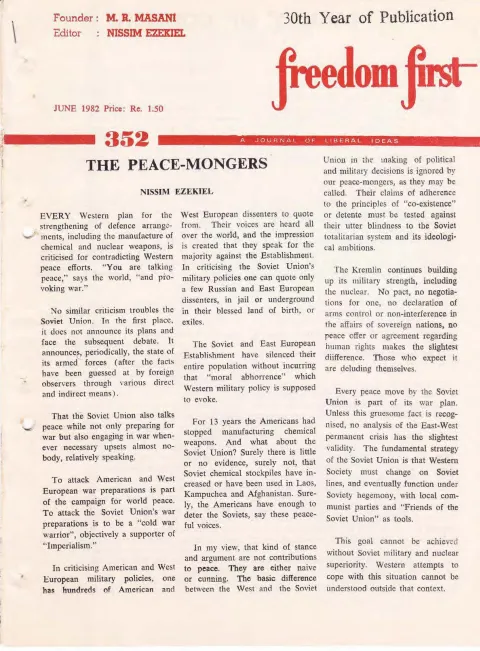
periodical issue
Freedom First
A Journal of Liberal Ideas
By A. Solomon
Published for the Democratic Research Service by J. R. Patel, Associate Editor, Freedom First at 127, Mahatma Gandhi Road, Bombay 400 023 (Phone: 273914) and Printed by him at The Popular Press (Bom.) Pvt. Ltd, 35C Tardeo Road, Bombay 400 034 · Bombay · 1982
16 pages
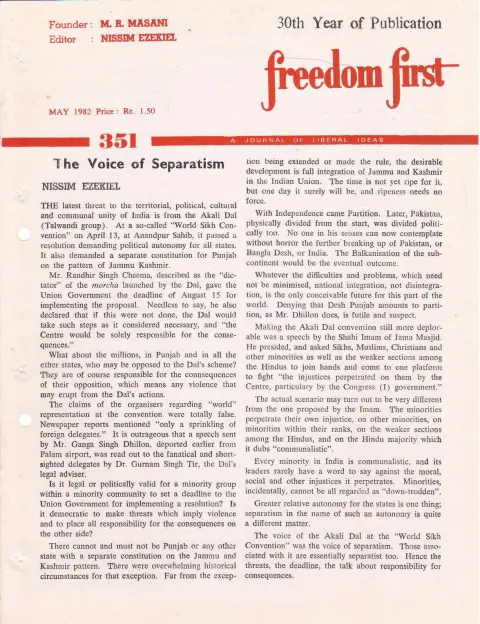
Freedom First
Summary
Freedom First issue no. 351 (May 1982), edited by Nissim Ezekiel and founded by M. R. Masani, opens with Ezekiel’s editorial condemning the Akali Dal’s “World Sikh Convention” resolution for political autonomy and a separate Punjab constitution as a voice of separatism, and rejecting any Jammu-and-Kashmir-style special status for Punjab. The issue’s regular “A Variety of Comment” column (K. S. Venkateswaran) covers the Law Commission’s questionnaire on restructuring the Supreme Court under Justice K. K. Mathew, and a spat between J. K. Galbraith and free-market economists (Milton Friedman, Arthur Laffer, Jude Wanniski) over monetarism, plus a note on Britain’s continued lead in bilateral aid to India. Other contributions address Indian opposition politics and the case for the BJP as a “national alternative” (S. S. Bankeshwar), a proposed international-arbitration approach to the Kashmir dispute with Pakistan (S. G. Mampalli), a detailed account of the Falklands/Malvinas crisis (Rashmi Taneja), Soviet media’s rare admissions about the economic burden of foreign aid, especially to Poland (Ram Swarup), two “Voices” opinion pieces on the politicization of Marathi literary conferences (C. Raju) and the economic squeeze on India’s middle-income group (A. Solomon), a short note on a Bengali-language play about Indira Gandhi banned from overt reference (“OK Calcutta”), a book review of L. J. Macfarlane’s The Right to Strike weighed against India’s Maintenance of Essential Services Act (Aloo Dalal), and a report on the political tensions following the death of Sikkim’s last Chogyal, Palden Namgyal (Brahmanand Mishra). The back matter carries the journal’s statutory ownership statement, subscription form, and advertisements.
Key points
-
Nissim Ezekiel’s “The Voice of Separatism” condemns the Akali Dal’s demand for a separate Punjab constitution modelled on Jammu and Kashmir, arguing greater state autonomy is legitimate but separatism dressed as autonomy is not.
-
K. S. Venkateswaran’s “A Variety of Comment” covers the Law Commission’s questionnaire floating a split of the Supreme Court seen as threatening judicial independence, and recounts J. K. Galbraith’s public clashes with Milton Friedman and Arthur Laffer over monetarism.
-
S. S. Bankeshwar’s “A National Alternative” credits the BJP alone among opposition parties with establishing independent credibility, tracing this to JP’s success in bringing the RSS and Jan Sangh into India’s national mainstream via the Janata experiment.
-
Rashmi Taneja’s “The Falkland Islands Crisis” narrates the escalation from Argentina’s flag-raising at South Georgia to Britain’s naval deployment, situating General Galtieri’s invasion within Argentina’s domestic economic crisis.
-
Ram Swarup’s “Soviet Media Sensitivity on Foreign Aid” documents a rare crack in Soviet press silence over the economic cost of meat shipments to Poland amid a third consecutive poor Soviet grain harvest.
-
Two “Voices” pieces cover criticism of politicised Marathi literary conferences and an argument that steep taxation and fare disparities are crushing India’s politically aware middle-income group.
-
A review of L. J. Macfarlane’s The Right to Strike is used to critique India’s Maintenance of Essential Services Act, arguing the measure is unprovoked given falling strike losses and likely reflects government’s inability to tackle inflation and corruption.
-
“The Sikkim Connection” reports on the political tension after the cremation of ex-Chogyal Palden Namgyal, when thousands proclaimed his son the 13th Chogyal, which New Delhi regarded as bordering on sedition.
Essays
The Voice of Separatism
By NISSIM EZEKIEL
In “The Voice of Separatism,” editor Nissim Ezekiel condemns the Akali Dal’s (Talwandi group) resolution at an April 13 “World Sikh Convention” in Anandpur Sahib demanding political autonomy for all Indian states and a separate constitution for Punjab modeled on Jammu and Kashmir. He argues the Jammu and Kashmir exception was historically justified but should not be extended, that further Balkanisation of the subcontinent following Partition and Bangladesh would be disastrous, and that the Shahi Imam of Jama Masjid’s call for minorities to unite against the Centre only deepens communal division. He concludes that greater state autonomy is legitimate but separatism dressed up as autonomy is not, and that the Akali Dal convention’s rhetoric, deadlines, and threats amount to a voice of separatism.
- The Akali Dal (Talwandi group) passed a resolution at Anandpur Sahib on April 13 demanding political autonomy for all states and a separate Punjab constitution on the Jammu and Kashmir pattern.
- Randhir Singh Cheema, described as the ‘dictator’ of the morcha, set an August 15 deadline for the Union Government and disclaimed responsibility for consequences if unmet.
- Claims of ‘world’ representation at the convention were exaggerated; a speech by deported Ganga Singh Dhillon was read out by legal adviser Gurnam Singh Tir.
- The Shahi Imam of Jama Masjid urged Sikhs, Muslims, Christians and weaker Hindu sections to unite against Centre/Congress(I) ‘injustices,’ which Ezekiel calls further evidence of communalism among minorities themselves.
- Ezekiel argues Jammu and Kashmir’s special status was justified by unique historical circumstances but should not be a precedent; full integration, not disintegration, is India’s only viable future.
- Greater relative autonomy for states is acceptable in principle, but separatism dressed as autonomy is categorically different and must be rejected.
A Variety of Comment
By K. S. VENKATESWARAN
K. S. Venkateswaran’s regular “A Variety of Comment” column has two parts. The first, “Against the Judiciary,” criticizes the Law Commission under Chairman K. K. Mathew for circulating a 28-page questionnaire that raises the possibility of splitting the Supreme Court into a Court of Appeal and a Constitutional Court, which many senior lawyers see as a threat to judicial independence; the author notes Mathew’s own admission that the Commission ‘means business’ and wants ‘absolutely drastic changes.’ The second, “Economists Disagree,” recounts John Kenneth Galbraith’s critical remarks in India about Milton Friedman and Arthur Laffer’s free-market economics, situates this within broader liberal establishment hostility to monetarism (including supply-sider Jude Wanniski’s criticism of Friedman), and quotes Friedman’s rebuttal defending his advice to Israel and his qualified admiration for Margaret Thatcher’s policy even as he criticizes her government’s practical failures to cut taxes and spending.
- The reconstituted Law Commission under former Supreme Court judge K. K. Mathew circulated a questionnaire on ‘evolving a methodology for speedier disposal’ of Supreme Court and High Court matters.
- The questionnaire floats splitting the Supreme Court into a Court of Appeal and a Constitutional Court, seen by many Bar members as endangering judicial independence.
- Mathew is reported to have said the questionnaire does not touch separation of powers, judicial independence, or fundamental rights, but admitted the Commission wants ‘absolutely drastic changes.’
- J. K. Galbraith’s remarks in India repeatedly criticized Milton Friedman and Arthur Laffer, which the author calls an unbecoming pettiness reflecting broader liberal-establishment hostility to free-market economists influential in the Reagan administration.
- Supply-sider Jude Wanniski also criticized Friedman’s monetarism as ruinous to England and Israel; Friedman responded that he is responsible for advice given, not for policies followed differently afterward.
- Friedman praised Thatcher’s announced policy as ‘splendid’ but said her government failed to cut taxes/spending or reduce regulation and ownership, calling the British economy’s performance under her ‘terrible’ in a BBC interview.
- The column also reports the UK’s continued top position among bilateral aid donors to India in 1980-81 (Rs. 196.7 crores), per the Economic Survey 1981-82, versus Rs. 170 crores total from the Soviet Union over six years.
A National Alternative
By S. S. BANKESHWAR
In “A National Alternative,” S. S. Bankeshwar argues that talk of opposition unity against Indira Gandhi’s ‘authoritarianism’ is a joke given the long history of splits among the Janata, BLD, Raj Narain’s party, the Socialist party, the CPI, and Congress(U), driven by personal ambition rather than ideology. He credits the Bharatiya Janata Party as the only opposition party that has recognized it must establish its own credibility rather than merge into shapeless alliances, crediting Jayaprakash Narayan’s original Janata project with successfully bringing the RSS and Jan Sangh into the national mainstream before defectors like Charan Singh, Jagjivan Ram, and Madhu Limaye sabotaged it. He closes by calling for merit-based policy, legislative abolition of caste, and dismissing all current opposition formations (Congress(J), Congress(S), BLD) as incapable of becoming a genuine national alternative to the BJP.
- Bankeshwar dismisses current opposition-unity talk as incredible given repeated splits in Janata, BLD, Raj Narain’s party, the Socialist party, CPI (and Naxalite offshoots), and Congress(U), driven by personal ambition rather than ideology.
- He credits the BJP alone with recognizing that no party can be a National Alternative without establishing its own credibility while cooperating selectively with other opposition parties on national issues.
- He argues Jayaprakash Narayan’s greatest achievement was bringing the RSS and Jan Sangh into India’s national mainstream through the Janata experiment, which was later sabotaged by defectors who isolated the Jan Sangh constituent.
- Contemporary opposition leaders (Charan Singh, Bahuguna, Charanjit, Raj Narain) are dismissed as capable of winning only a handful of municipal or panchayat seats.
- He calls for abolishing the caste system through legislation, ending strikes and bandhs, and grounding policy in merit rather than religion or caste.
- He concludes the BJP is the only party with the potential to become the National Alternative once Indira Gandhi is out of India’s political scene.
India, Pakistan and Kashmir: A Simple Solution
By S. G. MAMPALLI
S. G. Mampalli’s short piece “India, Pakistan and Kashmir: A Simple Solution” responds to a Radio Pakistan broadcast reiterating Kashmir as an obstacle to Indo-Pakistani friendship. He argues India has repeatedly said only the Pakistani-occupied portion of Kashmir remains an open question, and that the Pakistani demand for a plebiscite cannot survive the reality of Kashmir’s successfully held, unboycotted elections. Rather than merely invoking the bilateralism of the Simla Agreement, Mampalli proposes India take the diplomatic risk of referring the dispute to the International Court of Justice to settle the matter definitively and demonstrate India’s sincerity about regional friendship.
- A March 28 Radio Pakistan broadcast claimed the Kashmir problem remains unsolved and is an obstacle to Indo-Pakistani friendship.
- Mampalli notes India’s position that only the Pakistani-occupied portion of Kashmir remains a live problem.
- He argues Pakistan’s plebiscite demand fails against the reality of repeated, unboycotted elections in Kashmir.
- He proposes referring the Kashmir dispute to the International Court of Justice as a bolder, more positive step than merely defending the bilateral ‘Simla spirit.’
- He warns that continued drift could drag both nations to the battlefield, allowing superpowers to exploit the sub-continent.
The Falkland Islands Crisis
By RASHMI TANEJA
Rashmi Taneja’s “The Falkland Islands Crisis” narrates the escalation from Argentine scrap merchants raising their flag at Leith Harbour in March 1982 to Argentina’s April 2 declared ‘recovery’ of the Falklands, and Britain’s dispatch of half its navy after Mrs. Thatcher’s government was condemned in a special Saturday parliamentary session (the first since Suez in 1956), which cost Foreign Secretary Lord Carrington and two deputies their jobs. The piece situates General Galtieri’s invasion within Argentina’s internal crises of 143% inflation, 13% unemployment, and the junta’s 20,000 ‘disappeared’ since the 1976 coup, and surveys the diplomatic landscape: Soviet neutrality tilting toward blaming British colonialism, an EEC-led sanctions front, and a US ‘honest broker’ role via Alexander Haig shuttling between London and Buenos Aires amid rejected leaseback, Hongkong-formula, and UN-supervision proposals.
- The crisis began March 19 when Argentine scrap merchants raised the Argentine flag and sang the national anthem at Leith Harbour, South Georgia, provoking local British scientists.
- Argentina announced on April 2 that its forces had ‘recovered’ the Falklands through ‘a successful military operation’; Britain’s Parliament held its first special Saturday session since Suez (1956), where it condemned the government and Lord Carrington and two deputy foreign secretaries resigned.
- Mrs. Thatcher pledged to regain sovereignty by diplomatic means but would use force if necessary, and half the British navy sailed from Portsmouth for a two-week voyage south.
- General Galtieri’s junta, facing 143% inflation, 13% unemployment, mass protests, and an estimated 20,000 ‘disappeared’ since the 1976 coup, used the invasion to rally national sentiment and cast himself as a national hero.
- The Soviet Union initially abstained at the UN Security Council but later blamed the crisis on British colonialism, benefiting from Argentina’s trade relationship and hostility to Thatcher.
- The US, caught between its ties to Argentina and its alliance with Thatcher, pursued an ‘honest broker’ role via Secretary of State Alexander Haig; Argentina’s insistence on recognized sovereignty as a precondition for troop withdrawal stalled talks, and proposals for tripartite administration, leaseback, the ‘Hongkong formula,’ and UN supervision were all considered.
- The dispute dates to 1833, when Argentina’s garrison was expelled by the Royal Navy; the islands today have 1,800 people and 600,000 sheep, and residents have declared no wish to join the Argentine mainland.
Soviet Media Sensitivity on Foreign Aid
By RAM SWARUP
Ram Swarup’s “Soviet Media Sensitivity on Foreign Aid” documents a rare crack in Soviet press silence about the economic cost of foreign aid, particularly stepped-up meat shipments to Poland reported by Radio Warsaw and (in Polish only, for external consumption) Radio Moscow, against a backdrop of a third consecutive poor Soviet grain harvest and an official 2% fall in 1981 agricultural production. He cites the newspaper Trud’s defensive explanation of declining per-capita meat sales despite rising production figures, and a Komsomolskaya Pravda reader’s letter questioning whether Soviet aid abroad harms the domestic economy, concluding that domestic grumbling about aid burdens to ‘fraternal countries’ appears to be gathering momentum inside the USSR.
- Soviet citizens have long believed, contrary to official silence, that the USSR’s foreign-aid program burdens the domestic economy and causes chronic shortages; Western estimates put Soviet aid at just 0.12% of GNP in 1979.
- Radio Warsaw reported December 29 that the USSR supplied Poland 32,000 tons of meat since mid-November, with more shipments expected; Radio Moscow carried the same announcement only in Polish, for external consumption.
- Soviet agricultural production officially fell 2% in 1981, following the third poor grain harvest in a row, worsening the timing of meat exports to Poland.
- The newspaper Trud explained the gap between rising official meat production and falling per-capita sales as due to distribution through cafeterias, sanatoriums, and children’s establishments, and transport losses, without providing figures on the actual decline.
- Trud also rebutted rumors that too much meat is being sold abroad, citing meat import figures rising from 165,000 to 611,000 tons over a decade against exports falling from 55,000 to 34,000 tons.
- A Komsomolskaya Pravda reader asked whether aid to developing and other countries harms the Soviet domestic economy; the paper’s reassuring reply is read by the author as itself evidence that public discontent over aid burdens is becoming troublesome to the authorities.
Voices-1: Politics and Literature
By C. RAJU
In the “Voices” column entry “Politics and Literature,” C. Raju criticizes the politicization of Marathi literary conferences, contrasting a Government-backed Marathi Sahitya Sammelan in Raipur with a rival ‘rebel’ writers’ conference in Bombay, and argues that writers who accept political patronage and awards compromise their art. He quotes humorist P. L. Deshpande’s protest against ministers like Vasant Sathe and Antulay attending literary gatherings, and Sammelan president Malati Bedekar’s charge that ruling politicians seek to turn citizens into ‘tame domestic animals,’ concluding that only self-respecting refusal of political patronage preserves a writer’s integrity.
- Bombay’s rival Sangeeth Sabhas and Samajs are used as an analogy to justify the existence of two competing Marathi Sahitya Sammelans, one government-backed (Raipur) and one a ‘rebel’ session (Bombay).
- Raju argues politics has infiltrated literature, and that many aspiring writers are tempted by government awards and political patronage into becoming propagandists.
- P. L. Deshpande, ex-president of the Marathi Sahitya Sammelan, is quoted saying writers should tell ministers they have no right to attend and ‘pollute’ literary conferences.
- Deshpande singles out Union Information Minister Vasant Sathe and Antulay as examples of politicians whose presence at literary gatherings he finds intolerable.
- Sammelan president Malati Bedekar is cited agreeing that ruling politicians seek to convert self-respecting citizens into ‘tame domestic animals.’
- Raju allows an exception for politicians who are also eminent writers, citing Radhakrishnan and K. M. Munshi as acceptable invitees.
Voices-2: Middle-Income Miseries
By A. SOLOMON
The second “Voices” entry, A. Solomon’s “Middle-Income Miseries,” argues that government economic policy is deliberately crushing India’s middle-income group through steep taxation (33-40% marginal rates), disproportionate second/first-class train fare gaps, and the unaffordability of telephones, flats, cars, and air travel, suggesting rulers wish to silence this politically aware, rights-demanding class by economic attrition. It closes by mocking officials who decry a ‘phoren craze’ for imported goods while themselves importing foreign articles duty-free through diplomatic privilege, arguing Indian-made goods are often shoddier due to a captive, uncompetitive market. A short following item, “OK Calcutta,” notes that British playwright David Selbourne’s play for Calcutta’s People’s Theatre, originally titled The Trial of Mrs Gandhi, was renamed for its Bengali-language premiere by translator/director Utpal Dutt to avoid overt reference to Indira Gandhi, though the woman-in-the-dock character remains recognizable by her distinctive white hair streak.
- A. Solomon argues government tax policy (33% on the lowest taxable slab, nearly 40% up to Rs. 30,000) and steep train-fare disparities (e.g., roughly 20x between first and second class on Bombay suburban routes) are crushing India’s middle-income group.
- He suggests this is deliberate: the middle class is politically aware, demands civil liberties, and exposes corruption, so economic attrition silences it, leaving only the very rich and very poor for a patronage-based electoral system.
- He dismisses the ‘phoren craze’ accusation as a figment of politicians’ imagination, arguing Indian-made goods are often shoddier and costlier due to lack of competition, while quality Indian exports are forced abroad as ‘export quality’ goods unavailable domestically.
- He notes hypocrisy in ministers, politicians, and bureaucrats who criticize the public’s taste for foreign goods while themselves importing such items duty-free via diplomatic privilege.
- The short item ‘OK Calcutta’ reports that David Selbourne’s play, commissioned for the People’s Theatre of West Bengal and originally titled The Trial of Mrs Gandhi, was retitled for its Bengali premiere (translated/directed by Utpal Dutt) to avoid explicit reference to Indira Gandhi, though the character remains recognizable by a distinctive white hair streak.
OK Calcutta
By (The Times, London)
Aloo Dalal reviews L. J. Macfarlane’s The Right to Strike (Penguin, 1981), a closely-argued analysis of whether the right to strike is morally as well as legally justified, written partly in response to British Conservative restrictions on closed shops and picketing. Dalal uses the book to critique India’s Maintenance of Essential Services Act (February 1982), which permits detention without trial under the National Security Act for strikes in a sweeping range of ‘essential’ sectors, arguing the measure is unprovoked given improving industrial-dispute statistics and likely reflects government’s inability to tackle inflation, black money, and corruption by other means. Following Macfarlane, she surveys the conditions for a morally valid right to strike (independent trade unions, freedom from police interference, democratic strike calls) while noting Macfarlane’s view that doctors, surgeons, and nurses have a moral duty never to strike, and applies this framework approvingly to a contemporary Maharashtra college-teachers’ examination boycott.
- Macfarlane’s book (Penguin, 1981) examines whether the right to strike is morally justified, prompted by British Conservative restrictions on closed shops and picketing.
- Dalal contrasts this with India’s Maintenance of Essential Services Act, under which the government (Feb 8, 1982) defined essential services broadly enough to cover nearly all transport, government services, defence, banking, and basic industries, with detention without trial available under the National Security Act.
- She argues the measure is unprovoked given the government’s own claim that man-days lost to strikes fell in 1980-81, and suggests the real motive is government’s inability to address inflation, black money, and corruption.
- Under the 1976 Emergency, by contrast, man-days lost to lockouts, lay-offs, and retrenchment rose sharply (lockouts from 24% to 70% of lost man-days between 1975 and 1976), a comparison Dalal uses to argue the Essential Services Act one-sidedly targets workers.
- Macfarlane’s conditions for a morally valid right to strike include independent, non-government-controlled trade unions, freedom from police surveillance, and democratically called strikes; the right is instrumental and collective, not universal or absolute.
- Macfarlane holds that doctors, surgeons, and nurses have a moral duty never to strike regardless of grievance, though non-medical hospital staff may strike if minimum emergency cover is maintained; Dalal applies this framework approvingly to a contemporaneous Maharashtra college-teachers’ exam boycott, judging it morally justified.
The World of Books: The Right to Strike (review of L. J. Macfarlane, Penguin Books, 1981)
By ALOO DALAL
Brahmanand Mishra’s “The Sikkim Connection” reports on the political aftermath of the February 19 cremation of Palden Namgyal, Sikkim’s ex-Chogyal, when thousands of Nepalese, Bhutias, Lepchas, and Tsongs staged a ceremonial demonstration proclaiming his son Tobgyal Wangchuck Namgyal the 13th Chogyal, complete with a memorandum on court paper presented by opposition leader Bhim Bahadur Gurung. New Delhi, having abolished the Sikkimese throne in 1975 following a merger with India, regards the acclamation as a form of sedition it cannot ignore, and Sikkim’s Chief Minister Nar Bahadur Bhandari reportedly considered sedition charges against the ten legislators involved. The article details the scale of administrative overhead now running the small state (a Governor, IAS/IPS officers on deputation, thousands of state employees) versus the far leaner staff under the former monarchy, alongside a comparison to a similar anti-Indian demonstration by schoolchildren in December 1968.
- Palden Namgyal, Sikkim’s ex-Chogyal, was cremated February 19; the ceremony turned into a mass demonstration by Nepalese, Bhutias, Lepchas and Tsongs proclaiming his son Tobgyal Wangchuck Namgyal the 13th Chogyal.
- Opposition Congress (Revolutionary) leader Bhim Bahadur Gurung presented Prince Wangchuck a memorandum on a one-rupee court-paper stamp acclaiming him as Chogyal.
- New Delhi regards the acclamation as bordering on sedition, since Sikkim’s monarchy was abolished in 1975 following a special poll and merger with India; Chief Minister Nar Bahadur Bhandari reportedly considered sedition charges against the ten legislators involved.
- Prince Wangchuck, 29, educated at Harrow and the Ealing School of Business, denies seeking a ‘coronation’ but reportedly believes succession to his religious functions is ‘automatic.’
- The article contrasts the Chogyal-era administration (one private secretary, one chief secretary, 110 police) with the current top-heavy bureaucracy: a Governor, Military Secretary, 23 IAS officers, 3 IAS/5 IPS on Central deputation, and roughly 9,000 state employees serving under 300,000 residents.
- New Delhi provides roughly 80 crores of rupees every five years to Sikkim, versus the state’s own contribution of about 4 crores annually.
- The article draws a parallel to a similar December 15, 1968 anti-Indian demonstration by schoolchildren carrying placards reading ‘Indians go back’ and ‘Down with Indian Imperialism.’
Generated by the v1.5 extraction pipeline. Awaiting editorial review.
Metadata and summary are AI-extracted from the source PDF and reviewed for editorial accuracy. The original work is available via the Read PDF tab above (where present); paragraph-level citation inside the PDF is deferred to a future engagement.