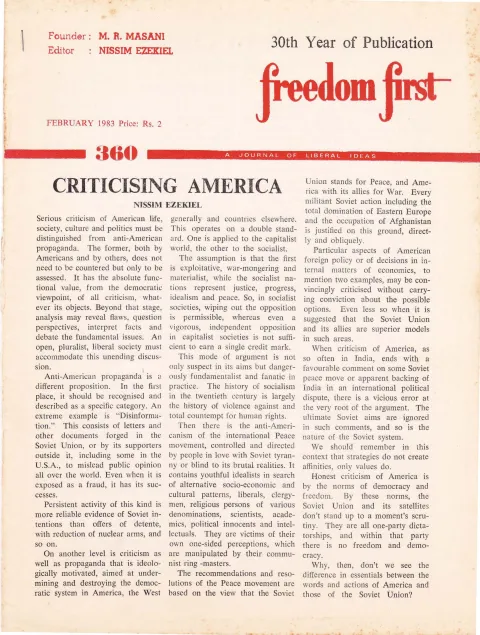
periodical issue
Freedom First
A Journal of Liberal Ideas
Published for the Democratic Research Service by J. R. Patel, Associate Editor, Freedom First at 127, Mahatma Gandhi Road, Bombay 400 023 (Phone: 273914) and Printed by him at The Popular Press (Bom.) Pvt. Ltd, 35C Tardeo Road, Bombay 400 034 · Bombay · 1983
16 pages
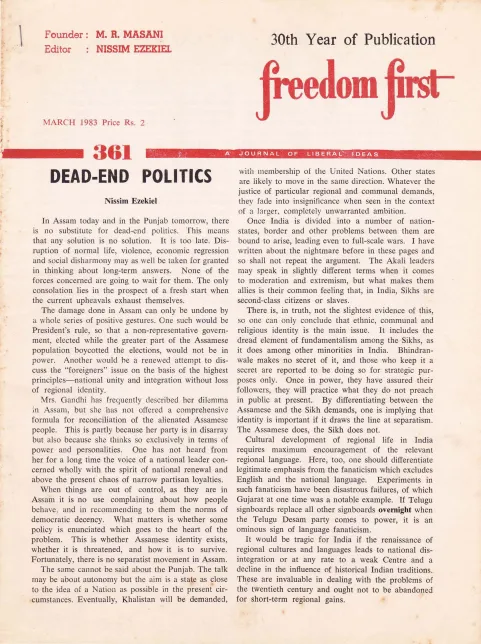
Freedom First
Summary
This is issue 361 of Freedom First (March 1983, Bombay), a monthly journal of liberal ideas founded by M. R. Masani and edited by Nissim Ezekiel in its 30th year of publication. The issue opens with Ezekiel’s own editorial on the deadlocked Assam and Punjab crises, warning against regional and communal fragmentation, then moves through a mix of staff commentary, geopolitics, religion-and-science debate, a defence of Muslim MPs against charges of communalism, a critique of a Madhya Pradesh ordinance prescribing harsh punishments, and a book review of Maxime Rodinson’s Marxism and the Muslim World. Contributors include Freedom First regulars (K. S. Venkateswaran, Minoo Masani) alongside outside writers (Rama Swarup, Aziz Madni, Manmohan Choudhuri, A. Solomon), reflecting the journal’s mix of in-house liberal commentary and guest polemic on politics, civil liberties, and Cold War-era international affairs.
Key points
-
Nissim Ezekiel’s editorial “Dead-End Politics” argues the Assam and Punjab crises have reached a point where no short-term solution remains possible, criticises Indira Gandhi for lacking a reconciliatory formula, and warns that separatist demands culminating in Khalistan could fragment India into warring nation-states.
-
K. S. Venkateswaran’s “A Variety of Comment” endorses Peter Bauer’s critique of the Brandt Commission’s “vicious circle of poverty” thesis, questions the legal reasoning behind Bombay pavement-dwellers’ constitutional claims, and surveys Amnesty International’s report on torture under Pakistan’s martial law regime.
-
Rama Swarup’s piece marking three years of Soviet intervention in Afghanistan documents Soviet forces growing to over 130,000 troops, resistance forces quintupling to over 100,000 fighters, and more than 2.8 million Afghan refugees fleeing to Pakistan and Iran.
-
Minoo Masani recounts his visit to Taiwan for World Freedom Day, contrasting Taiwan’s economic progress with the mainland through comparative income and wage statistics, and criticises President Reagan’s “China Card” diplomacy toward Peking as ineffective.
-
A. Solomon, President of the Maharashtra Rationalist Association, argues in “Science and Moral Values” that ethical values arise from reason applied to social experience rather than religious faith, and that religion has become an obstacle to social progress.
-
Aziz Madni’s “Yes, In the Name of Secularism!” defends the memorandum by 45 Muslim MPs against the RSS and Vishva Hindu Parishad, accusing an earlier Freedom First article by Nitin Raut of tendentious and selective quotation.
-
Manmohan Choudhuri’s “Brutalising the Polity” criticises a Madhya Pradesh ordinance imposing the death penalty for offences like bribery and illicit tree-felling, warning such measures may be used to intimidate the Opposition rather than curb corruption.
-
Mary Thomas and Thomas George review Maxime Rodinson’s “Marxism and the Muslim World,” summarising his argument that Marxist practice never escaped the spirit of colonialism and that Islamic sharia is not inherently incompatible with socialist strategy.
Essays
Dead-End Politics
By Nissim Ezekiel
Nissim Ezekiel’s editorial ‘Dead-End Politics’ argues that the crises in Assam and, prospectively, Punjab have reached a point where no solution remains possible in the short term, and that disruption, violence and economic regression must be accepted as the price of a future fresh start. He criticises Indira Gandhi for lacking a comprehensive reconciliation formula for Assam, argues that Sikh grievances in Punjab are, in truth, expressions of ethnic and religious identity politics rather than genuine discrimination, and warns that separatist demands (culminating in Khalistan) could fragment India into competing nation-states prone to war. He closes by cautioning that regional-language chauvinism (citing Gujarat and the Telugu Desam party’s signboard policy) threatens national integration and a weakened centre.
- Argues dead-end politics in Assam and Punjab means ‘any solution is no solution’ at this stage
- Calls for President’s rule in Assam and renewed negotiation on the ‘foreigners’ issue
- Criticises Indira Gandhi for lacking a national, reconciliatory voice above partisan politics
- Frames Sikh grievance under Bhindranwale as identity/fundamentalism rather than genuine second-class treatment
- Warns that a fragmented India of ethnic nation-states risks border wars
- Cites Gujarat’s language-signboard fanaticism and the Telugu Desam party as a cautionary example
A Variety of Comment (International Redistributionism; The Pavement-Dwellers’ Rights; Human Rights in Pakistan)
By K. S. Venkateswaran
K. S. Venkateswaran’s regular ‘A Variety of Comment’ column covers three items. First, he criticises the Brandt Commission’s renewed call for restructuring the international economic order, endorsing Peter Bauer’s critique (in Dissent on Development) of the ‘vicious circle of poverty’ thesis as empirically unsupported and politically motivated. Second, he argues that press coverage defending Bombay pavement-dwellers’ constitutional ‘right’ to occupy public land under Articles 14 and 21 rests on a confused and ultimately absurd extension of constitutional doctrine. Third, he surveys Amnesty International’s report on human rights abuses under Pakistan’s martial law regime under General Zia-ul-Haq, citing torture, incommunicado detention, and deaths in custody, alongside Zia’s ruling that two women’s testimony equals one man’s under Islamic law.
- Critiques the Brandt Commission report’s call for radical restructuring of the international economic order
- Endorses Peter Bauer’s Dissent on Development as debunking the ‘vicious circle of poverty’ thesis
- Argues the pavement-dwellers’ constitutional rights case (Articles 14 and 21) rests on flawed legal reasoning
- Surveys Amnesty International’s 1983 report on torture and detention under Pakistan’s Martial Law Regime
- Notes Zia-ul-Haq’s ruling equating two women’s testimony to one man’s under Islamic law reforms
Three Years of Soviet Intervention in Afghanistan
By Rama Swarup
Rama Swarup’s numbered analytical piece marks three years of Soviet military intervention in Afghanistan, documenting the growth of Soviet forces to over 130,000 troops, the weakness and demoralisation of the Afghan army, the quintupling of resistance forces to over 100,000 fighters, factional bloodletting within the Afghan Communist Party (Karmal’s Parcham wing versus the Khalq group), and the economic subjugation of Afghanistan to Soviet supply needs. It closes by noting international condemnation of the occupation, including criticism from Indira Gandhi during her September 1982 Moscow visit, and ongoing Geneva negotiations under UN auspices.
- Soviet forces in Afghanistan have grown from 30,000 to over 130,000 combat troops since the December 1979 invasion
- Afghan army has fallen to under 40,000 men amid mutinies, desertions, and forced recruitment
- Resistance forces have quintupled to over 100,000 fighters controlling most rural districts
- Documents a violent factional feud between Babrak Karmal’s Parcham wing and the Khalq group
- More than 2.8 million Afghan refugees have fled to Pakistan and Iran
- Notes Indira Gandhi’s public criticism of Soviet occupation during her September 1982 Moscow visit
- UN-sponsored Geneva talks between Afghan and Pakistani governments began in June 1982
A Visit to Free China
By Minoo Masani
Minoo Masani, reprinted from The Statesman’s ‘As I See It’ column, recounts his visit to the Republic of China (Taiwan) for World Freedom Day on 23 January, invited by the World Anti-Communist League. He recalls his 1963 visit and interview with Chiang Kai-shek, contrasts Taiwan’s economic progress against mainland China (citing per-capita income, wages, electricity consumption and calorie intake figures favouring Taiwan), and argues that both Moscow and Peking’s systems are equally to be rejected. He criticises U.S. President Reagan’s ‘China Card’ diplomacy toward Communist China as yielding no benefit to the U.S. and argues peace is indivisible between Europe and Asia, citing the Afghanistan invasion as evidence the focus of communist aggression has shifted East.
- Masani attended Taiwan’s World Freedom Day (23 January) as a guest of the World Anti-Communist League
- Recalls a 1963 interview with President Chiang Kai-shek and reporting to Nehru afterward
- Cites comparative statistics: Taiwan per-capita income $2265 vs. $238 on the mainland; monthly wage $91.7 vs. $12.4
- Argues both Soviet and Chinese communist systems are equally to be rejected, invoking Gandhi’s rejection of ‘the lesser evil’
- Criticises the U.S. ‘China Card’ strategy toward Peking as ineffective and unreciprocated
- Frames the Afghanistan invasion as evidence that communist aggression’s focus has shifted from Europe to Asia
Science and Moral Values
By Mr. A. Solomon
A statement by A. Solomon, President of the Maharashtra Rationalist Association and the Indian Secular Society, delivered at a Nehru Centre/Bharatiya Vidya Bhavan seminar on ‘Scientific Temper and Spiritual Values.’ Solomon argues that moral and ethical values arise from reason applied to social experience, not from religion or spirituality, and that religion has become an obstacle to social and cultural progress by resting on unquestionable faith and authority. He rejects the claim that transcendental religious wisdom is the true source of moral values, arguing instead that science and philosophy together provide a comprehensive, evolving world-view capable of grounding ethics.
- Argues moral and ethical values derive from reason and social experience, not religious faith
- Rejects the framing of the seminar topic, preferring ‘Scientific Temper and Moral or Ethical Values’ to ‘Spiritual Values’
- Challenges the claim that religion is the transcendental source of universal moral values
- Argues the abolition of practices like sati shows moral revulsion, not religion, refining religious belief
- Contends religions became dogmatic creeds based on unquestionable faith once reasoned inquiry was discarded
- Concludes science and philosophy provide the wisdom needed to meet the modern world’s challenges
Yes, In the Name of Secularism!
By Aziz Madni
Aziz Madni responds to an earlier Freedom First article (by Nitin C. Raut, ‘In the Name of Secularism’, February 1983) which criticised a memorandum by 45 Muslim MPs demanding a ban on communal para-military organisations such as the RSS and Vishva Hindu Parishad. Madni defends the memorandum as legitimate, accuses Raut of double standards and selective quotation (particularly of Syed Shahabuddin), and marshals counter-citations from A. G. Noorani, M. V. Kamath, and V. V. John to argue that Muslim grievances over police complicity in communal violence are genuine rather than communalist provocation.
- Defends the memorandum by 45 Muslim MPs demanding a ban on communal paramilitary organisations
- Accuses Nitin Raut’s earlier Freedom First article of tendentious and one-sided argument
- Cites A. G. Noorani’s charge of hypocrisy in labelling Muslim grievance gatherings as ‘communal’
- Quotes M. V. Kamath’s MID-DAY commentary defending Syed Shahabuddin’s remarks from being read out of context
- Cites V. V. John’s Indian Express column noting MPs are being ‘warned’ for raising police complicity in anti-Muslim violence
Brutalising the Polity
By Manmohan Choudhuri
Manmohan Choudhuri (an SPS Feature syndicated piece) criticises a Madhya Pradesh ordinance imposing harsh punishments, including the death penalty, for offences like bribery, illicit tree-felling, and adulterated liquor causing death. He argues the ordinance reflects a broader authoritarian drift and public appetite for ‘tough’ measures, but contends that crime levels correlate inversely with a society’s moral tone, not the harshness of its laws, and warns that such ordinances and press-restricting bills may be used to harass opposition and critics rather than genuinely combat corruption, given that the ruling party’s own members commit the same offences with impunity.
- Critiques an MP ordinance prescribing death penalty and harsh punishment for bribery, tree-felling, and other offences
- Notes proposals for anti-hijacking laws and special courts for communal and economic offences
- Argues brutality-as-deterrent is an age-old but discredited belief, citing worldwide abolition of the death penalty in about two dozen countries
- Contrasts India’s drift toward harsher penal measures with the global anti-death-penalty movement
- Warns the M.P. Ordinance and related press-restricting legislation (referencing the Bihar Press Bill) may be used to intimidate the Opposition rather than curb official corruption
- Calls for the civil liberties movement to scrutinise the M.P. Ordinance thoroughly
Book Review: Marxism and the Muslim World by Maxime Rodinson (trans. Michael Pallis)
By Mary Thomas and Thomas George
Mary Thomas and Thomas George review Maxime Rodinson’s Marxism and the Muslim World (Orient Longman, translated by Michael Pallis). The review traces Rodinson’s biography as a former French Communist Party member expelled in 1958 who became a critic of Soviet Marxism, and summarises his arguments: that revolution is an ongoing, unending process; that Marxist practice has not escaped the spirit of colonialism, illustrated through the case of Tartar Bolshevik Sultan Galiev; and that Islamic sharia is not inherently incompatible with socialist strategy, as illustrated by Nasser’s Egypt. The reviewers note Rodinson’s pessimism, expressed in his 1978 preface, about the entrenchment of reactionary systems funded by oil money in the Muslim world.
- Reviews Maxime Rodinson’s Marxism and the Muslim World, translated by Michael Pallis (Orient Longman, Rs. 80)
- Traces Rodinson’s biography from French Communist Party member (1937) to expulsion in 1958 over Soviet-era doubts
- Summarises Rodinson’s case study of Tartar Bolshevik Sultan Galiev as evidence Marxist practice retained colonialist attitudes
- Notes Rodinson’s view that sharia and socialist strategy are not inherently incompatible, citing Nasser’s Egypt
- Reports Rodinson’s 1978-preface pessimism about oil-money entrenching reactionary systems in Muslim-majority countries
Generated by the v1.5 extraction pipeline. Awaiting editorial review.
Metadata and summary are AI-extracted from the source PDF and reviewed for editorial accuracy. The original work is available via the Read PDF tab above (where present); paragraph-level citation inside the PDF is deferred to a future engagement.