periodical issue
Freedom First
A Journal of Liberal Ideas
By M. R. Masani, SUMANT BANKESHWAR, M. B. Shah, S. I. Clerk, Satish J. Shah
Published for the Democratic Research Service by J. R. Patel, Associate Editor, Freedom First at 127, Mahatma Gandhi Road, Bombay-400 023 (Phone: 273914) and Printed by him at The Popular Press (Bom.) Pvt. Ltd., 35C Tardeo Road, Bombay 400 034 · Bombay · 1984
16 pages
Freedom First
Summary
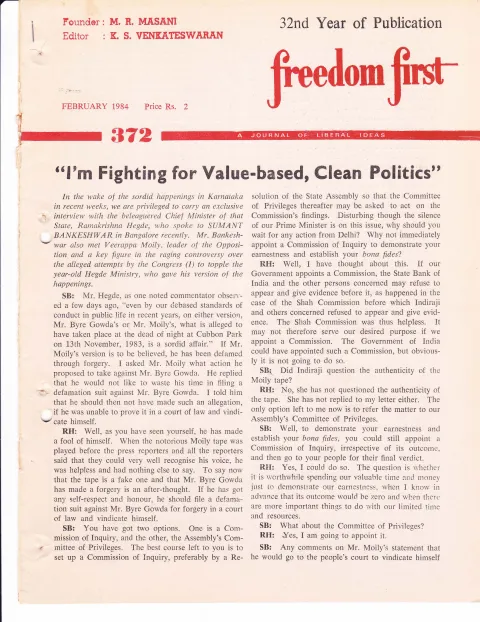
Freedom First No. 372 (February 1984) is dominated by the Karnataka political crisis: a pair of paired interviews with Chief Minister Ramakrishna Hegde and Opposition leader Veerappa Moily on the ‘Moily tape’ scandal and allegations of Congress(I) attempts to topple the year-old Janata ministry through defection and bribery. Founder-editor content includes Minoo Masani’s ‘As I See It’ column defending the U.S./Caribbean intervention in Grenada (with a reader’s rebuttal letter and Masani’s promised reply elsewhere in the issue) and K. S. Venkateswaran’s editorial on the U.S. withdrawal from UNESCO. The issue also reports the inaugural function of the newly launched Freedom First Foundation (a tribute to George Orwell’s 1984), carries a book review of an anti-Soviet account of the Afghan war, a theatre and chamber-music cultural roundup, a reader’s-letters page, and the recurring ‘With Many Voices’ quotations column.
Key points
-
Sumant Bankeshwar’s exclusive interview with Karnataka Chief Minister Ramakrishna Hegde has him defending his Janata ministry against Congress(I) defection attempts and the “Moily tape” bribery controversy, framing his politics as a fight for “value-based, clean politics.”
-
A companion interview with Opposition leader Veerappa Moily has him denying the authenticity of the “Moily tape,” calling it “nothing but political vendetta,” and preferring to contest the issue in the next election rather than in court.
-
Minoo Masani’s “As I See It” argues subsequent developments, including a Commonwealth refusal to condemn the action and a Grenadian petition for continued U.S. association, have vindicated his earlier support for the Grenada intervention.
-
K. S. Venkateswaran’s “Calling UNESCO’s Bluff” defends the Reagan Administration’s withdrawal from UNESCO, citing a Heritage Foundation study accusing the body of wasting money and inadvertently aiding “Marxist guerilla-terrorist groups.”
-
A news item reports the Freedom First Foundation’s inaugural function, “1984: A Tribute to George Orwell,” with Nissim Ezekiel praising Orwell’s invention of “Newspeak” and P. G. Mavalankar arguing totalitarianism must be actively resisted.
-
A reader’s letter from Satish J. Shah disputes Masani’s Grenada article, citing the 1973 CIA-linked overthrow of Chile’s elected government as grounds for scepticism about U.S. motives.
-
M. B. Shah reviews S. K. Bain’s “Afghanistan Will Not Die,” describing Soviet economic exploitation of Afghanistan and criticising the Indian government for failing to denounce the invasion.
-
S. I. Clerk’s “Cultural Roundabout” reviews the NCPA production of Jean Kerr’s “Mary Mary” and a chamber-music concert by the New London Wind Trio.
Essays
”I’m Fighting for Value-based, Clean Politics” (interview with Ramakrishna Hegde)
By SUMANT BANKESHWAR
No summary was extracted for this article. Listed for completeness.
”I’ll Take the Matter to the People’s Court” - Moily (interview with Veerappa Moily)
By SUMANT BANKESHWAR
An exclusive two-part interview conducted by Sumant Bankeshwar with Karnataka Chief Minister Ramakrishna Hegde, in which Hegde defends his year-old Janata ministry against Congress(I) efforts to engineer defections, discusses the ‘Moily tape’ bribery controversy, explains why he will not set up a Commission of Inquiry (citing the precedent of the Shah Commission), announces he will refer the matter to the Assembly’s Committee of Privileges, and describes his anti-defection and Lok Ayukta bills. Hegde argues that Karnataka’s Janata Party, though made up mostly of ex-Congressmen, represents a break from the ‘alien’ post-1969 Congress culture introduced by Indira Gandhi, and frames his politics as a fight for ‘value-based, clean politics’ against money- and power-driven public life.
- Hegde says he will not appoint a Commission of Inquiry because parties could refuse to appear before it (as happened with the Shah Commission), but will refer the bribery allegations to the Assembly’s Committee of Privileges.
- Hegde states some of his MLAs were offered Rs. 20-25 lakh to defect but refused, and calls a potential defector ‘very much afraid of the public reaction.’
- He distinguishes the ‘original’ pre-1969 Congress culture from the culture created after the Congress split by Indira Gandhi, which he says introduced defection politics.
- Hegde defends his minority government’s legitimacy by pointing to Indira Gandhi’s own minority government in Delhi after the 1969 split, and to the Congress(I) government in Kerala with only 15 members.
- He frames his project as promoting ‘value-based, clean politics’ in contrast to money-oriented politics, contrasting it with the patriotism-driven politics of the freedom struggle.
Calling UNESCO’s Bluff
By K. S. Venkateswaran
A companion interview, conducted 16 December 1983, with Opposition leader Veerappa Moily, who denies the authenticity of the so-called ‘Moily tape’ used to allege he took a bribe, calls it ‘nothing but political vendetta,’ and says he would rather ‘take the matter to the people’s court’ through the next election than pursue a defamation suit or judicial inquiry. The interviewer plays the tape for him during the interview and reports it as ‘hardly audible,’ with Moily’s voice unrecognisable. Moily also criticises the Hegde government as a minority administration propped up by defectors, comparing it to Indira Gandhi’s minority government in Delhi after the 1969 split.
- Moily calls the tape used against him ‘a fake one’ and ‘nothing but political vendetta,’ declining to sue Byre Gowda alone and instead threatening suit against all newspapers that published on it.
- When the tape is played during the interview, the reporter notes it is ‘hardly audible’ and Moily’s voice ‘cannot be recognised.’
- Moily says he would rather contest the issue in the next election (‘the people’s court’) than pursue courts or commissions.
- He argues the Janata Party in Karnataka is a party of ‘ticketless Congressmen’ living ‘on oxygen in an intensive care unit’ and predicts its imminent collapse.
- Moily challenges the legitimacy of Hegde’s minority government, drawing a parallel to Indira Gandhi’s minority government in Delhi before the 1971 elections.
As I See It
By Minoo Masani
Minoo Masani’s regular ‘As I See It’ column returns to the subject of the U.S./Caribbean intervention in Grenada, arguing that subsequent developments — including an apology by U.S. House Democrats who toured the island, a New York Times advertisement in which 110 Britons apologised to Reagan, the Commonwealth Heads of Government meeting’s refusal to condemn the intervention, the full U.S. withdrawal of forces, and a Grenadian petition for continued U.S. association — have vindicated his earlier support for the action, contrary to a Congress(I) resolution in Calcutta condemning the ‘overthrow of the Communist tyranny in Grenada.’
- Masani responds to a Congress(I) party resolution in Calcutta condemning the Grenada intervention by listing facts he says vindicate his earlier support.
- He cites House Speaker Thomas P. O’Neill’s reversal, from opposing to endorsing Reagan’s Grenada action after touring the island.
- He notes a New York Times advertisement in which 110 Britons, including Conservative MPs, apologised to Reagan for earlier British criticism.
- He notes the Commonwealth Heads of Government meeting in New Delhi refused to condemn the intervention, and that U.S. forces have since fully withdrawn.
- He reports that thousands of Grenadian citizens signed a petition seeking continued U.S. association for stability and protection from Soviet/Cuban influence.
Essay 4
By K. S. Venkateswaran
K. S. Venkateswaran’s editorial ‘Calling UNESCO’s Bluff’ defends the Reagan Administration’s December 1983 decision to withdraw the U.S. from UNESCO, arguing the move was well-considered (following a State Department review of 96 international organisations) and citing a Times of London editorial and a Heritage Foundation study accusing UNESCO of wasting money, promoting a ‘new world information and communications order’ as cover for authoritarian control of media, and inadvertently aiding ‘Marxist guerilla-terrorist groups.’ The piece concludes the U.S. has left the door open to reconsider if UNESCO reforms before the year’s end.
- The withdrawal followed a State Department review of U.S. participation in 96 international organisations.
- A Times of London editorial is quoted calling UNESCO’s activities wasteful and its ‘new world information and communications order’ a cover for authoritarian control of information.
- A Heritage Foundation U.N. Assessment Programme study is cited claiming the U.S. inadvertently supports ‘Marxist guerilla-terrorist groups’ through the U.N. and that KGB agents hold high U.N. positions.
- The editorial frames the withdrawal as an act of ‘courage and decisiveness’ by the Reagan Administration.
- It notes Washington signalled willingness to reconsider if UNESCO reformed before the end of the year.
Freedom First Foundation Launched
A short news item reports the inaugural function of the Freedom First Foundation, held 10 January 1984 at the Indian Merchants’ Chamber Committee Room in Bombay under the chairmanship of M. R. Masani, with a programme titled ‘1984: A Tribute to George Orwell’ featuring lectures by Nissim Ezekiel and P. G. Mavalankar. Masani outlined the Foundation’s mission as a non-partisan educational charitable trust promoting the values of a free society through lectures, seminars, and publications; Ezekiel eulogised Orwell as a sceptic and master of English prose whose invention of ‘Newspeak’ illuminated language’s role in self-deception; Mavalankar argued Orwell’s message was that totalitarianism, while not inevitable, must be actively resisted.
- The Freedom First Foundation held its inaugural function on 10 January 1984 at the IMC Committee Room, Bombay, chaired by M. R. Masani.
- The programme, titled ‘1984: A Tribute to George Orwell,’ featured lectures by Nissim Ezekiel and P. G. Mavalankar (Director, Harold Laski Institute, Ahmedabad).
- Masani described the Foundation as a non-partisan educational and charitable trust for promoting the values and ideals of a free society.
- Ezekiel praised Orwell’s precision and his understanding of language’s role in self-deception, citing ‘Newspeak.’
- Mavalankar argued Orwell’s central message was that totalitarianism can be resisted with courage, drawing relevance to recent events in India and abroad.
A Letter (on “Rescue, Not Invasion”, re: Grenada)
By Satish J. Shah
A reader’s letter from Satish J. Shah of Bombay disputes Minoo Masani’s earlier article ‘Rescue, Not Invasion’ (FF, Dec. 1983), arguing that India is not comparable to Grenada in scale, and that the U.S. intervention was motivated by opportunism and self-interest rather than principle, citing the CIA-backed 1973 coup against Chile’s elected Marxist government as a precedent for scepticism about U.S. motives, and speculating that mineral or oil resources near Grenada may explain the intervention.
- The letter-writer rejects Masani’s comparison between a hypothetical Indian scenario and Grenada, noting Grenada’s entire population could fit in Bombay’s Brabourne and Wankhede stadia.
- He argues disclosures show the U.S. had contemplated the attack and held military exercises in preparation before Maurice Bishop’s death.
- He cites the 1973 CIA-linked overthrow of Chile’s elected Marxist government as an example of U.S. opportunism disguised as principle.
- He speculates that oil or mineral discovery near Grenada might explain the U.S. action and predicts multinational companies will be given rights to exploit it.
- A note indicates Masani’s reply to this line of argument appears elsewhere in the same issue (page 5).
Book Review: Afghanistan Will Not Die by S. K. Bain
By M. B. Shah
A book review by M. B. Shah of S. K. Bain’s ‘Afghanistan Will Not Die’ (1982) praises the book’s account of the Soviet invasion and occupation of Afghanistan, describing Soviet economic exploitation (gas exports, gemstone expropriation, forced cotton cultivation), Mujahedin resistance controlling most rural and urban areas, and heavy Afghan and Soviet casualties, while criticising the Indian government for failing to denounce the invasion despite its threat to regional security.
- The review describes the book’s account of the 1979 Soviet invasion, the killing of Hafizullah Amin, and the installation of Babrak Karmal.
- It cites Soviet economic exploitation: gas priced far below international rates, expropriation of 275 tons of lapis lazuli, and forced conversion of Afghan agriculture to cotton.
- It reports Mujahedin control of roughly 90% of urban and rural areas versus Soviet control of about 10%.
- Casualty figures cited: roughly 8,000 Russian casualties (2,000 dead, 6,000 wounded) by March 1982, versus 3 lakh Afghan dead, 7 lakh wounded/disabled, and 35 lakh refugees.
- The review criticises the Indian government for failing to denounce the Soviet invasion despite India’s security being ‘vastly endangered.‘
Cultural Roundabout
By S. I. Clerk
A ‘Cultural Roundabout’ column by S. I. Clerk reviews the NCPA-sponsored theatre production of Jean Kerr’s ‘Mary Mary’ directed by Adi Marzban with Hosi Vasunia and Ruby Patel, and a chamber music soiree by the New London Wind Trio (Neil Black, Roger Birnstingl, Keith Puddy) at the Tata Theatre, covering works by Mozart, Telermann, Beethoven, Henri Tomasi, Jean Francaix, Alan Ridout, Malcolm Arnold, and Jacques Ibert.
- The ‘Mary Mary’ review praises the cast’s naturalism and Adi Marzban’s direction, calling the plot ‘entirely predictable’ but well executed.
- The New London Wind Trio concert at the Tata Theatre featured eight pieces of German, French, and English chamber music.
- Highlighted pieces include Mozart’s Divertimento No. 5, Beethoven’s Duo No. 3, and Jacques Ibert’s Five Pieces for Reed Trio.
- The concert was co-sponsored by the British Council, the NCPA, and the Hongkong Bank.
Generated by the v1.5 extraction pipeline. Awaiting editorial review.
Metadata and summary are AI-extracted from the source PDF and reviewed for editorial accuracy. The original work is available via the Read PDF tab above (where present); paragraph-level citation inside the PDF is deferred to a future engagement.