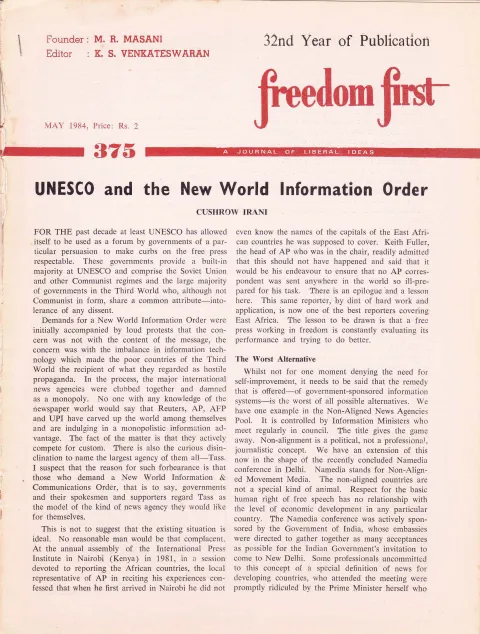
periodical issue
Freedom First
A Journal of Liberal Ideas
By Minoo Masani
Published for the Democratic Research Service by J. R. Patel, Associate Editor, Freedom First at 127, Mahatma Gandhi Road, Bombay 400 023 (Phone: 273914) and Printed by him at The Popular Press (Bom.) Pvt. Ltd., 35C Tardeo Road, Bombay 400 034 · Bombay · 1984
16 pages
Freedom First
Summary
This is issue No. 374 of Freedom First (April 1984, Rs. 2), the Bombay-based journal of liberal ideas founded by M. R. Masani and edited by K. S. Venkateswaran, published for the Democratic Research Service. The issue opens with the first instalment of Vladimir Voinovich’s first-person account (carried courtesy Radio Liberty) of his years-long persecution and expulsion from the USSR Union of Writers, illustrating the precariousness of freedom of expression in the Soviet Union. Founder M. R. Masani’s regular column ‘As I See It’ (reprinted from The Statesman) attacks the 1984 Union Budget’s tax and deficit-finance burden, contrasts it with Margaret Thatcher’s low-tax approach in Britain, reports on Nani Palkhivala’s budget speech at the Forum of Free Enterprise, and argues for winding up LIC’s life-insurance monopoly. Peter Sager (courtesy Swiss Press Review and News Report) reports from a visit to Sandinista Nicaragua, contrasting the regime’s official narrative of reform and non-alignment with what he found: continued militarisation, restrictions on emigration, censorship of the opposition paper Prensa, and an internal Sandinista document candidly avowing a Marxist-Leninist path to socialism. A ‘Cultural Roundabout’ column by S. I. Clerk reviews a Rosalind Solomon photography exhibition on Indian festivals and a retrospective of sculptor Pilloo Pochkhanawala. Book review pages cover the World Bank’s World Development Report 1983 (reviewed by Prof. B. P. Adarkar) and Alvin Toffler’s The Third Wave (reviewed by Gayatri Jayant, who reads it as heralding a ‘neo-Gandhism’ to replace Marxism). The issue closes with a page of quotations from the world press (‘With Many Voices’) and publisher notices/subscription information.
Key points
-
Vladimir Voinovich’s first-person account “Ten Years On” describes his years of harassment and 1974 expulsion from the USSR Union of Writers for refusing to withdraw his 1968 signature defending dissident writers.
-
Minoo Masani’s “As I See It” attacks the Union Budget’s combination of higher taxation and deficit financing, contrasts it with Margaret Thatcher’s low-tax approach, and calls for abolishing LIC’s life-insurance monopoly.
-
Peter Sager’s “Nicaragua: The Official Version and the Real Thing” contrasts Sandinista officials’ claims of reform and non-alignment with growing militarisation, unheld elections, and a leaked document explicitly describing socialism as a step toward communism.
-
S. I. Clerk’s “Cultural Roundabout” covers a Rosalind Solomon photography exhibition on Indian festivals and a three-decade retrospective of sculptor Pilloo Pochkhanawala.
-
Prof. B. P. Adarkar reviews the World Bank’s “World Development Report 1983,” noting developing-country debt projected to reach $1,997 billion within a decade and criticising the report for ignoring superpower arms spending’s distorting effect on the global economy.
-
Gayatri Jayant reviews Alvin Toffler’s “The Third Wave,” framing its vision of decentralised, electronic-cottage economies as a modernised “Neo-Gandhism” that will replace Marxism.
Essays
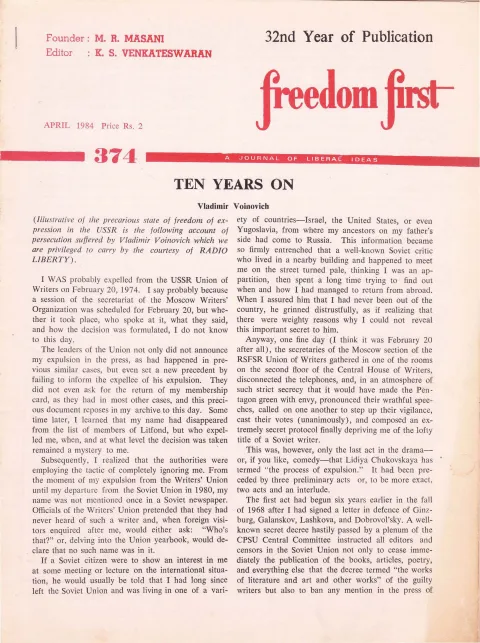
Ten Years On
By Vladimir Voinovich
Vladimir Voinovich narrates, in the first person, the circumstances of his expulsion from the USSR Union of Writers on (probably) February 20, 1974, and the years of harassment that preceded it. He describes the Soviet authorities’ tactic of erasing him from public existence — banning his books, stripping his name from broadcasts and print, and pressuring him to recant his 1968 signature on a letter defending dissident writers Ginzburg, Galanskov, Lashkova, and Dobrovol’sky. The account (continued from page 2 on pages 7-8) details two secretariat sessions of the Moscow Union of Writers at which colleagues — including KGB-linked officials — pressed him to disavow his novel (referred to obliquely as anti-Soviet, anti-popular, and ‘written on the orders of the CIA’), an ordeal that ended with a formal reprimand rather than expulsion, followed a year later by publication abroad of Chonkin and a second, ‘final’ warning in December 1970. The excerpt ends noting a second instalment will run in the next issue.
- Voinovich was expelled from the USSR Union of Writers around February 20, 1974, though the exact proceedings were never disclosed to him.
- The authorities’ preferred tactic was total erasure: banning his books, refusing to print his name, and instructing editors/censors to cease all mention of him.
- His plays ‘Khochu byt chestnym’ and ‘Dva tovarishcha’ were pulled from some 50 theatres, risking punishment of actors uninvolved in his ‘offense.’
- The persecution intensified after he refused, under pressure from Moscow Party Secretary Anna Shaposhnikova and others, to withdraw his 1968 signature on a letter defending dissident writers.
- Two secretariat sessions (1969 and December 1970) probed his ‘ideologically damaging’ unpublished novel, with KGB-linked figures like Viktor Il’in and colonel Mikhail Bragin present.
- Publication abroad (in the emigre journal Grani) of the first part of his novel Chonkin triggered a fresh round of pressure and a ‘last warning.’
- By late 1972 two of his books were allowed to be published simultaneously, which Voinovich frames as the authorities mistakenly believing they had broken him.
- The piece is credited as appearing by courtesy of Radio Liberty; a second instalment is promised for the next issue.
As I See It
By Minoo Masani
Minoo Masani’s column criticises the Union Budget for raising Rs. 230 crores in additional taxation and Rs. 1762 crores in deficit finance, arguing that only a massive cut in wasteful public expenditure — not more taxation — could have avoided further inflation. He contrasts this with Margaret Thatcher’s low-tax, ‘enterprise culture’ approach in Britain, reports approvingly on Nani Palkhivala’s Forum of Free Enterprise budget speech (and plugs Palkhivala’s book We, The People), and closes by arguing that LIC’s life-insurance monopoly — a legacy of C. D. Deshmukh’s tenure as Finance Minister under Nehru — should be abolished in favour of private enterprise and competition.
- Masani attacks the Union Budget’s combination of higher taxation and deficit financing as continuing two decades of fiscal drift.
- He invokes Winston Churchill’s description of a socialist society as one ‘in which nobody counts for anything except a politician and an official.’
- He contrasts India’s budget unfavourably with Margaret Thatcher’s UK approach of cutting public expenditure to permit lower taxes.
- He reports on Nani Palkhivala’s widely attended Forum of Free Enterprise speech on the budget and promotes Palkhivala’s book We, The People.
- He argues the LIC (Life Insurance Corporation) monopoly, created under C. D. Deshmukh to please Nehru, should be broken up in favour of private, competitive insurance.
Nicaragua: The Official Version and the Real Thing
By Peter Sager
Peter Sager reports on a visit to Sandinista-controlled Nicaragua, contrasting the official version of events given to him by Sub-Comandante Rafael Solis Cerda with the situation he observed. Solis claimed continued private ownership of much of the economy, non-aligned foreign policy, and remedial efforts among the Miskito Indians, but Sager finds the promised 1981 elections still not held, growing militarisation of a country whose army grew from 7,000 to 40,000, restrictions on emigration, and continued repression of the Miskitos despite admitted ‘mistakes.’ He cites a leaked 1982 internal Sandinista document explicitly describing socialism as a step toward communism, and highlights press censorship targeting the opposition paper Prensa following the 1978 murder of its editor Pedro Joaquin Chamorro Sr.
- Sager was received not by junta members but by Sub-Comandante Rafael Solis Cerda, who gave the ‘official version’ of the Sandinista revolution’s progress.
- Solis claimed two-thirds of the economy remained in private hands and cited agricultural and educational reforms, while admitting ‘mistakes’ regarding the Miskito Indians of the Atlantic Coast.
- The promised elections within two years of the 1979 revolution have not been held; new electoral law is not expected before 1985, and the opposition threatens a boycott.
- The army has grown from 7,000 under Somoza to 40,000, with a further 200,000-strong militia planned, alongside restrictions on university access and emigration.
- A leaked internal document (August 1982) analysing the slogan ‘Defend the revolution in order to build socialism’ explicitly frames socialism as a step toward communism.
- Opposition newspaper Prensa faces daily censorship; its former editor Pedro Joaquin Chamorro Sr. was murdered in January 1978, a killing widely attributed to the Somoza regime.
Cultural Roundabout
By S. I. Clerk
S. I. Clerk’s ‘Cultural Roundabout’ column covers two Bombay exhibitions: a 40-photograph show by American photographer Rosalind Solomon on Indian festivals (shot 1981-82 across Himachal Pradesh, Bengal, Orissa, Tamil Nadu and Kerala, and slated to travel to the Smithsonian in 1985), and a three-decade retrospective of sculptor Pilloo Pochkhanawala’s work at the Jehangir Art Gallery, later remounted at the Tata Theatre.
- Rosalind Solomon’s USIS-organised photography exhibition focused on Indian festivals and social ethos, favouring posed portraits that foreground facial expression over documentary spontaneity.
- The exhibition was concurrently shown at the International Museum of Photography, New York, with a 1985 Smithsonian showing planned as part of the Festival of India in the US.
- Pilloo Pochkhanawala’s retrospective spanned 1954-1984 and around 80 works in varied materials, showing an evolution from ‘Metal Scapes’ and ‘Sea-scapes’ toward more metaphysical themes.
- The columnist notes Pochkhanawala is also a poet and designer, and suggests her drawings would have deepened the retrospective’s presentation of her sculptural work.
Book Reviews: World Development Report 1983
By Prof. B. P. Adarkar
Prof. B. P. Adarkar reviews the World Bank’s World Development Report 1983, the sixth in its annual series, noting its two parts (recent development trends, and a special section on management and institutional aspects of development). He summarises its findings that the 1982-anticipated recovery did not materialise in 1983, setting back global development ‘more decisively than at any time since the Great Depression’; that developing-country debt (estimated at $548 billion in 1982, projected to reach $1,997 billion within a decade) has become a severe burden; and that the Report calls for stimulating growth and curbing population growth. Adarkar criticises the Report for ignoring the distorting effect of the superpowers’ armaments expenditure on the global economy and inflation, closing with the question of whether 1984 and beyond will bring ‘All Well or Orwell.’
- The World Development Report 1983 was prepared by a World Bank team with contributors from the UN, ILO, IMF, and OECD.
- The Report states the 1982-anticipated global recovery failed to occur in 1983, setting back development ‘more decisively than at any time since the Great Depression.’
- Developing-country debt was $548 billion in 1982 and is projected to reach $1,997 billion within ten years; India’s international debt is cited at Rs. 23,500 crores, projected to reach Rs. 30,000 crores by 1988-89.
- China and India are noted as having weathered the recession with ‘encouraging resilience’ compared to many low-income African and Asian countries.
- Adarkar’s central critique is that the Report ignores how superpower armaments expenditure distorts the world economy and fuels non-stop hyperinflation.
- The review ends with a rhetorical flourish asking whether 1984 will be a year of ‘All Well or Orwell’ for developing and developed countries.
Book Reviews: The Third Wave: Neo-Gandhism in Place of Marxism
By Gayatri Jayant
Gayatri Jayant reviews Alvin Toffler’s The Third Wave, describing it as an illuminating analysis of a coming civilisational shift beyond the Agricultural and Industrial Revolutions. The review outlines Toffler’s forecasts — a new ‘electronic cottage’ economy, decentralised and semi-autonomous governance, de-massified media, and a return to a higher-technology ‘cottage industry’ — and frames this vision as a modernised, technologically updated version of Mahatma Gandhi’s ideals, concluding that Toffler’s ‘Neo-Gandhism’ will replace Marxism, which the reviewer calls ‘totally outdated.’
- Toffler’s The Third Wave is presented as a sweeping analysis of a civilisational shift following the Agricultural and Industrial Revolutions.
- The book forecasts the fall of bureaucracies, the reduced role of the nation-state, and the rise of semi-autonomous, post-imperialist economies.
- Mass media will be forced to share influence with ‘de-massified’ localised dailies and periodicals as the Third Wave advances.
- The Third Wave is said to revive cottage industry on an ‘electronic’ basis, echoing but modernising Mahatma Gandhi’s vision.
- The reviewer concludes that Toffler’s vision amounts to a ‘Neo-Gandhism’ that will supersede Marxism.
Generated by the v1.5 extraction pipeline. Awaiting editorial review.
Metadata and summary are AI-extracted from the source PDF and reviewed for editorial accuracy. The original work is available via the Read PDF tab above (where present); paragraph-level citation inside the PDF is deferred to a future engagement.