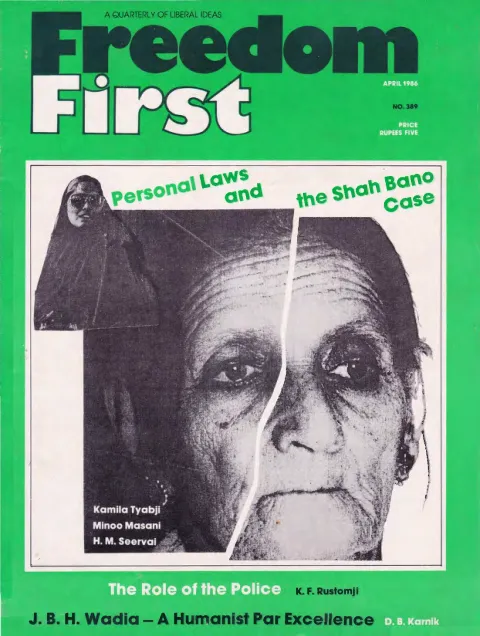
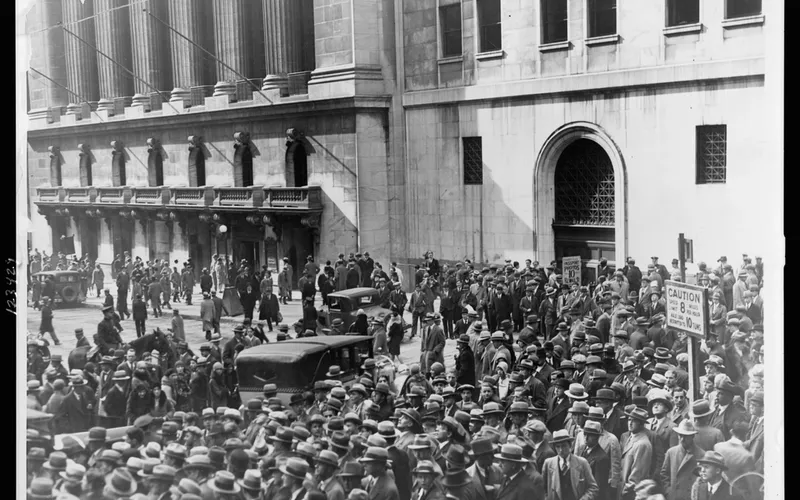
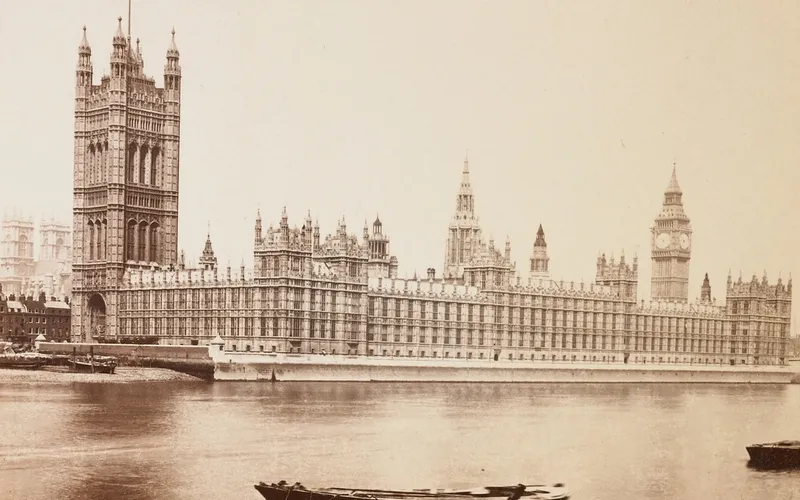
periodical issue
Freedom First
A Journal of Liberal Ideas
Published for the Democratic Research Service by J. R. Patel, Associate Editor, Freedom First at 127, Mahatma Gandhi Road, Bombay 400 023 (Phone: 273914) and Printed by him at The Popular Press (Bom.) Pvt. Ltd., 35C Tardeo Road, Bombay 400 034 · Bombay · 1985
16 pages
Freedom First
Summary
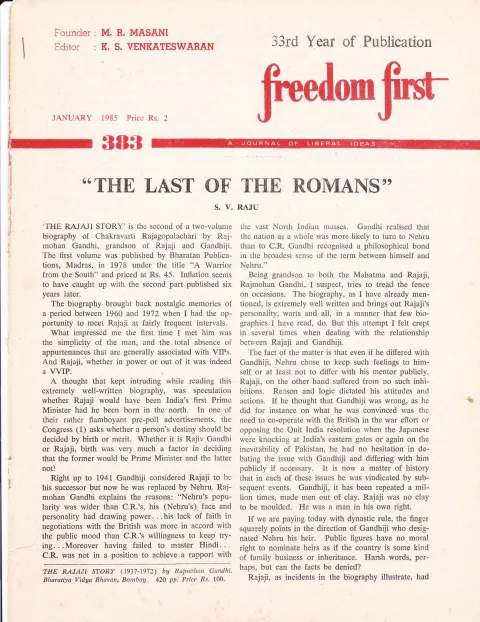
This is the January 1985 issue (No. 383, 33rd year of publication) of Freedom First, the Bombay liberal journal founded by M. R. Masani and edited by K. S. Venkateswaran. The issue opens with S. V. Raju’s review essay on Rajmohan Gandhi’s two-volume biography of C. Rajagopalachari, using the second volume, ‘The Rajaji Story (1937-1972),’ to reflect on Rajaji’s career, his rivalry and philosophical divergence from Nehru, and the founding of the Swatantra Party. Minoo Masani’s regular ‘As I See It’ column excoriates the Madhya Pradesh and central government response to the Bhopal gas disaster, attacking Chief Minister Arjun Singh’s conduct and the contradictory arrest and release of Union Carbide’s Warren Anderson. Rama Swarup contributes a short piece cataloguing Soviet defections in 1984, citing artists, soldiers, and Estonian citizens fleeing over Afghanistan war conscription and lack of artistic freedom. The issue closes with three book reviews (of a study of the Indian press, of ‘In Search of Excellence,’ and of a book on sex differences), a note on Karnataka’s small-industries schemes, and the ‘With Many Voices’ quotations column.
Key points
-
S. V. Raju’s “The Last of the Romans” reviews Rajmohan Gandhi’s “The Rajaji Story,” recalling how Gandhiji shifted his anointed successor from Rajaji to Nehru by 1941 and tracing Rajaji’s founding of the Swatantra Party at age 80.
-
Minoo Masani’s “As I See It” condemns the response to the Bhopal gas disaster, criticising Chief Minister Arjun Singh for touring with Rajiv Gandhi instead of resigning and detailing the swift, unexplained release of Union Carbide’s Warren Anderson from custody.
-
Rama Swarup’s “Soviet Union Plagued by Defections” surveys at least twenty Soviet defections in 1984, citing the war in Afghanistan, Russification pressure in Estonia and lack of artistic freedom as leading motives.
-
M. V. Kamath reviews Sunny Thomas’s “Truth Images and Distortions: A View of the Indian Press,” faulting the book for devoting nearly half its pages to style guidance rather than substantiating its thesis about a “manipulated press.”
-
K. S. Venkateswaran reviews Peters and Waterman’s “In Search of Excellence,” questioning how many Indian companies could match the American business culture’s orientation toward excellence.
-
Dr. Thangam Jacob reviews John Nicholson’s “Men and Women: How Different Are They,” which argues men and women are less different than commonly believed and that “a woman’s job” is a social construction.
Essays
”The Last of the Romans”
By S. V. Raju
S. V. Raju reviews Rajmohan Gandhi’s ‘The Rajaji Story (1937-1972),’ the second volume of a biography of C. Rajagopalachari by his grandson (also grandson of Gandhiji). Raju recalls his own encounters with Rajaji between 1960 and 1972, praising his simplicity and freedom from VIP trappings, and muses that Rajaji might have become India’s first Prime Minister had he been born in the north. He traces how Gandhiji shifted his anointed successor from Rajaji to Nehru by 1941 because Nehru had wider mass appeal, and argues Rajaji, unlike Nehru, never hesitated to publicly disagree with Gandhiji (on cooperating with the British war effort, opposing Quit India, and the inevitability of Pakistan) and was vindicated by subsequent events. The essay reviews Rajaji’s rapid rotation through top offices (Premier of Madras, Minister without Portfolio, Governor of Bengal, Governor-General of India, Home Minister, Chief Minister of Madras), his reputation for personal frugality and incorruptibility, and his founding of the Swatantra Party at age 80. It closes with the party’s rise and later internal strains, Rajaji’s ill-fated endorsement of the ‘Indira Hatao’ slogan, his falling out over the succession to Masani as party president, and his death, quoting Frank Moraes’s description of him as ‘the last of the Romans.’
- Reviews Rajmohan Gandhi’s ‘The Rajaji Story (1937-1972)’, the sequel to ‘A Warrior from the South’ (1978)
- Raju draws on personal memories of meeting Rajaji between 1960 and 1972
- Argues Gandhiji replaced Rajaji with Nehru as chosen successor by 1941 due to Nehru’s greater mass appeal and Rajaji’s weaker Hindi and rapport with north Indian masses
- Contrasts Rajaji’s willingness to publicly disagree with Gandhiji versus Nehru’s private dissent
- Details Rajaji’s frugality in office, e.g. voluntarily reducing his Premier’s salary from Rs. 56,000 to Rs. 9,000
- Covers founding of the Swatantra Party at age 80 and its rise as leading opposition party, later strained by Rajaji’s failing health and the ‘Indira Hatao’ slogan’s failure
- Ends with Rajaji’s death six months after his last public appearance in 1972, invoking Frank Moraes’s epithet ‘the last of the Romans’
As I See It
By Minoo Masani
Minoo Masani’s ‘As I See It’ column condemns the response of Indian authorities to the Bhopal gas disaster of December 1984. He criticizes Madhya Pradesh Chief Minister Arjun Singh for not resigning and instead joining Rajiv Gandhi’s election tour while complaints of official negligence poured in, and mocks Governor K. T. Chandy for leaving for Bombay during the crisis. Masani details the ‘crude attempt to cover up’ guilt through the arrest of Union Carbide chairman Warren Anderson and Indian company chairman Keshub Mahindra on non-bailable charges, followed by Anderson’s swift, seemingly illegal release and transport out of Bhopal, contrasted with the continued detention of Mahindra and Mr. Gokhale. He cites Indian Express reporting that Union Carbide experts had warned Madhya Pradesh authorities of safety problems, including methyl isocyanate leakage risk, as early as 1982, and closes by condemning a ‘double standard’ applied to politicians versus ordinary citizens.
- Attacks Arjun Singh for touring with Rajiv Gandhi instead of resigning or managing relief efforts after the Bhopal gas leak
- Criticizes Governor K. T. Chandy for leaving the state during the crisis
- Describes the arrest of Warren Anderson (Union Carbide USA) and Keshub Mahindra (Union Carbide India) on non-bailable culpable-homicide charges
- Details Anderson’s swift, unexplained release and removal from Bhopal without magistrate knowledge, while Mahindra and Gokhale remained in custody
- Cites 1982 Union Carbide safety report warnings about methyl isocyanate leakage that were not acted upon
- Frames the episode as an example of double standards between politicians in office and ‘ordinary’ citizens
Soviet Union Plagued by Defections
By Rama Swarup
Rama Swarup surveys at least twenty Soviet defections in the first eight months of 1984, noting that most defectors held positions allowing foreign travel and that five of the twenty risked fleeing outright. Reasons cited include the war in Afghanistan (especially among younger defectors and conscripted soldiers), Russification pressure in Estonia, and lack of artistic freedom. Named cases include theatre director Yurii Lyubimov (removed from the Taganka Theatre), filmmaker Andrei Tarkovsky and his wife Larisa Tarkovskaya, ballet dancer Yurii Aleshin, six Estonians including athletes, four Soviet soldiers from Afghanistan, a Soviet trade-mission member Yurii Shtankin, ship’s officer Igor Egorov, and Irena Majumdar, a Soviet citizen married to an Indian who sought asylum in the US after alleged KGB harassment in India.
- At least twenty Soviet personalities, artists, soldiers and trade union leaders defected in the first eight months of 1984
- War in Afghanistan and fear of conscription cited as a leading motive, especially among younger defectors
- Six Estonians, including four athletes, cited Russification and fear of Afghan war conscription
- Theatre director Yurii Lyubimov and filmmaker Andrei Tarkovsky both cited lack of artistic freedom and working conditions
- Four Soviet Army soldiers defected from Afghanistan citing mistreatment by senior soldiers and discovery they were fighting Afghan freedom fighters
- Irena Majumdar, a Soviet citizen settled in India, sought US asylum citing KGB harassment for refusing to spy in India
Book Reviews: Truth Images and Distortions: A View of the Indian Press by Sunny Thomas
By M. V. Kamath
M. V. Kamath reviews Sunny Thomas’s ‘Truth Images and Distortions: A View of the Indian Press’ (Heritage Publishers, Rs. 95), arguing the book’s title misleads readers into expecting a sharp examination of the Indian press but instead delivers a panegyric to journalists that fails to substantiate its own thesis that a ‘manipulated press is a symptom of a manipulated democracy.’ Kamath criticizes the book’s structure, noting that of 224 pages, 104 are devoted to usage/style guidance better suited to a textbook, 37 pages are quotations from historical orations (Pericles to Nehru), and only a small portion addresses the stated theme, leaving the reader ‘cheated.’ He credits Thomas’s entertaining style but faults him for naming no names when citing press failures, such as an unnamed editor who called the Emergency ‘90 days of national discipline.’
- Reviews Sunny Thomas’s ‘Truth Images and Distortions: A View of the Indian Press’ (Heritage Publishers, New Delhi, 224pp, Rs. 95)
- Argues the book’s title promises a critical examination of the Indian press that the text does not deliver
- Notes 104 of 224 pages are devoted to usage/style guidance irrelevant to the stated theme
- Faults the author for citing press failures (e.g. Emergency-era sycophancy) without naming the responsible editors
- Praises Thomas’s entertaining prose style while criticizing his failure of nerve in taking on the Indian press directly
Book Reviews: In Search of Excellence by Thomas J. Peters & Robert H. Waterman, Jr.
By K. S. Venkateswaran
K. S. Venkateswaran reviews Thomas J. Peters and Robert H. Waterman Jr.’s ‘In Search of Excellence’ (1982, Harper & Row), summarizing its argument that the pursuit of excellence, though rare in India across industry, sport, politics, and administration, is deeply embedded in the American business ethic. He cites the authors’ 1970-80 survey of 75 ‘excellent’ companies and their finding that these firms combined simplicity, discipline, and innovation, quoting the book’s invocation of psychologist Ernest Becker’s thesis on human dualism (the need both to belong and to stand out). The review closes by asking rhetorically how many Indian companies could be said to exhibit the same qualities.
- Reviews Peters & Waterman’s ‘In Search of Excellence’ (1982, Harper & Row, distributed in India by India Book Distributors at Rs. 80)
- Notes the book’s 1970-80 survey of 75 ‘excellent’ American companies
- Cites the authors’ invocation of psychologist Ernest Becker’s dualism thesis to explain the drive for excellence
- Frames American business culture as uniquely oriented toward excellence compared to Indian industry, sport, politics, and administration
- Closes with a pointed question about whether Indian companies could match this standard
Book Reviews: Men and Women: How Different Are They by John Nicholson
By (Dr.) Thangam Jacob
Dr. Thangam Jacob reviews John Nicholson’s ‘Men and Women: How Different Are They’ (Oxford, 1984), calling it a powerful, scholarly attempt to unravel the mystery of sex differences over 179 pages. The review praises the book’s use of scientific research and surveys to argue men and women are less different than commonly believed, and that the notion of a ‘woman’s job’ is a social construction. Jacob cautions that the argument may be a double-edged sword for men while noting the book’s central claim: that equality for women depends on rejecting the idea of inherently gendered work.
- Reviews John Nicholson’s ‘Men and Women: How Different Are They’ (Oxford, 1984, 193pp, £2.50)
- Book draws on scientific research and surveys across 179 pages to argue men and women are less different than assumed
- Argues the book could be liberating for women but a ‘two-edged sword’ for men
- Central thesis: rejecting the concept of a ‘woman’s job’ (aside from childbirth) is necessary for the equality of the sexes
Generated by the v1.5 extraction pipeline. Awaiting editorial review.
Metadata and summary are AI-extracted from the source PDF and reviewed for editorial accuracy. The original work is available via the Read PDF tab above (where present); paragraph-level citation inside the PDF is deferred to a future engagement.