periodical issue
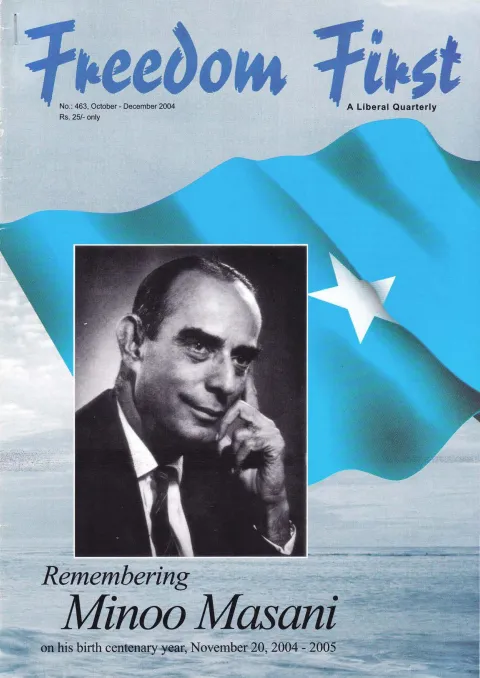
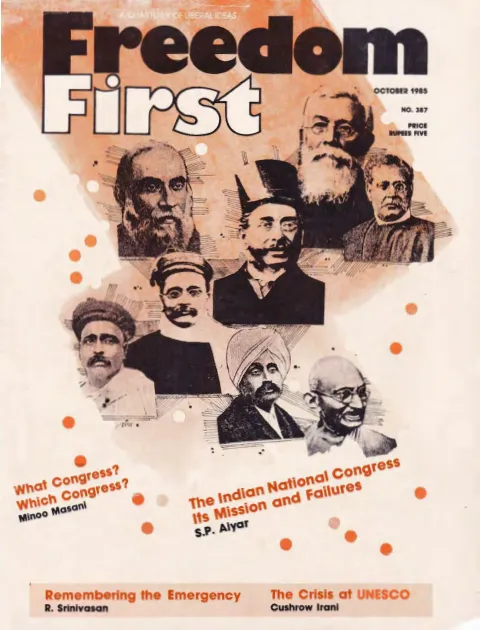
Freedom First
A Quarterly of Liberal Ideas
By Minoo Masani, C. Rajagopalachari
Published for the Democratic Research Service by J. R. Patel, Associate Editor, Freedom First at 127, Mahatma Gandhi Road, Bombay 400 023 (Phone: 273914) and printed by him at The Popular Press (Bom.) Pvt. Ltd., 35C Tardeo Road, Bombay 400 034 · Bombay · 1985
56 pages
Freedom First
Summary
Freedom First No. 387 (October 1985), the quarterly of liberal ideas published by the Democratic Research Service under editors S. V. Raju and K. S. Venkateswaran, appears amid the centenary celebrations of the Indian National Congress and takes a deliberately unsentimental view of that anniversary. The lead essay by S. P. Aiyar surveys the Congress’s century from 1885 to 1985 and argues that its ideological vagueness, drift from mass movement to authoritarian one-party dominance, and erosion of federalism have left it unable to fulfil its founding mission. Minoo Masani’s ‘What Congress? Which Congress?’ makes a companion argument from personal testimony, disowning the post-1952 Congress as a hijacked institution. In the rendered pages the issue also carries editorial miscellany (‘With Many Voices’ and ‘Of Cabbages & Kings’) commenting on Rajiv Gandhi’s politics, the future of Chandigarh, and a critical review of a booklet on Sikh separatism; a light piece on shoe-throwing in Indian legislatures; a translated 1886 eyewitness account of the first Congress convention; Masani’s defence of the NDDB/IDC’s Operation Flood dairy programme against press criticism, citing the Jha Committee evaluation report; and the opening pages of R. Srinivasan’s ‘Remembering the Emergency,’ surveying press silence and public ambivalence ten years after 1975.
Key points
-
S. P. Aiyar’s centenary essay “The Indian National Congress—Its Mission and Failures” traces the party from Hume’s 1885 founding through Gandhi’s mass movement to what he calls “the twilight of federalism” under Indira and Rajiv Gandhi.
-
Minoo Masani’s “What Congress? Which Congress?” personally disavows any continuity between the Congress he served as an underground activist and Constituent Assembly member and the party celebrating its 1985 centenary, arguing it “died when India achieved independence.”
-
A wry piece by Padmini Menon traces shoe- and slipper-throwing as a form of political protest in Indian legislatures back to the 1907 Surat Congress session.
-
A translated 1886 eyewitness account describes a Coimbatore delegate’s journey to the first Indian National Congress convention in Bombay and the hospitality of hosts including Dadabhai Naoroji and Pherozeshah Mehta.
-
Minoo Masani’s “Operation Flood” defends the National Dairy Development Board’s dairy programme against press criticism of Dr. V. Kurien, citing the Jha Committee’s findings that it benefited small farmers and Scheduled Castes and Tribes.
-
R. Srinivasan’s “Remembering the Emergency” finds most Indian publications, including the left-leaning Economic and Political Weekly, largely silent on the tenth anniversary of the Emergency’s end, and cites a survey finding 65 per cent of urban respondents would support its reimposition.
-
Srinivasan summarises Professor Rajni Kothari’s argument that the Emergency exposed enduring beliefs favouring state supremacy over civil society and the suppression of grassroots dissent.
Essays
The Indian National Congress—Its Mission and Failures
By S. P. Aiyar
S. P. Aiyar, Head of the Department of Civics and Politics at Bombay University, surveys the Indian National Congress’s hundred-year history on the occasion of its 1985 centenary, which he notes ‘roused little enthusiasm.’ He traces the organisation from Allan Octavian Hume’s 1885 founding letter through its transformation under Gandhi into a mass movement, its drift toward intolerance of dissent and a ‘one party doctrine,’ the ideological vagueness of its socialism (from the 1931 Karachi resolution through Nehru’s ‘Socialistic Pattern of Society’), the failures of centralized planning and community development schemes, and finally what he calls ‘the twilight of federalism’ under Indira Gandhi and Rajiv Gandhi, in which state autonomy was steadily eroded by centre-driven planning and political dominance. He closes by arguing that only a genuine federal system with less statism can allow the diversified leadership India’s future nation-building requires.
- The Congress’s 1985 centenary provoked little public enthusiasm or idealism
- The Congress evolved from an elite ‘microscopic minority’ movement into a mass movement under Gandhi after 1920, then into an intolerant, near one-party political force after Independence
- Socialism within Congress economic policy was never precisely defined, producing what Aiyar calls ‘fuddled ideology’ and ‘confusion most confounded’ in planning (citing S.K. Dey and community development failures)
- Centralised planning and near one-party rule under Indira Gandhi eroded state autonomy and reduced federalism to a ‘quasi-federal system’
- Aiyar argues India’s future nation-building requires diversified leadership possible only under genuine federalism with less statism
died when India achieved independence,
Minoo Masani, founder of Freedom First, personally disavows any continuity between the Indian National Congress he served (as an underground activist, imprisoned Bombay Provincial Congress Committee president, Constituent Assembly member, and independent MP after 1957) and the party being celebrated in 1985. He states that, for him, the Congress ‘died when India achieved independence,’ and that it was hijacked by politicians who converted it into a permanent ruling party rather than winding it up or splitting into two parties as advised. He cites former Congress President Nijalingappa’s charge that Indira Gandhi’s 1969 split ‘defamed, degraded and destroyed’ the original Congress.
- Masani recounts his own Congress career from 1932 underground activity through 1957, when he returned to Parliament as an independent
- He argues the historic Indian National Congress effectively ceased to exist at Independence in 1947
- He quotes former Congress President Nijalingappa’s view that Indira Gandhi’s 1969 split destroyed the original party
- He refuses to recognise the 1985 centenary celebration as connected to the Congress he belonged to for twenty years
sole-throwing
A short, wry piece by Padmini Menon on the historical and contemporary phenomenon of shoe- and slipper-throwing (‘sole-throwing’) in Indian legislative politics, tracing it from the 1907 Surat Congress session’s ‘sole split’ between Nationalists and Moderates through to its persistence on parliament floors in 1985.
- Traces sole/shoe-throwing as a mode of political protest back to the 1907 Surat Congress session, when a shoe thrown at Rash Behari Ghosh split the party into Nationalists and Moderates
- Frames the practice as a form of self-expression that carries less risk and responsibility than a physical scuffle
- Treats the subject satirically as a comment on the state of decorum in Indian parliamentary politics
Essay 4
A translated eyewitness account (rendered by ‘R.S.’ from a 1886 Kalanidhi article, reproduced in Kumari Malar, September 1967) by a Coimbatore delegate to the first Indian National Congress convention held in Bombay, 27-30 December 1885. The account describes the journey from Madras, the hospitality of Bombay hosts including Dadabhai Naoroji, Pherozeshah Mehta and K. T. Telang, and the lavish arrangements made by Goculdas Tejpal.
- First-person account of travel from Madras to Bombay for the inaugural Congress convention of December 1885
- Describes hospitality from Dadabhai Naoroji, Pherozeshah Mehta and K. T. Telang among the Bombay elite
- Notes the philanthropy of Goculdas Tejpal, whose estate funded a palace used to house delegates
- Piece is a translation reproduced from a 1967 Tamil periodical, itself drawing on an 1886 source
Operation Flood
By Minoo Masani
Minoo Masani defends the National Dairy Development Board (NDDB) and Indian Dairy Corporation’s ‘Operation Flood’ programme against press criticism associated with Dr. V. Kurien, citing the findings of the L. K. Jha-chaired Evaluation Committee on Operation Flood-II. He quotes the Committee’s conclusions that the programme was implemented competently, benefited small and marginal farmers and Scheduled Castes/Tribes, stabilised producer prices, and expanded urban milk supply, and states his own admiration for AMUL’s work in Anand under Kurien’s leadership.
- Masani responds to press criticism of Operation Flood and Dr. V. Kurien by citing the Jha Committee’s evaluation report
- The report credits NDDB and IDC with competent, dedicated implementation despite uneven state-level cooperation
- Cited achievements include stabilised producer prices, increased milk availability free of adulteration in Delhi, Bombay, Calcutta and Madras, and technical innovations such as aseptic tetrapak milk and an indigenised dairy equipment industry
- Masani concludes the Committee’s findings dispel doubts raised in the public mind about the programme
Remembering the Emergency
By R. Srinivasan
R. Srinivasan reflects, ten years on, on how the Indian press and public engaged with the memory of the 1975-77 Emergency. He notes that while a few weeklies (Sunday, Illustrated Weekly, Imprint) ran retrospective pieces, most mainstream and even leftist journals (including Economic and Political Weekly) were largely silent, and that survey data showed a troubling majority of urban respondents open to the Emergency’s reimposition. In the pages rendered, he goes on to summarise Professor Rajni Kothari’s analysis of the Emergency’s ideological legacy — including its normalisation of state supremacy over civil society and suppression of grassroots dissent — but the essay continues past the rendered pages.
- Marks the tenth anniversary of the end of the Emergency and surveys how sparsely it was covered in the press in 1985
- Only a handful of weeklies (Sunday, Illustrated Weekly of India, Imprint) ran substantive retrospective analysis; most publications, including left-leaning Economic and Political Weekly, were silent
- Cites a four-city survey (in Imprint, July 1985) finding roughly 65% of respondents would support another Emergency and 37% expected one
- Discusses Professor Rajni Kothari’s argument that the Emergency exposed enduring beliefs favouring state supremacy over civil society and suppression of grassroots movements
- Essay is cut off mid-argument at page 20 within the rendered chunk; discussion of Kothari’s analysis continues beyond it
Generated by the v1.5 extraction pipeline. Awaiting editorial review.
The Crisis at UNESCO
By Cushrow Irani
No summary was extracted for this article. Listed for completeness.
Gandhi Jayanti Thoughts
By C. Rajagopalachari
No summary was extracted for this article. Listed for completeness.
Report of Seminar on Reservation
No summary was extracted for this article. Listed for completeness.
Metadata and summary are AI-extracted from the source PDF and reviewed for editorial accuracy. The original work is available via the Read PDF tab above (where present); paragraph-level citation inside the PDF is deferred to a future engagement.