periodical issue
Freedom First
A Quarterly of Liberal Ideas
By Bhanu Pratap Singh, Minoo Masani, Arvind Deshpande, Peter Bauer
Published for the Democratic Research Service by J. R. Patel, Associate Editor, Freedom First at 127, Mahatma Gandhi Road, Bombay 400 023 (Phone: 273914) and printed by him at The Popular Press (Bom.) Pvt. Ltd., 35C Tardeo Road, Bombay 400 034 · Bombay · 1986
56 pages
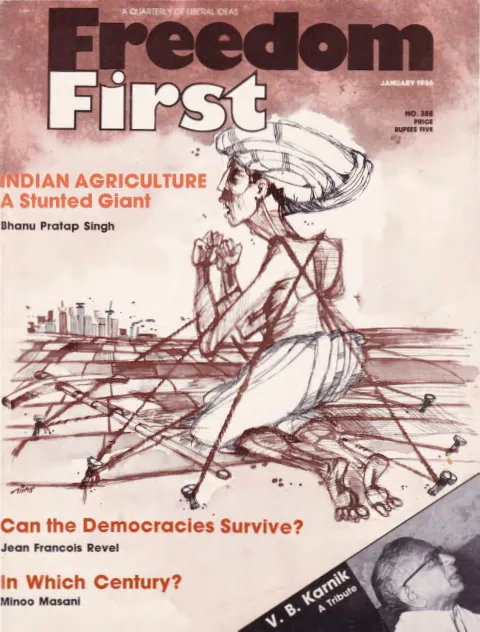
Freedom First
Summary
This is the January 1986 issue (No. 388) of Freedom First, ‘A Quarterly of Liberal Ideas’, published by the Democratic Research Service and edited by S. V. Raju and K. S. Venkateswaran, with Minoo Masani as founder. The issue opens by dedicating itself to the memory of V. B. Karnik, the Democratic Research Service’s Honorary Secretary and former Freedom First editor, who died on November 5, 1985, and carries a tribute to him by Vilas Patankar. It also marks Minoo Masani’s eightieth birthday, noting the felicitation dinner held in his honour and the presentation of a festschrift volume, ‘Freedom and Dissent’, with congratulatory notes reproduced from figures including J. R. D. Tata and Senator Giovanni Malagodi of the Liberal International. In the rendered pages, the issue’s regular front-of-book columns (‘With Many Voices’, a digest of quoted commentary from the Indian and international press, and ‘Of Cabbages & Kings’, an editorial notes column) address contemporary Indian politics, media freedom, and human-rights concerns such as the 1984 anti-Sikh violence and ‘black laws.‘
Key points
-
Vilas Patankar’s tribute “V. B. Karnik—A Tribute” recounts Karnik surviving a knife attack decades earlier when colleague Wamanrao Kulkarni intervened, his direction of Acharya Kripalani’s 1962 campaign against Krishna Menon, and his decades as Honorary Secretary of the Democratic Research Service and editor of Freedom First; a sidebar by Minoo Masani praises the dignified manner of his death at 82.
-
Bhanu Pratap Singh’s “Indian Agriculture—A Stunted Giant” blames the Nehru-Mahalanobis strategy of capital-intensive industrialisation for stunting Indian agriculture, citing Punjab’s outsized productivity as proof of unrealised potential and calling farmers “captive producers and captive consumers.”
-
In an essay headed “Traditions and Trends in Marathi Newspapers,” Minoo Masani recalls Nehru once telling him he “thinks like a modern man” and argues India’s readiness for the 21st century is a matter of human attitudes and institutions, citing postal delays, bank inefficiency, superstition, and the absence of a common civil code and link language.
-
The issue opens by dedicating itself to the memory of V. B. Karnik, the Democratic Research Service’s Honorary Secretary, who died on 5 November 1985.
-
The issue also marks Minoo Masani’s eightieth birthday, noting a felicitation dinner and the presentation of a festschrift volume, “Freedom and Dissent,” with congratulatory notes from J. R. D. Tata and Senator Giovanni Malagodi of the Liberal International.
-
The regular “With Many Voices” and “Of Cabbages & Kings” columns address contemporary Indian politics, media freedom, and human-rights concerns including the 1984 anti-Sikh violence and “black laws.”
Essays
V. B. Karnik—A Tribute
By Vilas Patankar
Vilas Patankar’s tribute to V. B. Karnik recounts an assassination attempt on Karnik decades earlier (from which a colleague, Wamanrao Kulkarni, saved him by intervening physically), Karnik’s composure after his wife’s murder, his work organizing a 1960 seminar marking the formation of Maharashtra, his direction of Acharya Kripalani’s 1962 election campaign against Krishna Menon, and his qualities of self-effacement, rationalism, and moral courage. A sidebar by Minoo Masani, ‘A Life of Great Dignity,’ adds that Karnik served for years as Honorary Secretary of the Democratic Research Service and as editor of Freedom First, and describes the dignified manner of his death.
- Karnik survived a knife attack decades earlier when colleague Wamanrao Kulkarni threw himself between Karnik and the assailants
- Karnik insisted the attackers be released rather than handed to police, saying cruelty should not be repaid with cruelty
- He maintained composure and kept working even during his wife’s medical emergency and after her murder
- He conceived and executed a 1960 seminar series marking the formation of the state of Maharashtra
- In 1962 he directed Acharya Kripalani’s parliamentary campaign against V. K. Krishna Menon
- Masani’s sidebar notes Karnik served for years as Honorary Secretary of the Democratic Research Service and as editor of Freedom First
- Karnik died at 82 after declining artificial life-prolonging measures
Indian Agriculture—A Stunted Giant
By Bhanu Pratap Singh
Bhanu Pratap Singh’s essay argues that Indian agriculture has been artificially stunted by the Nehru-Mahalanobis development strategy, which prioritized capital formation in large-scale (especially public-sector) industry and treated agriculture as merely a source of subsistence food, raw materials, and surplus for industrial growth. He documents India’s poor comparative growth in foodgrain production during 1971-81, low per-capita caloric intake, and argues India’s natural endowments (arable land, water, climate allowing multiple cropping seasons) are under-utilized, citing Punjab’s disproportionate productivity and National Demonstration Plot yields as evidence of unrealized potential. He attributes the underperformance to policies that suppress farm prices, restrict trade and movement of foodgrains, under-invest in rural infrastructure and credit, and force farmers to buy inferior domestic implements, calling farmers ‘captive producers and captive consumers,’ and calls for restoring farmers’ right to sell produce freely, building rural warehousing, and redirecting budgetary and credit allocations toward agriculture.
- Blames the Nehru-Mahalanobis strategy of channeling capital into large-scale industry for stunting Indian agriculture
- Notes 1971-81 was India’s slowest farm-production growth decade in South Asia except Bangladesh and Nepal
- States 1981-82 foodgrain production was only 8.82% of world production versus 11.76% of world arable land and 15.66% of world population
- Cites Punjab (under 3% of national farmland) contributing 9.75% of national foodgrain production in 1983-84 as proof of unrealized potential
- Estimates India’s agricultural capacity utilization at perhaps no more than 30%
- Argues government price and trade policy, not nature, causes low farm incomes, terming farmers ‘captive producers and captive consumers’
- Calls for restoring farmers’ right to sell at best price, building rural warehouses, and ending dumping of subsidized imported foodgrains
- Author identified as a former Minister of State for Agriculture, Government of India
Traditions and Trends in Marathi Newspapers
By D. B. Karnik
In ‘In Which Century?’, Minoo Masani recalls Jawaharlal Nehru once telling him in Parliament that Masani, like Nehru, ‘thinks like a modern man,’ and uses this to argue that India’s readiness for the ‘21st century’ is a matter of human attitudes and institutions, not technology alone. Drawing on his service on a Railway Accidents Enquiry Committee, he concludes accidents stemmed from human failure despite adequate safety devices. He catalogues examples of institutional dysfunction and low productivity in daily Indian life as seen through 1985 — unresponsive postal service, slow bank clearing, low government-employee working days, and (continuing onto the essay’s second rendered page) superstition and ‘mumbo-jumbo,’ customs officials, population growth despite available contraception, the absence of a common civil code, and the weakening of a common Hindustani link-language under pressure from Hindi-lobby fanaticism.
- Recounts Nehru telling Masani in a Parliament debate that Masani ‘thinks like a modern man’
- Argues India’s entry into the 21st century is a human/institutional problem, not merely a technological one
- Cites his role on the Railway Accidents Enquiry Committee (with Justice Wanchoo) concluding accidents were due to human failure despite safety devices
- Lists everyday institutional failures: slow postal delivery, slow bank cheque clearing, striking bank officers, low government workday counts
- Criticizes reliance on ‘mumbo-jumbo’ — caste, untouchability, reservation, astrology — as brakes on progress
- Calls for a common civil code, noting his own unsuccessful attempt to move for one in the Constituent Assembly
- Advocates Hindustani over Hindi as India’s practical link language, criticizing ‘Hindi lobbyists’
Generated by the v1.5 extraction pipeline. Awaiting editorial review.
Metadata and summary are AI-extracted from the source PDF and reviewed for editorial accuracy. The original work is available via the Read PDF tab above (where present); paragraph-level citation inside the PDF is deferred to a future engagement.