
periodical issue
Freedom First
A Quarterly of Liberal Ideas
By K. F. Rustomji, Minoo Masani
Published for the Democratic Research Service by J. R. Patel, Associate Editor, Freedom First at 127, Mahatma Gandhi Road, Bombay 400023 (Phone: 273914) and printed by him at The Popular Press (Bom.) Pvt. Ltd., 35C Tardeo Road, Bombay 400 034 · Bombay · 1986
60 pages
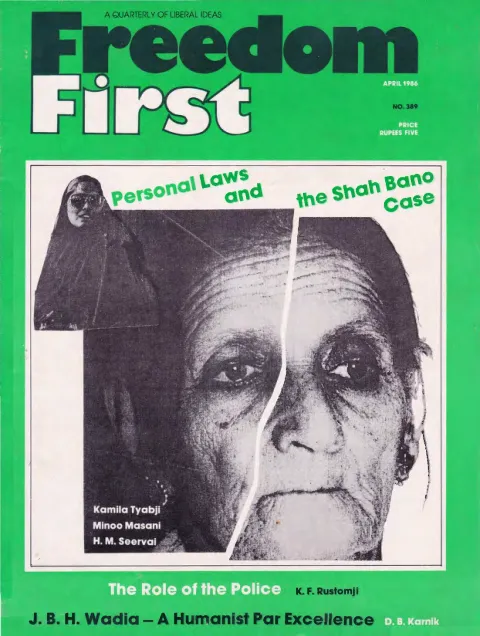
Freedom First
Summary
Freedom First No. 389 (April 1986), a 60-page quarterly of liberal ideas priced at Rs. 5 and published for the Democratic Research Service from Bombay with Minoo Masani as Founder and S. V. Raju and R. Srinivasan as Editors, is dedicated to the memory of Jamshed Wadia, the humanist, Royist and film pioneer who served for many years on the Executive Board of the Democratic Research Service and died in Bombay on 4 January 1986, and whom D. B. Karnik’s opening tribute treats as a cultured humanist par excellence. The quarter’s cover essay prints three speeches from a PUCL public meeting in Bombay on personal laws and the Shah Bano case: Kamila Tyabji argues as a Muslim woman that the Supreme Court read the Quran correctly and calls the government’s Bill’s reliefs illusory, urging instead a composite Bill and a standard Nikah-namah; Minoo Masani, who moved the uniform civil code proposal in the Constituent Assembly’s Fundamental Rights Committee, narrates the volte face by which three Law and Home Ministry notes upholding the judgment were abandoned; and H. M. Seervai, dissenting from Masani on a uniform code, contends that marriage is a social arrangement subject to reform, so the maintenance provision involves no attack on freedom of religion. Around that essay, K. F. Rustomji’s keynote on the role of the police blames a political culture that tolerates organised mob violence and calls for insulating the force from political interference, P. R. Brahmananda’s valedictory address on new structures for the world economy holds that Myrdal’s and Prebisch’s pessimistic theses are falsified by developing-country savings and India’s terms of trade, and Marina Pinto’s study of Centre-state finance proposes an Inter-state Council and a single divisible tax pool. Babu Joseph argues that Marxist infiltration of Kerala’s Christian churches threatens the United Democratic Front’s slender majority, Padmini Menon profiles Henry Derozio of Hindu College for the ‘Profiles of Indian Liberals’ series, Darius Cooper argues that anti-corruption drives enforcing bad laws are counter-productive, Rena Noronha’s prize-winning essay ‘We the Inheritors’ calls for an awakening of youth, Peter Sager reads Lenin’s Swiss writings to show that Leninism leaves no room for neutrality, Roger W. Robinson Jr. argues that largely invisible Western interbank deposits finance Soviet global commitments, and S. I. Clerk reports on the Maharashtra Adivasi Kala Mahotsava at Baba Amte’s Anandvan. The departments are ‘With Many Voices’, ‘Of Cabbages and Kings’, which announces R. Srinivasan joining as Editor in place of K. S. Venkateswaran, and seven book reviews.
Key points
- The issue is dedicated to the memory of Jamshed Wadia, and D. B. Karnik’s opening tribute treats him as a cultured humanist par excellence, tracing his path from Congress to M. N. Roy’s Radical Democratic Party and his parallel career as founder of Wadia Movietone.
- The quarter’s cover essay is a three-hander on personal laws and the Shah Bano case, printing speeches by Kamila Tyabji, Minoo Masani and H. M. Seervai from a PUCL public meeting in Bombay the previous month; Masani argues for a uniform civil code and Seervai argues against one, while all three oppose the government’s Bill.
- Minoo Masani’s contributions under the title ‘The Masani Viewpoint’ are reprinted, with permission, from his column in The Statesman, and cover V. P. Singh’s deficit budget, Ramakrishna Hegde’s withdrawn resignation, Arjun Singh’s attendance at the CPSU Congress in Moscow, and the trial of Rama Swarup.
- ‘Of Cabbages and Kings’ announces that K. S. Venkateswaran, editor since January 1983, has resigned, and that Dr. R. Srinivasan of the University of Bombay joins as an Editor with this issue.
- Brahmananda’s and Rustomji’s pieces are both reprinted addresses: Brahmananda’s from a December 1985 Bangalore seminar organised with the Friedrich Naumann Stiftung, Rustomji’s from a Rajaji Foundation seminar on policing.
- Two pieces come from abroad: Peter Sager’s essay carries the credit ‘Courtesy: Swiss Press Review’, and Roger W. Robinson Jr.’s is adapted from a Heritage Foundation talk published in The Asian Wall Street Journal.
- The statutory ownership statement dated 1 April 1986 lists Freedom First as a quarterly published from Bombay by J. R. Patel, with S. V. Raju and R. Srinivasan as Editors and the Democratic Research Service as owner.
- The masthead names Minoo Masani as Founder, Jehangir Patel as Associate Editor, Geeta Doctor as Contributing Editor, and an Advisory Board of Adam Adil, Sumant Bankeshwar, S. I. Clerk, Arvind Deshpande, Nissim Ezekiel, Aziz Madni, S. A. A. Pinto, Nitin Raut, Abe Solomon and Ashley Tellis; the cover picture is credited to The Week and the issue is priced at Rs. 5.
Essays
J. B. H. Wadia: A Humanist Par Excellence
By D. B. Karnik
D. B. Karnik’s opening tribute presents J. B. H. Wadia, the recently deceased Jamshed Wadia, as a many-sided figure whose greatest asset was that he was a cultured humanist par excellence: scholar, thinker, writer, poet, political worker and film pioneer at once. Karnik traces Wadia’s move from ardent Congressman to devoted associate of M. N. Roy, his role as trustee of the Renaissance Institute at Dehradun, founder-member of the Radical Democratic Party and champion of the Radical Humanist Movement, and his willingness to bear public fury for backing Roy’s unpopular thesis that the Second World War was an anti-fascist war worth supporting. Alongside this, Karnik recounts a film career that began in 1928 in the last years of the silent era and produced, under the Wadia Movietone banner founded in 1933, some seventy features and twenty documentaries, with Wadia known as the emperor of the stunt film even as he insisted his pictures carried thrill without vulgarity or cruelty. The piece closes on Wadia’s death from cancer, on the partnership with his wife Hilla and the hospitality of their Worli Sea Face home Casada Vinci, and on Karnik’s judgment that Wadia was not only a great man but a noble soul. A footnote identifies Karnik as a former editor of Maharashtra Times.
- Wadia defended his stunt films by saying he stood for the entertainment of the common people, who admire adventurism, intrigue and some thrill.
- He idolised Leonardo da Vinci, named his son Vinci and called his Worli bungalow Casada Vinci, where he and Hilla hosted the Royists of Bombay.
- He wrote a book on M. N. Roy, M. N. Roy the Man, which he called an incomplete Royana, and published his own Gujarati poems through his own publishing house while also writing verse in Urdu.
- Karnik places Wadia, with V. B. Karnik, among Minoo Masani’s closest colleagues in the Indian Committee for Cultural Freedom and the Democratic Research Service, organisations he says were widely and mischievously misunderstood.
- Wadia discovered and filmed young talent, including short films on Kumar Gandharva when the singer was only eight and on the tabla master Thirakawa.
The Role of the Police
By K. F. Rustomji
K. F. Rustomji’s essay on the role of the police, based on his keynote speech to a Rajaji Foundation seminar on policing held for Rajaji’s 106th birthday, argues that India’s law and order situation has become a matter of grave concern and that the deeper cause is a political culture that tolerates and even glorifies organised mob violence. Reviewing three years of agitations in Assam, Punjab, Bhiwandi and Ahmedabad, the anti-Sikh killings in Delhi after Indira Gandhi’s assassination, and the reservation riots in Ahmedabad, he holds both the organisers and the wider society guilty for permitting such brutality while blaming the police for the consequences. Rustomji then traces the habit of letting mobs dictate outcomes back through 1942, the Calcutta killings of 1946, Noakhali and the partition massacres, and forward into the post-independence pattern of linguistic-state agitations and communal riots, contending that firm impartial policing was and remains the crying need of the subcontinent. He also concedes a genuine decline in professional standards, with little preventive patrolling, poor records and weak investigation, and links India’s weakness against terrorism to the absence of a trusted, accountable police force and to a criminal justice system that the Chief Justice of India had described as on the verge of collapse. His prescription is structural: protect the police from political interference and from the corrupt and sycophantic within their own ranks, improve conditions in the subordinate judiciary, and design any strategy around protecting the poor and the defenceless. A footnote identifies Rustomji as a retired Inspector-General of Police and a member of the Police Commission.
- Rustomji cites twelve thousand Indian lives lost to organised violence over three years, and nearly 2,500 Sikhs killed in Delhi after Indira Gandhi’s assassination.
- On Ahmedabad he argues the reservation agitation was designed to mislead, cost close to 100 lives and crores in property and lost wages, and that officials campaigned against the police to cover their own mistakes even as the force itself broke down under prolonged strain.
- He credits Gandhi as the only leader who understood how dangerous a mob can be, noting the withdrawal of non-cooperation in 1922 after 22 policemen were killed at Chauri Chaura.
- On 1942 he recounts the Cripps Mission’s failure and the mutual distrust between Linlithgow, Churchill, Cripps, Amery and Attlee, with Linlithgow calling the Cripps plan ‘hawking rotten fish’.
- He credits Gandhi’s embedded secularism and martyrdom, and Nehru’s part, with averting irretrievable disaster at partition, while judging that secularism proved skin-deep further down the line.
- He notes the new central Department for Internal Security under Arun Nehru, assisted by the police officer Ribeiro, as a hope for improvement.
- He quotes Chief Justice P. N. Bhagwati on the judicial system being on the verge of collapse, with delays and arrears making litigation a gamble that favours the dishonest and the rich.
New Structures for the World Economy: The Indian Perspective
By P. R. Brahmananda
P. R. Brahmananda’s essay, printed as extensive extracts from his valedictory address to a Bangalore seminar of the same title organised jointly in December 1985 by the AIRD and the Friedrich Naumann Stiftung of West Germany, argues that the world economy of the 1980s has confounded the expectations on which most development theory was built. He observes that the supposed law linking inflation to growth has broken down, with developed countries running 3 to 6 per cent inflation while developing countries average above 20 per cent, and that the thesis attributing developing-country inflation to spillovers from the rich world has been exploded. From there he lays out five assumptions about the coming international order: closer trade relations and a shrinking role for aid, increasingly multilateral trade, technology transfer through the market by multinational firms, the fading of tariff and non-price barriers, and market-determined but reasonably stable exchange rates that will force adjustment through domestic monetary and fiscal policy rather than devaluation. Brahmananda then tests the two dominant pessimistic theories against the evidence, holding that Gunnar Myrdal’s cumulative-causation thesis on widening income gaps is already falsified by developing-country savings rates near 25 per cent of income, higher than much of Europe and the United States, and that Raul Prebisch’s declining-terms-of-trade thesis does not hold for India and has no prospect of holding for China. He closes by questioning the whole classificatory apparatus of First, Second and Third Worlds, North and South, developed and developing, and proposing instead a division by freedom, with India’s special contribution being a third paradigm that bridges freedom and planning through social justice. A footnote identifies Brahmananda as Head of the Department of Economics, University of Bombay.
- Brahmananda opens by greeting Minoo Masani, whose idea of a ‘mixed economy’ he says is the political economy frame in which India finally landed, and credits Rajaji, Jayaprakash Narayan and Masani with conserving India’s democracy and economic freedoms.
- He notes India’s inflation rate of about 9 per cent and observes that India can no longer pride itself on being the lowest-inflation country.
- He forecasts monetary growth settling at 5 to 6 per cent, notes the Chakravarthy Panel’s proposed 9 per cent ceiling for India, and reports that most Indian economists favour a 5 per cent ceiling.
- On growth he postulates roughly 3 per cent for developed and 4 to 5 per cent for developing countries, so that the absolute development gap narrows steadily though slowly, with the per capita gap starting to narrow if population growth falls to 1 per cent by about 2000.
- He argues high accumulation alone is insufficient and that productivity gaps close only through vigorous exchange of ideas, inventions, processes and products, dissenting from I. G. Patel’s view that growth in itself is the engine of trade.
- He judges the future of SDRs clouded and the IMF and IBRD caught in their own trappings, since the developed world by and large no longer needs the Fund.
- The essay ends on an aphorism: from freedom solely to justice also is easier than from justice only to freedom also.
- A boxed item on the same pages, ‘The Anguish of Sanjiva Reddy’, extracts the former President’s Hindu interview of 23 February 1986 criticising the gap between Rajiv Gandhi’s precept and practice, the harassment of small taxpayers while black money holders go unraided, and the menace of sycophants around those in power.
The Masani Viewpoint
By Minoo Masani
‘The Masani Viewpoint’ collects four short pieces and two boxed items by Minoo Masani, reprinted with permission from his column in The Statesman. ‘The Recklessness Continues’ attacks V. P. Singh’s Union Budget for deficit finance, likening the Finance Minister to the trespassers run over by the Cannanore-Ernakulam Express and arguing that a Swatantra budget would instead have cut wasteful public expenditure and privatised loss-making government enterprises. ‘Et tu Mr. Hegde?’ regrets Ramakrishna Hegde’s withdrawal of his resignation as Chief Minister of Karnataka under pressure from the Janata Party executive, insisting that no party in a free society has the right to force a man into leadership against his wishes and that ‘my party right or wrong’ is nearly as pernicious as ‘my country right or wrong’. ‘Supping with the Devil’ condemns Arjun Singh’s attendance, with a four-man Congress (I) delegation, at the Congress of the Communist Party of the Soviet Union in Moscow, arguing that only Soviet satellites permit such party-to-party links. ‘The Curious Case of Rama Swarup’ protests the treatment of Rama Swarup, whose contacts with Taiwan cost two Union ministers their offices, distinguishing lobbying from espionage, objecting to reports that the trial would be held in camera, and volunteering that Masani himself had twice visited Taiwan.
- Masani puts last year’s ‘legalised counterfeiting’ at Rs. 4,400 crores against an estimate of Rs. 3,316 crores, and predicts that the budget’s uncovered deficit of Rs. 3,660 crores will exceed Rs. 5,000 crores.
- He recalls the Finance Minister mocking those who live within their means as lacking imagination, and replies that this is like an alcoholic making fun of temperate people.
- On Hegde he invokes Oliver Goldsmith on Edmund Burke, who ‘to party gave up what was meant for mankind’, and R. H. Tawney’s refusal of a Labour peerage on the ground that his party had claims on him but no right to dishonour him.
- He notes his own insistence on resigning as Chairman of the Minorities Commission in 1978, when he was told that in India one only threatens to resign but never does.
- On Taiwan he quotes his memoir Against the Tide on a 1963 meeting at which he reported President Chiang’s lack of bitterness to Nehru, and says their twenty-five-year duel over international communism ended on a friendly note.
- A boxed item, ‘Why This Distinction?’, reproduces a reader’s list of newspaper headlines to ask why Sikhs are named in reports of misdeeds when the religion of other offenders never is.
- A second box quotes Mary Renault, via Bernard Levin’s The Way We Live Now, on the word ‘committed’ meaning a state in which something else matters more than truth.
Will Kerala Go the Communist Way?
By Babu Joseph
Babu Joseph’s paper argues that Kerala’s Christian churches, long the mainstay of the state’s anti-Communist democratic forces, are being infiltrated by Marxists in a disguised and effective way, and that if the trend continues the Left Democratic Front will be able to convert the United Democratic Front’s very slender 1982 majority into power. He builds the case from the 1982 Assembly result, where the UDF led by K. Karunakaran outpolled E. K. Nayanar’s LDF by only 95,277 votes out of more than 95 lakh cast, and then names bishops he says have canvassed openly for the Marxists, among them Bishop Paulose of the Kaldaya Church, Geevarghese Mar Osthathios of the Orthodox Syrian Church, and Paulose Mar Gregorios, a President of the World Council of Churches. Joseph traces the same influence through the Church of South India’s youth wing, through Liberation Theology imported from Latin America, the Philippines and Thailand into Jesuit, C.M.I. and Redemptorist congregations, and through World Council of Churches associate bodies that he says fund some twenty-two Indian action groups to the tune of about Rs. 6 lakhs a month in the name of development. He treats the month-long Kerala fishermen’s agitation against mechanised trawling as a case in point, quoting an Indian Express interview with Sr. Alice of the Assumption Sisters who describes the established church as catering to the elite, defends working with Communists, and criticises the over-glorification of Mother Teresa’s work. Joseph’s remedies are two organisations he helped create: an inter-denominational Christian Forum, born of a consultation at Kottayam on 23 June 1984 and constituted as ‘The Christian Liberation Movement’, and ‘The Centre for Democratic Studies’, a non-partisan body inaugurated by Minoo Masani at Ernakulam on 28 April 1984 to educate non-Christians on liberal democratic lines. A footnote states that Babu Joseph teaches in a college and is a political activist.
- Christians make up about 25 per cent of Kerala’s 25 million people and were, Joseph writes, traditionally considered the Communists’ number one foe.
- He argues the Communists’ new strategy is to ‘wreck from within’ rather than confront the churches directly, and cites a leftist source claiming about 3 bishops, 300 priests and 75 sisters across Kerala’s denominations as Marxist supporters or sympathisers.
- He quotes Mar Osthathios telling a conference of Christian educationalists at B.C.M. College, Kottayam in September 1983 that the profit-oriented capitalist structure of Kerala education must be brought down before improvement can be contemplated.
- He quotes Paulose Mar Gregorios saying that when Russia intervenes anywhere it is socialistic and when America intervenes it is imperialistic.
- He describes the Church of South India as worst affected at the grass roots because its membership is drawn mainly from financially and socially backward sections.
- The Kerala Catholic Bishops Conference’s appeal to end the fishermen’s agitation was, he notes, flatly rejected by the agitation’s leaders.
Sharing the Financial Cake
By Marina Pinto
Marina R. Pinto’s study of Centre-state financial relations describes a virtual tug-of-war over finances in which the Constitution denied the states fiscal autonomy and the compulsions of developmental activity have deepened their dependency on the Centre ever since. She argues that inadequate devolution of centrally levied taxes forces states to rely on plan grants, loans and ad hoc grants, and that the Centre has made mighty inroads into state subjects through what she calls the financial backdoor, virtually obliterating the distinction between Central and state subjects. Agriculture is her leading example: though a state subject, it functions as a concurrent one in practice, with the Centre accounting for two-thirds of expenditure under that head and agricultural research effectively centralised through the Indian Council of Agricultural Research. Pinto documents the pattern with tables of federal fiscal transfers from 1951 to 1979 and of Finance Commission awards from the First to the Eighth, then turns to the overdraft question, tracing the Union Finance Ministry’s staged plan to eliminate unauthorised state overdrafts by 31 March 1989 and arguing that closing this last ‘window’ without reforming resource-sharing will aggravate Centre-state tension. Her remedies are institutional: an Inter-state Council under Article 263 to take charge of all areas of Centre-state conflict, the quinquennial Finance Commission appointed in consultation with it, the Reserve Bank made a federal institution, a National Economic Council with the National Loans Corporation and National Credit Council represented on it, and a single divisible pool of Centre and state tax revenues split on an agreed basis such as 52:48. She pairs this with a call on the states to cut unnecessary expenditure, reduce losses on water, power and road transport, and withdraw from loss-making activities that could safely be left to the private sector. A footnote identifies Dr. Marina Pinto as Reader in Public Administration, University of Bombay.
- More than two-thirds of the total budgetary resources of the Centre and the states first accrue to the Centre, while Central fiscal transfers to the states account for less than one-third of the Centre’s total resources, and the states’ share of aggregate budgetary expenditure is only about two-fifths.
- Her Table 1, drawn from the Eighth Finance Commission report via G. Thimmaiah’s Burning Issues in Centre-State Financial Relations (1985), shows total federal fiscal transfers rising from Rs. 1,431 crores in the First Plan to Rs. 34,090 crores in the Sixth, with the statutory Finance Commission share climbing from 31 per cent to 61 per cent.
- Tables on income tax sharing show the states’ share rising from 55 per cent under the First Commission to 85 per cent under the Seventh and Eighth.
- Unauthorised state overdrafts stood at Rs. 1,808 crores as on 28 January 1985, to be cut by 10 per cent, then 35 per cent a year in 1986-87 and 1987-88, and 20 per cent in 1988-89.
- She cites Ramakrishna Hegde’s argument that Karnataka’s budgetary problems and overdraft trace directly to a change in the Centre’s attitude after the 1983 elections, instanced by the shelving of the Vijayanagar steel plant and the downgrading of the Mangalore oil refinery.
- She observes that in Marxian thinking the states’ continuous dependency amounts to a kind of ‘financial imperialism’, highlighted in the operation of Central loans.
- She suggests the Sarkaria Commission consider a single divisible pool and the abolition of the distinction between agricultural and non-agricultural incomes for income tax purposes.
Personal Laws and the Shah Bano Case
By Kamila Tyabji, Minoo Masani and H. M. Seervai
Kamila Tyabji, Minoo Masani and H. M. Seervai supply ‘Personal Laws And The Shah Bano Case’, the issue’s cover essay, headed simply ‘Essay’, which prints the texts of speeches by the social worker Tyabji, the Constituent Assembly member Masani and the eminent jurist Seervai at a public meeting the PUCL organised in Bombay the previous month, and which the editors present as articulating the liberal response to the Shah Bano judgement and to the controversial Bill the government brought before the Lok Sabha in its light. Kamila Tyabji speaks as a Muslim woman, arguing that the Supreme Court read the relevant Quranic ayat correctly in holding that a reasonable provision is due to a divorced woman, and that the orthodox and the Mullahs have foisted false interpretations of Muslim Law on the community. She does not regret the commotion, calling it the biggest awakening of Muslim women since independence, and instead of arguing over whether mata’a means ‘provision’ or gifts of saris and clothes she urges a far more composite Bill, together with a Standard Nikah-namah of the kind the All India Women’s Conference has demanded since the 1930s, which would state Mehr, define the wife’s rights on a second marriage, give her an equal right to divorce, and settle maintenance. Minoo Masani, describing himself as a minorities man who does not accept the right of a majority to trample on minorities, recalls that he moved the uniform civil code proposal in the Fundamental Rights Committee of the Constituent Assembly with the support of B. R. Ambedkar, Rajkumari Amrit Kaur and Hansa Mehta, and that when the all-Hindu sub-committee rejected it the four of them tabled a Minute of Dissent. He holds that minorities have every right to protect, propagate and teach their religion but no right to claim exemption from the general civil or criminal law, and he narrates the chronology by which three successive Law and Home Ministry notes advising the government to stand by the Supreme Court judgment were abandoned once Rajiv Gandhi decided the Muslim vote bank required a volte face, leaving Arif Mohamed Khan, who had defended the judgment in Parliament at the party’s own request, to resign. H. M. Seervai closes the essay by rejecting Masani’s premise as well as the Bill: he argues that marriage is essentially a matter of social arrangement rather than protected religious doctrine, so that the Criminal Procedure Code’s maintenance provision, already more than seventy years old in what was originally Section 488, involves no attack on freedom of religion at all. He shows how Hindu, Parsi and Christian marriage law has each been reformed by legislation over the past century, insists the Bill is open to the gravest challenge and that the challenge must succeed, and yet dissents sharply from Masani on a uniform civil code, denying that every civilised country has one, pointing to Scotland’s separate law within Great Britain, and calling the judges’ unsolicited remarks on a uniform civil code the most unfortunate part of an otherwise wholly correct Shah Bano judgment.
- Tyabji notes that the ayat at issue, numbered 241 in her account, is distinct from the provisions governing the three-month Iddat period, since a divorce in the Prophet’s time was not complete until Iddat had run and triple divorce in one sitting was accepted only in later times.
- She contrasts the claim that Rs. 179 a month is against Muslim Law with a religion that gave women full property rights centuries before British women won them in the 1860s, and asks why no morchas are taken out against bigamy or dowry.
- She warns that the present Bill cannot stand as it is, its reliefs being illusory, and that the Supreme Court would strike it down as contrary to its own judgment.
- She calls the clause removing Muslim women from section 125 of the Criminal Procedure Code the worst possible course, and says she can think of nothing worse than allowing any particular community to be excluded from the general laws of the State.
- Tyabji identifies as the greatest tragedy of Muslims since partition that no liberal Muslim wanted to join the Muslim League or any Muslim party, leaving Muslim audiences fed entirely on the views of obscurantists.
- Masani quotes the Minute of Dissent’s argument that personal laws based on religion have kept India divided into water-tight compartments and held it back from advancing to nationhood, and notes that Article 44 of the Directive Principles has stood since 1947 while the Prime Minister says the time for a common code has not yet come.
- Masani recounts his own resignation as Chairman of the Minorities Commission after six months, when the Janata government refused to accept his Commission’s finding that Aligarh Muslim University is a Muslim institution, and observes that Arif Mohamed Khan has now committed the same ‘un-Indian act’ of resigning.
- He credits Arun Shourie’s investigative articles in the Times of India of 3 and 4 March with establishing the record of the Law Ministry note of 31 May 1985, its endorsements by Bhardwaj and Ashok Sen, and the Home Ministry note of 24 July 1985, all advising rejection of Banatwala’s Bill.
- He quotes the Muslim lawyer Daniel Latifi in the Times of India calling the Bill obnoxious to Islamic principles, derogatory to human rights and an insult to the traditions of Islamic civilisation, and best withdrawn.
- Masani also argues that many of those objecting to the Bill are male chauvinists rather than principled critics, citing unanswered questions Madhu Mehta of the Hindustani Andolan put to Muslims about whether they would accept Shariat punishments in the Criminal Procedure Code as well.
- Masani asks Hindu communal organisations to keep out of the controversy, saying there is nothing to choose between Muslim and Hindu obscurantists and that their intervention will weaken liberal Muslims.
- He records the minister Ansari’s Lok Sabha remark that the Chief Justice was too small a man to interpret Islamic law, and Rajiv Gandhi’s defence of him, as evidence of disrespect for the judiciary, and hopes Congress (I) members will demand a free vote as the British House of Commons allows on such matters.
- He notes an Indian Law Institute discussion in Delhi involving Soli Sorabjee, Upendra Baxi, Amrik Singh and Justice Krishna Iyer, whose participants reportedly resolved to move the Supreme Court if the Bill passes.
- Seervai’s counter-example on freedom of religion is Hindu law: polygamy, once permitted, was held by the Supreme Court not to be part of religion, and in any case reformable, and Parsis themselves gave up polygamy after the Parsi Panchayat’s 1865 representation to the Government.
- He traces the same logic through Christian marriage, from ecclesiastical separation to A. P. Herbert’s Act, to argue that laws of marriage change with social manners and customs.
- On testamentary succession he notes that a Muslim cannot will away more than one-third of his property without the heirs’ consent while a Hindu can dispose of self-acquired property freely, and asks which of these a uniform code would adopt.
- He recalls being told that Justice Lallubhai Shah would award about Rs. 25 to a Hindu widow where a European, Parsi or Muslim judge would award Rs. 400 to Rs. 500.
- He retells Margot Asquith’s answer to a widowed Hindu politician who asked what good the British had done, that but for the abolition of Sati she would have been burnt on her husband’s pyre.
- Seervai urges keeping passion and politics out of the argument, holding up Abraham Lincoln’s refusal to abuse his opponents, and warns against treating the Supreme Court as a last refuge, since on preventive detention and habeas corpus it was the High Courts, not the Supreme Court, that reached their finest hour.
Profiles of Indian Liberals: Henry Derozio, Firebrand of the Bengal Renaissance
By Padmini Menon
Padmini Menon’s entry in the ‘Profiles of Indian Liberals’ series recovers Henry Louis Vivian Derozio (1809-1831), the Eurasian poet who was invited at seventeen to teach English literature at Hindu College, Calcutta, and who in about five years before his death from cholera at twenty-two shaped the students who became known as ‘Young Bengal’. Menon presents Derozio as cast in the mould of European Enlightenment social thought, ingrained with Hume’s religious scepticism, Diderot’s rationalism and Rousseau’s democratic faith, and teaching his pupils to doubt all things and accept nothing on authority. She sets him against Rammohan Roy, noting that where Roy introduced modernity through English education, Derozio adopted everything Western including dress, and quotes an 1843 literary journal’s mocking description of his foppery to argue that such a portrait does little justice to the mind of the man. The profile then narrates the founding of Hindu College from Bidyanath Mukherjee’s approach to Chief Justice Sir Hyde East and the meeting of more than fifty ‘respectable Hindus’ on 14 May 1816 that raised half a lakh of rupees, Derozio’s earlier clerical work and his time on his uncle’s indigo plantation at Bhagalpur where he began writing verse under the pseudonym Juvenis, and his teaching methods: the Academic Association debating society, the weekly Parthenon, and an open house on Lower Circular Street where free will, the sacredness of truth, the attributes of God and female education were discussed. Menon records the orthodox backlash against the ‘vagabond firingis’, the college management’s pressure that forced his resignation on 25 April 1831 with his protest that he was dismissed unexamined and unheard, and his subsequent editorship of The East Indian. She concludes that Derozio cannot be dismissed as a mere flash in the night sky of nineteenth-century Bengal. A footnote identifies Padmini Menon as a Research Assistant in the Times of India library.
- Menon draws on R. C. Majumdar’s British Paramountcy and Indian Renaissance for the college’s founding and for evidence that Derozio’s students were politically motivated, citing a July Revolution celebration attended by 200 people on 10 December 1830 and the hoisting of the French Revolution’s tricolour on Christmas Day that year.
- Derozio’s poem ‘Fakir of Jhungeera’, based on a local legend, is noted as popular, and Menon states that some of the earliest nationalist poetry was written by him.
- She recounts a contemporary Bengali weekly’s report that a bookseller who obtained 100 copies of Tom Paine’s Age of Reason found demand so great he sold them at Rs. 8 a copy.
- Derozian students showed contempt for Hindu tradition by consuming meat and liquor, reciting lines from the Iliad instead of mantras, and greeting the goddess Kali with a ‘good morning Madam’.
- Students including Tarachand Chakraborti, Rasik-Krishna Mallik, Ramgopal Ghosh, Dakshinaranjan Mukhopadhyaya and Pearychand Mitra went on to fight police corruption and the unprotected status of the peasantry and to advocate freedom of the press and civil and social reform.
- Menon closes with Kishorichand Mitra’s 1861 image of the Hindoo College reformers as the top of the Kanchenjunga, first to catch and reflect the dawn.
Theory and Practice
By Darius Cooper
Darius Cooper’s essay uses an invented average citizen, Mr. Kapoor, to argue that anti-corruption drives are usually counter-productive because enforcing a bad law makes matters worse rather than better. Cooper’s principle is that the harder one pushes for a bad thing, the more of the bad thing one is likely to get: actions follow from motivations acting within an accepted theory, so a high motivation held within an incorrect theory will produce effects contradicting the original goal. He applies this to smuggling, arguing that if free trade is in fact best for the country and government has no right to regulate citizens’ lives that far, then a successful anti-smuggling drive necessarily worsens the national position, and he extends the analysis to the black market as a creature of price control rather than scarcity, to black money as a response to heavy taxation, and to official corruption as a safety valve around restrictive law. Cooper’s conclusion is not a defence of illegality but a shift of target: since Mr. Kapoor accepts laws unthinkingly and cannot say precisely what is wrong with smuggling or the black market, the honest response is to change the statutes rather than enforce them harder, and the legislative role therefore takes primacy in a country long bogged down by restrictive laws. A footnote identifies Darius Cooper as a student of I.I.M., Calcutta.
- Cooper argues Mr. Kapoor may paradoxically be better off voting for a government that has no intention of keeping its promises.
- Movie tickets reach the black market, he writes, because people will pay more for the entertainment than the government allows hall owners to charge.
- He notes that in some countries, notably the communist ones, even food and clothes are sold on the black market, and that without that supply people could not obtain bare necessities.
- He allows that anti-corruption measures are indicative of honesty, but warns that misguided honesty can be dangerous, so protest should be aimed at the laws themselves.
- Mr. Kapoor’s failing, in Cooper’s account, is a lack of intellectual foundation regarding ideas he thoughtlessly accepts as true, so that he acts toward modern statutes almost as a subject would toward a monarch’s edicts.
We the Inheritors: The India of Tomorrow
By Rena Noronha
Rena Noronha’s essay, printed under the standing head ‘Prize Winning Essay’, opens from Nehru’s tryst-with-destiny broadcast and asks what the generation that inherited a free India owes to it. Noronha surveys a bleak present, invoking the Orwellian year just past to ask whether the negative utopias of Orwell and Huxley are prophecies of doom or warning bells, and cataloguing totalitarianism, hunger and poverty across two-thirds of the globe, a nuclear arms race now extending into space, an economic order nowhere near just, and at home the smouldering embers of Punjab followed by fresh conflagration in Gujarat and a Prime Minister laid down by bullets with a thousand more lives lost in the violent aftermath. Against this she argues that the time of reckoning calls for an awakening of youth, whose exuberance must be channelled towards universal human freedom and dignity, requiring a crusading zeal and a spirit of sacrifice, an awakened consciousness of rights among the exploited millions, and the eradication of caste and its attendant inequalities so that the fetters of social backwardness can be cast off within a few generations.
- Noronha frames India as a land of diverse cultures and the birthplace of many civilisations, whose village artisans and craftsmen moulded the very existence of rural Indian life.
- She writes that the task before ‘we the inheritors’ was a total revolution in the social, economic and political life of the country, and that India had to keep pace with the rest of the civilised world.
- She treats the decisions taken today as crucial not only to India’s destiny but to the destiny of humankind.
- Eradication of the caste system and its concomitant inequalities is named as one of the aims the youth must set for itself.
- She calls for a job-oriented education policy with vocational training, so that the educated no longer find themselves at the crossroads with no basic training to start a career.
- She welcomes the age of computers while insisting the human brain is the best computer, and regrets that a great proportion of resources goes to war machines rather than to nuclear energy for peaceful purposes, citing the Greenpeace movement as evidence of Western awareness on disarmament.
- Her practical proposals include youth vigilance committees to expose corrupt officials, local peace committees where there are signs of communal disharmony, and youth action against drug addiction.
- She closes on an optimistic note about the International Year of the Youth and the youthful leadership that has emerged under the new Prime Minister. A footnote identifies her as a student of ICL College, New Bombay.
What Neutrality Means to a Leninist
By Peter Sager
Peter Sager’s essay takes Mikhail Gorbachov’s remark, on arriving in Geneva on 18 November 1985 to meet President Reagan, that the Soviet Union has always recognised Switzerland’s self-chosen permanent neutrality, and asks how such recognition can be squared with Marxist-Leninist doctrine on the class struggle and world revolution. Sager answers by returning to Lenin’s own Swiss years, from 1903 to 1917 in Geneva, Berne and Zurich, and to his writings of that period. He grants that Lenin’s 1916 brochure ‘A Caricature of Marxism’ allowed that all nations will arrive at socialism but not by exactly the same road, yet insists Lenin never doubted that revolution must ultimately be brought about by force, quoting the same period’s article on ‘The Disarmament Slogan’ to the effect that whoever expects socialism without a socialist revolution and the dictatorship of the proletariat is not a socialist. The essay’s central exhibit is Lenin’s ‘Twelve Brief Theses’ of January 1917, written in reply to Hermann Greulich’s articles in the Zurich paper Volksrecht: where Greulich held that for Switzerland neutrality and defence of the fatherland are identical, Lenin answered that faith in proclamations of neutrality amounts to blind faith in one’s own and other bourgeois governments and is simply absurd, since Swiss bourgeois society is itself financially tied to the Great Powers and thoroughly imperialist. Sager’s conclusion is that in a picture of two parties to a conflict in which one must win, Leninism leaves no room at all for neutrality.
- Sager notes that Gorbachov’s remark revived interest in the Soviet concept of neutrality much as the Austrian government’s declaration of ‘neutrality on the Swiss pattern’ did at the conclusion of the Austrian State Treaty thirty years earlier.
- On disarmament Lenin held that dictatorship is state power based directly on violence, and that in the twentieth century violence means neither a fist nor a club but troops, so that putting disarmament in a programme is as un-Marxist as declaring opposition to violence.
- Lenin’s reply to Greulich appeared in Volksrecht on 31 January and 1 February 1917, and argued that whoever accepts defence of the fatherland becomes an accomplice of his own national bourgeoisie.
- Sager quotes Lenin’s unpublished November 1916 ‘Tasks of Left Zimmerwaldists’ instructing the party to bring home to the masses that so-called neutrality is bourgeois deception and in fact means passive submission to the bourgeoisie.
- He cites What Is To Be Done? (1902) for Lenin’s insistence that the only choice is bourgeois or socialist ideology, with no middle course and no ‘third’ ideology.
- The historical record he assembles runs from the failed 1920 offer of permanent neutrality to Estonia, Latvia and Lithuania and the 1921 attack on Georgia through the 1939 invasion of Poland and the annexation of the Baltic republics, to the 1952 Soviet proposal to neutralise Germany, the 1955 Austrian State Treaty, and the 1956 invasion of Hungary after Imre Nagy’s declaration of neutrality.
- He notes that Soviet interventions are billed as aid to a threatened people, citing KGB head Viktor Chebrikov on Nicaragua and Afghanistan, while Foreign Minister Eduard Shevardnadze’s UN speech of 24 September was more discreet.
- Sager concludes that in Soviet doctrine neutrality is simply one alternative to NATO membership, to be seen with one eye on military advantage, and reads Gorbachov’s respect for Swiss neutrality through Lenin’s May 1918 counsel in “Left-Wing” Childishness to postpone the decisive battle and take advantage of the slightest opportunity.
- The piece carries the credit line ‘Courtesy: Swiss Press Review’.
Financing the Soviet Union
By Roger W. Robinson Jr.
Roger W. Robinson Jr. asks how the Soviet Union sustains a global empire on total annual hard-currency income of only about $32 billion, roughly a third of Exxon’s 1985 revenue, and answers that untied and unobserved Western financial flows to the Warsaw Pact countries are a principal avenue by which the West underwrites Soviet global commitments. Borrowing John le Carré’s advice from The Honourable Schoolboy to ‘follow the money’, Robinson calls for a security-oriented cash-flow analysis of the U.S.S.R. setting sources of hard currency such as oil, gas, arms, gold and diamonds against uses such as imports, technology theft, the underwriting of client states and KGB operations, and predicts it would reveal a formidable annual shortfall financed by Western borrowings. His particular target is the interbank market, where six Soviet-owned banks in the West and their branches draw on a largely invisible pool of Western deposits at rates well below U.S. prime, without lenders necessarily checking the country exposure limit of the state that owns the taking bank. Robinson stresses that he is not arguing for an end to interbank business with the Soviet Union, only for specific information on the amounts, use and maturity of such deposits, and he closes by insisting that the West must come to terms with the scale of its own contribution to the economic and financial vitality of the Soviet Union and its client states. A footnote identifies Robinson as president of RWR Inc., a Washington-based consulting firm, and the article as adapted from a talk to the Heritage Foundation published in The Asian Wall Street Journal.
- Oil and natural gas make up about two-thirds of the Soviet Union’s hard-currency earnings, so declining production and falling prices should push Moscow further into world credit markets than the roughly $4.5 billion in new credits observed in 1985.
- Robinson notes that Soviet indebtedness stayed largely unchanged between 1979 and 1984 even as hard-currency needs grew significantly, a discrepancy he attributes partly to hidden borrowing.
- The largest Soviet-owned banks in the West he names are Banque Commerciale pour l’Europe du Nord (Eurobank) in Paris, Moscow Narodny Bank in London, which often coordinates the others, and Ost-West Handelsbank in Frankfurt, with further wholly owned institutions in Luxembourg, Zurich and Vienna.
- These banks are incorporated under local law, employ foreign nationals in management and show diverse shareholders, which Robinson reads as deliberate obscuring of complete Soviet ownership.
- He puts a ball-park estimate of Western deposits with Soviet-owned banks in the West at roughly $5 billion, with several billion more attracted directly by the Soviet Bank for Foreign Trade and the Comecon banks, and notes East European banks enjoy the same untied low-cost access.
Adivasi Kala Mahotsava
By S. I. Clerk
S. I. Clerk reports on the Maharashtra Adivasi Kala Mahotsava held from 1 to 4 February 1986 at Baba Amte’s complex at Anandvan, Warora, some 80 kilometres from Nagpur, which brought together about 600 tribals, sixty scholars and twenty-five journalists and critics for morning seminars, afternoon demonstrations and night performances. Clerk credits the Indian National Theatre Research Centre For The Performing Folk Arts with sterling research and documentation of the folk and tribal performing arts of Maharashtra and Gujarat, and treats the festival less as entertainment than as an academic record of how much of the tradition survives and how modern life is altering it. He is candid that the performances would probably flop on a sophisticated urban stage, and notes creeping modern influences in Gandhi caps, vests, shorts, saris and blouses and even a mention of Indira Gandhi’s name in one performance, which is precisely why he argues the traditional folk arts must be scientifically documented before they are lost. Clerk’s central point is that in tribal society art is no mere decoration and the artist is not a special person: art serves religious, social and communal purposes, individual talent is not recognised as such, and all activities must be group activities. He hopes the INT will continue such presentations as valuable to anthropologists, scholars, theatre people and the average man, and welcomes Hindustan Lever Limited’s sponsorship as enlightened art patronage by an industrial house, the festival having been jointly presented by Baba Amte’s Maharogi Seva Samiti and the INT centre.
- The tribal groups represented included Gonds, Warlis, Ghorpads, Dhemsas, Ghusadis, Kolams, Bhillas and Thakurs, drawn from Thane, Pune, Dhule, Amaravati, Parbhani, Gadchiroli, Yavatmal, Nasik, Nanded, Aurangabad and Jalgaon districts.
- Jivya Soma’s afternoon demonstration of how Warlis paint covered, in Clerk’s judgment, the fine art fact as well.
- Highlights among the night performances included Kahalyacha Naach by Warlis from Thane, Morga Naach by Warli women, Dhemsa by Gonds and Koknis, Gau Bahadhani Natya by Kolam and Gotul Patang by Madias, with a number of dances showing strong influences of the Rasa and Garba of Gujarat.
- The seminars, presided over by Prof. Deogarkar, covered Adivasi art and culture, dance, costumes, musical instruments, deities, dialects and economic development, with participants including Dr. Prabhakar Mande, Prof. Rajabhau Deshpande and Dr. Sudam Jadhav.
With Many Voices
‘With Many Voices’, the quarterly’s opening quotation department, takes its epigraph from Tennyson and gathers short extracts from the recent press. The selection in this issue turns mainly on the state of Indian politics and on economic freedom: Nayantara Sahgal in the Indian Express of 27 October 1985 on the absurdity of charging V. M. Tarkunde with sedition, K. R. Sundar Rajan in Debonair on politicians for whom only power matters, Kuldip Nayar in Mid-day of 17 April calling the Rajiv Gandhi government the most vacillating India has had, N. A. Palkhivala in Business World of 17 March on how deceptively easy the descent into a police state is, and Ramesh Sharma in the Illustrated Weekly of India on Doordarshan being afraid of reality and truth.
- On competition and the economy the column quotes L. K. Jha in the Illustrated Weekly of India that competition acts as a powerful spur, and Vinod Doshi of the Walchand Group in Fortune International that competition is fine so long as the rules are the same for all.
- The Economist of 25 February is quoted on British union leaders alone having grown arrogant enough to think they can do without democracy, and a young Soviet Communist Party member in Fortune International of 25 November 1985 on being tired of waiting for the next five year plan.
- India Today of 30 April is quoted on India’s record of dilly-dallying and flip-flopping on major contracts, and Mario Miranda in Imprint on money as a form of influence.
Of Cabbages and Kings
‘Of Cabbages and Kings’, the editorial notes department headed by a Lewis Carroll epigraph, carries five short items initialled by the editors. An obituary of S. R. Venkataraman, President of the Servants of India Society, records the loss to Indian liberalism of a stalwart who was secretary to the Rt. Hon. Srinivasa Sastri, kept the memory of Sastri and Gokhale green through his annual Gokhleana and Sastriana pamphlets, and worked tirelessly for Harijan education and adivasi welfare. ‘When Are “Exceptions” Exceptions?’ follows the Finance Ministry’s refusal of N. E. L. Chidambaram’s request for a commemorative coin bearing Rajaji’s effigy, and uses the reply’s phrase about very few exceptions to press a liberal argument against the personality cult rather than for the coin. ‘A Lesson and a Prayer’ draws from the Mexico City earthquake of 19 September the point that it was modern buildings put up by public authorities, not old working-class housing, that collapsed, and hopes Delhi will be spared a comparable test of the Delhi Development Corporation’s work. ‘Why Not Tihar Jail a Motel?’ takes the emptying of San Marino’s single jail as a cue to suggest that overcrowded Delhi turn Tihar into a low-cost motel. A boxed note by Minoo Masani announces that K. S. Venkateswaran, who edited Freedom First from January 1983 and the Quarterly with S. V. Raju from April 1985, has resigned under the pressure of professional work, and that Dr. R. Srinivasan, Professor of Political Science at the University of Bombay, joins as an Editor with this issue.
- The editors state plainly that as liberals they have no use for the personality cult and do not believe a republican government should indulge in forms of slavish adulation prevalent in African dictatorships.
- They allow that minting Mahatma Gandhi’s effigy may be unobjectionable, since he gave up party politics long before independence, but note that Nehru and his daughter were party leaders, which makes a difference.
- They ask what yardstick decided the ‘very few exceptions’, given that Pherozeshah Mehta, Tilak and Gokhale would equally qualify, and invite the Under-Secretary to clarify.
- On Mexico City the column notes that official deaths of 5,000 to 8,000 were believed to run to 20,000 or 30,000, that 450 school buildings collapsed, and that of about 900 buildings that came down fewer than ten fell because of the earthquake itself rather than bad construction or design.
- The Aztec city’s original builders, it observes, never built above three storeys on the lake mud, a convention the Spaniards followed and modern high-rise developers abandoned.
Book Reviews
The ‘Book Reviews’ department closes the issue with seven notices. Ishwar Behl reviews Concilium: Suicide and the Right to Die, edited by J. Pohier and D. Mieth, a collection on suicide and euthanasia that treats suicide as a social as well as individual phenomenon, cites Durkheim on suicide varying inversely with individual integration, and sets Pope Pius XII and Pope John Paul II on the relief of suffering against the prolongation of life. B. N. Mehrish reviews A. J. P. Taylor’s The Trouble Makers: Dissent Over Foreign Policy 1792-1939, tracing the Radical Dissenters’ claim that the governing class kept foreign affairs free from democratic interference and their loss of moral force after 1917. Kamal Wadhwa reviews Digvijay Sinh’s The Eco-Vote: People’s Representatives and Global Environment, an appeal to parliamentarians that Wadhwa judges more polemic than analysis but valuable for its scheme to halt further depredation of the global environment. M. Symala Rao reviews Yelamanchili Sivaji’s Telugu collection Our People: Our Politics, some 170 topics over 800 pages, praising its sincerity and robust optimism while dissenting on particulars. Kunjbala Modi reviews B. R. Nanda’s The Nehrus: Motilal and Jawaharlal, a two-in-one biography drawn from the Nehru family papers and the Gandhi and Sapru papers. Deepika Maurya reviews Thomas Gay’s sonnet collection The South-West Monsoon Has Withdrawn, finding the verse light-weight and its language archaic but its social consciousness genuine. Rosbeh Bilimoria reviews Women in Poverty: Tyranny of the Household, edited by Devaki Jain and Nirmala Bannerji, twelve essays on inequality within indigent households, in employment, in the labour market, and in the collection of data on women’s work.
- Sinh’s book, Wadhwa notes, traces the ecology movement from the 1972 Stockholm conference of nearly 113 countries through the creation of UNEP, and turns on an imaginary conversation in which a legislator persuades a constituent to stop felling trees and breeding a large family.
- Modi cites Nanda on the temperamental contrast between father and son, Motilal practical and confident, Jawaharlal academic and introspective, and Gandhi’s judgment that Motilal’s greatest quality was love of his son.
- Bilimoria highlights the volume’s finding that women’s unpaid domestic work is not counted as work at all in the Census and the National Sample Survey, since only activities with exchange or market value qualify.
- Mehrish notes Taylor’s account of the Dissenters as Radicals rather than good party men, aiming in 1876 to capture the Liberal Party through Gladstone rather than overthrow the Conservative government.
- The statutory ownership statement printed among the reviews confirms Freedom First as a quarterly published from Bombay by J. R. Patel, with S. V. Raju and R. Srinivasan as Editors and the Democratic Research Service as owner, dated 1 April 1986.
- The closing pages advertise the Leslie Sawhny Centre at Deolali, the Freedom First Foundation, and ‘Freedom and Dissent’, a volume of essays in honour of Minoo Masani edited by R. Srinivasan with contributions from S. P. Aiyar, N. A. Palkhivala, Soli J. Sorabjee, Nissim Ezekiel, P. T. Bauer and B. S. Yamey and others.
Metadata and summary are AI-extracted from the source PDF and reviewed for editorial accuracy. The original work is available via the Read PDF tab above (where present); paragraph-level citation inside the PDF is deferred to a future engagement.
People in this work
Related across the archive
- Primary work1st Indian Liberals Annual Lecture | The Case for Individual Liberty in India by Ms. Sagarika Ghose
 Primary workThe Indian Libertarian
- Primary work2nd Indian Liberals Annual Lecture | The Scope for Political Liberalism in India by Dr. JP Narayan
 ExcerptEconomic Reforms In India: Where Are We And Where Do We Go?
 ExcerptGlobalisation and The Poor