periodical issue
The Indian Libertarian
An Independent Journal of Economic and Public Affairs
By M. N. Tholal, MA Venkata Rao, G N Lawande
The Indian Libertarian, Arya Bhuvan, Sandhurst Road, Bombay 4 · Bombay · 1958
28 pages
The Indian Libertarian
Summary
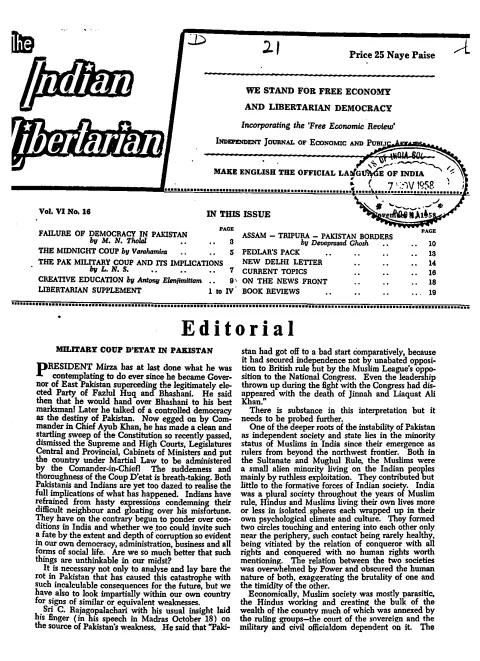
The November 1, 1958 issue (Vol. VI No. 16) of The Indian Libertarian, the Bombay fortnightly edited by Miss Kusum Lotwala that incorporated the ‘Free Economic Review’ and carried the standing mottoes ‘We stand for free economy and libertarian democracy’ and ‘Make English the official language of India’, is given over almost entirely to the military coup d’etat of October 1958 in Pakistan and to what it portends for India. The unsigned editorial, ‘Military Coup D’Etat in Pakistan’, reads President Iskander Mirza’s abrogation of the constitution and the installation of Commander in Chief Ayub Khan under Martial Law as the fruit of a society that never developed the habits of self-government, and asks whether corruption in India could invite the same fate. M. N. Tholal’s ‘Failure of Democracy in Pakistan’ traces the coup to the Ahmedia massacres and the impending Muslim League alliance with Maulana Maudoodi’s Jamait-e-Islam, and warns that Ayub has already said a war with India would be popular. Varahamira’s ‘The Midnight Coup’ holds that Islam and democracy cannot go together and reports a rift between the Pathan Ayub and the Punjabi officer corps, while L. N. S., in ‘The Pak Military Coup And Its Implications’, sets the coup inside a decade of American containment strategy and argues that Pakistan was armed as a brake on a Nehruvian India drifting towards communism. A statement reprinted from ‘Organiser’ by Pt Prem Nath Dogra and Prof. Balraj Madhok demands the deletion of Article 370, Anthony Elenjimittam’s ‘Creative Education’ attacks the state’s grip on schooling, and Principal Devaprasad Ghosh reports from the Assam and Tripura border on months of Pakistani firing and official neglect. A four-page Indian Libertarian Supplement carries Prof. G. N. Lawande’s ‘In Defence of Free Economy’ and ‘Foreign Exchange Crisis And Gold Loan’, an unsigned ‘Let’s Abolish the Income Tax’, and ‘The Law of Inequality’ by Fred G. Clark and Richard Stanton Rimanoczy. ‘Pedlar’s Pack’ signed Libra, a New Delhi Letter headed ‘The Expected Happens In Pakistan’, R. C. McCormick’s ‘What’s In A Name?’ from the Freeman, Current Topics on the Gramdan hoax and deficit financing, On The News Front, M. A. Venkata Rao’s review of Ralph Borsodi’s ‘The Challenge of Asia’, two reviews by G. N. Lawande, ‘Did You Know…’ by Scio and Letters to the Editor close the number.
Key points
-
The unsigned editorial argues that the deeper root of Pakistan’s instability is the minority status of Muslims in India since their arrival as rulers, and that a community which held power by force alone produced politicians who were British favourites rather than men of the calibre of Gandhi, Nehru, Patel or Rajagopalachari.
-
M. N. Tholal defends President Mirza’s belief in guided democracy on the ground that free elections in Pakistan would have returned a Muslim League and Jamait-e-Islam coalition led by Maulana Maudoodi, the man an enquiry commission held responsible for the Ahmedia massacres.
-
Varahamira contends that Islam and democracy cannot go together, notes that unlike De Gaulle or Ne Win President Mirza has promised no return to elections, and reports revolt in Kalat and a rift between General Ayub, a Pathan, and a Punjabi-dominated officer corps.
-
L. N. S. argues that Pakistan was brought into being as a rod in pickle against India and has been put on a war footing by American diplomacy, so that in any trial of strength India would lose within weeks, and closes by turning Cromwell’s dismissal of the Rump against Nehru.
-
Pt Prem Nath Dogra and Prof. Balraj Madhok, in a statement reprinted from ‘Organiser’ and delayed by the censors, demand the deletion of Article 370 and the removal of every distinction between Jammu and Kashmir and the rest of India, naming both Bakhshi Ghulam Mohammed and Pandit Nehru as obstacles.
-
Anthony Elenjimittam argues that schools and colleges under direct government control are becoming factories for manufacturing human tools for government service, and calls, with John Locke, Tagore, Sri Aurobindo and Ralph Borsodi, for schools set up far away from government recognition.
-
Principal Devaprasad Ghosh, president of the Bharatiya Jana Sangh, describes his September tour of the Cachar and Tripura firing zone, where villages were seized and a wounded border policeman was left to die untended, and reports that neither the Chief Minister of Assam nor any of the thirteen Cachar M.L.A.s visited the area.
-
Prof. G. N. Lawande’s supplement argues that the competitive system alone offers the greatest hope of improving the lot of mankind, that the state should act as umpire and not as active fielder, and that state interference, not private enterprise, is the root cause of India’s food, unemployment and foreign exchange crises.
-
Fred G. Clark and Richard Stanton Rimanoczy hold that no nation can make lasting progress without recognising the Law of Inequality, and that the progressive personal income tax cancels the free-market incentive by letting people receive higher rewards without keeping them.
-
M. A. Venkata Rao, reviewing Ralph Borsodi’s ‘The Challenge of Asia’, endorses the author’s view that Western man is ex-Christian and modern rather than pagan, and that India’s foreign and internal policies, both resting on an apotheosis of machine industry, can claim no affinity with genuine Asianism.
Essays
Editorial: Military Coup D’Etat in Pakistan
The editorial ‘Military Coup D’Etat in Pakistan’ opens the issue with President Mirza’s clean and startling sweep of the constitution so recently passed, the dismissal of the Supreme and High Courts, the legislatures and the cabinets, and the placing of the country under Martial Law administered by the Commander in Chief. It reports that Indians have refrained from gloating and have instead begun to ask whether the extent and depth of corruption in Indian democracy, administration and business could invite the same fate. Taking up Sri C. Rajagopalachari’s Madras speech of October 18, which laid the source of Pakistan’s weakness in its having won independence by the Muslim League’s opposition to the National Congress rather than by opposition to British rule, the editorial probes further into what it calls the minority psychosis of Muslims in India, arguing that under the Sultanate and Mughal rule they were a small alien minority whose economy was largely parasitic and whose relation to the majority was one of conqueror and conquered.
- Holds that the suddenness and thoroughness of the coup left both Pakistanis and Indians too dazed to realise its full implications
- Argues that a community which came into the country by force, remained by force and administered by force retains the mentality of a military garrison, and reacts savagely to any expression of independence in the subject populace
- Traces the growth of a Muslim middle class out of British favour-seekers, with easy university degrees, easy civil service posts and easy business patronage, against a Hindu governing class that found its feet and learned to measure swords with the British
- Reads the Aligarh movement and the career of the Muslim League as demonstrations of a minority’s habit of judging every development by gain or loss to its own group
- Presents the Iraqi coup as the precipitating example for the Mirza and Ayub Khan revolution, and warns that Pakistan will now make a strong bid for settlement by the arbitrament of force, so that strengthening American guarantees is a subject of the highest priority for India
Failure of Democracy in Pakistan
By M. N. Tholal
M. N. Tholal’s ‘Failure of Democracy in Pakistan’ insists that the coup can only be understood by keeping in mind the rioting in Western Pakistan some six years after the birth of the state, in which hundreds of Ahmedias were killed as Kafirs while the police looked on and the military was not called until the work of expropriation was over. Tholal argues that the educated and tolerant men who took power afterwards jailed the Maulvis and Maulanas responsible because they saw that heresy-hunting would move next to the Shias and then to some other sect, and that Indians make fun of the Pakistan President’s belief in guided democracy without asking what they would have done in his place. He then reports that the Muslim Leaguers, determined to win the coming elections at any cost, had again begun flirting with the instigators of the Ahmediya massacres, and that talks between the League and Maulana Maudoodi’s Jamait-e-Islam were scheduled for the Friday following the declaration of Martial Law.
- Cites the molestation of about twenty women by Karachi goondas in the presence of police on the eve of Mohurrum as evidence of what an Islamic constitution permits
- Quotes Dr. Khan Sahib’s remark that Pakistan needed not general elections but a revolutionary council such as Egypt has, and his earlier description of army rule as the best form of government for Pakistan
- Explains the timing by the political complexion of the coming elections, the certain dissolution of West Pakistan as one unit, and the Muslim League’s own denunciation of the Baghdad Pact, which left the Republicans isolated on foreign policy
- Observes that even with the unjust equation of the two wings in the National Assembly, East Pakistan needed only one West Pakistani province as ally to oust the Punjabi Muslims for ever
- Warns that General Ayub has declared a war with India would be most popular in Pakistan, calls this a threat India will ignore at her peril, and notes that when power resides plainly in the gun there is no knowing who may face the firing squad the day following
The Midnight Coup
By Varahamira
Varahamira’s ‘The Midnight Coup’, printed under the standing head ‘Inside Pakistan’, declares that the author is not surprised, since a cursory glance at the history of Islamic countries shows that Islam and democracy cannot go together and that Pakistan has merely stood up to the Islamic tradition after Egypt and Iraq. He blames the politicians, describing a decade of ceaseless and unscrupulous scrambling for office, shifting loyalties and the exploitation of ignorant masses in the name of Islam, which destroyed the people’s confidence in every leader and party and left the way open for a dictator. Varahamira concedes that a strong military rule may become imperative until a nation is brought back to sanity, but observes that unlike De Gaulle in France or Ne Win in Burma, President Mirza has not promised to quit office, hold free elections and restore democracy even in the distant future.
- Reports widespread revolt in Kalat and simmering unrest in Baluchistan, the North West Frontier region and East Bengal over the arrests of Khan Abdul Ghaffar Khan, Samad Khan, G. M. Syed and Maulana Bhashani
- Gives the composition of the Pakistan Army as 70 per cent Punjabi, 20 per cent Pathan and 10 per cent Sindhi and East Bengali, and describes it as behaving like an army of occupation in East Pakistan
- Alleges a rift between General Ayub, a Pathan, and the Punjabi-dominated forces, with Ayub reported to have shot dead several officers who disagreed with him and President Mirza furious at the act
- Casts Mirza as the Naguib to Ayub’s Nasser, made prisoner of the Army by his own dependence on it in the absence of a popular government
- Predicts that the struggle for power will now shift from the politicians to the officers of the defence services, naming the Air Force Chief Askar Ali as Mirza’s confidant and the Navy Chief Chowdhury as an ambitious man backing Ayub for his own reasons
Delete Article 370 of Constitution: Make Kashmir One With India
The joint statement ‘Delete Article 370 of Constitution: Make Kashmir One With India’, issued on 21 September by Pt Prem Nath Dogra, President of the Jammu and Kashmir Praja Parishad, and Prof. Balraj Madhok, North-West Zonal Secretary of the Jana Sangh, is reprinted from ‘Organiser’ with an editorial note that the censors did not let it reach the paper until 26 September. The two argue that eleven years after the accession a feeling of uncertainty about the oneness of the State with India persists, sustained by a set of obvious and unnatural distinctions: the permit system, a separate nomenclature and mode of appointment for the head of the State, a separate citizenship camouflaged as permanent residentship, the absence of full jurisdiction for the Supreme Court and the Election Commission, and indirect election to the Lok Sabha.
- Contends that it is these distinctions, defended in the name of a special position, which keep the Kashmir question alive and prevent the return of normalcy
- Argues that the ruling circles have a vested interest in the special position because it lets them play havoc with democratic liberties and prolong their own spell of power
- Holds that offering special privileges appeals to the selfishness of the people and cannot substitute for an emotional sense of oneness born of nationalism, while corruption in distributing those benefits discredits India
- Names both Bakhshi Ghulam Mohammed and Pandit Nehru as, maybe unwittingly, sabotaging the wider interests of Jammu and Kashmir and of India
- Notes that the National Democratic Conference has now been forced by realities to seek the jurisdiction of the Election Commission and the Supreme Court, but insists that half measures will not do and that One Constitution, One Flag and One President is the cornerstone of Indian unity
The Pak Military Coup And Its Implications
By L. N. S.
‘The Pak Military Coup And Its Implications’, by L. N. S., observes that the Indian press has been either childishly complacent or mildly critical and that world reaction has gone unreported, and sets out a survey of the past decade to place the coup in context. The writer calls the circumstances of Pakistan’s birth a sordid chapter in which Indian leadership played a passive role in the global policies of astute empire builders, and holds that Indians gulled themselves into believing non-violence had brought Swaraj when it was violence to which they succumbed. He then traces the post-war breakdown between Washington and Moscow, the decision to contain communism from Korea to the Lebanon intervention, and argues that Pakistan, a crazy and unviable creation, was brought into being as a rod in pickle with which India could be beaten into submission.
- Argues that Nehru, in the name of planning, plunged the country into recurring bankruptcy while slanging the American benefactors whose aid sustained it
- Holds that the drift of Nehru’s policies towards the installation of communism without the label made America put Pakistan on a war footing as a brake on India, since the Islamic belt is the one area of Asia never likely to go communist
- Warns that in any military trial of strength Pakistan would win in weeks if not days, being armed by the most militarily advanced nation in the world while Indian equipment is outdated junk bought at bloated prices
- Notes the talk of a corridor between West and East Pakistan and Nehru’s slogan about a few square miles this way or that, and links it to the appeasement commended in the name of Panch Shila
- Observes that Indian ruling prices are absurdly above world prices, that exports are subsidised at the internal consumer’s cost, and closes by asking when Cromwell’s words to a venal opposition will be addressed to the main architect of India’s misfortunes
Creative Education
By Anthony Elenjimittam
Anthony Elenjimittam’s ‘Creative Education’ argues that government totalitarianism is fast encircling the field of education in India, that the Education Bill in Kerala State is only the logical sequence of Communist totalitarianism, and that in Congress-governed States the strangling grip of government on educational institutions is just as obvious to anyone engaged in teaching. He objects to the regimentation, standardisation and centralisation of policy pursued by the Central and State Governments, to the undue stress on paper titles, diplomas and cramming, and to schools and colleges under direct government control which are becoming factories for manufacturing human tools for government services while a vast majority of their products join the army of the unemployed. Quoting John Locke on the business of education, and Ralph Borsodi on a society that makes no provision for the right education of adults, Elenjimittam holds that Indian institutions are producing intellectual and spiritual suicide on a far greater scale than a developed country like the United States.
- Notes that matriculates and graduates are among the most frustrated class in Indian society because the creative dynamics of education has been lost sight of
- Cites students who sell their textbooks to any second hand shop after the examinations, saying they have finished their education, and then hunt for jobs as though titles were passports
- Holds that schools and colleges can give only a direction and a push, while education, learning and self-unfoldment continue throughout life
- Points to Rabindranath Tagore and Sri Aurobindo Ghose, who set up their own schools for living and learning as a protest against the prevailing system, and to Borsodi’s School of Living
- Calls on all who aspire after creative education to set up their own schools far away from government recognition, so that children may grow in freedom, creative dynamics and joy of life
Assam-Tripura-Pakistan Borders
By Principal Devaprasad Ghosh
Principal Devaprasad Ghosh, President of the Bharatiya Jana Sangh, writes ‘Assam-Tripura-Pakistan Borders’ under the head ‘Through the Firing Zone’ as a first-hand account of his visit to the border in the first days of September. He records that since March 1958 Pakistani forces on the Assam and Tripura borders have been making incursions and firing under the pretext of anti-smuggling measures called ‘Operation Close Door’, that Prime Minister Nehru had to admit in Parliament that three cease fire agreements had been made and violated in six months, and that the trouble reached an acute phase in August when a regular fusillade was kept up across the Kushiyara River and the Indian village of Tukergram was seized under cover of night. Ghosh describes the deserted Bhanga Bazar with its shops locked, a saw mill roof riddled with bullets, villagers half a mile inland who said bullets had rained like hailstones, and a body of border people who had lost all confidence because cease fires had been declared and broken so many times.
- Reports that the more experienced police section at the Sutarkandi check post had been withdrawn on the very morning of his visit, that no telephone connections were working in the area, and that an officer who had done valuable work spotting fifth columnists had been suddenly transferred
- Tells the story of a wounded policeman at Lakshmipur in Tripura, left untended in a paddy field through a night and a morning, crying for water, and found dead when a rescue party finally reached him
- Charges the thirteen Cachar M.L.A.s and Chief Minister Bimala Prasad Chaliha with dereliction of duty for not touring the firing zone during the three fateful weeks of August
- Records reports of fifth column activity among local Muslims and the pre-partition Muslim League antecedents of Assam Congress figures, and describes anti-Bengali sentiment stirred up among Asamiyas in a Bengali-speaking Cachar
- Finds the Noon and Nehru joint statement silent on six months of unprovoked incursions and on the fate of Tukergram and Lakshmipur, and lists the concessions revealed in Mr. Noon’s separate statement, including enclaves in Cooch Behar, half of Berubari Union and a strip near the Tripura border to ease the running of Pakistani railways
In Defence of Free Economy
By Prof. G. N. Lawande, M.A.
Prof. G. N. Lawande’s ‘In Defence of Free Economy’ opens the four-page Indian Libertarian Supplement with the complaint that attacking capitalism has become a fashion among Indian politicians and economists, and that Karl Marx, the first economist to mount such an attack, was proved wrong by history because his assumptions were not based on reality. Lawande argues that the competitive system alone offers the greatest hope of improving the lot of mankind, that the period since the Industrial Revolution raised real incomes to heights previously thought unattainable, and that its defects call for removal by wise legislation rather than for abolition. He answers the socialist charges of exploitation, waste and depression by proposing that the state act as umpire or referee rather than as an active fielder, and denies that it is any business of the state to make men moral, welfare being an abstract concept that means one thing to the individual and another to the State.
- Holds that monopoly curtails output, lowers the demand for labour and raises prices, so that consumers are doubly hit, and that the labourer’s lot would not improve under socialism, real incomes in Russia being far below American wages
- Argues that competition maintains consumer sovereignty, since the citizen of a socialist state must accept whatever the all-controlling managers put before him
- Cites Prof. Taussig against the claim that combinations mitigate fluctuations, calling the argument commonly a mere excuse for building a monopoly
- Contends that socialism would select managers by political rather than competitive means, would lack the profit motive and the drive it supplies, and would establish a tyrannical bureaucracy more concerned to keep power than to serve the people
- Concludes that state interference, not private enterprise, is the root cause of India’s food, unemployment and foreign exchange crises, and that free competition without any element of monopoly is the only remedy
Let’s Abolish the Income Tax
The unsigned supplement piece ‘Let’s Abolish the Income Tax’ argues that America’s founding fathers were right to advise that government be kept simple, and that legislators now face hundreds of bills in difficult legal language which neither they nor the people can be expected to understand. It recalls that the founding fathers limited the power of taxation and did not permit an income tax, and holds that freedom will not be restored until the tax is got rid of, because it gives the collector too much power, violates nearly all constitutional liberties, permits prying into private affairs and creates a government of men rather than of law.
- Objects that the income tax reverses the presumption of innocence and lets a collector ruin individuals he dislikes
- Reports that many who agree privately ask that their names not be mentioned, which the writer takes as proof that the tax rules by fear
- Answers the argument that it taxes the rich with the figure that 83 per cent of income tax comes from incomes of six thousand dollars and under
- Answers the argument that government needs the money by claiming that fifty cents of every dollar collected is wasted
Foreign Exchange Crisis And Gold Loan
By Prof. G. N. Lawande, M.A.
Prof. G. N. Lawande’s second supplement article, ‘Foreign Exchange Crisis And Gold Loan’, takes up the proposal that the Government mobilise the country’s private gold to meet the foreign exchange crisis. Lawande notes that Prof. Shenoy’s remedy of devaluation was turned down by economists, businessmen, the Prime Minister and the Finance Minister on the ground that it would raise the cost of the Plan, and that the alternative slogan of export or perish leaves unanswered what is to be exported and to whom, since Indian prices are high and quality is not of the requisite type. He then examines Mr. C. B. Mehta’s presidential proposal at the ninth general meeting of the Bombay Bullion Association that a Gold Loan be floated, with subscribers repaid in gold alone through a Gold Mohur of one tola, and with an assurance that the income tax authorities would not treat the gold as concealed income.
- Doubts that the French example can be followed in full, since Indian gold is held not in bars but as jewellery scattered across the country
- Suggests that temple trustees be persuaded to buy gold certificates, which would protect temple wealth from dacoits and turn it towards the country’s development
- Warns that if cash is excluded from the loan people will convert cash into gold, raising its price and giving smugglers a golden opportunity
- Cites the Reserve Bank estimate of about 106 million ounces of gold in private holding, and asks that hoarding be made less lucrative and smuggling severely dealt with before any loan is issued
- Concludes that if the flotation is not feasible the only course open is a libertarian policy, with import licences issued freely on condition that importers export five times their imports, which would end the bribery and corruption now attending licences
The Law of Inequality
By Fred G. Clark and Richard Stanton Rimanoczy
‘The Law of Inequality’, by Fred G. Clark and Richard Stanton Rimanoczy, closes the supplement with the proposition that no two human beings are equal in all respects and that the enormous contrasts in natural talents stagger the imagination. The authors hold that almost every person is potentially good at something, that the key problem of any society is to let everybody make their maximum contribution, and that the equality the Founding Fathers had in mind was equality of opportunity to develop and exercise natural talents. They argue that until the advent of the United States most people were born to their station in life and expected to stay there, so that governmental power and productive wealth remained concentrated in the hands of a few who had nothing personally to gain from better government or from relieving the poverty of the masses.
- States that the unfailing sign of a nation recognising the law is the rise of a strong prosperous middle class, and that such a society is fluid because people are free to rise or sink according to their value to their fellow men
- Argues that recognition of unequal talents requires recognition of unequal rewards, and that wages should follow the supply of and demand for various services
- Notes that Communist Russia partly recognises the law and pays fabulous premiums to specially talented people, a policy that has paid dividends including Sputniks
- Holds that the free world’s recognition of the need for unequal rewards has been decreasing, and that the twentieth century cult of artificial equality tends to make its own belief come true by equalising effort at the bottom of the productive scale
- Concludes that the free-market economy suits the law best, and that the progressive personal income tax cancels much of the free-market incentive by letting people receive higher rewards but not keep them
Pedlar’s Pack
‘Pedlar’s Pack’, the paper’s column of squibs signed Libra, opens with Pandit Nehru explaining after his Himalayan hike that his absence from Delhi prevented him commenting on the formation of the Free Government of Algeria on Egyptian soil and on the Far Eastern crisis, and remarks that it was very inconsiderate of these events to occur without obtaining his prior approval. The column turns next to Nehru’s statement that conditions in Tibet are not fully normal, calling it a painful example of his genius for surrendering in panic and then repining at leisure, and recalls that Tibetan representatives who came to Calcutta on their way to the United Nations were turned back by the Nehru Government without proper publicity, while Byelo-Russia, the Ukraine and Outer Mongolia secured recognition.
- Jokes that President Nasser’s gift of an Egyptian-made sub-machine gun to Mr. Karanjia of the Blitz was in exchange for the butter of his book on Arab nationalism
- Observes that Mr. Chavan’s warning against communalists after the firing over music before mosques evidently means the Hindus, and notes that music is older than mosques and would survive them
- Replies to Acharya Bhave’s praise of Nehru as a philosopher-statesman who believes India and the world are indivisible that, if he keeps giving away bits of India to Pakistan, India would soon become wholly invisible
- Compares Russia’s announcement that it has resumed nuclear tests to the wag who vowed to starve between meals
- Ends with a verse on Mr. Aneurin Bevan, the bulky British Ivan who says that Mr. Dulles sends a shiver down his spine
New Delhi Letter: The Expected Happens In Pakistan
The New Delhi Letter, headed ‘The Expected Happens In Pakistan’ and filed from our correspondent, reports that the revolution which Prime Minister Nehru had almost predicted a year earlier has set the capital asking whether democracy and Islam can go together. The correspondent argues from the conflicting statements of the two generals, Mirza saying martial law should not continue beyond two months and Ayub that it will not be lifted until the whole fabric of Pakistan is repaired, that the contradiction is a pre-planned manoeuvre to outwit the people rather than evidence of a difference of opinion, and that the story of the President’s hand having been forced was cooked up for public consumption. He holds that the coup is in a real sense a revolution against Islam, or against the sort of Islam the man in the street in Pakistan believes in, and asks how far an army manned by that same man in the street will support the regime.
- Recalls Ghulam Mohammad, whom the correspondent knew over cards in Delhi, as the broad-minded Governor-General but for whom the Qadianis would have been murdered in cold blood, and who concluded that democracy would mean the ruination of Pakistan
- Reports a Pakistani visitor’s view that the officers’ hatred of the politicians had become personal, because the Karachi goondas who molested the wives of majors and generals were protected by politicians who counted on them at elections
- Notes that General Ayub’s declaration at Karachi that birth control must be introduced runs against the popular belief that the Prophet enjoined multiplying the number of the faithful, and calls it the thin end of the wedge
- Describes Ahmed’s cartoon in the Hindustan Times showing Mirza and Ayub before the imprisoned party leaders, with Ayub firing a pistol and saying he knows there is a next step he ought to take and wishes he knew what it was
- Warns that the course is dangerous for India too, since the hotheadedness of fanatically inclined officers will not long resist the temptation of a blitz against India, and observes that the Indian public does not view the problem with the gravity it demands
What’s In A Name?
By R. C. McCormick
‘What’s In A Name?’, by R. C. McCormick and reprinted from the Freeman, is introduced by an editorial note explaining that the author has recently completed a trip around the world and records here his impressions of India, namely that Pandit Nehru is a virtual dictator, that politicians in high places are woefully dishonest, and that Nehru and his supporters are practising all the evils of communism under a different label. McCormick writes that a visitor soon becomes cognisant of Nehru’s fascination with communism as the only scientific plan of living known to him, and that he does not believe in the sanctity of property, though history has proven repeatedly that a government which takes a man’s well-earned property also takes away his freedom.
- Recounts a travelling companion, a former ruler and an intimate of both the Queen of England and Nehru, who questioned Nehru about allowing the Communist party to operate openly in India
- Reports Nehru’s reply that communism is an emotion sweeping the world and that it would be poor politics to exclude it by force, since he hoped to discredit it by devising a more scientific plan for social living
- Judges Nehru successful as the amalgamator of India but a hand of putty as its dictator, with pay-offs rampant and few dishonest officials punished or dismissed
- Illustrates the point with parcels that cannot be trusted to the mail, a tiger skin that must be carried personally to a distant tanner, and gifts machine stitched into burlap, hand overcast and wax-sealed against theft
- Closes with the image of stealing the communism machine and painting it a different colour, since stripped of the paint it is the same machine, built to direct the energies of all men by force
Current Topics
‘Current Topics’ gathers the issue’s shorter commentary, opening with ‘The Gramdan Hoax’, which reports that after the great myth of Bhoodan was exploded Vinoba launched the Gramdan movement, and that the gramdan revolution in Koraput has proved a total debacle with most of the district’s gramdan fictitious. The section objects that the gospellers of Bhoodan, Gramdan and Sarvodaya go abroad acclaiming Vinoba as a second Mahatma while disliking any close scrutiny, and singles out Mr. Jaya Prakash Narain for advising socialist governments in Europe to practise a doctrine that has succeeded in India only as vote-catching propaganda.
- Reports behind-the-scenes friction between Moscow and Peking over the supply of atomic weapons to the Chinese army and over which capital is to exercise central control of the world communist movement
- Lists 82 delegations sent abroad in 1957 and 1958 at a cost of over Rs. 20 lakhs, with the External Affairs Ministry alone accounting for Rs. 7,89,706
- Notes that the Posts and Telegraphs Department yielded a surplus of Rs. 6.32 crores in 1956 and 1957, and attributes the rise to the naya paisa, to lost letters that compel registration, and to a belief that departments are told not to answer complaints until four reminders arrive
- Argues under ‘Indo-Pak Relations’ that editorial complacency about the Nehru and Noon meeting rests on treacherous foundations, calls Mr. Jai Prakash Narain an arrested adolescent and a political Peter Pan, and says the initiative has always rested with Pakistan while Indian leadership has been content to dance to the tune
- Carries Mr. Per Jacobsson of the International Monetary Fund warning that deficit financing depletes resources and brings inflation, with the observation that the Finance Minister is not prepared to accept that inflation exists in India
On The News Front
‘On The News Front’ assembles agency and newspaper items, beginning with the Central Executive of the Bharatiya Jan Sangh terming the recent events in Pakistan ominous for India, on the ground that the military may at any time be tempted to divert popular discontent into aggressive activity and that the pronouncements of the new rulers reveal no change in Pakistan’s attitude towards India or towards the Hindu minorities.
- Lists the new martial law regulations in Pakistan, with five years rigorous imprisonment for molesting women, fourteen for bribery, a year for throwing rubbish before shops, and prohibition of beggary on pain of six months or twenty five whips
- Reports rebel Khambas in control of a major part of the Lhasa to Peking highway through Kham province, with trucks smashed by boulders rolled from hilltops and consumer goods no longer reaching Lhasa
- Carries an Indian Express report from Karachi that Pakistan’s October revolution has revitalised public interest, ended the helplessness of the underdog and filled offices by nine in the morning
- Describes the organising of a Muslim force named the Gaznavi Sena in the Sorath district of Saurashtra, trained by officers of the old Junagadh army and meeting at night under cover of religious gatherings
- Records Mr. Justice Datta of the Calcutta High Court issuing a rule on the Governments of India and West Bengal to show cause under what authority they were giving effect to the Nehru and Noon decision to transfer Indian territory to Pakistan, on the application of Mr. Nirmal Bose, a professor of political science
Book Review: The Challenge of Asia
By M. A. Venkata Rao
M. A. Venkata Rao reviews ‘The Challenge of Asia’ by Ralph Borsodi, founder-chancellor of a university at Melbourne, Florida, whose courses rest on a penetrating vision of the central defects of Western civilisation as it has developed in the two forms of capitalism and communism. Venkata Rao describes Borsodi’s seminar method, in which students and teachers confront key problems of civilisation with alternative solutions and the accumulated wisdom of past civilisations, and reports that these experiments have led Borsodi to conclusions remarkably free of the prejudices of Western man. Borsodi holds that America is not going the right way in trying to save herself and the Asian nations from communism, that neither dollar and military aid nor rapid industrialisation is the answer, and that the root of the malaise is a material idea of progressive and excessive industrialisation, urbanism, militarism and love of pleasure.
- Reports Borsodi’s finding, from his visit to India and other Asian countries, that the leaders of the newly freed nations had forgotten their Asianism and that Nehruism had jettisoned Gandhism
- Quotes Borsodi that Western man is ex-Christian in Toynbee’s phrase, not so much pagan as barbarian, with two ideologies, capitalism and communism, both of them false
- Notes Borsodi’s blunt denunciation of the narrowness and intolerance of the Semitic religions, Judaism, Christianity and Islam, as inferior in humanism to the tolerant religions of Asia, and Venkata Rao’s remark that this is just the vital faith of the liberal Hindu
- Argues that India’s present foreign policy, leaning decisively towards the world of communism, and its internal policy committed to Marxist socialism, both deriving from an apotheosis of machine industry at the cost of human values, can claim no affinity with genuine Asianism
- Judges Borsodi a man of vision with clarity, sincerity and courage to match, whose university appears to be a true gurukula, and the book a work of insight into the crisis of civilisation
Book Review: Poverty And Capital Development In India
By G. N. Lawande
G. N. Lawande reviews ‘Poverty And Capital Development In India’ by Dr. D. K. Rangnekar, published by the Oxford University Press at Rs. 25, a doctoral thesis approved by London University whose object is to portray the contemporary pattern of investment in relation to some of India’s major problems of development. Lawande grants that everyone knows India to be a rich country inhabited by poor people, and that the first chapter gives a good description of that poverty, but observes that what Rangnekar says about poverty is not new and that the book’s importance lies rather in assembling the available facts in a lucid form. He reports that the author accepts the pattern of the First Five Year Plan but attacks the Second as over-ambitious in size and wrong in its priorities, holding that greater emphasis should have gone to agriculture instead of heavy and basic industries.
- Agrees with Rangnekar that the problem of Indian development is linked to the performance of agriculture, but notes that the author himself concedes agriculture cannot advance far without industry as its technological base
- Objects that heavy industry accounts for less than ten per cent of investment in the Second Plan period, so that the criticism is aimed at a small part of the whole
- Argues that realistic planning must weigh long term gains as well as immediate ones, and that Rangnekar’s bias costs his criticism much of its force
- Doubts the author’s own calculation of capital formation for 1948 to 1952, which is lower than the official figures and relates to a period before the Plan
- Concludes nonetheless that the thesis is one of the good ones to come out of London University, well written and timely, and should be read by the Planning Commission before the Third Five Year Plan is drafted
Book Review: On The Decline In The Value Of Money
By G. N. Lawande
G. N. Lawande reviews ‘On The Decline In The Value Of Money’ by R. G. Allen, published by Longmans Green and Co. at 2sh. 6d., a reprint of the Stamp Memorial Lecture delivered before the University of London on 12 November 1957. Lawande calls the subject apt, since many countries experienced inflation in the post-war period in doses varying with the money pumped into the market by their governments, and notes that Prof. Allen bases his analysis of British price trends on the index of market prices calculated annually by the Central Statistical Office and on the retail price index published in the Ministry of Labour Gazette.
- Summarises Allen’s treatment of two phases of rising prices since 1938, one after the Second World War and one on the eve of the Korean War, both of the demand pull type
- Distinguishes cost-push inflation, a more sophisticated version of wage inflation in which increases in all cost items are passed on, as the inflation of an overloaded economic system
- Notes that in the inflation preceding the Korean War the pressure exerted by import prices and external factors was greater
- Reports Allen’s case for a macro dynamic model that separates the disturbance which starts inflationary price movements, the mechanism that keeps it going, and the factors that might stabilise it
- Recommends the lecture to government officials and especially to the Finance Ministers of underdeveloped countries who, in their zeal for rapid development, pump more and more money into the market
Generated by the v1.5 extraction pipeline. Awaiting editorial review.
Metadata and summary are AI-extracted from the source PDF and reviewed for editorial accuracy. The original work is available via the Read PDF tab above (where present); paragraph-level citation inside the PDF is deferred to a future engagement.