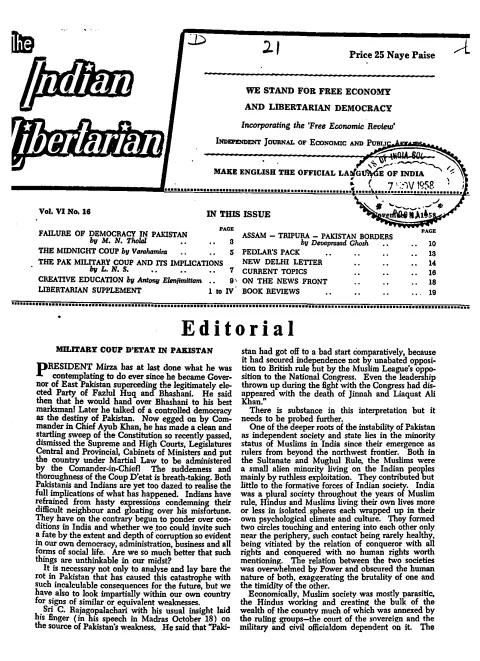
periodical issue
The Indian Libertarian
Independent Journal of Economic and Public Affairs
By MA Venkata Rao, M. N. Tholal, KD Valicha
The Indian Libertarian, Arya Bhuvan, Sandhurst Road, Bombay 4 · Bombay · 1957
20 pages
The Indian Libertarian
Summary
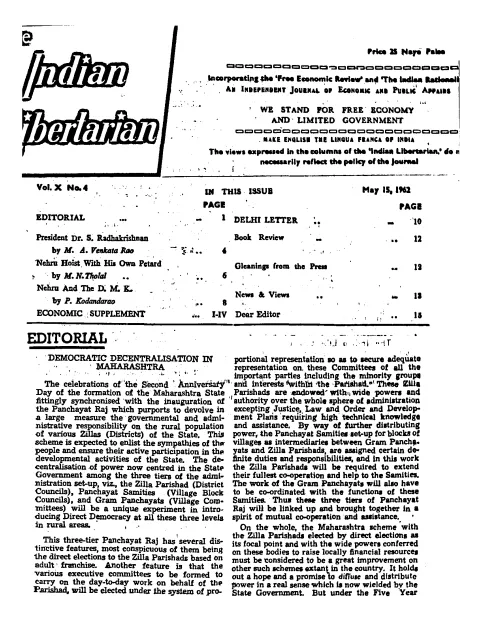
The 15 May 1962 issue (Vol. X No. 4) of The Indian Libertarian, the Bombay fortnightly edited by D. M. Kulkarni, B.A., LL.B. for the Libertarian Publishers (Private) Ltd., which incorporated the ‘Free Economic Review’ and ‘The Indian Rationalist’ and stood for free economy and limited government, opens with an unsigned editorial in three parts. ‘Democratic Decentralisation In Maharashtra’ welcomes the three-tier Panchayat Raj inaugurated on the state’s second anniversary while warning that the Planning Commission’s power over funds has already made a mockery of state autonomy; ‘Nuclear War And Peace’ holds that Nehru and Bertrand Russell should not have panicked over the American resumption of testing when Russia persistently spurns on-site inspection; and ‘Kashmir And The Future Of Indian Democracy’ reads General Ayub Khan’s courting of China at the Security Council as a blunder India should answer by re-orienting its foreign policy towards the Western democracies. M. A. Venkata Rao marks the imminent installation of Dr. S. Radhakrishnan in Rashtrapati Bhavan with an appraisal of the philosopher statesman as an indignant prophet on behalf of the under-dog whose counsel a lonely Prime Minister now needs. M. N. Tholal’s ‘Nehru Hoist With His Own Petard’ argues that Indian anger at King Mahendra for practising non-alignment towards China convicts Nehru’s own gospel of trust, which has already cost the country fifteen thousand square miles. P. Kodandarao’s ‘Nehru And The D. M. K.’ opposes the Prime Minister’s threat to answer a peaceful secessionist demand by war and traces Dravidian separatism to the coercive imposition of Hindi and a series of broken promises about English. The four-page Economic Supplement carries the second part of Prof. S. Kesava Iyengar’s ‘Patent Pitfalls In Planning’, which shows Plan outlay to be a fringe of the national economy and the private sector’s share of it falling Plan by Plan, and the second part of Ambassador Galbraith’s Gujarat University address on the causes of poverty. A Delhi Letter on Nehru’s defiant replies to the Chinese note of 30 April and on the collapse of PSP and Socialist Party unity, M. A. Venkata Rao’s review of Stefan T. Possony’s ‘A Century of Conflict’, ‘Gleanings from the Press’ on the Moscow and Peking schism, a long ‘News & Views’ section and a ‘Dear Editor’ letter from P. Kodandarao close the issue.
Key points
-
The masthead of this Vol. X No. 4 issue, dated May 15, 1962 and priced at 25 Naye Paise, declares that the journal stands for free economy and limited government and asks readers to make English the lingua franca of India, and the colophon names D. M. Kulkarni, B.A., LL.B. as editor for the Libertarian Publishers (Private) Ltd. of 26, Durgadevi Road, Bombay 4.
-
The unsigned editorial welcomes the Maharashtra Panchayat Raj as a bold experiment in direct democracy at district, block and village levels, but holds that the Central Government, through the Planning Commission and its power of allocating funds, has already made a mockery of state autonomy and local self-government.
-
The editorial section on nuclear war argues that men of the stature of Nehru and Bertrand Russell should not have grown panicky over the American resumption of testing, since every proposal for effective on-site inspection has been spurned by Russia, and that appeals addressed only to the Free World abet Russian bullying.
-
The editorial on Kashmir contends that by hobnobbing with China at the Security Council General Ayub Khan has missed the bus and caught the wrong one, that Pakistan would be the first victim of Chinese aggression, and that India should answer by strengthening its bonds with the Western democracies rather than buying supersonic fighters from Moscow.
-
M. A. Venkata Rao’s appraisal of Dr. S. Radhakrishnan, written before the election of 7 May, presents the professor as a traditionalist who is no defender of privilege, an indignant prophet on behalf of the under-dog, and a counsellor whose frank private correction Nehru now needs as public criticism of his policies grows strident.
-
M. N. Tholal argues that Indians angry with King Mahendra for practising non-alignment and trust towards China are convicting Nehru’s own doctrine, which has already lost India between twelve and fifteen thousand square miles, and asks whether the Prime Minister has at last seen the insanity of his own policy.
-
P. Kodandarao holds that Nehru’s threat to resist the D. M. K.’s secessionist demand by war will only win sympathy for a party that has confined itself to peaceful constitutional agitation, and traces the decay of national sentiment to the coercive imposition of Hindi and the Government’s broken promises about English.
-
Prof. S. Kesava Iyengar’s Economic Supplement shows Plan outlay to be a fringe of the national economy, the private sector’s share of it falling across the three Plans from 47.87 to 35.34 per cent, and the distinction between Plan and Non-Plan expenditure to be a rule of thumb that hampers the discretion of State Cabinets.
-
Ambassador Galbraith’s Gujarat University address, printed in the supplement, rejects the assumption that poverty everywhere is caused by a shortage of capital and technical know-how, comparing that prescription to a physician who has vitamins available and so prescribes them for every illness.
-
The Delhi Letter observes the irony that Nehru, in telling the Rajya Sabha on 3 May that the Chinese are apprehensive about India’s growing strength, has resorted to the very language of negotiating from strength that he condemned for years in the Western Powers.
Essays
EDITORIAL
The editorial opens with ‘Democratic Decentralisation In Maharashtra’, which notes that the celebrations of the second anniversary of the formation of the Maharashtra State coincided with the inauguration of the Panchayat Raj, and describes the three tiers of Zilla Parishads or District Councils, Panchayat Samities or Village Block Councils, and Gram Panchayats or Village Committees. It praises the direct election of the Zilla Parishads on adult franchise and the use of proportional representation for their executive committees, which is meant to secure a place for minority groups and interests, and defends as provisional the Government’s reserving to itself the appointment of executive officers. The second section, ‘Nuclear War And Peace’, accepts that the nuclear age has come to stay with all its attendant benefits and evils, and blames Russia rather than the United States for the breakdown of the test moratorium. The third, ‘Kashmir And The Future Of Indian Democracy’, reads General Ayub Khan’s approach to China as a stupidity that has already cost Pakistan the sympathy of enlightened opinion in America and England. A closing column of notes, ‘Here And There’, comments on Morarji’s Central Budget for 1962-63, on the Moscow debate over whether Stalin was a faithful associate of Lenin, and on the Indian Airlines Corporation advertising a bar service on its international flights while the Centre remains split over prohibition.
- Warns that casteism and party factionalism may prove great hurdles to the smooth working of the Zilla Parishads, though the system of proportional representation should counter-balance them to a degree.
- Holds that the Free World must reconcile itself to a long drawn out series of tests by both camps, since neither can be expected to commit hara-kiri by stopping unilaterally.
- Argues that the deferment of the Kashmir question at the Security Council, with the common consent of America and England, proves that sympathetic understanding of India’s case is not lacking among the leading democratic countries.
- Objects that the so-called Leftists in the Central Cabinet are fishing in troubled waters, stampeding India into buying supersonic fighter planes from Russia and into a war hysteria that would make the country forget the greater menace from China.
- Predicts that Morarji’s budget will hit the middle classes hardest, with the prices of necessities like cloth and tea shooting up once its full impact is understood.
President Dr. S. Radhakrishnan
By M. A. Venkata Rao
M. A. Venkata Rao writes on the eve of Dr. S. Radhakrishnan’s election of 7 May and his installation in Rashtrapati Bhavan, calling the presidency the coping stone of the remarkable career of an exceptionally successful savant from university life. He traces the many sided gifts of the learned doctor: the early study of Rabindranath Tagore’s philosophy, the co-operative volume of essays on Mahatma Gandhi issued on the Mahatma’s birthday, the lectures in England and America on Indian philosophy and on the spiritual contribution a free India could make to world peace, and the vivid satirical bent with which he etches the hypocrisies of current fashionable feeling and the half-baked philosophies of scepticism, hedonism and determinism that end in nihilism. Venkata Rao sets him at the opposite pole of the mental heaven of the age from Mr. M. N. Roy, whose ‘Reason, Romanticism and Revolution’ he commends to those of a more sceptical mind, and argues that beneath an external air of conformity the professor has done the work of an indignant prophet on behalf of the disinherited of the earth.
- Records that the professor condemns injustices of all kinds, including racial persecution, imperial oppression, the selfish tyranny of capital ownership and the aristocracy of birth and inherited rank.
- Notes his argument before the League of Nations Committee for Intellectual Co-operation for India’s immediate fitness for self-government, against the counsels of delay from Lindsay, Sir John Simon, Sir Gilbert Murray and H. G. Wells.
- Observes that in politics he was not a moderate like the Rt. Hon’ble Srinivasa Sastri but stood for unadulterated independence forthwith.
- Recalls that Nehru chose him to succeed Smt. Vijayalakshmi Pandit as Ambassador at Moscow during Stalin’s regime, and that he had the courage to ask Stalin to his face when he would allow civil liberties to his people.
- Argues that as President he will advise the rulers in camera like the raja gurus of old, and that a Prime Minister losing his trusted colleagues one by one and facing strident criticism, especially from Rajaji’s movement, needs so ripe and frankly corrective a counsellor.
Nehru Hoist With His Own Petard
By M. N. Tholal
M. N. Tholal opens ‘Nehru Hoist With His Own Petard’ by observing that Mr. Nehru, a gospeller of non-alignment and of a policy of trust, ought to have been happier than anyone to find a redoubtable follower in King Mahendra of Nepal, and is instead angry at the discovery of his own gospel spreading to neighbouring lands. What is sauce for the gander, Tholal writes, is apparently no sauce for the goose, and if Indians plead that circumstances alter cases they concede that non-alignment admits of no universal application. He points to Switzerland as the classic instance of a country kept safe by non-alignment and trust, and to India as a country whose anger with Nepal makes abundantly clear that there is something radically wrong with a policy that has already lost it twelve to fifteen thousand square miles of territory. Under the headings ‘Bad For Nepal’, ‘Offshoots Of Policy’ and ‘Anti-Non-Alignment Advice’ he presses the point that the arguments Nehru must have used privately on King Mahendra contradict everything he has said publicly for years in advocacy of non-alignment.
- Notes that at the Congress Parliamentary Party meeting of April 29, a few days after meeting the King of Nepal, Nehru again asserted that trust begets trust and distrust begets distrust, having only days earlier accused China of another incursion and another breach of promise.
- Recalls that Nehru long condemned the anti-Communist observations of John Foster Dulles at the very time when China was demonstrating their truth by invading India, a fact the Prime Minister kept a closely guarded secret.
- Suggests that the Prime Minister could have told the King the result of his own policy of trusting China, namely fifteen thousand square miles of territory gone and God knows how much more to go.
- Argues that the country’s stand has not been advocated or debated in the press, and that no leader of any party has publicly condemned the non-alignment of the present Government of Nepal.
- Ends by hoping that King Mahendra has been made to see that he should not place both countries in jeopardy by letting the Chinese complete the projected Kathmandu to Lhasa road, and by asking whether Nehru, in pointing to the insanity of Nepal’s policy, has at last realised the insanity of his own.
- Is followed on the same page by a short unsigned column, ‘True Charity’, reprinted from ‘The Freeman’, which argues that socialism does precisely what its advocates deplore in competitive private enterprise, since it insists that some must lose what others are to gain.
Nehru And The D. M. K.
By P. Kodandarao
P. Kodandarao argues in ‘Nehru And The D. M. K.’ that Prime Minister Jawaharlal Nehru’s threat to resist by war the secessionist demand of the D. M. K. was, if seriously meant, very unfortunate, and is likely to win sympathy for a party that has confined itself to peaceful and constitutional agitation. The arguments for secession, he writes, should be countered by superior arguments and not by sabre-rattling, and the demands of the D. M. K., partly provoked by Mr. Nehru himself, should be examined sympathetically and respected so far as they are reasonable and feasible. He then examines the question from the constitutional, political and emotional points of view, observing that the American Supreme Court’s decision against secession came only after the victory of the North and was a post facto judgement more political than judicial, that no federation is beyond dissolution, and that the Indian Constitution has itself been amended repeatedly to cede Berubari, to incorporate Goa and to constitute linguistic States.
- Holds that the Government’s moral prestige suffered when it rewarded the Nizam with the Rajpramukhship of Hyderabad after he had waged war on India, penalised the Maharaja of Kashmir by dethroning and exiling him after he had acceded, and used force in Goa while talking of peaceful methods elsewhere.
- Argues that the reorganisation of the provinces on a linguistic basis has promoted secessionist tendencies, since in each linguistic province one language exercises imperial sway over the others and citizens of one province become aliens in another.
- Cites Mr. C. Subramaniam’s repeated assertion that if English were replaced as the language of higher education and administration it would be by Tamil rather than by Hindi, and warns that the alternative to English will be the regional languages and the Balkanization of India.
- Recounts that Hindi won by a majority of one vote in the Constituent Assembly on the promise that English would continue until at least 1965, that Nehru later offered English only the status of an associate language, and that the press release of March 17, 1962 substituted the words as long as necessary for the promise to wait until the non-Hindi Indians asked for a change.
- Notes that Mr. C. Rajagopalachari is equally opposed to Hindi imperialism though equally opposed to secession, and closes by warning that it would be a tragic anti-climax if Nehru, after shaking off British imperialism, were to fight a civil war to impose Hindi imperialism.
- Is followed on the same page by ‘Supporters Of Schemes’, a passage credited to Herbert Spencer on how the perpetually helped come to look for more help and to think governmental agencies the only available agencies.
ECONOMIC SUPPLEMENT: Patent Pitfalls In Planning, The Indian Experiment, II
By Prof. S. Kesava Iyengar
Prof. S. Kesava Iyengar continues ‘Patent Pitfalls In Planning, The Indian Experiment’ through the four-page Economic Supplement, arguing from the official figures that Indian planning covers only a fringe of the national economy. Public expenditure rose from 14.38 per cent of national expenditure under the First Plan to 23.10 under the Second, yet Plan outlay itself works out at 7.05, 12.55 and 12.89 per cent, the main explanation being that a high proportion of the national economy is unorganised. He finds it unclear why planning did not cover the whole sphere of public expenditure, since almost half of public expenditure is non-Plan and to that extent indicates the fragmentary character of planning in India. Tables of service expenditure, of development and non-development accounts and of Plan outlay as a percentage of expenditure and of Central assistance carry the argument through the supplement, and he concludes that the distinctions between Plan outlay and development expenditure, and between total Central assistance and assistance for Plan projects, are uncalled for and warrant immediate rethinking by the Finance Commission and the Planning Commission.
- Notes that the private sector’s share of Plan outlay fell across the three successive Plan periods from 47.87 to 40.26 to 35.34 per cent, a reverse trend he attributes to the ideology of a Socialist Society.
- Objects that a Five Year Plan is never accompanied by a five year forecast of public revenue, which is like adopting a Plan frame without an approximate estimate of what will be available to pay for it.
- Gives the Central Statistical Organisation’s national income analysis for 1957-58, with net output of Government enterprises at Rs. 510 crores and of Government administration at Rs. 660 crores against Rs. 10,240 crores from the private sector.
- Compares the Soviet Ambassador’s figure of 1,970 billion roubles for the Seven Year Plan with the Rs. 11,600 crores of the Third Plan, about Rs. 50 per head a year, and observes that the Russian figure works at about 33 times the Indian.
- Points out that Rs. 610 crores is allotted in the public sector for agriculture, animal husbandry, forestry and anti-erosion and anti-flood measures against only Rs. 850 crores for the private sector, although agriculture contributes about half the national income and receives only 14 per cent of aggregate investment.
The Causes Of Poverty: A Clinical View, II
Ambassador Galbraith’s Address At Gujarat University
Ambassador Galbraith’s address at Gujarat University, printed in the Economic Supplement as ‘The Causes Of Poverty: A Clinical View’, begins from the admission that there is no diagnosis of poverty, or rather a plethora of explanations, each superficially plausible and each inadequate for any considerable number of the conditions it is called upon to explain. Nothing is currently more unfashionable, he observes, than to attribute the absence of economic advance to the indifference of the people involved, yet the Navajo of North America remained aloof for more than a century from a national ambition for economic improvement, and Kusum Nair records in ‘Blossoms in the Dust’ a comparable tendency among Indian villagers to answer improved agricultural opportunity with the argument that they have enough. Galbraith warns against generalising from the sparse, illiterate population of northern Brazil to the dense and relatively well educated populace of south India, or from the semi-serfdom of Central America to the Congo and Laos, and attacks the assumption that the basic problem everywhere is a shortage of capital and, to a lesser extent, of technical know-how, which happen to be the things the prosperous countries have available for export.
- Compares the prescription of capital and technical assistance for poverty wherever it occurs to a physician who has vitamins available, has been improved by taking them, and so prescribes his vitamin pills for every illness that comes to his attention.
- Argues that the task is to relate the remedy to the contributing cause in the particular case, and that specific, identified causes require specific remedies.
- Holds that if illiteracy and ignorance are the most common barriers to advance, then money and energy and assistance must go into organising a school system, and into the instruments of public administration a school system requires.
- Urges the prompt abandonment of the assumption that there is a single explanation, with its fatal presumption that there is a single remedy.
- Concedes that to be patiently right may command less honour than to be grandly wrong, since the author of the bold generalisation wins the applause of those who believe he is saving them from thought.
DELHI LETTER: Mr. Nehru Talks From A Position Of Strength
(From Our Correspondent)
The Delhi Letter, headed ‘Mr. Nehru Talks From A Position Of Strength’ and filed from our correspondent, reports that Prime Minister Nehru seemed to be in a defiant mood on Thursday, the 3rd of May, 1962, and that for the first time in several years he spoke like the Prime Minister of a brave country. Referring to the Chinese note of April 30, which demanded that India withdraw from two posts in Ladakh, Nehru told the Rajya Sabha that if the Chinese took the steps they had threatened India would be prepared for them, and told the Lok Sabha the same day that India proposed to remain where it was and not move because of Chinese threats. The correspondent examines China’s decision to resume border patrols in the sector from the Karakoram Pass to the Kongka Pass, and finds a curious irony of fate in the Prime Minister’s assertion that the Chinese are apprehensive about India’s growing strength, which is the very language of negotiating from strength that he has condemned for years in the Western Powers. A second section, ‘Socialist Unity’, reports the failure of the PSP’s efforts for union with the Socialist Party.
- Notes that the Prime Minister also disclosed that Pakistan had for some months been recruiting tribesmen as levies and asking them to go to Kashmir, and warned that if the tribal invasion were ever attempted the result would be all-out war.
- Observes that Nehru blamed American military aid to Pakistan for the latter’s war-like utterances on Kashmir, but did not say the same of the arms received by China from Soviet Russia, and so is not being equally frank on the Sino-Indian issue.
- Recalls that the Narain and Lohia talks of 1957 broke down over Dr. Lohia’s insistence that the PSP accept the constitution, programme and policy of the Socialist Party in toto, and that his stand has hardly changed.
- Summarises the Socialist Party’s two main principles as the slogan Angrezi hatao and what Dr. Lohia has described as permanent civil disobedience, and argues that the first can only lay the foundation of another division of the country while the second invites every other party to do likewise.
- Concludes with the observation of a PSP leader that the general election results showed the socialist parties in India must either unite or perish.
Book Review: A CENTURY OF CONFLICT by Stefan T. Possony
By M. A. Venkata Rao
M. A. Venkata Rao reviews ‘A Century of Conflict’ by Stefan T. Possony, subtitled Communist Techniques of World Revolution, 1848-1950, published by the Henry Regnery Company of Chicago at $7.50 in 439 pages including the index. The author, he notes, is a professor of international politics at Georgetown University in the USA who has published ‘Tommorow’s War’, ‘Strategic Air Power’ and ‘International Relations’, has lectured at the American war colleges and contributes to military journals. The work traces Soviet techniques of world revolution as laid down in the proceedings of the Third Communist International, following the ideas on revolutionary strategy and tactics discussed by Karl Marx and Engels, who took fruitful hints from the German master of war strategy Clausewitz, and then the course of communist doctrine in the thought and practice of Lenin in building his revolutionary party and guiding the Russian Revolution after the Bolshevik seizure of power in October 1917.
- Draws the parallel with Hitler, who laid down his plan for world conquest in ‘Mein Kamf’ for all the world to see, in editions sold and broadcast by the million between 1933 and 1939, while no serious politician took notice until it was too late.
- Reports Possony’s conclusion, on evidence the reviewer finds as frightening as it is thorough, that the masters of International Communism in the Kremlin have spelled out a blue-print for world conquest more elaborate and more scientific than Hitler’s ever was.
- Notes the account of the Sixth and Seventh World Congresses of the Communist Parties held in Moscow in 1928 and 1935, which laid down in detail the instructions for subverting bourgeois governments and establishing dictatorships of the proletariat under communist lead.
- Observes that the book describes in great detail how East European states like Czechoslovakia and Asian states like China were drawn behind the Iron Curtain after the war of 1939-46.
- Recommends the book as an eye-opener for educated persons in India who are anxious to preserve national independence.
Gleanings from the Press: Unbreakable Affinity Between Russia And China
The ‘Gleanings from the Press’ column reprints ‘Unbreakable Affinity Between Russia And China’, signed C. R. in Swarajya, which reports that nine eminent Americans have contributed articles to the New Leader on the apparent schism between Moscow and Peking, asking whether the rupture is real and significant and whether it is of any use to non-communists. On the whole, the piece finds, the inclination is to hold that there is a real break between them but that it can have little implication for the West. Most of the contributors hold that the doctrinaire assumption of the international solidarity of communist societies has broken down and that individual nations have begun to reassert national interests, the Soviet Union having attained a degree of power and prestige that makes it believe in the ultimate triumph of communism through peaceful means, which China cannot believe.
- Reports that Khrushchov does not now want international tension to be maintained but Mao does, so that the co-existence slogan of the Soviet leader is unacceptable to Peking.
- Notes the agreement among most commentators that today it is power and not ideology that makes the difference between one communist centre and the other.
- Closes with the warning of one commentator that once a totalitarian State has been set up, a formal political break does not destroy the institutional affinity between the ruling class in the State and the bureaucracies of orthodox communist countries.
News & Views
The ‘News & Views’ section gathers reports and press extracts from Washington, Rangoon, Ahmedabad, Bhudaneswar and Bombay. It opens with ‘Anti-Test Outburst Is Directed To Wrong Party’, which reports from Washington that the eight months of public debate preceding the American resumption of nuclear testing produced solid public support for President Kennedy’s reluctant decision, that the only newspaper campaigning against testing was ‘The Worker’ published in New York by the U. S. Communist Party, and that no opposition newspaper existed in Moscow to chronicle local protests when the Soviet Union broke off the three-year moratorium with its fifty test series the previous autumn. Further items report Western belief that an internal uprising against the communist regime in China is now a distinct possibility, a study of Soviet economic exploitation of the satellites, the standing of the Swatantra Party after the general election, an all-India convention of opposition leaders, an agitation in Gujarat for the restoration of English, and G. D. Birla’s warning that the Third Plan might prove a complete flop.
- Summarises a study of Soviet yearbooks made for the Assembly of Captive European Nations by Aleksander Kutt, an economist from Estonia, showing Russia buying wheat from the West at $62.30 a ton in 1956 and selling it to East Europe at $82.60, overcharging by up to 300 per cent in 41 commodities by 1960, and forcing Outer Mongolia to pay twice what Japan paid for Soviet crude oil.
- Reprints from ‘Caravan’ the judgement that the Swatantra Party is now the main opposition in several states and the third largest party in the Lok Sabha, and the only party with a clear-cut alternative programme rather than an embellishment of the Congress programme.
- Reports the all-India convention in New Delhi to save democracy from Congress misrule, which urged a united front, demanded President’s rule six months before every general election and complete separation of the executive and the judiciary, and was attended by the Akali Dal, the Swatantra Party, the Socialist Party, the Bharatiya Jan Sangh, the Hindu Mahasabha, the Muslim League, the Dravida Munnetra Kazhagam and the Republic Party.
- Carries the Ahmedabad press conference of Mr. T. S. Thakore, president of the Gujarat Secondary Teachers’ Federation, on the campaign for the restoration of English from Standard V, and his readiness to face disciplinary action from the Ahmedabad City Congress Committee.
- Reports Mr. G. D. Birla’s talk in Bombay under the auspices of the Commerce Graduates’ Association, in which he called the present investment policy anti-production, anti-consumption and anti-savings, and said that on an investment of Rs. 1,000 crores in the Government steel plants the net loss was Rs. 60 crores after allowing for depreciation and interest.
- Closes with a note that Mr. G. S. Ullal, Advocate, addressed a study circle meeting of the Libertarian Social Institute, Bangalore on 20-4-1962 on property as a fundamental right, with Prof. M. A. Venkatrao in the chair.
Dear Editor
By P. Kodandarao
P. Kodandarao writes from Bangalore to the ‘Dear Editor’ column that the advantage to consumers of an industry being in the private and not the public sector was convincingly exemplified by President Kennedy’s action when the American steel industry recently raised prices. Kennedy was able to restrain the producers in the interest of the consumers, he argues, precisely because his Government was not organically connected with the industry as owner or partner; had the industry been nationalised and the Government itself raised the prices, the consumers would have been victimised with nowhere to appeal. He disputes the claim that prices in the public sector are fixed with the interest of the consumer in view, and holds that Government should normally be above and aloof from economic activity and should protect the consumers, who form a hundred per cent of the citizenry but are unorganised.
- Instances the State Trading Corporation raising the price of cement unconscionably high and taking in profits that would be condemned as exorbitant profiteering if indulged in by the private sector.
- Rejects the further argument that public sector profits are used for the benefit of the public rather than of private individuals, since the Government is prone to treat the ruling party and its individual favourites as the public.
- Concludes that the Government should not itself indulge in profiteering at the expense of the consumers and in the interest of its party and favourites.
- Appears on the closing page beside a Libertarian Social Institute announcement of a prize of Rs. 200 for an essay of not more than 10,000 words on English as the lingua franca of India, to reach the Secretary at Arya Bhuvan, Sandhurst Road (West), Bombay 4 by 15th June 1962.
Generated by the v1.5 extraction pipeline. Awaiting editorial review.
Metadata and summary are AI-extracted from the source PDF and reviewed for editorial accuracy. The original work is available via the Read PDF tab above (where present); paragraph-level citation inside the PDF is deferred to a future engagement.