periodical issue
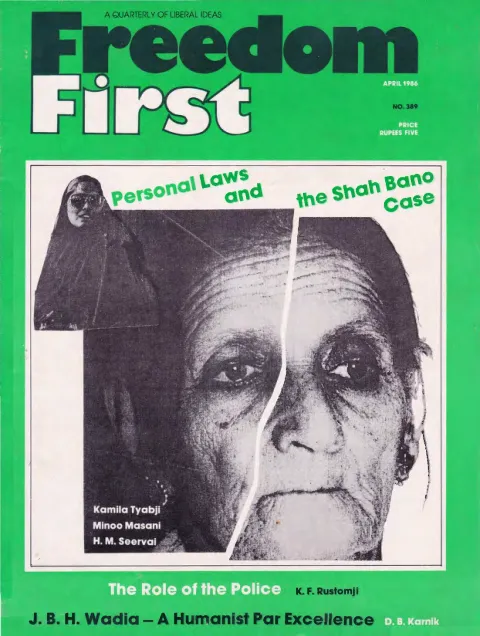
Freedom First
A Quarterly of Liberal Ideas
By M. R. Pai, S. V. Raju, Bhanu Pratap Singh
Published by J.R. Patel for the Democratic Research Service and printed by him at Parsiana Publications Pvt. Ltd. 300 Perin Nariman Street, Bombay 400 001 · Bombay · 1986
52 pages
Freedom First
Summary
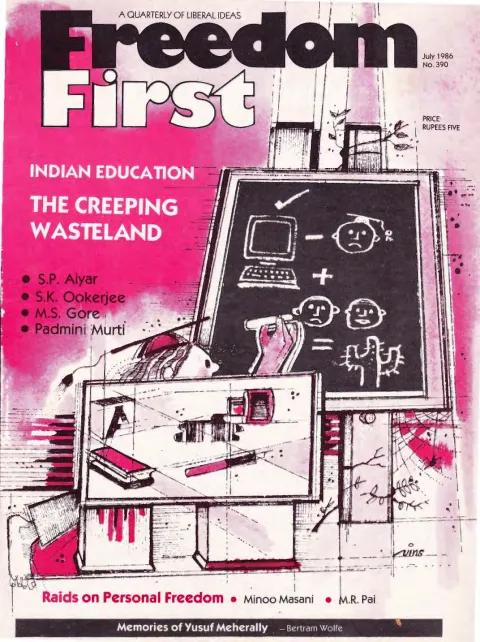
This July 1986 issue of Freedom First (No. 390) marks the quarterly’s entry into its 35th year of continuous publication and carries a redesigned, modernised layout. The issue centers on a symposium, “Indian Education — The Creeping Wasteland,” with four contributions examining the deterioration of Indian universities and schools: S.P. Aiyar diagnoses the collapse of the classroom relationship between teacher and student and proposes that students pay the full cost of their education to restore accountability; M.S. Gore addresses the financing of higher education along similar lines; and Padmini Murthy surveys the state of women’s education in India, documenting high female drop-out rates, gendered channeling into arts and humanities, and the double burden placed on rural women. A second strand, “Raids on Personal Freedom,” carries pieces by founder Minoo Masani and M.R. Pai (seen only via the table of contents in the rendered pages). The issue also carries Giovanni Malagodi’s “The Maintenance of Freedom,” an essay by the President of Liberal International on the erosion of press freedom and pluralism through concentrated media ownership and state control, written against the backdrop of UNESCO’s “New World Information Order” debate. Recurring back-of-book features in the rendered pages include “With Many Voices” (a page of press clippings and quotations), “Of Cabbages and Kings” (a miscellany column with obituary notes on Masti Venkatesa Iyengar and Sophia Wadia, plus commentary on the Arwal massacre, the Tagore centenary, and environmental pollution), and “The Masani Viewpoint,” a caustic column by Minoo Masani criticizing government holiday-making, Rajiv Gandhi’s rhetoric on pragmatism and alienness, and gender-unequal marriage rules for Indian diplomats.
Key points
-
S.P. Aiyar’s “Recapturing the Lost Spirit of the University” contrasts the post-Independence university ideal with 1986 decay, citing growth from 27 to 140 universities between 1950-51 and 1982-83, and proposes that students pay the full cost of their education to restore accountability.
-
Padmini Murty’s “Women’s Education — A Perspective” documents that only 30 of 100 girls enrolled in class I reach class V, a gendered concentration of women students in arts and medicine over engineering, and calls for literacy programmes tailored to women’s socio-economic circumstances.
-
Minoo Masani’s “Dangerous ‘Carelessness’” column satirises the Maharashtra government’s habit of declaring ad hoc holidays, notes the irony of the pre-1980 rule barring diplomats from marrying foreigners given Rajiv Gandhi’s own foreign-born wife, and mocks his warning against the “alien concept of pragmatism.”
-
Giovanni Malagodi, President of Liberal International, in “The Maintenance of Freedom” argues free states now use low-visibility administrative controls on information in place of overt censorship, and frames the UNESCO “New World Information Order” debate as Third World governments’ complaints often masking their own domestic media monopolies.
-
The issue marks Freedom First’s entry into its 35th year of publication with a redesigned layout, and its “Of Cabbages and Kings” column carries obituary notes on Masti Venkatesa Iyengar and Sophia Wadia alongside commentary on the Arwal massacre and the Tagore centenary.
-
A second symposium strand, “Raids on Personal Freedom,” carries contributions from founder Minoo Masani and M.R. Pai on civil-liberties concerns of the day.
Essays
Recapturing the Lost Spirit of the University
By S.P. Aiyar
S.P. Aiyar’s essay opens the education symposium by contrasting the ideal of the university as a retreat for disinterested inquiry — the model he says prevailed when he began teaching in 1950 — with a 1986 landscape of collapsed student motivation, rote learning, and administrative dysfunction. He traces the growth from 27 universities and 798 colleges in 1950-51 to 140 universities and 5,246 colleges by 1982-83, blaming this proliferation, reservation policy effects on faculty recruitment, and poor teacher morale for declining standards. His proposed remedy is that students pay the full cost of their education (directly or through loans) rather than receiving state subsidy, arguing this would make them more demanding clients and free government funds for primary and secondary schooling.
- Compares the post-Independence university ideal (research, disinterested inquiry, teacher-student engagement) to its 1986 state of decay
- Cites growth from 27 universities/798 colleges (1950-51) to 140 universities/5,246 colleges (1982-83) with over 3 million students
- Blames reservation-driven recruitment uncertainty and low teaching status for declining faculty quality
- Describes a ‘gigantic conspiracy against the intellect’ in which guide books and objective-type exams remove the need to read or think
- Proposes that students should pay the full cost of their education to restore institutional accountability and free public funds for primary/secondary education
- Invokes Robert Gaudino’s and Rabindranath Tagore’s remarks on teacher-student disengagement
Women’s Education — A Perspective
By Padmini Murty
Dr. Padmini Murthy’s essay on women’s education documents severe gender disparities across the Indian schooling pipeline in the rendered pages: high drop-out rates for girls at the elementary stage, a sharp narrowing of access at the secondary and higher-education levels, and a gendered concentration of women students in arts, education and medicine rather than science, commerce or engineering. She attributes this to the low social status accorded daughters relative to sons, the domestic and childcare burdens placed on girls during family crises, and broader patriarchal patterns that persist even in modern economic sectors. The essay extends into the situation of rural women specifically, describing their disproportionate share of agricultural and domestic labour, the effects of deforestation on time spent gathering fuel and water, and the structural reasons — including uneconomical landholding sizes — that keep marginal farmers from fully using their land. She closes (within the rendered portion) by arguing that any programme to improve female literacy must be tailored to women’s specific socio-economic circumstances, including flexible hours and curricula.
- One in three girls aged 6-11 remains outside school in classes I-V; only 30 of 100 girls enrolled in class I reach class V
- Educational opportunity narrows sharply for women in secondary and higher education, concentrated among urban middle and upper-middle classes
- 1981-82 faculty-wise enrolment data show women clustered in arts (56%), education, and medicine, with negligible representation in engineering (0.7%)
- Attributes gendered education gaps to the lower social status of daughters, domestic-chore expectations, and family crises that fall disproportionately on girls
- Describes rural women’s disproportionate share of agricultural and domestic labour, worsened by deforestation increasing time spent gathering fuel and water
- Calls for education policy and literacy programmes tailored to women’s specific socio-economic needs, including flexible curricula and hours
- Author bio note: Dr. Padmini Murthy teaches political science at Thana College, Thane, Maharashtra
Dangerous ‘Carelessness’
By Minoo Masani
In this instalment of his regular column, Minoo Masani (writing as founder and columnist under “The Masani Viewpoint”) delivers three short, sharply satirical items. In “Any Excuse Not to Work,” he mocks the Maharashtra government’s and the Prime Minister’s practice of declaring ad hoc public holidays, using the announcement of a holiday for Tagore’s 125th birth anniversary as a springboard to sarcastically propose a holiday for every great Indian who has died a century or more ago. In “Sauce for the Goose,” he highlights a letter noting that Indian diplomats who marry foreign women without government permission risk being forced to resign from the Foreign Service, and points out the irony that the Prime Minister himself has a foreign-born wife. In “Rajiv Gandhi’s Alienitis,” he ridicules the Prime Minister’s warning against the “alien concept of pragmatism,” arguing from the dictionary definition of pragmatism that Rajiv Gandhi misunderstands or misapplies the term, and suggests his advisers are responsible for the confusion.
- Satirises the Maharashtra government’s and Prime Minister’s habit of declaring holidays on short notice, using the Tagore 125th-birthday holiday as the trigger
- Proposes, tongue-in-cheek, that India create a public holiday for every century-old death anniversary of a great son or daughter of the country
- Notes the pre-1980 rule barring Indian diplomats from marrying foreign women without government permission, and the irony that the Prime Minister himself has a foreign-born wife
- Criticises Rajiv Gandhi’s warning against the ‘alien concept of pragmatism’ as a misunderstanding of the term’s dictionary meaning
- Suggests the Prime Minister’s advisers, not he himself, are responsible for muddled political rhetoric
Financing Higher Education
By M.S. Gore
Giovanni Malagodi, President of Liberal International, writes on “The Maintenance of Freedom,” examining threats to press freedom and pluralism worldwide. He argues that although the technical means of disseminating information (post, telegraph, radio, television, satellites) have expanded enormously, they are increasingly subject to control by the state or by powerful private and state-run bodies, and that modern administrative measures for controlling information are more effective and less visible than old-fashioned censorship laws. He discusses the UNESCO-centered “New World Information Order” debate between Western states defending free information flow and Third World states who see themselves as threatened by Western media power, arguing that Third World governments often use this critique to justify their own media monopolies. His proposed remedy rests on maintaining freedom and genuine pluralism among those who already have it, on ethical and political education, and possibly on the creation of a qualified ombudsman or professional codes of conduct for journalists. He closes by lamenting the general decline in the quality of news and comment programming, including sensationalism and the compression of news for television.
- Notes the paradox that free states now use effective but low-visibility administrative controls on information, replacing overt censorship laws
- Frames the UNESCO ‘New World Information Order’ debate as pitting Western defenders of free information flow against Third World states citing Western media dominance
- Argues Third World governments’ complaints often mask their own monopolistic and primitive control of domestic media for political ends
- Proposes maintaining freedom and pluralism among free societies, plus ethical/political education and possibly a qualified ombudsman or professional codes of conduct, as remedies
- Warns against concentrated ownership of media by multinational companies with self-interested economic motives
- Laments declining quality in news and comment programming — political sectarianism, sensationalism, and compression of news, especially on television
Generated by the v1.5 extraction pipeline. Awaiting editorial review.
Metadata and summary are AI-extracted from the source PDF and reviewed for editorial accuracy. The original work is available via the Read PDF tab above (where present); paragraph-level citation inside the PDF is deferred to a future engagement.