periodical issue
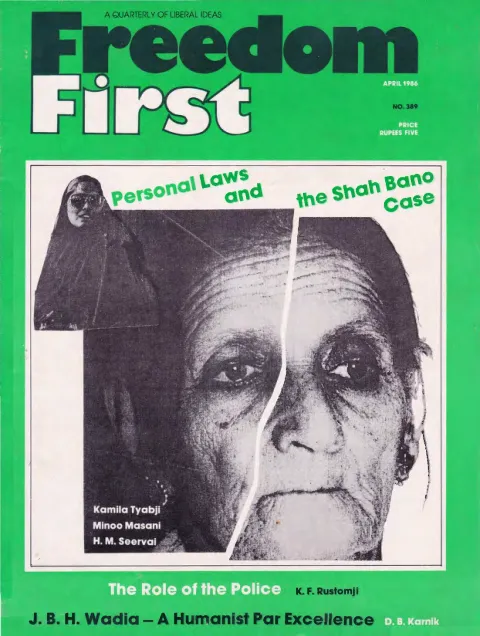
Freedom First
A Quarterly of Liberal Ideas
By Minoo Masani, Bhanu Pratap Singh
Published by J.R. Patel for the Democratic Research Service and printed by him at Parsiana Publications Pvt. Ltd, 300 Perin Nariman Street, Bombay 400 001. Typeset at Ace Fototypesetters, 6, Sailor Building, 3rd floor, (Above Pyrkes Restaurant), 373 D.N. Road, Bombay 1. · Bombay · 1986
52 pages
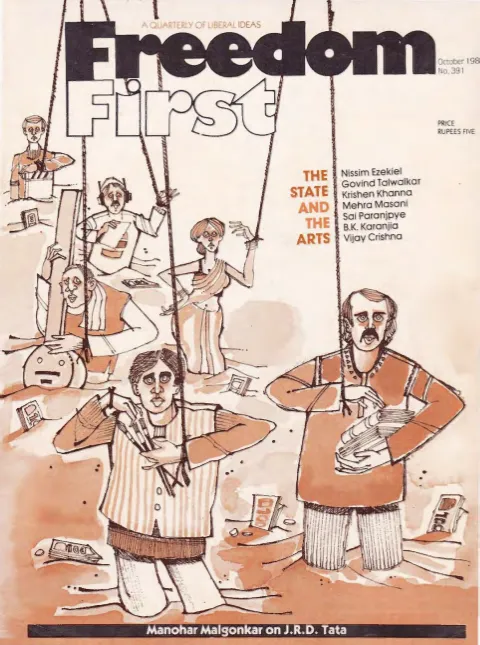
Freedom First
Summary
This is the October 1986 issue (No. 391) of Freedom First, the quarterly of liberal ideas published by the Democratic Research Service, Bombay, under founder Minoo Masani and editors S.V. Raju and R. Srinivasan. The issue opens with Manohar Malgonkar’s profile of J.R.D. Tata occasioned by the book Keynote, followed by Minoo Masani’s regular “Masani Viewpoint” column (on the Supreme Court’s national-anthem ruling, Vasant Sathe’s public-sector heresies, and a reminiscence of Gandhi and Subhas Chandra Bose). The bulk of the rendered pages is given to the issue’s special symposium, “The State and the Arts,” reprinting condensed papers from a Leslie Sawhny Programme seminar held in Goa in August 1986 on “The Arts, Letters and the State.” Contributors argue, from a broadly classical-liberal position, that the State’s proper role in cultural life should be minimal — confined to education and preservation rather than direct patronage — because government support tends to reward mediocrity, invite censorship, and corrupt both artists and bureaucrats. S.V. Raju’s framing essay describes the seminar’s inconclusive debate over autonomy for All India Radio and Doordarshan and over the ethics of state art awards; Nissim Ezekiel, Govind Talwalkar, Krishen Khanna, and Mehra Masani each contribute essays applying this liberal skepticism of state cultural patronage to literature, the visual arts, and broadcasting respectively.
Key points
-
Manohar Malgonkar’s “J.R.D. Tata – A Profile in Trusteeship” reviews Tata’s compiled speeches in Keynote, crediting him with founding Tata Air Mail (forerunner of Air India), holding India’s first pilot’s certificate, and choosing in 1938 to dedicate himself to running the Tata empire over deeper involvement in the freedom struggle.
-
In “The Masani Viewpoint,” Minoo Masani criticises the Supreme Court review sought against the ruling that anthem-singing is not compulsory, broadly endorses Vasant Sathe’s public criticism of the public sector as an unaccountable “holy cow,” and recalls his personal acquaintance with both Subhas Chandra Bose and Mahatma Gandhi.
-
The symposium “The State and the Arts,” reprinting papers from an August 1986 Leslie Sawhny Programme seminar in Goa, lays out the classical-liberal premise that the State’s role in cultural life should be minimal, confined to education and preservation rather than direct patronage.
-
S.V. Raju’s “The Arts on a Leash” reports disappointment at the seminar’s lack of consensus on state arts funding and broadcasting autonomy, criticising the government’s plan to raise Zonal Arts Council funding from 12 crores to Rs. 51 crores as a scheme for artificial “national integration.”
-
Nissim Ezekiel argues government cannot legitimately claim to speak for Society and Culture, and, citing Hugh Jenkins on Britain’s Arts Council, contends state art awards raise controversy without raising standards.
-
Govind Talwalkar traces the tension between the state and literature through Plato and Hans Morgenthau, blaming India’s textbook nationalisation and the underperforming National Book Trust translation scheme for undermining serious private literary publishing.
-
Krishen Khanna surveys state involvement in the visual arts from royal patronage through colonial “Victorian” academic art to the Lalit Kala Akademi, recounting censorship episodes involving F.N. Souza and Akbar Padamsee.
-
Mehra Masani argues against state monopoly of All India Radio and Doordarshan, rebutting Rajiv Gandhi’s claim that India is “not ready for autonomy” and citing the restrictive 1967 AIR Code and the absence of any constitutional safeguard against political interference in broadcasting.
Essays
J.R.D. Tata – A Profile in Trusteeship
By Manohar Malgonkar
Novelist Manohar Malgonkar reviews Keynote, a compiled volume of J.R.D. Tata’s speeches and shareholder addresses edited by S.A. Sabavala and R.M. Lala, using it as an occasion for a personal profile of Tata. He reads Tata’s altered Tata family crest (adding wings to the original ring-and-sceptre motto Humata, Hukhta, Hvarshta) as symbolic of the expansiveness he brought to the Tata group, crediting him with founding India’s first air service, Tata Air Mail, precursor to Air India. Malgonkar notes Tata’s disarming self-deprecation about the book’s origins in shareholder statements, his blend of criticism and occasional praise for government economic policy, his lifelong passion for flying (he held aviator’s certificate No. 1), and his stated regret-free acceptance in 1938 of the burden of running the Tata empire at a young age, a decision that meant sacrificing personal aspirations including active involvement in the freedom struggle.
- Malgonkar frames Tata as an exception to public figures who fear having early statements exhumed, since Tata endorsed republishing decades of his speeches in Keynote.
- Tata modified the Tata family crest by adding wings to the original ring-and-sceptre emblem bearing the motto Humata, Hukhta, Hvarshta (Good thoughts, Good deeds, Good words).
- Tata is credited with founding India’s first air service, the Tata Air Mail, forerunner of Air India.
- In 1938 Tata resolved to dedicate himself to Jamshedji Tata’s vision, choosing business responsibility over deeper involvement in the independence movement, a choice he said he never regretted.
- Tata held India’s first pilot’s aviator certificate and maintained a lifelong ‘infatuation’ with flying alongside interests in French and English language, literature, and poetry.
The Masani Viewpoint
By Minoo Masani
In his regular column, Minoo Masani takes up three subjects. First, he criticises the Supreme Court’s August 1986 ruling that singing the national anthem is not compulsory, and objects to the Attorney-General’s decision to seek a review of that judgment, calling Kerala’s expulsion of three schoolchildren for religious non-participation in Jana Gana Mana absurd; he confesses to a lifelong preference for singing Vande Mataram over the national anthem. Second, he surveys Union Minister Vasant Sathe’s public criticisms (in three Times of India articles and a Telegraph interview) of India equating the public sector with socialism and treating it as a ‘holy cow,’ broadly endorsing Sathe’s diagnosis of monopoly and unaccountability while noting it falls short of the Swatantra Party’s own critique, and criticises Prime Minister Rajiv Gandhi for publicly disowning Sathe’s views rather than staying silent as Indira Gandhi reportedly would have. Third, prompted by a new book on Gandhi and Subhas Chandra Bose by Samar Guha, Masani reminisces about his personal acquaintance with both men, characterising Bose as a nationalist par excellence and Gandhi as a humanist who denied being a nationalist at all.
- Masani criticises the Supreme Court review sought by the Attorney-General against the ruling that anthem-singing is not compulsory, and calls Kerala’s expulsion of dissenting schoolchildren absurd.
- He discusses Union Minister Vasant Sathe’s public criticism that India wrongly equated the public sector with socialism, turning it into an unaccountable ‘holy cow.’
- Masani largely agrees with Sathe’s diagnosis but notes it does not go as far as the Swatantra Party’s historical critique of the public sector.
- He criticises PM Rajiv Gandhi for publicly repudiating Sathe’s views instead of staying silent, contrasting this with Indira Gandhi’s handling of a similar episode with Sathe previously.
- Reflecting on a new book by Samar Guha, Masani recalls personal relations with both Subhas Chandra Bose and Mahatma Gandhi, quoting his own memoir Bliss Was It That Dawn on his friendship with Bose.
- He also comments on the Reliance Industries/Dhirubhai Ambani monopoly controversy, arguing that a large enterprise is not necessarily a monopoly and that government monopolies are India’s real monopolies.
The Limits of State Involvement
By Nissim Ezekiel
This unsigned framing piece introduces the special symposium section, laying out the liberal premise that the State should play only a minimal role in the Arts and Letters, since these are the expression of individual creativity in a free society. It previews the questions taken up by the individual contributors: whether state awards and patronage promote or corrupt excellence, whether broadcasting should be state-owned or autonomous, and what the correct limits of censorship are.
- States the classical-liberal premise that a democratic State has a minimal role, if at all, to play in the Arts and Letters.
- Frames the symposium’s guiding questions: the extent of State involvement, effects on quality, awards, censorship, and autonomy for AIR and TV.
The Perils of State Support
By Govind Talwalkar
S.V. Raju’s “The Arts on a Leash” reports on the Leslie Sawhny Programme’s August 1986 Goa seminar on “The Arts, Letters and the State,” expressing disappointment at the lack of consensus among the assembled writers, artists, and media figures. He describes sharp disagreement over whether the state should fund the arts at all (a strong minority favoured leaving artists entirely to the market), whether state literary and art awards corrupt the process, and whether broadcasting (AIR and Doordarshan) should be made autonomous — the official government position being that neither the public nor the system was ‘ready’ for autonomy. Raju is particularly critical of the government’s announcement of a large increase in arts funding (from 12 crores to Rs. 51 crores) intended for Zonal Arts Councils, which he sees as a scheme to promote artificial ‘national integration’ by circulating artists like Kathakali dancers to places such as Mizoram regardless of local interest or appreciation.
- The seminar was organised by the Leslie Sawhny Programme in Goa, August 15-17, 1986, bringing together prominent figures from the arts and media plus a few government representatives.
- No consensus emerged on whether the State should support the arts at all; views ranged from total non-interference to institutional assistance or tax relief.
- Sharp division on censorship: one faction favoured letting works fail or succeed in the marketplace without censorship, another argued censorship was necessary but poorly administered by incompetent bureaucrats.
- The government defended its stance that AIR and Doordarshan autonomy was not yet appropriate, framing it as a management rather than ownership question.
- Raju criticises the government’s plan to raise arts funding from 12 crores to Rs. 51 crores for Zonal Arts Councils, questioning the forced circulation of regional art forms (e.g. Kathakali in Mizoram) as a substitute for genuine cultural policy.
- Overall conclusion: state interference in the arts should be minimal, but state assistance was still seen by the majority as necessary; disagreement centred on execution rather than the underlying system.
The Contemporary Arts Scene
By Krishen Khanna
Poet Nissim Ezekiel argues that a democratic government, while not identical with Society and Culture and therefore unable to legitimately speak in their name, cannot in practice do nothing for the arts; at minimum it maintains inherited commitments to art education, academies, and prize funds. He is skeptical of state patronage’s benefits, arguing that state art awards and subsidized institutions tend to raise controversy without raising standards, benefiting mediocrity and a class of literary bureaucrats rather than genuine creative achievement, citing Hugh Jenkins’s account of Britain’s Arts Council ballooning appetite for funds without commensurate cultural payoff. He proposes that government funding should focus on education and preservation, with patronage kept to a necessary minimum, and that the state must not attempt to control or dominate the arts but only promote and assist them.
- Ezekiel’s core premise: government is only one expression of Society and Culture, and cannot legitimately claim to speak in their name.
- He argues state support for the arts is unavoidable at a minimal level (education, preservation) but should not extend to broad patronage.
- Citing Hugh Jenkins’s The Culture Gap, he notes UK Arts Council funding grew from GBP 350,000 (1946/47) to over GBP 50 million (1977/78) without commensurate cultural achievement, becoming a ‘novel concept of government dependance.’
- He distinguishes support for the sake of artists from support for the sake of the public/society, arguing the latter (popularising art) is neglected in favour of the former.
- Government’s proper function, per Ezekiel (quoting Charles Morgan), is to promote and assist the arts without controlling or dominating them, treating the artist as neither the community’s priest nor its slave.
TV and Radio – The Case Against Monopoly
By Mehra Masani
Editor Govind Talwalkar argues that the modern state’s role and the world of letters are inherently in tension, tracing this back to Plato’s argument in The Republic that rulers must be willing to lie for the good of the city, and to Hans Morgenthau’s claim that even democratic governments ‘strangulate truth.’ He surveys India’s post-independence cultural bureaucracy — state takeover of textbook publishing, government literary and cultural boards, state-sponsored literary workshops, the Sahitya/Natya/Sangeet/Lalit Kala Akademis, and the National Book Trust — arguing these schemes have largely failed: textbook nationalisation crowded out serious literary magazines and private scholarly publishing, the National Book Trust badly missed its translation targets and lost heavily on unsold stock, and state-funded literary conferences bred linguistic chauvinism and provincialism rather than lasting literature. Talwalkar concludes that creative literature is a private enterprise which government patronage cannot substitute for genuine recognition by discerning readers, though some minimal government support via media, tax concessions for donors, and university endowment (on the Western model) remains desirable.
- Talwalkar frames the tension between the world of letters and the modern state through Plato’s claim (The Republic) that rulers must be willing to lie for the city’s benefit, likening this to ‘all modern rulers and politicians’ being Platonists.
- He quotes Hans Morgenthau’s Truth and Power on the US President’s ability to ‘deform’ truth at will, arguing writers’ duty is to resist this even under democratic governments.
- State takeover of textbook publishing in India is blamed for undermining private publishing of serious literature and for financially starving literary magazines that textbook profits once cross-subsidised.
- The National Book Trust’s translation scheme badly underperformed its target (170 of 1,300 planned titles by 1985) with large unsold stock and losses of Rs. 147.8 lakhs, per an Indian Express report and CAG criticism.
- State-sponsored literary conferences and workshops (e.g. in Maharashtra) are said to have produced ‘not a single outstanding book’ while breeding linguistic chauvinism, provincialism, and factional Akademi awards.
- Talwalkar concludes creative literature is fundamentally a private enterprise that government patronage cannot substitute for, though some limited state role via ‘via media’ funding of arts councils/magazines and tax concessions for private donors is acceptable.
Cinema and TV – Playing Complementary Roles
By Sai Paranjpye
Painter Krishen Khanna surveys the varying relationship between the state and the visual arts across countries and through Indian history, noting that even the ostensibly hands-off United States has State Department cultural diplomacy and depression-era arts programmes. He traces Indian state patronage from royal and princely support of court artists and musicians through the colonial production of “Victorian” academic art (citing Raja Ravi Verma) to the post-independence Lalit Kala Akademi’s neutral stance between “Traditional” and “Modern” art. Khanna recounts censorship episodes — Souza’s exhibition being partially taken down at the Artists’ Aid Centre, and Akbar Padamsee’s 1954 obscenity trial and acquittal — to argue the state is ill-equipped to judge where art’s legitimate boundaries lie, especially as cinema, TV and video (unlike the plastic arts) reach far larger audiences and are treated by the state as needing moral curbs like drugs. In the rendered pages, Khanna’s essay continues with a critique of the National Gallery of Modern Art’s bureaucratic, once-a-year acquisition procedure, which he says produces a poor collection because serious artists rarely submit works for purchase and private collectors beat the museum to good work.
- Khanna compares state involvement in the arts across the US, Soviet bloc, Western Europe, and India, arguing even ‘hands-off’ states like the US fund museums, fellowships and ‘cultural diplomacy’ abroad.
- He traces Indian state-versus-arts patronage from royal/princely court painters and musicians, through colonial ‘Victorian’ academic art (e.g. Raja Ravi Verma), to the post-independence Lalit Kala Akademi’s neutral Traditional/Modern art categories.
- Recounts censorship incidents: Souza’s exhibition partly taken down at the Artists’ Aid Centre, and Akbar Padamsee’s 1954 obscenity trial (he was acquitted).
- Argues cinema, TV and video reach vastly larger audiences than the plastic arts, prompting the state to treat morally objectionable content ‘in much the same way as it prohibits the use of drugs.’
- Describes two personal anecdotes of state and quasi-state mishandling of his own paintings (one intended as a gift to Sheikh Mujibur Rehman, dumped in a warehouse; another rejected by the Ministry of External Affairs for embassy display as ‘too near the bone’).
- Criticises the bureaucratic, once-a-year submission-and-purchase system of India’s National Gallery of Modern Art, arguing serious artists rarely submit work and private collectors ‘beat the Museum to it.‘
Travails of the Indian Cinema
By B.K. Karanjia
In the opening pages of her essay (cut off in the rendered chunk), Mehra Masani argues against state monopoly of radio and television broadcasting in India. She contends that all governments, including democratic ones, would prefer a compliant media, but that the difference between authoritarian and democratic societies lies in whether the right to dissent and question is protected. She criticises Prime Minister Rajiv Gandhi’s declaration that India is ‘not ready for autonomy’ for All India Radio and Doordarshan, arguing the broadcasters and the public are ready and it is only the government that is not, and traces the history of unfulfilled promises of broadcasting autonomy back through the Janata government’s Prasar Bharati Bill. She lists specific disadvantages of state control: denial of citizens’ right to full information, limited and urban/middle-class-skewed programming despite the greater need in rural areas, politically biased news coverage under the restrictive 1967 AIR Code, and the absence of any constitutional safeguard protecting broadcasting from political interference, unlike print media where plurality of ownership provides some check.
- Masani argues all governments prefer a compliant media, but democracies are distinguished by protecting the right to dissent and question, unlike Communist states where broadcasting is ‘operated by the government and entirely subservient.’
- She criticises PM Rajiv Gandhi’s statement that India is ‘not ready for autonomy for AIR and Doordarshan,’ arguing the broadcasters and public are ready and only the government is not.
- Traces the history of broadcasting-autonomy promises through the 1977 Janata government’s Prasar Bharati Bill, noting it still granted government directive powers.
- Lists the disadvantages of state broadcasting control: denial of the public’s right to full information, urban/middle-class-skewed programming versus greater rural need, heavily pro-government news bias under the restrictive 1967 AIR Code, and no constitutional safeguard against political interference in broadcasting (unlike the press, which benefits from plurality of ownership).
- Notes the AIR Code (1967) bars criticism of friendly countries and religious/communal commentary, and was abrogated during the Emergency but restored (and increasingly ignored) by the Janata government.
Generated by the v1.5 extraction pipeline. Awaiting editorial review.
Metadata and summary are AI-extracted from the source PDF and reviewed for editorial accuracy. The original work is available via the Read PDF tab above (where present); paragraph-level citation inside the PDF is deferred to a future engagement.