periodical issue
Freedom First
A Quarterly of Liberal Ideas
By K. F. Rustomji, Minoo Masani, C. Rajagopalachari, Bhanu Pratap Singh, Arvind Deshpande
Published by J.R. Patel for the Democratic Research Service and printed by him at Parsiana Publications Pvt. Ltd, 300 Perin Nariman Street, Bombay 400 001 · Bombay · 1987
52 pages
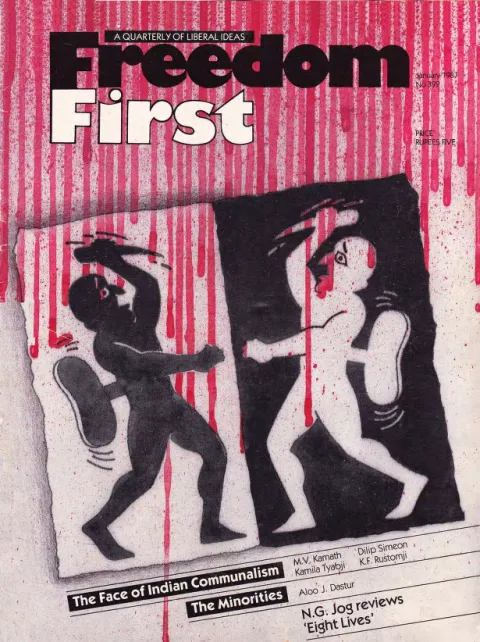
Freedom First
Summary
This is the January 1987 issue of Freedom First (No. 392), a quarterly of liberal ideas published by the Democratic Research Service in Bombay, edited by S.V. Raju and R. Srinivasan under founder Minoo Masani. The issue is organised around a special theme, “The Face of Indian Communalism,” for which the editors invited a range of contributors to examine communal violence and majority-minority relations in India from different angles, explicitly noting in the editorial that the views expressed are the contributors’ own. In the rendered pages, M.V. Kamath surveys the sociology and history of Hindu-Muslim and other communal tensions; Kamila Tyabji reflects, through personal experience organising a women’s group in a Bombay-area village, on how segregated schooling entrenches communal division and proposes multi-lingual, multi-community schools as a remedy; Dilip Simeon argues that Indian communalism is best understood as a species of fascist populism rooted in Brahmanical revivalism rather than as the antithesis of nationalism; K.F. Rustomji, drawing on decades of policing experience, contends that rioters are rarely genuine believers but opportunists exploiting religion; and Aloo J. Dastur (essay continues past the rendered pages) surveys the proliferation of government minority commissions and questions whether India’s minority policy has become self-defeating. The issue also carries the regular features “With Many Voices” (a page of quoted press clippings) and “Of Cabbages and Kings” (a column of short editorial notes on black money, leadership, and defaulting politicians).
Key points
-
M.V. Kamath’s “The Face of Indian Communalism” argues most riots are economically rather than religiously driven, using the 1982-83 Baroda riots as his central case study, and concludes that reconciling India-Pakistan relations is “the key” to ending communalism.
-
Kamila Tyabji’s “The Roots of National (Dis)Integration” recounts a 1968 episode organising a mixed stitching class in Taloja village where Muslim women refused to cross into a “Hindu mohalla,” and proposes multi-lingual, mixed-community schools as a structural remedy.
-
Dilip Simeon’s “Communalism: A Symptom of Fascism” argues Indian communalism is better understood as “Brahmanical fascism,” a domestic variant of fascist populism tracing to Bankim Chattopadhyay and Tilak, and holds that Partition was substantially its product.
-
K.F. Rustomji’s “Who Are the Fanatics?” draws on fifty years of policing to argue rioters are rarely genuine believers but cynical operators — lawyers, businessmen, and politicians — who invoke religion for personal or political gain.
-
Aloo J. Dastur’s “Are the Minorities Too Much With Us?” catalogues the proliferation of Indian commissions on minorities and backward classes, arguing they have “whetted minority appetites, not satisfying them,” while surveying rising Hindu majority anxiety evidenced by the VHP and the Ekatmata Yatra.
-
The issue’s regular “With Many Voices” and “Of Cabbages and Kings” columns carry press clippings and short editorial notes on black money, leadership, and defaulting politicians.
Essays
The Face of Indian Communalism
By M.V. Kamath
M.V. Kamath surveys the many faces of communal tension in India — Hindu-Muslim, Hindu-Christian, Hindu-Sikh, and intra-Hindu caste conflict — arguing that most riots are locally triggered by economic competition (using the 1982 Baroda riots between Bhoi Hindu and Muslim bootleggers as his central case study) rather than by ancient religious grievance. He discusses the difficulty of defining “who is a Hindu,” citing R.K. Hazari and Girilal Jain, and traces the historical roots of the Hindu-Muslim divide to the trauma of Partition and to a Muslim political “dilemma” articulated by Sir Syed Ahmed and analysed by Prof. R. Suntheralingam. He closes by arguing that reconciling India and Pakistan into a friendlier regional relationship is key to ending communalism.
- Argues that most communal riots are ‘sectoral’ economic conflicts rather than truly religious, using the 1982-83 Baroda riots (Bhoi Hindus vs. poor Muslim bootleggers) as evidence
- Notes that Hindu unity has historically been cultural rather than political, citing a Turk/stone-sand simile for Hindu disparateness-as-strength
- Cites Girilal Jain on Hindus’ amorphous, non-proselytizing self-image and the Census’s negative definition of a Hindu
- Discusses caste violence in UP, Bihar, and Maharashtra as distinct from communal (interreligious) violence, with 1,500 UP caste-related murders cited
- Presents statistics on communal ‘incidents’ 1968-1982, peaking at 519 clashes in 1969 and troughing at 169 in the Emergency year of 1976
- Invokes Sir Syed Ahmed’s early-20th-century ‘Muslim dilemma’ — fear of permanent political subjugation under majoritarian democracy — as an explanatory root of Muslim separatism
- Concludes that reconciling India-Pakistan relations, not just internal reform, is ‘the key’ to ending communalism
The Roots of National (Dis)Integration
By Kamila Tyabji
Kamila Tyabji recounts her 1968 experience organising a stitching class for Hindu and Muslim women in Taloja, a village near Bombay, where the venue had to be moved after five weeks because Muslim women would not cross into a ‘Hindu mohalla’ just an eight-foot street away — an episode she says opened her eyes to communal division despite her own background as a Muslim who had never previously perceived such rifts. She argues that Indian schooling, which segregates children by language and community from the earliest age, is a root cause of adult communal estrangement, and proposes multi-lingual, mixed-community schools (citing the Godrej School at Vikroli and Women’s India Trust’s own Panvel kindergarten as existing models) as a long-term remedy that existing minorities commissions and integration seminars have failed to deliver.
- Recounts a 1968 personal episode in Taloja village where Muslim women stopped attending a mixed stitching class rather than cross into a ‘Hindu mohalla’ just across the street
- Notes her own surprise at this, given her background organising the Women’s India Association (UK) and the India Defence Fund Committee as a Muslim without prior sense of communal difference
- Argues that communalism/racism is ‘nothing but the fear we all have of something new or different’
- Proposes multi-lingual, mixed pre-primary and primary schools as a structural fix, citing the Godrej School at Vikroli and Women’s India Trust’s Panvel kindergarten
- Calls for the State to house different language-medium schools in the same building/premises with shared facilities to encourage intermingling
Communalism: A Symptom of Fascism
By Dilip Simeon
Dilip Simeon argues that Indian ‘communalism’ is best understood not as the opposite of nationalism but as a domestic variant of fascist populism — a form of ‘Brahmanical fascism’ that manufactures an internal enemy (in the manner of Nazi antisemitism) and legitimises mass violence as retributive justice. He traces this to late-19th-century revivalist thought (Bankim Chattopadhyay’s shift from critiquing Brahmanism to authoring ‘Anandamath,’ and Tilak’s fusion of Ganapati/Shivaji festivals with nationalist politics), contrasts it with India’s shramanic/syncretic counter-tradition (Buddhism, Bhakti saints, Kabir, the sufis), and holds that Partition was itself substantially a product of Brahmanical fascism’s political success alongside British scheming and Muslim League intransigence. He closes by warning that a society in crisis can turn to communal, authoritarian reconstruction, and that only a social-democratic nationalism rooted in India’s syncretic traditions offers an antidote to the ‘nightmare of Partition.’
- Opens with a vignette of Congress politicians administering loyalty oaths to widows of the 1984 anti-Sikh pogrom at India Gate, calling it symbolic of political hypocrisy
- Defines communalism as ‘the Indian form of fascist populism and racist nationalism’ that substitutes religious frenzy for rational, tolerant patriotism
- Critiques the Mishra Commission of Inquiry into the 1984 anti-Sikh violence as designed to shield ‘communalism in high places’ rather than establish guilt
- Traces revivalist Hindu nationalism to Bankim Chattopadhyay (‘Anandamath’, 1883) and Bal Gangadhar Tilak’s Shivaji/Ganapati festivals, arguing they fused patriotic and communal sentiment
- Identifies a parallel ‘protocommunal’ current in Deoband ulema nationalism, arguing all such 1930s-40s tendencies were ‘equally communal’ despite differing on Partition
- Contrasts Brahmanical orthodoxy with India’s shramanic/syncretic tradition (Buddhism, Bhakti saints, Kabir, Nanak, sufis) as evidence India was ‘never purely Brahmanic’
- Argues ‘Hindu communalism’ is a misnomer better called Brahmanical fascism, since it need not implicate all Brahmins any more than Christian antisemitism implicates all Christians
- Concludes that Partition was substantially a product of Brahmanical fascism’s political success, and that only social-democratic, syncretic nationalism can prevent renewed authoritarian crisis
Who Are the Fanatics?
By K.F. Rustomji
K.F. Rustomji, drawing on nearly fifty years in policing, argues that the perpetrators of communal riots are almost never genuine religious believers but rather cynical operators — lawyers, businessmen, editors, and politicians — who invoke religion instrumentally to mobilise crowds for personal or political gain, while ordinary devout people are conspicuously absent from mob violence. He criticises the Mushawarat’s inflexibility over disputed mosque sites and questions whether confrontation over such symbolic issues is worth endangering the safety and economic interests of poor Muslims, concluding that communal politics harms both Hindus (made to feel falsely besieged) and Muslims (pushed toward confrontation that historically ‘brought ruin’).
- States that in fifty years of policing communal riots he has ‘never come across a genuine fanatic’ among rioters
- Argues killers ‘have no faith in their religion’ but a ‘deep, obstinate, fiendish sort of hatred of the other side’
- Identifies lawyers, businessmen, and editors who incite riots for personal/political gain as the real instigators, not religious men
- Argues that fear of police and majority-community reprisal, not aggression, often drives minority crowds to gather defensively
- Criticises the Mushawarat’s refusal to compromise over an unused mosque as endangering thousands of poor Muslims for a symbolic cause
- Concludes that communal politics harms Hindus (manufactured sense of victimhood despite real socioeconomic gains) and Muslims (pushed toward a confrontational course that ‘brought ruin … in the sub-continent’)
Are the Minorities Too Much With Us?
By Aloo J. Dastur
Aloo J. Dastur opens by cataloguing the proliferation of Indian government bodies addressing minorities and backward classes — the Kaka Kalelkar Commission, the Mandal Commission, the Minorities Commission, state-level minorities boards, and the National Integration Council — arguing that this profusion of commissions has whetted minority appetites without resolving underlying grievances. She argues the deeper problem is a national ‘minority psyche’ rooted in segregated, partitioned communal identities rather than superficial policy gaps, and begins to explore the tension between majority (Hindu) backlash sentiment — evidenced by the rise of the Vishwa Hindu Parishad and the Ekatmata Yatra — and minority separateness. The essay is cut off mid-argument (discussing the Uniform Civil Code and Nehru’s handling of the Hindu Code Bill) at the end of the rendered pages, so its concluding argument was not seen.
- Lists the proliferation of Indian commissions on minorities/backward classes: Kaka Kalelkar Commission (2399 castes identified), Mandal Commission (3743 castes), Minorities Commission, state Minorities Boards (UP, Bihar, Andhra Pradesh, Gujarat), and National Integration Council
- Argues these bodies have ‘succeeded in whetting minority appetites, not satisfying them’
- Criticises the Ramakrishna Mission’s 1980s claim to minority-institution status as a ‘caricature’ of Vivekananda’s universalist teaching
- Notes rising Hindu majority anxiety evidenced by the VHP, Virat Hindu Sabha, and the Ekatmata Yatra
- Frames the central policy question as how to judge/identify ‘minorities’ — nationally versus in states like J&K, Punjab, Nagaland, Mizoram, and Arunachal Pradesh where Hindus are local minorities
- Discusses Nehru’s Hindu Code Bill/Hindu Marriage and Divorce Act reforms as benefiting Hindu women while leaving Article 44’s Uniform Civil Code unrealised for Muslim women (essay cuts off here)
Generated by the v1.5 extraction pipeline. Awaiting editorial review.
Metadata and summary are AI-extracted from the source PDF and reviewed for editorial accuracy. The original work is available via the Read PDF tab above (where present); paragraph-level citation inside the PDF is deferred to a future engagement.