periodical issue
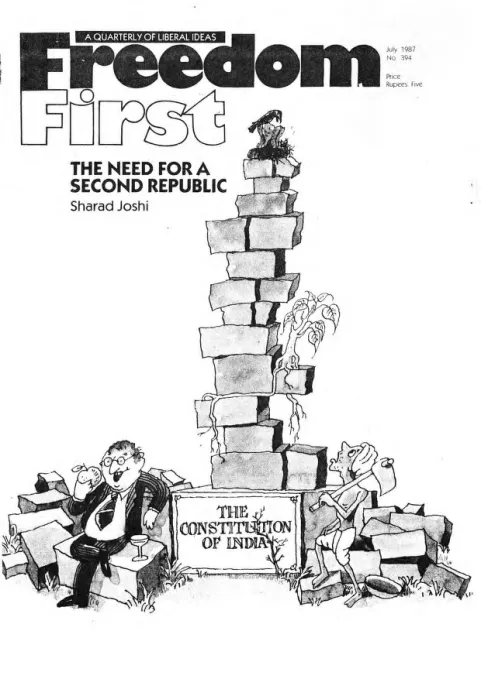
Freedom First
A Quarterly of Liberal Ideas
By Jayaprakash Narayan, Arvind Deshpande, BK Nehru, Minoo Masani
Democratic Research Service, 4th floor, Maneckji Wadia Bldg. 127, Mahatma Gandhi Road, Bombay 400 001. Published by J.R. Patel for the Democratic Research Service and printed by him at Parsiana Publications Pvt. Ltd., 300 Perin Nariman Street, Bombay 400 001. · Bombay · 1988
52 pages
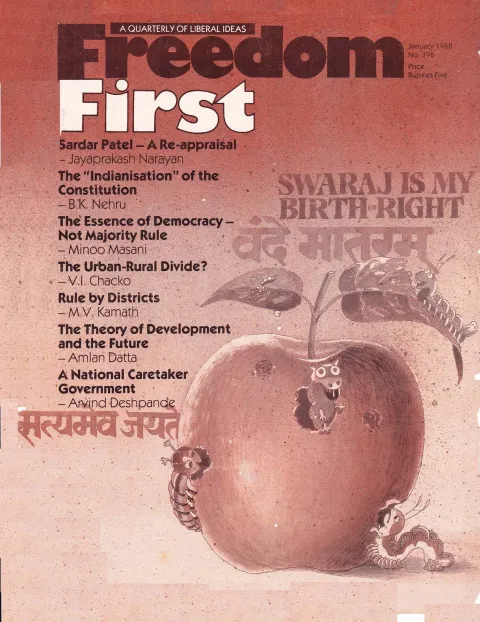
Freedom First
Summary
This is the January 1988 issue (No. 396) of Freedom First, the Bombay-based quarterly of liberal ideas founded by Minoo Masani and published by the Democratic Research Service. The issue opens with a reappraisal of Sardar Vallabhbhai Patel by Jayaprakash Narayan (reprinted from a 1974 Bhavan’s Journal special issue marking Patel’s centenary), paired with an extract from Patel’s November 1950 letter to Nehru warning of Chinese expansionism after the annexation of Tibet. The bulk of the rendered pages carry four papers from a Leslie Sawhny Programme seminar on ‘Problems of Democracy in India’ (Bangalore, August 1986/87): Arvind Deshpande on the case for a National Caretaker Government, B.K. Nehru on the erosion of constitutional checks through the ‘Indianisation’ of the Constitution, Minoo Masani arguing that majority rule is not the essence of democracy, and (beginning within the rendered pages but continuing past them) M.V. Kamath on ‘Rule by Districts.’ The issue also carries the regular features ‘With Many Voices’ (press quotations), ‘Of Cabbages and Kings’ (editorial notes on current affairs), and a tribute to Nobel laureate Joseph Brodsky by Nissim Ezekiel.
Key points
-
Jayaprakash Narayan’s “Sardar Patel – A Re-appraisal” recounts his own past opposition to Patel as a defender of capitalism, credits Patel’s integration of the princely states (which even Khrushchev admired) and his prophetic 1950 letter warning Nehru of Chinese designs on Tibet, and faults Nehru for tolerating corruption once Patel’s discipline was gone.
-
Arvind Deshpande’s “A National Caretaker Government” argues repeated electoral mandates have produced a corrosive “choicelessness,” and proposes a temporary, President-installed National Caretaker Government of talents to bridge the crisis, distinct from both an Emergency and a “palace revolution.”
-
B.K. Nehru’s “The ‘Indianisation’ of the Constitution” argues decades of practice have eroded the Presidency’s informational role, the bureaucracy’s Westminster-style independence, and the individual MP’s ability to check the executive, calling for constitutional revision to build more durable checks.
-
Minoo Masani’s “The Essence of Democracy – Not Majority Rule” argues unlimited majority rule can itself be tyrannical, laying out five conditions for genuine democracy and favourably citing Switzerland’s proportional, cantonal model over India’s “first past the post” system.
-
The issue opens with a reappraisal of Sardar Patel paired with an extract from his November 1950 letter warning Nehru of Chinese expansionism, and closes its rendered pages with a tribute to Nobel laureate Joseph Brodsky by Nissim Ezekiel.
Essays
Sardar Patel – A Re-appraisal
By Jayaprakash Narayan
Jayaprakash Narayan reappraises Sardar Vallabhbhai Patel, confessing that during Patel’s lifetime he had been not merely a critic but an opponent, viewing him as a conservative defender of capitalism and foe of socialism. JP recounts how the Congress Socialists, including himself, Narendra Deva, Achyut Patwardhan, Ram Manohar Lohia, and Asoka Mehta, regarded Patel warily despite personal respect, and describes Patel’s mastery of the Bardoli Satyagraha and his role integrating the princely states after independence — a feat JP says even Khrushchev admired. The essay dwells on the Kashmir issue (which JP argues Nehru mishandled by internationalising it), recounts Patel’s foresight on Tibet and China, and criticises the ‘dignity of State’ ostentation that grew after Patel’s death, contrasting it with Patel’s own modest official residence. It closes admiringly, quoting Nehru’s own parliamentary tribute to Patel as builder and consolidator of modern India.
- JP admits he was an opponent of Patel during Patel’s lifetime, viewing him as a defender of capitalism against Congress Socialist aims.
- Patel organised the Bardoli Satyagraha and was regarded even by socialists as an impeccable, incorruptible commander.
- Patel’s integration of the princely states after 1947 is presented as a unique feat — even Khrushchev is quoted admiring how India ‘liquidated the Princely States without liquidating the Princes.’
- JP argues Nehru’s mishandling of Kashmir (leaving it to the UN) made it an enduring international dispute, unlike the states Patel integrated directly.
- Patel’s November 1950 letter warning Nehru about Chinese designs on Tibet is treated as prophetic in light of the 1962 war.
- The essay criticises the growth of ‘dignity of State’ pomp among post-Patel leaders, contrasting it with Patel’s modest residence at 1 Aurangzeb Road.
- JP faults Nehru for tolerating corruption and floor-crossing once Patel’s organisational discipline was gone, quoting Vinoba on the ‘accepted social code’ of self-interest.
A National Caretaker Government
By Arvind Deshpande
Arvind Deshpande argues for a ‘National Caretaker Government’ as a constitutional middle path between an unaccountable elected majority and the drastic remedy of an Emergency. Surveying objections raised by legal and political figures (H.M. Seervai, Soli Sorabji, N.G. Goray) to an appeal for the President to explore forming such a government, he contends that repeated electoral mandates (1971, 1977, 1985) have left voters disillusioned, producing a corrosive ‘choicelessness,’ and that no credible alternative to the Congress exists because it functions as an umbrella party. His proposed solution is a short, President-installed caretaker government of talents to steer the country through a crisis of legitimacy before fresh elections, explicitly distinguished from both an Emergency and a ‘palace revolution.’
- Deshpande frames the core problem as ‘choicelessness’: voters repeatedly change governments but never see accountability or good governance result.
- He reports legal objections from H.M. Seervai and Soli Sorabji doubting the President has power to impose a National Government while the Council of Ministers retains majority confidence.
- N.G. Goray warns that presidential imposition of a ‘national government’ effectively amounts to a subjective declaration of Emergency under Article 352, risking a ‘palace revolution.’
- Deshpande argues no real alternative exists to the Congress because it is a historic ‘umbrella party’ embodying all shades of opinion.
- He proposes explicitly calling it a ‘National Caretaker Government’ — a temporary arrangement of talents installed by the President to bridge an interregnum before elections, not a permanent alternative.
- The essay closes on the paradox that Indian voters can elect a government but cannot force it to be honest, efficient, and ethical.
The “Indianisation” of the Constitution
By B.K. Nehru
B.K. Nehru, a former civil servant and diplomat, argues that while the Constitution as framed contained strong checks and balances modeled partly on the Westminster system, decades of ‘Indianisation’ in practice have eroded nearly all of them. He traces this across the Presidency (whose informational and advisory role vis-a-vis the Prime Minister has shrunk since Nehru’s era), the bureaucracy (whose Westminster-style independence has been compromised by ministers deciding individual cases and transferring or suspending recalcitrant civil servants), and the individual MP (rendered powerless by the party whip). He concludes by calling for constitutional revision to create new checks that cannot be dismantled by the same processes of ‘Indianisation.’
- Nehru argues the Indian Presidency was intended to function like the British Crown — with rights to be consulted, to encourage, and to warn — but this role has been steadily eroded since Nehru’s premiership.
- He notes the weekly Prime Minister-President audience, scrupulously observed until 1962, has since lost any fixed convention.
- Article 74 (binding the President to ministerial advice) is now read to override Article 78 (the President’s right to information), reducing the latter to an absurdity.
- The bureaucracy’s Westminster-model independence has been undermined because Indian ministers, unlike their British counterparts, routinely decide individual cases and can transfer or suspend civil servants who object.
- The individual MP has no real check on the executive because party whips compel voting regardless of personal conviction.
- Nehru calls for a revision of the Constitution to build checks and balances resistant to further erosion by ‘Indianisation.‘
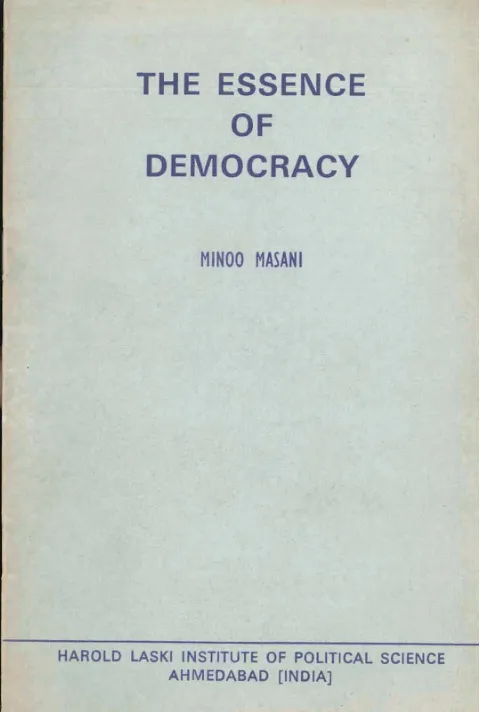
The Essence of Democracy – Not Majority Rule
By Minoo Masani
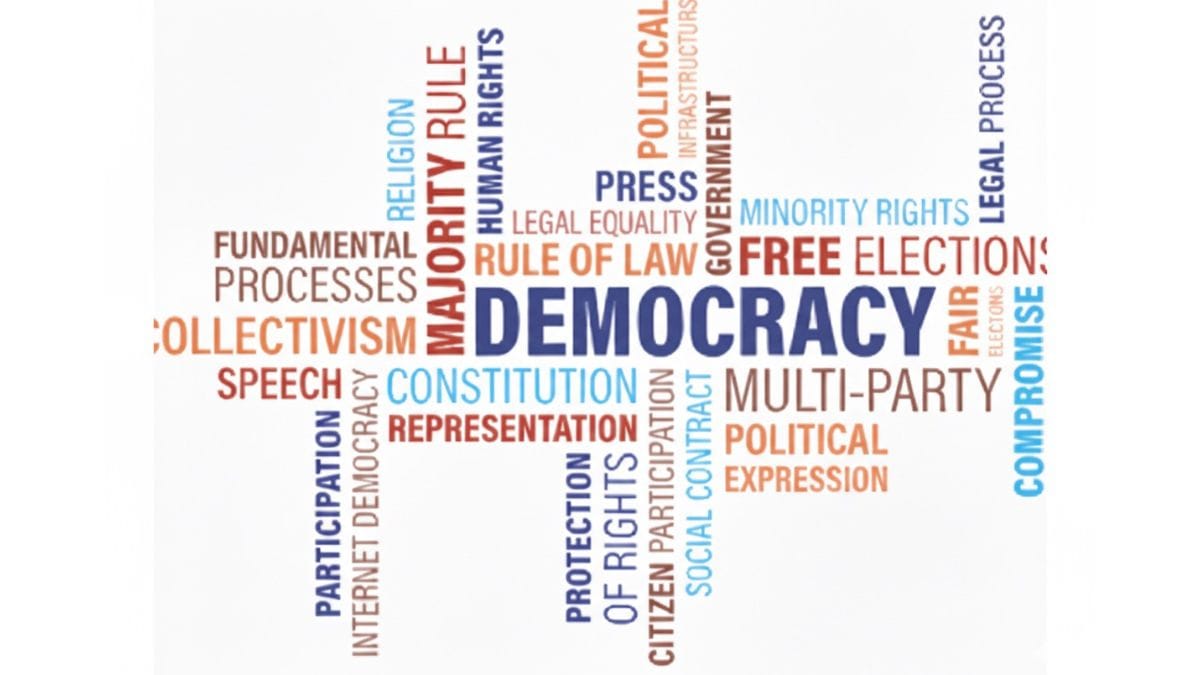
Minoo Masani argues that majority rule, taken alone, is not the essence of democracy and can in fact be undemocratic — especially in ‘polyglot societies’ with a permanent ethnic, religious, or linguistic majority (he cites Sinhalese domination in Sri Lanka and Hindu domination over minorities in India as examples). Drawing on E.F.M. Durbin’s test of effective opposition, Croce’s warning against the State becoming the sole employer and landlord, and comparative examples (Stalin, Hitler, African dictatorships, apartheid South Africa), Masani lays out five conditions for genuine democracy: limited government, sharing and participation in power (including proportional representation for minorities), separation of powers, rule of law, and individual liberty. He is critical of India’s ‘first past the post’ system and its concentration of economic control in the state, and favourably cites Switzerland’s proportional, cantonal, rotating-executive model as a superior alternative for polyglot societies.
- Masani’s central claim: majority rule without limits is not democracy, and can produce tyranny of a permanent majority over minorities.
- He invokes E.F.M. Durbin’s test that a society without effective, actually exercised opposition is not a democracy.
- Benedetto Croce is cited for the argument that when the State becomes the sole employer/landlord, society ceases to be free because there is no autonomous social force left to oppose it.
- Masani lists five requirements for real democracy: limited government, shared/proportional power, separation of powers, rule of law, and individual liberty.
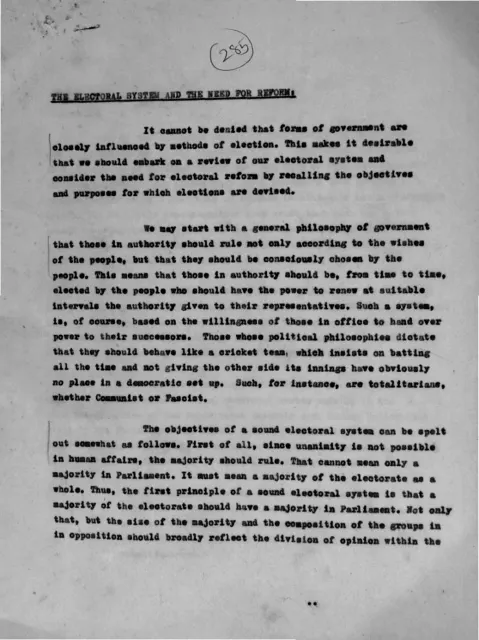
- He criticises ‘first past the post’ electoral systems (UK, US, India) for producing gross under-representation, citing Margaret Thatcher’s re-election on a minority of votes as an example.
- Switzerland’s system of proportional representation, cantonal autonomy, and a rotating collective executive is held up as the superior model for religiously/linguistically plural societies.
- He argues reservations for scheduled castes/tribes should be time-limited and phased out, calling permanent or excessive discrimination ultra vires the Constitution.
Generated by the v1.5 extraction pipeline. Awaiting editorial review.
Metadata and summary are AI-extracted from the source PDF and reviewed for editorial accuracy. The original work is available via the Read PDF tab above (where present); paragraph-level citation inside the PDF is deferred to a future engagement.