periodical issue
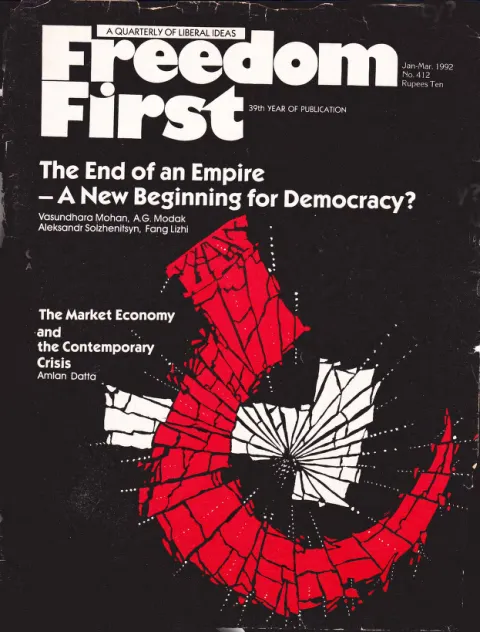
Freedom First
A Quarterly of Liberal Ideas
By Milovan Djilas, Jiban Mukhopadhyay, Bhanu Pratap Singh, S. V. Raju
Published by J.R. Patel for the Democratic Research Service and printed by him at Parsiana Publications Pvt. Ltd. 300 Perin Nariman Street, Bombay 400 001 · Bombay · 1988
56 pages
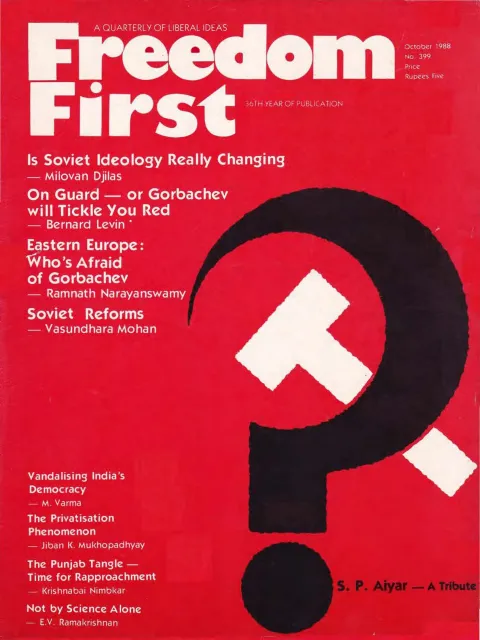
Freedom First
Summary
This is issue No. 399 of Freedom First (October 1988, 36th year of publication), the Bombay-based liberal quarterly founded by Minoo Masani and published by the Democratic Research Service, edited by S.V. Raju and R. Srinivasan. In the rendered pages (PDF pp.1-20, covering printed pages 1-18 plus front matter), the issue is built around a symposium titled ‘The Hammer & Sickle — A Big Question Mark’ on Mikhail Gorbachev’s glasnost and perestroika, alongside editorial commentary on India’s own political scene (the withdrawal of the Defamation Bill, 1988, and the fragility of the newly formed National Front). The symposium gathers international and Indian contributors — Milovan Djilas, Bernard Levin, Geeta Doctor (satire), Ramnath Narayanswamy, and Vasundhara Mohan — who together take a mostly skeptical, wait-and-see view of Soviet reform, framing it as change managed from above by the ruling oligarchy rather than a genuine embrace of liberty or free markets.
Key points
-
Milovan Djilas’s “Is Soviet Ideology Really Changing” argues Gorbachev’s reforms are changes made by the ruling oligarchy, too limited to be systemic change, though he credits glasnost as a real if modest achievement exposing “the destructive force of Brezhnev’s bureaucratism.”
-
Bernard Levin’s “On Guard — or Gorbachev will Tickle You Red” skewers Western credulity toward glasnost, arguing Gorbachev differs from his predecessors chiefly in intelligence rather than any liberal inclination, and lists continuing Soviet abuses including the Gulag and censorship.
-
Geeta Doctor’s satirical “Glass Nose Anyone?” imagines a bewildered global “agent” failing to get a coherent answer about what glasnost and perestroika actually mean, ending with a grieving Muscovite’s pun rejecting “Glasnost.”
-
Ramnath Narayanswamy’s survey frames 1988 as an “acid test” year for Gorbachev and works country by country through Eastern Europe, from Hungary’s debt crisis and Poland’s stalled reform to Ceausescu’s unreformed Romania and Yugoslav economists proposing a full market economy.
-
Vasundhara Mohan’s report on the 19th CPSU Conference, the first in 47 years, credits glasnost with exposing official misdeeds like the Yuri Churbanov corruption case, and profiles Boris Yeltsin as the reform camp’s most impatient, demoted figure.
-
The issue also carries editorial commentary on India’s own political scene, including the withdrawal of the 1988 Defamation Bill and the fragility of the newly formed National Front.
Essays
Is Soviet Ideology Really Changing
By Milovan Djilas
Milovan Djilas, the Yugoslav dissident and former Vice-President of Yugoslavia, argues that Gorbachev’s reforms are changes made by the ruling oligarchy and are too limited to constitute a change of system: communism, he writes, is always changing while remaining essentially the same. He traces the fossilization of Marxism-Leninism through Lenin’s reduction of the state to ‘the stick’ and Stalin’s consistent use of it, and contends that Soviet-style economies cannot embrace a genuine free market because ‘socialist property’ and party monopoly of power are treated as sacred and are abandoned only when strictly necessary. Djilas credits Gorbachev’s glasnost as a real, if modest and non-institutionalized, achievement — chiefly as publicity that exposes the ‘destructive force of Brezhnev’s bureaucratism’ — but predicts Gorbachev will face resistance from the conservative bureaucracy, and that fundamental ideology remains an obstacle he cannot circumvent. He closes by urging that the Soviet Union be understood ‘in long blocks of time, in decades if not in centuries.’
- Argues changes under Gorbachev and Deng are made by the ruling oligarchy and are too limited to be called systemic change; communism ‘has always been changing, remaining in essence always the same.’
- Traces the ideological lineage from Marx through Lenin (‘the state equals the stick’) to Stalin, arguing Stalinism is a phase of Leninism, not an aberration.
- Contends property in communist states is not legally defined, which lets the party monopolize the economy and generate ‘total power,’ unfreedoms, and stagnation.
- Credits glasnost as Gorbachev’s most important achievement — publicity/exposure of Brezhnev-era bureaucratic rot — but says it operates strictly within party-prescribed limits.
- Predicts resistance from the conservative bureaucracy and warns that ideology (Marxism-Leninism) itself remains an obstacle Gorbachev cannot get around.
- Sees Gorbachev as more flexible in foreign policy than his predecessors, and expects arms-control gestures aimed at removing Western distrust.
- Advises observers to judge Soviet developments over decades or centuries, not in the short term.
On Guard — or Gorbachev will Tickle You Red
By Bernard Levin
Bernard Levin’s essay, reprinted from The Times of London (March 9, 1987), skewers the Western rush to celebrate Gorbachev’s glasnost as naive. He argues Gorbachev is distinguished from Brezhnev, Andropov, and Chernenko not by any liberal inclination but by intelligence, and that his reforms so far amount to efficiency measures rather than a genuine embrace of freedom. Levin recounts, as a personal thought experiment, the 25-year-old claim that real change would come to the Soviet Union ‘through the system, from below,’ via safe, unremarkable apparatchiks who privately know the system is rotten — and he insists this is not romantic fantasy but literally what happened in the Czechoslovak Spring. He catalogues the regime’s continuing evils — arbitrary law, censorship, the Gulag — and warns against extending Gorbachev the benefit of the doubt before he has earned it, closing with a line from Brecht’s Arturo Ui warning that the totalitarian legacy is ‘fecund still.’
- Argues the salient difference between Gorbachev and his three predecessors is intelligence, not any liberal or democratic inclination.
- Distinguishes Gorbachev’s genuine drive for economic efficiency from an unproven, and doubted, commitment to political freedom.
- Recounts a 25-year-old personal prediction that real Soviet change would come ‘through the system, from below’ via unremarkable, compliant officials who privately despise it — and claims this is exactly what happened with the leaders of the Czechoslovak Spring.
- Lists continuing Soviet abuses — arbitrary law, a meaningless constitution, torture, censorship, anti-semitism, religious persecution, exploitation — as evidence the ‘evil empire’ framing still applies.
- Criticizes Western public figures and celebrities for embracing ‘Glasnost Chic’ uncritically.
- Concludes it would be premature and dangerous to extend Gorbachev the benefit of the doubt before real, unambiguous evidence of freedom arrives.
Glass Nose Anyone?
By Geeta Doctor
A short satirical piece by Geeta Doctor, Contributing Editor of Freedom First, imagining a hapless ‘agent’ sent around the world’s capitals to find out what glasnost and perestroika actually mean, encountering only marketing slogans, confused bystanders, and a French president who mishears perestroika as a call for the restoration of the monarchy. It ends with a Muscovite named Ivan, weeping, offering only ‘Perish the thought of a Glasnost.’
- Frames the global media excitement over glasnost and perestroika as empty sloganeering, from New York billboards to a Radio City musical.
- Satirizes Western credulity by having an unnamed international ‘agent’ fail to get a coherent answer anywhere he travels.
- Imagines France’s President Mitterrand misconstruing perestroika as ‘Pour restorer les rois’ (for the restoration of royalty).
- Ends on a bleak note in Moscow itself, where an ordinary citizen, Ivan, can only respond with grief and a pun rejecting glasnost.
Eastern Europe: Who’s Afraid of Gorbachev?
By Ramnath Narayanswamy
Ramnath Narayanswamy, who teaches at the Gokhale Institute of Politics and Economics, Pune, surveys glasnost and perestroika’s reception across the Soviet bloc. He opens with the rehabilitation of Nikolai Bukharin — including publication of his long-suppressed political ‘testament’ — as a marker of how far glasnost has gone, then argues that Soviet economic reform, despite genuinely new elements like contract brigades and price decontrol, remains modest next to China’s, Hungary’s, and Yugoslavia’s more far-reaching departures from the centralized model. He frames 1988 as an ‘acid test’ for Gorbachev, tied to the outcome of the 19th Party Conference and confrontation with hardliner Yegor Ligachev, and then works country by country through Eastern Europe: Hungary in economic crisis despite two decades of reform; Poland facing the same debt crisis with no glasnost to match it; a GDR openly resistant to reform despite efficient central management; Bulgaria descending into chaos from Zhivkov’s own reforms; Czechoslovakia reforming ‘under pressure’ following Husak’s exit and Jakes’s ambiguous succession; Ceausescu’s Romania as unreformed and repressive as ever; Yugoslavia amid deepening crisis with economists proposing a full market economy; and Albania cautiously opening diplomatic and credit ties with West Germany while resisting internal reform.
- Cites the Soviet publication of Bukharin’s long-suppressed ‘testament’ and moves toward his political rehabilitation as concrete evidence glasnost has substance.
- Argues Gorbachev’s economic reform program, though containing genuinely new elements, remains modest compared with China’s, Hungary’s, and Yugoslavia’s more radical departures from centralized planning.
- Frames 1988 as an ‘acid test’ year for Gorbachev, hinging on the outcome of the 19th Party Conference and his rivalry with Yegor Ligachev.
- Surveys Eastern Europe country by country: Hungary in economic crisis with 18 billion dollars of debt despite two decades of reform; Poland facing 36 billion dollars of debt with ‘no glasnost’; the GDR openly resisting decentralization; Bulgaria in ‘greater and greater disorder’ from Zhivkov’s own reforms.
- Notes Czechoslovakia is ‘reforming under pressure’ after Husak’s retirement and Milos Jakes’s ambiguous succession, on the eve of the 20th anniversary of the Prague Spring.
- Describes Ceausescu’s Romania as unreformed, repressive, and hostile to Gorbachev, with ‘some of the harshest’ living conditions in Europe.
- Reports Yugoslav economists Marijan Korosic and Slavko Gudstein proposing a full free-market economy, and Albania cautiously restoring diplomatic and credit ties with West Germany while resisting internal reform.
Reforms in the Soviet Union
By Vasundhara Mohan
Vasundhara Mohan reports on the 19th All-Union Conference of the CPSU (June-July 1988), the first such conference in 47 years, describing it as a clear endorsement of Gorbachev’s perestroika and glasnost and a moment that exposed dissenters within the party. She summarizes the structural and economic ills perestroika was meant to cure — declining investment, labour indiscipline, an overcentralized command system, and consumer goods shortages — and credits glasnost with allowing the press to report past mistakes, official misdeeds, and rights violations, including the corruption case against Brezhnev’s son-in-law Yuri Churbanov. In the section on ‘Voices of Dissent’ (continuing past the rendered pages), she profiles Boris Yeltsin as impatient for faster reform and demoted for his methods, quotes historian Roy Medvedev’s warning against moving too fast, and outlines conservative critics — including Ligachev, Gromyko, Chebrikov, and Shcherbitsky — who resented the press freedoms glasnost had unleashed.
- Describes the 19th CPSU Conference (June-July 1988) — the first in 47 years — as a clear endorsement of perestroika and glasnost, and a forum that exposed dissenters.
- Lists the systemic ills perestroika targeted: declining investment, infrastructure underdevelopment, labour indiscipline, chronic overemployment alongside labour shortages, and an overcentralized command-and-administer system.
- Credits glasnost with expanding press freedom to report past mistakes, the causes of failures, and misdeeds by high officials — citing the Yuri Churbanov corruption case as an example.
- Profiles Boris Yeltsin as the reform camp’s most impatient figure, who was demoted and stripped of Candidate Membership after Gorbachev criticized his ‘peremptory attitudes and command methods.’
- Quotes historian Roy Medvedev warning that going ‘too fast’ risks ‘the end of perestroika rather than its success.’
- Identifies conservative critics of glasnost’s press freedoms — Y.K. Ligachev, Vladimir Karpov, Filipp Popov, Andrei Gromyko, Viktor Chebrikov, and Vladimir Shcherbitsky — who accused the press of painting the Soviet past exclusively in black.
Generated by the v1.5 extraction pipeline. Awaiting editorial review.
Metadata and summary are AI-extracted from the source PDF and reviewed for editorial accuracy. The original work is available via the Read PDF tab above (where present); paragraph-level citation inside the PDF is deferred to a future engagement.