periodical issue
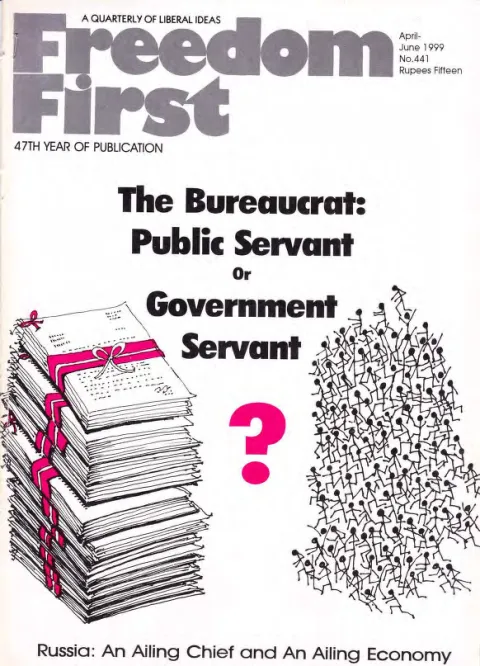
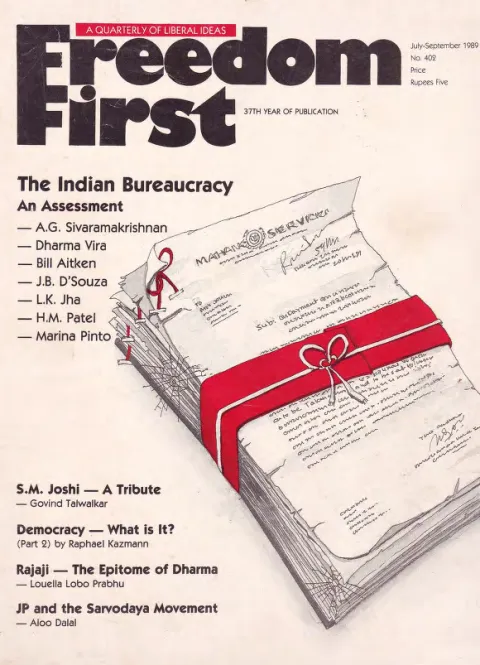
Freedom First
A Quarterly of Liberal Ideas
By L. K. Jha, H. M. Patel
Published by J.R. Patel for the Democratic Research Service and printed by him at Parsiana Publications Pvt. Ltd, 300 Perin Nariman Street, Bombay 400 001 · Bombay · 1989
56 pages
Freedom First
Summary
This is issue No. 402 of Freedom First (July–September 1989, 37th year of publication), the Bombay-based quarterly of liberal ideas founded by Minoo Masani and edited by S.V. Raju and R. Srinivasan. The rendered pages (1–20 of 56) cover the front matter, the two regular commentary columns, and the bulk of the issue’s cover symposium, ‘The Indian Bureaucracy — An Assessment.’ The editorial and both columns (‘With Many Voices’ and ‘Of Cabbages and Kings’) are dominated by the Tiananmen Square massacre of June 1989 and its regional echoes (Tibet, the Dalai Lama’s statement, India’s tepid official response), alongside a domestic complaint about the government’s refusal to grant autonomy to All India Radio and Doordarshan. The main symposium assembles retired and serving civil servants and administrators — Dharma Vira, L.K. Jha, J.B. D’Souza, H.M. Patel, and (continuing past the rendered pages) A.G. Sivaramakrishnan — to assess why India’s bureaucracy, once the ‘steel frame’ inherited from the British, has declined into self-serving inefficiency since Independence. Contributors trace the shift from a public-service ethos under Sardar Patel’s original vision for the IAS to a culture of political subservience, rigid and unenforced service rules, and personal advancement at the expense of integrity. In the rendered pages Sivaramakrishnan’s essay had just begun a reminiscence about the British ICS officer Philip Mason. Further symposium essays (A.G. Sivaramakrishnan continuing, Marina Pinto) and separate pieces on S.M. Joshi, ‘Democracy — What is It?’, Rajaji, the Roy Medvedev piece ‘The Suit Against Stalin,’ ‘Perestroika for India,’ ‘JP and the Sarvodaya Movement,’ ‘Economics for the Common Man,’ and book reviews were listed in the table of contents but fall outside the rendered page range.
Key points
-
Dharma Vira’s “The Civil Service — Then & Now” credits Sardar Patel as architect of the all-India services and Article 311 safeguards, and argues the civil service’s original integrity and esprit de corps have eroded as officers pursued personal advancement.
-
L.K. Jha’s satirical “Mr. Red Tape” personifies bureaucratic obstruction as a character who explains his caution as rational self-preservation, since “sins of commission are easier to detect than sins of omission.”
-
J.B. D’Souza’s “Bumbling Officialdom” uses Bombay’s 1981–2001 Draft Development Plan, delayed for years amid proliferating advisory committees, to ask whether civil servants are merely government servants or public servants with obligations to society at large.
-
H.M. Patel’s “What is Wrong with our Bureaucracy?” argues today’s civil servants behave as masters rather than servants, calling for “a total revolution” in their self-conception of duty while locating the real solution in voters’ willingness to remove bad government.
-
A.G. Sivaramakrishnan’s reminiscence recounts British ICS officer Philip Mason publicly rebuking a Brigadier for disrespecting a junior Indian assistant, framing such officers as embodiments of an administrative ethos India has since lost.
-
The editorial and regular columns are dominated by the June 1989 Tiananmen Square massacre and its regional echoes, alongside a domestic complaint about the government’s refusal to grant autonomy to All India Radio and Doordarshan.
Essays
The Civil Service — Then & Now
By Dharma Vira
In the rendered pages, Dharma Vira’s opening essay in the bureaucracy symposium traces the history of India’s administrative services from the East India Company era through the creation of the Indian Civil Service and its post-Independence transformation into the IAS. He credits Sardar Patel with insisting on constitutional safeguards (Article 311) and political insulation for the services, quoting Patel’s warning that ‘the Union will go’ without a strong all-India service. The essay argues that the civil service’s original ideals of integrity, courage in advising political masters, and esprit de corps have eroded since Independence because officers pursued personal advancement and bowed to self-seeking politicians, while salaries stagnated relative to inflation. Vira proposes concrete reforms (fighting corruption, resuming district touring, fearless advice-giving) and insists the decline can still be reversed, closing by holding the services accountable to the memory of Patel, Nehru, and the constitution-makers.
- Traces administrative history from the East India Company’s part-time trader-administrators to the creation of the ICS via UK Public Service Commission recruitment.
- Credits Sardar Patel as architect of the all-India services and Article 311 safeguards, quoting his warning that without a good all-India service ‘the Union will go.’
- Lists five original tasks of the IAS: law and order, clean government, advising on policy, implementing policy, and continuity during political instability.
- Argues integrity and esprit de corps have collapsed since Independence as officers prioritized personal gain over duty, aided by self-seeking politicians.
- Notes salaries were cut relative to the pre-Independence era (Secretary’s pay fell from Rs. 4,000/month to Rs. 3,500/month) despite rising prices, pushing some toward corruption.
- Proposes a six-point reform programme: esprit de corps, objectivity in decisions, stringent anti-corruption penalties, fearless advice, resumed district touring, and mentorship of younger officers.
- Closes with a moral appeal that the services owe it to Patel, Nehru and other freedom-fighting founders not to betray the country’s future.
Mr. Red Tape
By L.K. Jha
L.K. Jha’s satirical sketch ‘Mr. Red Tape’ (reprinted from his book Mr. Red Tape, courtesy Allied Publishers) personifies bureaucratic obstruction as a single character encountered at every stage of an ordinary citizen’s life. Jha, a former Governor of the Reserve Bank of India and Chairman of the Administrative Reforms Commission, imagines interviewing ‘Mr. Red Tape’ at home, where the official explains his own behaviour as a rational response to a system that punishes decisive error far more than it punishes paralysis: ‘Sins of commission are easier to detect than sins of omission.’ The piece closes with Mr. Red Tape deflecting responsibility for reform onto the Department of Administrative Reforms, illustrating the essay’s satirical point that no one within the system is willing, or able, to fix it.
- Personifies bureaucratic delay and objection-raising as a single recurring character, ‘Mr. Red Tape’, encountered at every official transaction of a citizen’s life.
- Frames the character as sympathetic in private but transformed into an obstructive persona at the office, prompting the narrator to ask why.
- Mr. Red Tape explains his caution as rational self-preservation: results don’t get him judged, but deviations from rules do.
- Coins the maxim that sins of commission are punished more severely than sins of omission, so refugees and citizens are made to wait rather than risk an official error.
- Ends with Mr. Red Tape passing responsibility for fixing the system to the Department of Administrative Reforms, underscoring the essay’s satire that the system is self-perpetuating.
Bumbling Officialdom — Vaccillation & Dilemma
By J.B. D’Souza
J.B. D’Souza, a former Municipal Commissioner of Bombay and Chief Secretary of Maharashtra, uses an extended guard-and-train metaphor to argue that India’s creaking administrative machinery habitually slows or blunts the initiatives of elected politicians. He illustrates this through the case of Bombay’s 1981–2001 Draft Development Plan, sanctioned for preparation in 1977 but still unadopted eight years after submission to government, delayed by an endless proliferation of advisory committees and consultations. D’Souza quotes Paul Appleby’s decades-old critique of Indian administrative review as still apt, and closes by asking whether senior officials are ‘just Government servants’ or ‘public servants whose responsibilities transcend the ordinary master-servant relationship’ to the government of the day — a question he leaves open as the central dilemma of his essay.
- Opens with a guard-and-train metaphor: officials are usually the slow ‘train’ that blunts the guard-politician’s initial zeal, though exceptions exist.
- Case study: Bombay’s Draft Development Plan (1981-2001) took from 1977 to 1985 to reach government, then remained unsanctioned for years further, passed among a proliferating chain of advisory committees.
- Quotes Paul Appleby’s critique that Indian administrative decisions are reviewed by too many people in too many organs of government, creating systematic barriers to action.
- Notes that Appleby, an experienced New Deal administrator invited by Nehru to advise on Indian public administration, found the ‘steel frame’ too rigid to reform even then.
- Raises unresolved central question: are civil servants merely government servants bound to loyalty to the government of the day, or public servants whose obligations run to society at large?
What is Wrong with our Bureaucracy?
By H.M. Patel
H.M. Patel, a former Union Finance Minister and ICS officer, argues in the rendered concluding pages of his essay that a corrupt surrounding political and social atmosphere neuters even a well-manned bureaucracy, and that today’s civil servants have inverted their proper relationship to citizens — behaving as masters rather than servants by imitating their political bosses’ arrogance. He contrasts this with older ICS officers, who toured their districts extensively and thus understood ground realities, unlike their less-travelled, more arrogant successors. Patel calls for a ‘total revolution’ in civil servants’ self-conception of duty, insisting they must recover courtesy and responsiveness to citizens, but ultimately locates the lasting solution in the electorate’s willingness to vote out bad government.
- Argues bureaucratic machinery cannot function well when the surrounding political and social atmosphere is itself corrupt.
- Criticises today’s civil servants for behaving as masters rather than servants, imitating the arrogance of their political bosses.
- Contrasts today’s officers, who rarely tour districts and have little ground knowledge, with earlier ICS officers who traveled extensively and knew their districts’ residents.
- Calls for ‘a total revolution’ in civil servants’ concept of their duties, urging courtesy and readiness to listen rather than treating service to citizens as a favour.
- Concludes that real change ultimately depends on voters exercising their right to vote out non-performing governments.
The Steel Frame — Some Reminiscences
By A.G. Sivaramakrishnan
A.G. Sivaramakrishnan’s essay, a personal reminiscence titled ‘The Steel Frame — Some Reminiscences,’ opens by praising the calibre of the old ICS ‘steel frame’ and lamenting that Sardar Patel’s far-sighted recognition of these officers’ abilities was squandered by an unsympathetic political leadership after his death. In the rendered pages the essay centres on a lengthy anecdote about Philip Mason, a British ICS officer who served as Joint Secretary in the War Department during World War II: Mason is shown treating a junior Indian scientific assistant with more respect and attention than a superior-ranked British Brigadier, and is described as an excellent draftsman whose incisive file notes (including a famous dig about the Bhatnagar Committee having ‘raised this genie… It cannot be bottled up until it has had its say’) exemplified administrative wit and independence. The essay (continuing beyond the rendered pages) frames Mason and similar officers as embodiments of an administrative ethos India has since lost.
- Opens by praising the ICS ‘steel frame’ and blaming an unsympathetic post-Patel political leadership for discarding these officers’ talents.
- Notes that ICS officers, though drawn from Britain’s and India’s elite, are generally agreed to have served the country well and included nationalist leaders like Sri Aurobindo and Subhas Chandra Bose who began careers in the ICS.
- Long anecdote: British ICS officer Philip Mason, Joint Secretary of the War Department, publicly rebukes a senior Brigadier for disrespecting a junior Indian assistant, demonstrating his rejection of racial hierarchy.
- Describes Mason as an outstanding draftsman whose file notes were ‘crisp, pungent and hit the nail on the head,’ including a witty two-line note about the Bhatnagar Committee.
- Notes Mason later wrote well-regarded books on the British Raj, including The Men Who Ruled India: The Founders and The Guardians.
- Essay explicitly marked complete: false — the rendered chunk ends mid-essay at page 18, before further reminiscences promised by the title.
Generated by the v1.5 extraction pipeline. Awaiting editorial review.
Metadata and summary are AI-extracted from the source PDF and reviewed for editorial accuracy. The original work is available via the Read PDF tab above (where present); paragraph-level citation inside the PDF is deferred to a future engagement.