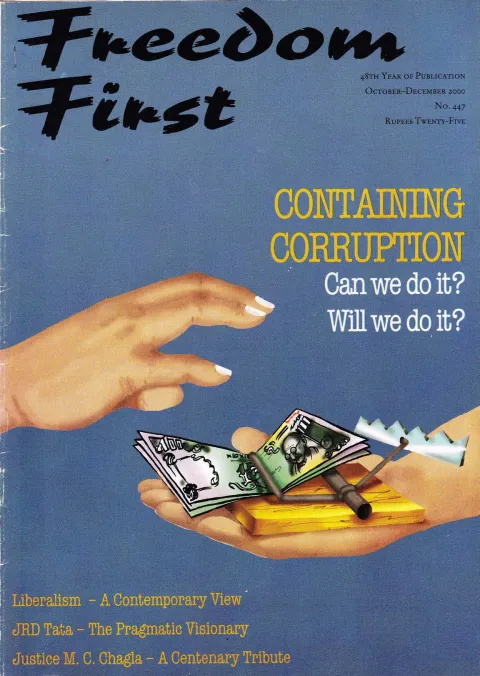
periodical issue
Freedom First
A Quarterly of Liberal Ideas
Edited by S. V. Raju
Published by J.R. Patel for the Democratic Research Service and printed by him at Parsiana Publications Pvt. Ltd., 300 Perin Nariman Street, Bombay 400 001. Publishers: Democratic Research Service, 4th floor, Maneckji Wadia Bldg, 127, Mahatma Gandhi Road, Bombay 400 001. · Bombay · 1990
64 pages
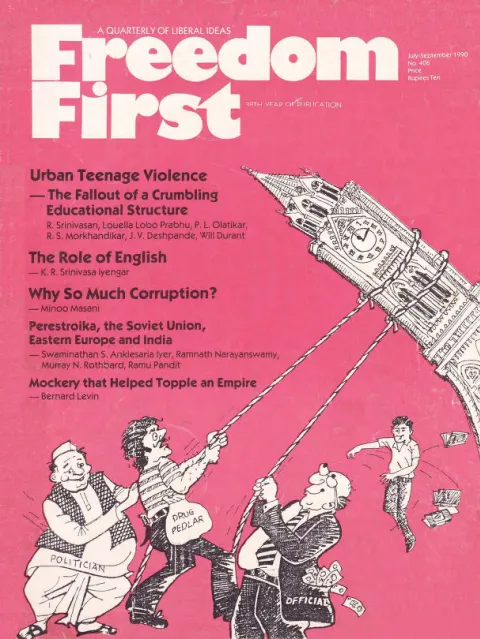
Freedom First
Summary
This is the July-September 1990 issue (No. 406, 38th year) of Freedom First, a quarterly of liberal ideas published by the Democratic Research Service in Bombay, founded by Minoo Masani and edited by S.V. Raju and R. Srinivasan. In the rendered pages, the issue opens with front matter (a masthead editorial explaining the theme, a personal tribute to broadcaster Mehra Masani by P.C. Chatterji, a ‘With Many Voices’ page of press quotations, and an ‘Of Cabbages and Kings’ commentary column) before turning to its lead symposium, ‘Urban Teenage Violence — The Fallout of a Crumbling Educational Structure.’ The editorial frames the symposium around a spate of campus killings and rising student violence, arguing this reflects the degeneration of Indian higher education under political interference, corruption, and the collapse of family and institutional discipline. Contributors include R. Srinivasan, Louella Lobo Prabhu, P.L. Olatikar, R.S. Morkhandikar, an anonymous schoolteacher, and a reprinted 1959 convocation address by Will Durant.
Key points
-
R. Srinivasan’s “Degeneration of Higher Education” links urban teenage violence to collapsing family discipline and media glorification of violence, using two regional novels as sociological evidence of political patronage corrupting college admissions, and details a candidate’s line-itemed election bribery budget.
-
P. L. Olatikar’s “Turmoil in the Campus” argues the mass rush for college admission reflects parental anxiety rather than academic interest, and proposes vocationalisation of education after the 10th standard.
-
An unsigned piece by “A Teacher,” “Urban Teenage Violence — The Danger Signals,” catalogues flashpoints including the Rinku Patil murder and criticises both careerist teachers and moralising commentary that ignores adolescent frustration.
-
R. S. Morkhandikar’s “The Decline of Education” traces how institutions founded by politician-educationists like Ambedkar and Panjabrao Deshmukh were captured from the 1960s onward by politicians seeking patronage over admissions to lucrative courses.
-
Will Durant’s reprinted 1959 convocation address, “Advice to Youth,” offers paternal counsel on health, marriage, and character, arguing modern civilisation has unwisely over-stimulated the sexual impulse.
-
The issue opens with a personal tribute to broadcaster Mehra Masani by P.C. Chatterji and frames its whole symposium around a spate of campus killings reflecting the degeneration of Indian higher education.
Essays
Degeneration of Higher Education
By R. Srinivasan
In the rendered pages, R. Srinivasan’s ‘Degeneration of Higher Education — The Roots of Student Unrest’ argues that urban teenage violence connects to a broader collapse of discipline, family structure, and moral values, compounded by media glorification of violence and a rush to send unqualified students to college. He cites two novels (Kannada ‘College Ranga’ and Marathi ‘Bonsai’) as sociological windows into how political patronage, nepotism, and criminal elements have corrupted higher-education institutions, and closes (in the rendered portion) with a section on politicians’ direct control over colleges via admissions, bribery, and violence against principals.
- Frames urban teenage violence as linked to, but not simply explained by, the general social dimension of violence in India
- Blames commercial cinema and TV for normalizing violence and eroding parental/family discipline
- Argues an earlier generation’s college students had discipline and hard work instilled at home; today college admission is pursued regardless of fitness for it
- Uses two novels (‘College Ranga’ in Kannada, ‘Bonsai’ in Marathi) as sociological evidence of institutional corruption in higher education
- Describes politician-controlled colleges as sources of patronage, admissions-for-bribes, and violence against principals who resist
- Cites Rs 3.5 crore worth of colleges started with money ‘tucked away’ via the Indira Gandhi Pratibha Pratisthan as an example of political abuse of educational institutions
- Details a candidate’s Rs 45,000 election-expense breakdown in a college union election, including line items for liquor and ‘blue films’
Turmoil in the Campus
By P. L. Olatikar
In the rendered pages, P.L. Olatikar’s contribution ‘A Right to Higher Education?’ argues that the mass rush for college admission stems from parental confusion and anxiety rather than genuine academic interest, with many students uninvolved in study, discipline, or examinations. He calls the current system of open admission a waste of public money and proposes vocationalisation of education after the 10th standard as a partial remedy.
- Argues most students admitted to college have no real interest in academics or discipline
- Says government/society spends crores of rupees admitting students to no productive end
- Proposes mass vocationalisation of education after the 10th standard as a solution
Urban Teenage Violence — The Danger Signals
By A Teacher
In the rendered pages, an unsigned piece by ‘A Teacher,’ titled ‘Urban Teenage Violence — The Danger Signals,’ catalogues recent flashpoints (the Rinku Patil murder in Ulhasnagar, campus strikes, drug problems, assaults on teachers) and argues society has failed to understand adolescents’ frustrations rather than merely moralize about them. It criticizes teachers for careerism (private tuitions, outdated lecture notes) as much as students for indiscipline, and situates campus violence within a wider politician-student nexus reaching back to the freedom struggle and Dravidian movement, but now driven by corruption, ignorance, and violence instead of idealism.
- Lists ‘danger signals’ of urban teenage violence: campus crises, student strikes, drugs, campus politicization, the Rinku Patil murder, assaults on teachers
- Criticizes moral judgment of youth without addressing underlying causes: adolescent frustration, hidden tensions, lack of engagement from educators
- Notes teachers increasingly treat classroom teaching as secondary to private tuition/coaching income
- Frames student-politician relationships as historically rooted (Quit India movement, Dravidian movement in Tamil Nadu) but now degraded into mutual exploitation
- Concludes today’s student politics reflects corruption, ignorance, and violence rather than idealism
The Decline of Education
By R. S. Morkhandikar
In the rendered pages, R.S. Morkhandikar’s ‘The Decline of Education’ traces how educational institutions founded by idealist politician-educationists (Ambedkar, Bhaurao Patil, Panjabrao Deshmukh) for social uplift were gradually captured, from the 1960s onward, by politicians seeking patronage, contracts, and control over admissions to lucrative courses (MBA, engineering, medicine, B.Ed). He documents scandals in Marathwada’s B.Ed and engineering colleges and argues that university ‘democratic’ governance structures (syndicates, committees) have themselves become vehicles for capture by ‘educational entrepreneurs.’
- Distinguishes an earlier generation of politician-educationists motivated by social uplift from a post-1960s generation that captured institutions for patronage and profit
- Describes how control of admissions to high-demand courses (MBA, engineering, medicine, B.Ed) became a source of under-the-table funds
- Notes institutions are privately administered but run largely on public funds from UGC, state/central governments, and trusts
- Cites scandals in B.Ed and engineering colleges in Marathwada as evidence of institutional corruption
- Argues ‘democratic’ university governance (syndicates, committees) has itself become a site of capture by political and business interests
Advice to Youth
By Will Durant
In the rendered pages, Will Durant’s reprinted 1959 convocation address, ‘Advice to Youth,’ offers a philosopher’s paternal counsel on health, marriage, character, and religion, urging discipline of bodily appetites, early and considerate marriage, and cultivation of character as prerequisites to a well-lived life, with reflections on how modern civilization has unsettled the restraints once provided by family, religion, and moral code.
- Urges youth to prioritize health, calling illness often ‘a crime’ resulting from foolish choices
- Frames marriage as a civilizing check on the sexual impulse and advises marrying young rather than waiting for false wisdom
- Defines a gentleman as ‘a person continually considerate’ and urges youth to speak no evil of others
- Argues modern civilization has unwisely over-stimulated sexual impulse through advertising and a doctrine that inhibition is a mistake
- Traces the origins of human character to hunter-gatherer survival pressures, later restrained by moral codes transmitted through family, parental authority, and religious instruction
Generated by the v1.5 extraction pipeline. Awaiting editorial review.
Metadata and summary are AI-extracted from the source PDF and reviewed for editorial accuracy. The original work is available via the Read PDF tab above (where present); paragraph-level citation inside the PDF is deferred to a future engagement.