periodical issue
Freedom First
A Quarterly of Liberal Ideas
By D. R. Pendse
Democratic Research Service, 4th floor, Maneckji Wadia Bldg., 127, Mahatma Gandhi Road, Bombay 400 001. Published by J.R. Patel for the Democratic Research Service and printed by him at Parsiana Publications Pvt. Ltd., 300 Perin Nariman Street, Bombay 400 001. · Bombay · 1992
52 pages
Freedom First
Summary
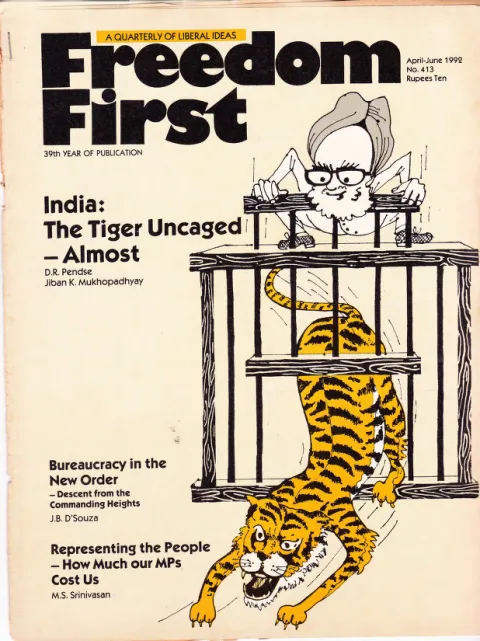
This is issue No. 413 (April–June 1992) of Freedom First, the Bombay-based quarterly of liberal ideas founded by Minoo Masani, in its 39th year of publication, edited by S.V. Raju and R. Srinivasan. In the rendered pages, the issue centers on the early phase of India’s 1991 economic liberalisation, framed by the cover story “India: The Tiger Uncaged — Almost.” D.R. Pendse and Jiban K. Mukhopadhyay assess the Narasimha Rao government’s reform trajectory and the Union Budget 1992-93; J.B. D’Souza argues that bureaucratic resistance, not political will, is the chief obstacle to the new economic order; M.S. Srinivasan itemises the cost of Parliament to the taxpayer and proposes reforms to MP pay and perquisites; and a report covers a Project for Economic Education seminar, “Obstacles to Liberalisation,” featuring Gurcharan Das, D.R. Pendse, and D.N. Patodia. The issue also carries a reprinted Amnesty International petition on human rights in Myanmar, a Friedrich Hayek obituary (reprinted from The Economist), a page of press quotations (“With Many Voices”), Minoo Masani’s regular opinion column (“The Masani Viewpoint”) touching on India-Israel relations and the historiography of independent India, and the recurring “Of Cabbages and Kings” notes column on MPs’ pensions and a Bihar medical-college admissions scandal.
Key points
-
J.B. D’Souza’s “Bureaucracy in the New Order” argues civil-service negativity and delay remain the biggest threat to liberalisation, citing the JJ Hospital glycerine poisoning case and Justice B. Lentin’s inquiry as evidence that culpable officials are shielded or promoted.
-
Jiban K. Mukhopadhyay defends the 1991-92 reforms as unavoidable given the debt and deficit dynamics that brought India to the IMF and World Bank, warning that reform-era inflation near 14% falls hardest on the poorest three-quarters of the population.
-
D. R. Pendse’s review of the 1992-93 Union Budget frames it as a further step toward de facto rupee convertibility via LERMS, praising Finance Minister Manmohan Singh as “a dextrous economist” while listing five outstanding reform areas.
-
A seminar report on “Obstacles to Liberalisation,” featuring Gurcharan Das and D.N. Patodia, records agreement that forty years of state socialism had failed and warns vested interests could scuttle honest implementation of reform.
-
M.S. Srinivasan’s “Representing the People — How much Our MPs Cost Us” itemises Parliament’s perquisites at roughly Rs. 30 crore a year and proposes a ten-point reform including a Rs. 3,000/month salary cap and a contributory provident fund in place of pensions.
-
Minoo Masani’s regular column welcomes India’s establishment of full diplomatic relations with Israel and opposes a proposed government-sponsored history of independent India as improperly politicised.
Essays
Bureaucracy in the New Order – Descent from the Commanding Heights
By J.B. D’Souza
J.B. D’Souza, a former Chief Secretary of Maharashtra, argues that India’s civil service culture — negativity, delay, and self-protective obstruction — remains the single biggest threat to the success of economic liberalisation, regardless of which party governs. He traces the pathology to Parkinson’s ‘Abominable No-Man’ and ‘Prohibitive Procrastinator,’ illustrates bureaucratic resistance with the story of flood-relief administrator S.G. Barve in Poona and a Peruvian anecdote about permit delays, and catalogues the deterioration of policing, land administration, and the judiciary. He calls for a fundamental re-orientation of officialdom: shedding paternalism and the pretension to omniscience, and rewriting civil service rules so the dishonest and incompetent can actually be removed. He cites the JJ Hospital glycerine poisoning scandal in Maharashtra and Justice B. Lentin’s inquiry as an example of a system that protects the culpable and even promotes them.
- Frames bureaucratic obstruction, not politics, as the main threat to India’s reform programme
- Uses Parkinson’s concept of the ‘Abominable No-Man’ / ‘Prohibitive Procrastinator’ to characterize administrative delay as a substitute for outright refusal
- Recounts S.G. Barve’s fight against bureaucratic resistance during Panshet dam flood relief in Poona
- Cites the JJ Hospital glycerine poisoning case and Justice B. Lentin’s inquiry as evidence that culpable officials are shielded or even promoted
- Calls for civil servants to shed ‘God-given omniscience’ and serve underprivileged and informal-sector clienteles, not just the organised elite
- Argues for a rewrite of civil service rules to make it possible to actually dismiss the dishonest and incompetent
India: The Tiger Uncaged – Almost / Economic Reforms – No Soft Options Left
By Jiban K. Mukhopadhyay
Economist Jiban K. Mukhopadhyay lays out the fiscal logic that forced India to the IMF and World Bank in 1991: a 1980s growth path financed by heavy borrowing and deficit spending, negligible returns on massive investment in state-owned enterprises, and a balance-of-payments crisis brought to a head by the Gulf War. He defends the resulting reforms — rupee devaluation, new industrial policy opening to MNCs, and outward-looking trade policy — as unavoidable, and frames the 1992-93 Budget as a continuation of that process. He warns that the burden of the reform-linked inflation (which he estimates near 14%, above the government’s 9% target) falls disproportionately on the poorest 75% of the population, calling this ‘the price to be paid for the wrong economic policies of the past four and half decades.’
- Explains the debt and deficit dynamics of the 1980s that led India to the brink of default by 1990-91
- Details the scale of IMF/World Bank borrowing received by the previous two governments and the current one
- Defends the Narasimha Rao government’s 1991-92 and 1992-93 budgets as necessary breaks from Fabian socialism and Soviet-style planning
- Argues that decades of import-substitution policy isolated India from global economic activity and increased import-dependence rather than reducing it
- States plainly that reform-era inflation, projected around 14% rather than the pledged 9%, falls hardest on the poorest three-quarters of the population
The Union Budget 1992-93 – Some Economic Implications
By D.R. Pendse
Economist D.R. Pendse reviews the Union Budget 1992-93 as a further step toward de facto rupee convertibility, tracing how the Liberalised Exchange Rate Management System (LERMS) formalises what the havala market had already priced in. He praises the decision to permit gold imports and welcomes new treatment of remittances from Indian workers abroad, criticising the historic treatment of returning NRIs as suspects. He judges the budget’s inflationary impact modest given offsetting customs relief, defends it against charges of being anti-poor by noting the demonstrated failure of prior anti-poverty schemes to reach beneficiaries past ‘middlemen,’ and closes by praising Finance Minister Manmohan Singh as ‘a dextrous economist’ and ‘dedicated patriot’ for having made significant, if incomplete, progress on bureaucratic reform, centre-state relations, energy policy, privatisation, and other unresolved items on his ten-point liberalisation agenda.
- Frames the budget as continuing the 1991-92 shift away from a fully convertible-in-practice (‘havala market’) rupee toward de jure convertibility via LERMS
- Welcomes the new gold-import policy as ‘a crucial link in the opening up process’ though flags the accompanying scheme as inadequately drafted
- Criticizes India’s historic treatment of returning NRI workers as if ‘criminals’ at airports and calls for reform of remittance handling
- Judges the Budget’s net additional tax burden (about Rs. 983 crore) modest at 0.8% of government expenditure
- Defends the budget against charges of being anti-poor, arguing poverty schemes have failed due to leakage to ‘middlemen,’ not the new budget’s design
- Praises the elevation of J.R.D. Tata’s Bharat Ratna as signalling that ‘a good industrialist is an honoured citizen’
- Lists five outstanding reform areas: bureaucratic reform, centre-state relations, energy policy, planning process, and privatisation
Obstacles to Liberalisation – A Seminar Report
A staff report on a two-day seminar, “Liberalisation of the Indian Economy: The Obstacles and Measures to Overcome Them,” organised in Bombay (April 4-5) by the Project for Economic Education. D.R. Pendse addressed obstacles to liberalisation and the Union Budget as a reform instrument; Gurcharan Das (an MNC chief executive in India) spoke on economic sovereignty vis-à-vis the IMF/World Bank and multinationals; and former MP and industrialist D.N. Patodia traced the progress of reforms to date. Participants broadly agreed the forty-year policy of state socialism had failed, that current inflationary pressures stem from past policies rather than the new liberalisation measures themselves, and that the new policy’s success depends on honest implementation and resistance to capture by vested interests (politicians, bureaucrats, and businessmen who benefited from the licence-permit-quota raj).
- General agreement that forty years of state socialism had failed and inflation stems from past, not present, policy
- Warned of the risk that vested interests — politicians, bureaucrats, and licence-raj beneficiary businessmen — could scuttle honest implementation
- Dismissed concerns about loss of economic sovereignty to the IMF/World Bank/MNCs as a ‘bogus cry,’ noting it is often raised by communists who have themselves received foreign funds
- Stressed the need for Reserve Bank of India autonomy and consumer-oriented restructuring of public sector undertakings
- Identified follow-up implementation at state and municipal level (e.g. octroi, State Electricity Boards) as decisive for the reforms’ ultimate success
Representing the People – How much Our MPs Cost Us
By M.S. Srinivasan
M.S. Srinivasan, an engineer-economist and founder of the First Public Education Trust, itemises the direct salary, allowances, housing, travel, telephone, medical, and pension perquisites enjoyed by India’s roughly 800 Members of Parliament, estimating a total annual cost to the exchequer of about Rs. 30 crore, equivalent to a notional ‘head-tax’ of roughly Rs. 100 per eligible voter. He contrasts this largesse with MPs’ comparatively modest legislative productivity, citing the House of Commons as a counter-example of substantive lawmaking. He closes with a ten-point reform programme — capping salary at Rs. 3,000/month, standard housing, abolishing pensions in favour of a contributory provident fund, taxing legislators’ incomes like ordinary citizens, and creating a research secretariat — and warns that unchecked, legislators could entrench their perquisites into a hereditary right.
- Estimates the all-in cost of each MP at roughly Rs. 4 lakh/year and the full 800-member Parliament at about Rs. 30 crore/year
- Details specific perquisites: liberal air/rail travel, two free-call telephone lines, subsidised housing (Rs. 10,000-50,000/month value), free utilities, subsidised food, tax-exempt allowances
- Describes the MP pension scheme (Rs. 500/month after 58 months’ service, rising with tenure, extending to spouse) as unlimited and undisqualified even by illegal conduct
- Proposes a ten-point reform: salary cap at Rs. 3,000/month, standard housing, provident fund instead of pension, taxable income, and a research secretariat for legislators
- Warns that expanding the number of legislators, as some clamour for, would only multiply the cost of ‘democracy’ without improving representation
The Erosion of Political Authority and Legitimacy
By Louis D’Silva
Minoo Masani’s regular opinion column, covering several unrelated topics current at the time. He welcomes India’s belated establishment of full diplomatic relations with Israel, crediting Israeli Consul General G. Becher and Prime Minister Narasimha Rao (overruling the Foreign Minister). He dismisses a Far Eastern Economic Review contributor’s ‘neo-Nehruism’ framing of India’s economic troubles, endorsing a correspondent’s view that thirty-five years of cloning the Soviet economic model, not the current reforms, produced India’s crisis. He opposes a proposal for a government-sponsored history of India since independence, arguing history-writing is the job of independent scholars, not the state, and criticizes historian Sarvepalli Gopal’s prior biography of Nehru as ‘abjectly adulatory.’ He closes by congratulating South Africa’s F.W. de Klerk on his referendum win while cautioning that ‘majority rule is not democracy’ in a plural society without power-sharing.
- Welcomes India’s establishment of full diplomatic relations with Israel, crediting Consul General G. Becher and PM Narasimha Rao
- Rejects the ‘neo-Nehruism’ framing of India’s economic crisis, instead blaming 35 years of Soviet-style planning
- Opposes a government-sponsored official history of independent India as improperly politicised, criticizing Professor Sarvepalli Gopal’s prior Nehru biography as adulatory
- Comments on the F.W. de Klerk referendum in South Africa, distinguishing majority rule from genuine power-sharing democracy
Generated by the v1.5 extraction pipeline. Awaiting editorial review.
Metadata and summary are AI-extracted from the source PDF and reviewed for editorial accuracy. The original work is available via the Read PDF tab above (where present); paragraph-level citation inside the PDF is deferred to a future engagement.