periodical issue
Freedom First
A Quarterly of Liberal Ideas
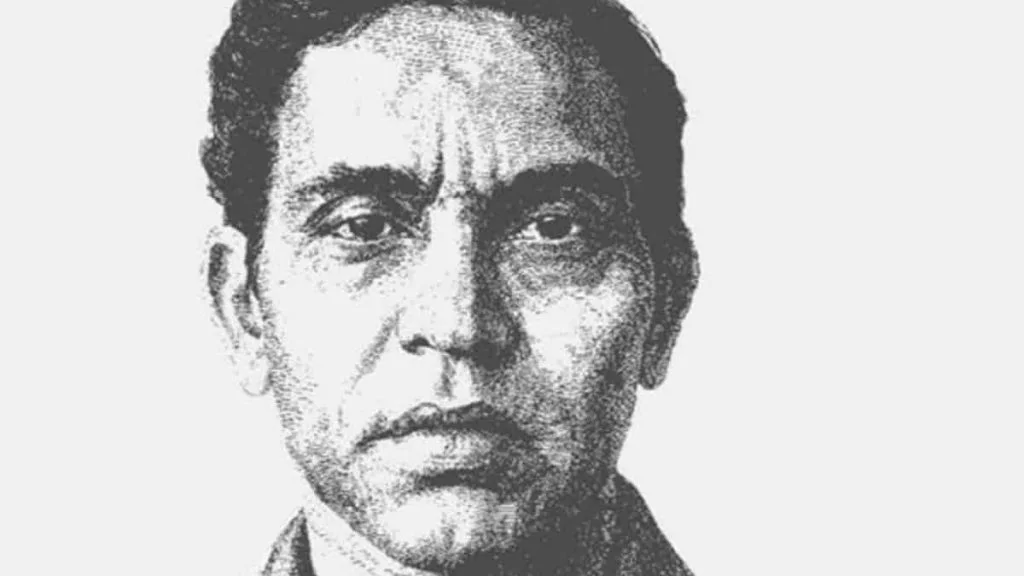
By Hamid Dalwai
Democratic Research Service, 4th floor, Maneckji Wadia Bldg., 127, Mahatma Gandhi Road, Bombay 400 023. Published by J.R. Patel for the Democratic Research Service and printed by him at Parsiana Publications Pvt. Ltd., 300 Perin Nariman Street, Bombay 400 001. · Bombay · 1993
60 pages
Freedom First
Summary
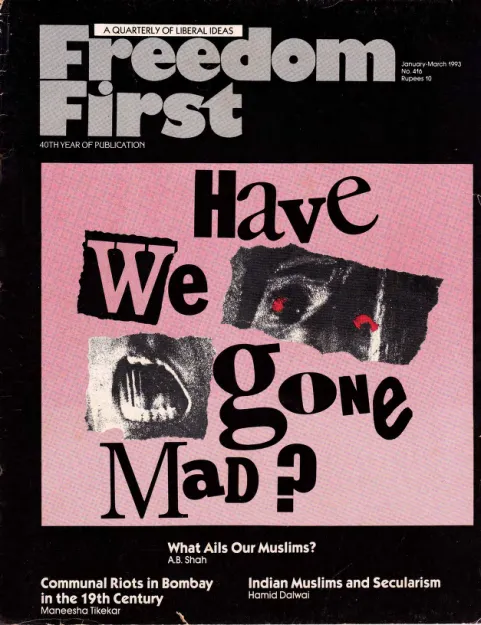
This January-March 1993 issue of Freedom First (No. 416), marking the magazine’s 40th year of publication, is dominated by its response to the December 1992 demolition of the Babri Masjid and the Bombay riots that followed. The editors S.V. Raju and R. Srinivasan explain in their opening note that the issue was delayed because the planned January symposium on “The Role of the State in a Market Economy” had to be shelved in the wake of the violence; in its place the Freedom First Foundation, the Indian Secular Society, and the SNDT Women’s University Department of Politics convened an emergency seminar on “Secularism, Precept and Practice in Contemporary India” on January 9, 1993, held despite curfew and unrest in Bombay. In the rendered pages, the volume’s main feature, “Have We Gone Mad?”, reproduces that seminar’s proceedings at length — debating what secularism means in India, whether sarva-dharma-samabhava is a coherent basis for a secular state, the failures of the post-Independence political class, and the case for a Uniform Civil Code — interspersed with boxed contributions from named participants (M.S. Gore, Minoo Masani) and reprinted pieces (a Shivaji-Aurangzeb tolerance exchange, Babar’s “secret will”, B.T. Dastur on lawlessness, and Ruchira Gupta’s eyewitness account of the Ayodhya demolition). Regular features in the rendered pages include the “With Many Voices” page of quotations from the contemporary press and the “Of Cabbages and Kings” column of editorial miscellany.
Key points
-
The lead feature reports on a January 9, 1993 emergency seminar on secularism held amid curfew and Bombay’s post-Babri Masjid riots, with 51 participants questioning whether pre-modern India was ever genuinely tolerant.
-
M.S. Gore directly disputes that sarva-dharma-samabhava (equal regard for all religions) is consistent with a secular ethic, arguing genuine secularism requires treating religion as irrelevant to individual opportunity.
-
Minoo Masani argues India should be “non-denominational, not secular,” proposing only Republic Day and Independence Day as universal holidays.
-
Ruchira Gupta’s eyewitness account describes the December 6, 1992 demolition of the Babri Masjid, kar sevaks assaulting journalists, and her own near-lynching when identified as Muslim.
-
The seminar’s Uniform Civil Code discussion reproduces a 1986 Indian Secular Society draft proposal, with Justice V.D. Tulzapurkar, recommending abolition of polygamy and unilateral divorce.
-
Reprinted historical material includes a 1679 letter from Shivaji to Aurangzeb pleading for religious tolerance and Babar’s 1529 “secret will” to Humayun urging the same, alongside B.T. Dastur’s polemic on India’s “relapse into savagery.”
-
A contribution from a Muslim Satyashodak Mandal activist describes the “dilemma of progressive Muslims,” accused of teaching Islam when raising reform and of anti-Islamic bias when criticising it.
Essays
Have We Gone Mad
The lead feature reports on a January 9, 1993 emergency seminar on secularism convened by the Indian Secular Society, SNDT Women’s University’s Department of Politics, and the Freedom First Foundation, held in the middle of the Bombay riots that followed the Babri Masjid demolition. The piece opens by describing the surreal circumstance of holding an intellectual discussion on secularism while the city burned, then moves through a wide-ranging discussion: the argument that pre-modern India was fundamentally communal rather than harmoniously plural; a critique of school history for flattening India’s past into a Hindu-Muslim binary; competing dictionary and philosophical definitions of secularism; a sustained rebuttal (via M.S. Gore’s contributed piece) of the idea that sarva-dharma-samabhava (equal respect for all religions) is equivalent to secularism, arguing instead that genuine secularism requires treating religion as irrelevant to the individual’s access to opportunity; and a survey of how political parties across the spectrum have compromised with communalism for electoral gain. The section also carries reprinted material: a 1679 letter from Shivaji to Aurangzeb pleading for religious tolerance and Babar’s 1529 ‘secret will’ to Humayun urging the same; a polemical piece by B.T. Dastur on India’s supposed ‘relapse into savagery’; and Ruchira Gupta’s first-person eyewitness account of the December 6, 1992 demolition at Ayodhya, describing kar sevaks attacking journalists and the mob turning on her when identified as Muslim. The seminar report continues into discussion of a Uniform Civil Code, reproducing Indian Secular Society president A. Solomon’s introduction and Dr. S.P. Sathe’s rationale for a 1986 draft proposal on marriage and matrimonial remedies, plus a boxed piece titled ‘The Dilemma of Progressive Muslims’ voicing concerns from within the Muslim Satyashodak Mandal about the difficulty of spreading secular ideas at the grassroots.
- The seminar was held on January 9, 1993 despite curfew and continuing violence in Bombay, with 51 participants including academics, judges, businessmen, and activists.
- Discussion questioned whether pre-modern India was ever genuinely tolerant, arguing that the ‘plural, tolerant India’ narrative is partly a myth that ignores intra-Hindu and intra-religious persecution.
- M.S. Gore directly disputes the idea that sarva-dharma-samabhava (equal regard for all religions) is consistent with a secular ethic, arguing that most religions posit transcendental claims that cannot be reconciled by mere tolerance.
- Multiple speakers argue that Indian political parties across the spectrum — Congress, Janata Dal, BJP — have all compromised with communal politics for electoral advantage.
- Minoo Masani argues India should be ‘non-denominational, not secular,’ proposing only Republic Day and Independence Day as universal holidays with all religious holidays observed sectionally.
- Ruchira Gupta’s eyewitness account describes the December 6, 1992 demolition of the Babri Masjid, kar sevaks assaulting journalists and photographers, and her own near-lynching when identified as Muslim.
- The Uniform Civil Code section reproduces a 1986 draft proposal (Indian Secular Society, with Justice V.D. Tulzapurkar) recommending abolition of polygamy and unilateral divorce while permitting religious rituals to continue outside the law’s purview.
- A contribution attributed to a Muslim Satyashodak Mandal activist describes the ‘dilemma of progressive Muslims’: accused of trying to teach Islam when raising reform, and of anti-Islamic bias when criticizing it.
Generated by the v1.5 extraction pipeline. Awaiting editorial review.
Metadata and summary are AI-extracted from the source PDF and reviewed for editorial accuracy. The original work is available via the Read PDF tab above (where present); paragraph-level citation inside the PDF is deferred to a future engagement.