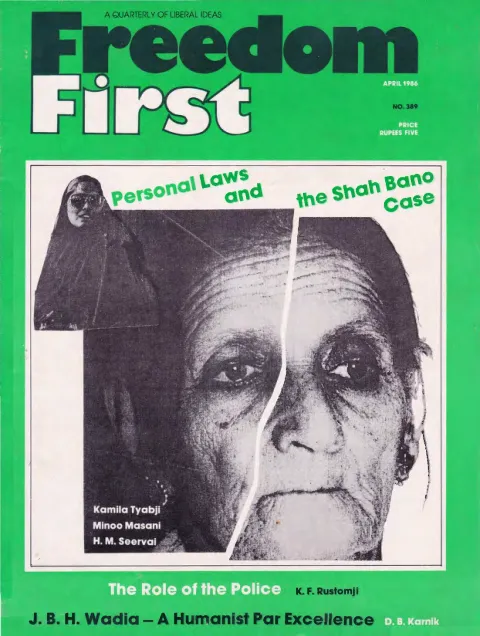
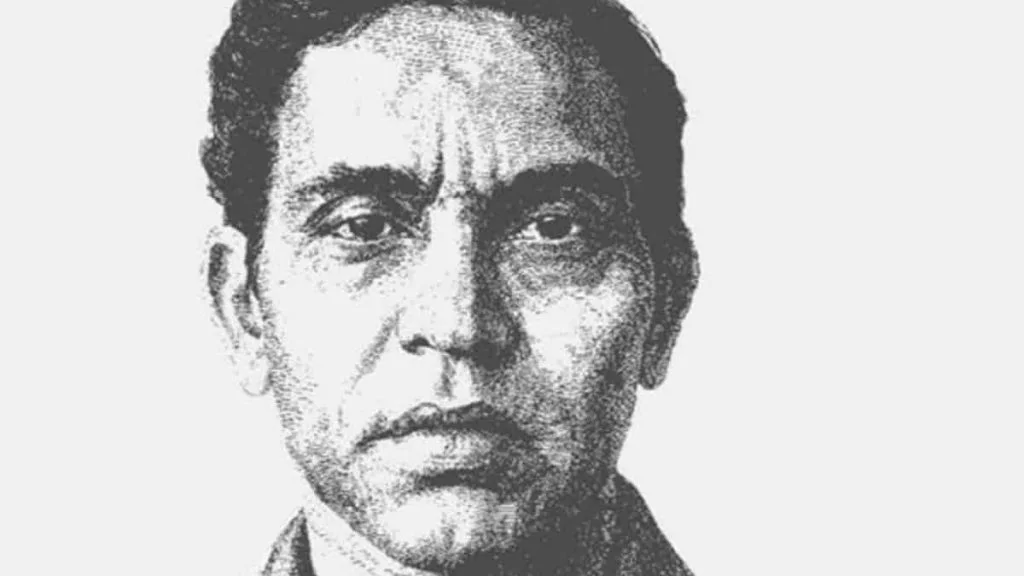
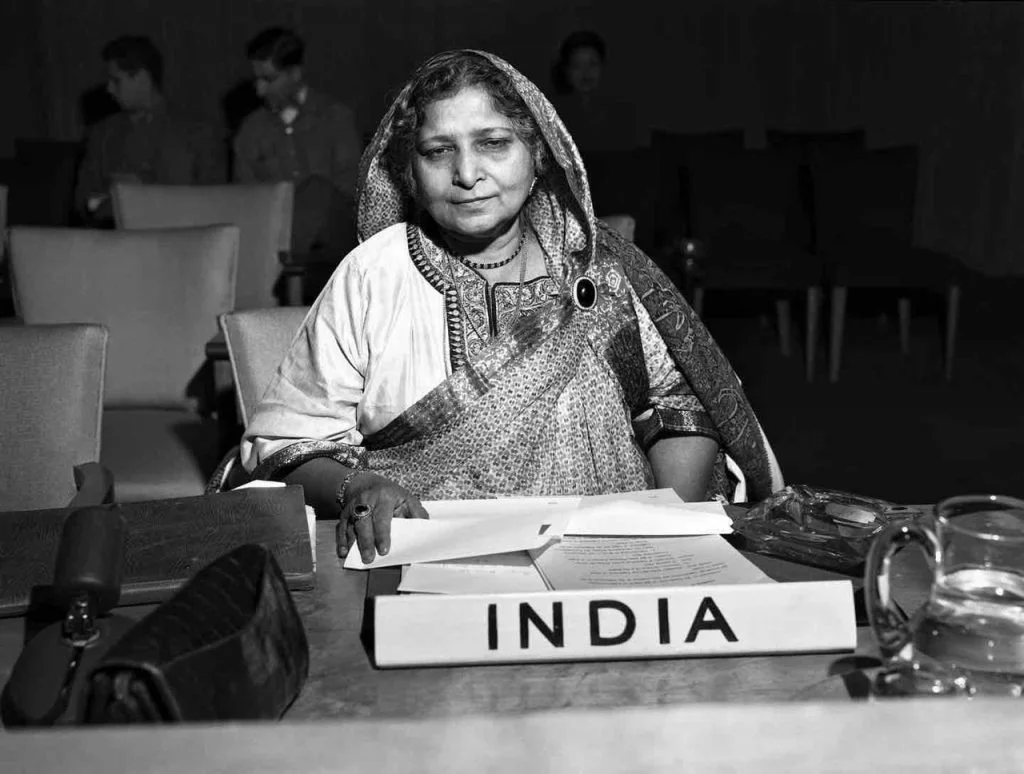
periodical issue
Freedom First
A Quarterly of Liberal Ideas
Published by J. R. Patel for the Democratic Research Service and printed by him at Parsiana Publications Pvt. Ltd., 300 Perin Nariman Street, Bombay 400 001. Publishers: Democratic Research Service, 4th Floor, Maneckji Wadia Bldg., 127, Mahatma Gandhi Road, Bombay 400 023. · Bombay · 1994
52 pages
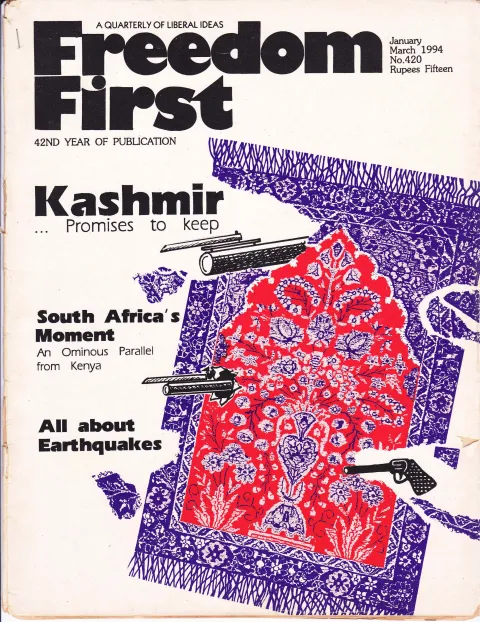
Freedom First
Summary
This is issue No. 420 of Freedom First (January-March 1994), the Bombay-based quarterly of liberal ideas in its 42nd year of publication, edited by S. V. Raju and R. Srinivasan. The cover feature is Kashmir, presented through three contrasting pieces: K. S. Ramamurthy’s case for an internationally-supervised plebiscite honouring India’s original commitment to the Kashmiri people; a Swiss Press Review piece arguing for outright Kashmiri independence as the only durable solution; and Ashok V. Chowgule’s rebuttal, in the letters vein, defending the Indian Army’s conduct against Bernard Levin’s earlier accusations and insisting Kashmir’s accession is non-negotiable. Alongside the Kashmir package, the issue carries M. R. Masani’s ‘Open Letter to My Younger Friends’ urging a new generation to organise in defence of economic liberalisation, a lengthy set of resolutions from the Fifth Convention of the Shetkari Sanghatana (covering the Latur-Osmanabad earthquake, agricultural pricing, property rights, and austerity in government spending), tributes to the recently deceased H. M. Patel and Justice N. P. Nathwani, a short history of the Indian Secular Society’s 25 years, R. Srinivasan’s regular ‘With Many Voices’ and ‘Of Cabbages and Kings’ columns, and Jude H. Gomes’s historical essay on Bombay’s early mercantile and social peculiarities. In the rendered pages the volume’s argumentative centre is classical-liberal: scepticism of the Nehruvian planned economy, insistence on property rights and market reform, and a nationalist-liberal but rights-conscious position on Kashmir.
Key points
-
K. S. Ramamurthy’s “Kashmir - The Way Out” argues India should honour its 1948 commitment to a free plebiscite, citing N. Gopalswamy Iyengar’s UN Security Council pledge and Article 370 as evidence India never treated the accession as final.
-
A reprinted Swiss Press Review piece, “The Solution: An Independent Kashmir,” argues neither the Indian nor Pakistani position serves Kashmiris and recalls Nehru’s near-agreement with Ayub Khan on independence with joint neutrality guarantees before his death.
-
Ashok V. Chowgule’s rebuttal defends the Indian Army’s conduct in Kashmir against Bernard Levin’s earlier accusations, citing the Verghese Committee’s finding that reports of Army excesses were “grossly exaggerated or invented.”
-
Minoo Masani’s “An Open Letter to My Younger Friends” recalls founding the Swatantra Party with Rajaji in 1959 and appeals to a younger generation to organise a movement keeping economic liberalisation from stalling.
-
Resolutions of the Fifth Shetkari Sanghatana Convention at Aurangabad blame the Latur-Osmanabad earthquake’s toll on anti-farmer housing policy and demand abolition of agricultural pricing controls and restoration of constitutional property rights.
-
An obituary tribute to H. M. Patel recounts his roles reorganising the armed forces after Partition, founding LIC, and serving as Swatantra Party president and Janata-government Finance and Home Minister.
-
Yogesh Kamdar’s tribute to Justice N.P. Nathwani recounts his defence, then public renunciation, of the Preventive Detention Act, his Emergency-era free-speech victory, and his 1978 inquiry into repression of the Dawoodi Bohra community.
Essays
H.M.Patel - A Many-Splendoured Personality
By S.V.Raju
An unbylined obituary tribute (signed S. V. Raju) to H. M. Patel, the ICS officer, Swatantra Party leader and Union Finance/Home Minister who died on 30 November 1993. It recounts his role reorganising the armed forces after Partition, nationalising insurance and forming LIC, his presidency of the Swatantra Party, his tenure as Finance Minister in the Janata government, and his later work building a rural hospital at Vallabh Vidyanagar.
- H. M. Patel died on 30 November 1993 at his residence in Vallabh Vidyanagar.
- As Defence Secretary in 1947 he helped reorganise the Indian armed forces after Partition.
- As Principal Secretary in the Department of Economic Affairs he was involved in nationalising insurance companies and forming LIC, and in creating the State Bank of India.
- He was falsely implicated in an LIC scam, was exonerated, and took premature retirement.
- He joined the Swatantra Party in 1966 at Bhaikaka’s urging, later became its national president in 1968, and was Morarji Desai’s choice as Finance Minister and later Home Minister in the Janata government.
- After leaving active politics in 1980 he helped build an 850-bed hospital complex at Vallabh Vidyanagar.
Many Voices / Of Cabbages and Kings
R. Srinivasan’s regular ‘With Many Voices’ column, a compilation of pointed quotations culled from the press (The Sunday Observer, The Week, Time, Indian Express, The Statesman, The Economist, and others) on Indian politics, economic liberalisation, Kashmir, and social commentary, followed by ‘Of Cabbages and Kings’, a set of short editorial notes on a Muzaffarnagar panchayat that shielded a rapist, on the value of a free press in exposing wrongdoing, and a note recommending the new magazine Communalism Combat.
- The ‘With Many Voices’ page strings together press quotations on Indian politics, Israel policy, communism’s decline, budget-making, Kashmir security policy, and consumer capitalism.
- ‘Of Cabbages and Kings’ opens with a case from Muzaffarnagar (UP) where a gram panchayat let a rapist off with a minor, face-blackening punishment and destroyed evidence, prompting a call for panchayat education on democratic responsibility.
- A second item argues a free press, despite its excesses, is essential to exposing the misdeeds of the powerful, citing historical examples from Nero to Indira Gandhi and the Antulay affair.
- The column also notes a reader’s complaint about the magazine’s coverage and recommends the new monthly Communalism Combat, founded by Teesta Setalvad and Javed Anand.
Indian Secular Society - 25 years of commitment
By R.Srinivasan
A short piece marking 25 years of the Indian Secular Society (founded 1968 in Bombay), tracing its origins to secularist humanist G. G. Agarkar’s legacy, its founding moving spirit Professor A. B. Shah, and early activist Hamid Dalwai. It covers the Society’s work on the Uniform Civil Code, Muslim Satyashodak Mandal, and opposition to Hindu Sanatanist attacks on dissidents, and appeals to readers to support the Society and its journal The Secularist.
- The Indian Secular Society was inaugurated in 1968 in Bombay and has completed 25 years of activity as of the special Jan-Feb 1994 issue of The Secularist.
- Professor A. B. Shah was the moving spirit, aided by early activist Hamid Dalwai, focusing on Muslim community reform, a Uniform Civil Code, and countering both Muslim and Hindu obscurantism.
- The article situates the Society’s mission against a backdrop of post-Ayodhya intolerance, quoting Leviticus 24:16 on blasphemy to illustrate how local figures now act as ‘Ayatollahs’.
- Both A. B. Shah and Hamid Dalwai died early but their successors are said to be carrying on the work.
The Masani Viewpoint - An Open Letter
M. R. Masani’s ‘An Open Letter to My Younger Friends’, part of his regular ‘Masani Viewpoint’ column. Masani recalls founding the Swatantra Party with Rajaji in 1959 against the prevailing socialist dogma, argues that the economic reforms of the 1990s were forced on the Congress government only by necessity rather than conviction, and appeals to a younger generation to organise a movement to keep the liberalisation process from stalling.
- Masani and Rajaji founded the Swatantra Party in 1959 to advocate a market economy against Nehru’s ‘socialistic pattern of society’.
- He argues the Congress leadership speaks with different voices to different audiences: free economy to foreign investors, continuity to partymen, residual socialism to organised labour, and welfarism to the poor.
- Masani criticises government price administration (e.g. on petrol) as anti-market backsliding that undermines liberalisation.
- He is unhappy that Indian voters must choose between unwilling liberalisers and those appealing to religion or caste (Ayodhya, Mandal).
- Citing his advanced age and frailty, he appeals to younger readers who believe in individual dignity and minimal state intervention to organise a movement to keep pressure on the government to honestly implement reforms.
Kashmir … Promises to Keep (section header)
No summary was extracted for this article. Listed for completeness.
Kashmir - The Way Out
By K.S.Ramamurthy
K. S. Ramamurthy’s ‘Kashmir - The Way Out’ argues that India should move past treating Pakistan as a permanent enemy and should honour its original 1948 commitment to hold a free plebiscite in Kashmir. It reviews the legal history of accession (N. Gopalswamy Iyengar’s 1948 Security Council address, A. A. A. Fyzee’s view that the Kashmir valley would have gone to Pakistan under partition’s logic, Maharaja Hari Singh’s conditional accession), Article 370’s special status, and concludes that India should proceed to an internationally acceptable free and fair plebiscite regardless of Pakistan’s cooperation, since India’s own past assurances make this the honourable course.
- The article argues that under the ‘basis of partition’ logic applied elsewhere (Junagadh, Hyderabad, Jodhpur, Bhopal), the Muslim-majority Kashmir valley would properly have gone to Pakistan.
- Maharaja Hari Singh’s accession was made conditional on Indian military help against raiders, and the Government of India itself pledged, via N. Gopalswamy Iyengar’s 1948 UN Security Council speech, to let Kashmiris decide their future by plebiscite.
- Article 370 of the Constitution is cited as evidence that India itself, tacitly, never treated the accession as final or irrevocable.
- The author cites Jayaprakash Narayan’s 1974 observation that no election in Kashmir was ever fought on the accession issue itself.
- Ramamurthy concludes India should proceed with an internationally acceptable free and fair plebiscite in the entire state, honouring its ‘solemn assurance’ to Kashmiris even without Pakistani agreement, since doing so enhances India’s international standing regardless of outcome.
The Solution: An Independent Kashmir
By Swiss Press Review
A reprinted Swiss Press Review piece, ‘The Solution: An Independent Kashmir’, arguing that neither the Indian nor Pakistani position serves the interests of Kashmiris, that both countries risk nuclear confrontation over the dispute, and that independence for Kashmir would be a solution consistent with the fundamental principles of both nations. It reviews the 1962-63 period when Nehru and Ayub Khan came close to agreeing on Kashmiri independence with joint neutrality guarantees, and criticises the Indian Army’s human-rights record while also blaming Pakistan’s rigid insistence on Kashmir as a precondition for any dialogue.
- The article characterises the Siachen Glacier conflict as ‘stupid’ and unwinnable for either side, fought in a totally inhospitable, undemarcated area.
- It notes India and Pakistan are both nuclear powers, raising the stakes of any renewed confrontation over Kashmir.
- Nehru, after 1962, came to see Kashmir’s special Muslim-majority status as an exception to his usual insistence on keeping every part of India, and reached a near-agreement with Ayub Khan on independence with joint guarantees of neutrality shortly before his death.
- The piece states over 12,000 people have been killed in Kashmir since 1990, overwhelmingly civilians, citing collapse of rule of law and lack of foreign observer access.
- It closes urging that Kashmiri independence, jointly guaranteed by India and Pakistan, would let two ‘prestigious leaders’ (P. V. Narasimha Rao and Benazir Bhutto) resolve one of the longest-running problems of decolonisation.
Indian Army’s Role in Kashmir
By Ashok V.Chowgule
Ashok V. Chowgule’s letter-style rebuttal, ‘Indian Army’s Role in Kashmir’, responds to Bernard Levin’s earlier Freedom First article ‘India’s Army on the Rampage’ by defending the Army’s overall conduct in Kashmir, citing the Press Council’s Verghese Committee finding that reports of army excesses were ‘grossly exaggerated or invented,’ and arguing that Kashmir’s accession to India is not a negotiable issue.
- Chowgule argues Levin’s article did India and its Army a disservice by ignoring that India is fighting a proxy war with Pakistan in Kashmir.
- He acknowledges that excesses by the Army have occurred, comparing this to abuses by American and Pakistani troops in Somalia, but insists such incidents are properly dealt with through inquiry and punishment rather than blanket condemnation.
- He quotes the Verghese Committee report (Press Council of India, December 1990) via Anil Maheshwari’s book ‘The Crescent over Kashmir’, stating that reports of Army human rights excesses have been ‘grossly exaggerated or invented.’
- He challenges Levin to identify his source of evidence and pass it to the Government of India rather than making unsubstantiated claims.
- He cites the Army’s operation clearing out terrorists from Sopore without civilian casualties as an underreported success, and insists Kashmir’s status as part of India is non-negotiable.
The Rural Perspective (section header) / Resolutions of the 5th Shetkari Sanghatana Convention held at Aurangabad
A long compilation of formal resolutions adopted at the Fifth Convention of the Shetkari Sanghatana held at Aurangabad, covering the Latur-Osmanabad earthquake of 30 September 1993 and its politicised relief effort, agricultural pricing and marketing controls, welcome for economic liberalisation (‘Bali Rajya’), demands for structural economic reforms, restoration of constitutional property rights, and austerity in government expenditure.
- The Convention mourns the Latur-Osmanabad earthquake victims and attributes the scale of the disaster to the state’s longstanding anti-farmer policies that left farmers living in unsafe stone-and-mud houses, rather than to natural causes alone.
- It condemns politicised village ‘adoption’ for earthquake relief and demands only non-political, non-communal organisations be allowed to adopt villages.
- Resolutions on agricultural pricing condemn the state cotton monopoly, restrictions on milk/paddy/sugarcane processing, and demand all controls, levies and export restrictions on agricultural produce be abolished.
- The Convention welcomes the fall of the ‘Nehru model’ and international ‘Bali Rajya’ (liberalisation), but criticises the government’s reform effort as tepid and driven by necessity rather than conviction.
- It demands restoration of the constitutional right to property (eroded via Schedule IX), redefinition of ‘public purpose’ land acquisition, and a public enquiry into politicians’ land wealth.
- It calls for halving administrative and bureaucratic expenditure, freezing salary scales, and stopping further government recruitment to reduce the fiscal deficit.
Bombay Peculiarities
By Jude H.Gomes
Jude H. Gomes’s historical essay ‘Bombay Peculiarities’ describes the early growth of Bombay under the East India Company, arguing that Parsi shipbuilder Lowji Nassarwanjee Wadia, rather than the English, was the true maker of the city thanks to its harbour and dockyard. It covers Bombay’s early reputation as an unhealthy ‘cemetery of the English’, its slow population growth compared to rival ports like Surat, Bassein, and Salsette, its slave-owning household economy, and the relatively liberal, non-purdah social outlook of its Parsi and Christian communities.
- Bombay was surrounded by more powerful rival settlements (Surat, Portuguese Bassein and Salsette) until the mid-18th century and grew slowly, reaching only an estimated 70,000 people by 1744.
- The city’s unhealthy malarial climate earned it the label ‘the cemetery of the English’; Keigwin’s revolt (1683-84) and Child’s Moghul war further set back its development.
- The Parsi shipbuilder Lowji Nassarwanjee Wadia, rather than the English, is credited as the true maker of Bombay via its dockyard and harbour trade.
- In 1789 there were 431 slaves in Bombay, typically arriving from Madagascar or the Red Sea and converting to Roman Catholicism.
- The Parsi and Christian communities had no purdah system or caste inhibitions restricting contact with the English, giving Bombay society a comparatively cosmopolitan, tolerant character.
N.P. Nathwani: He Bestowed Dignity to Dissent
By Yogesh Kamdar
Yogesh Kamdar’s tribute ‘N.P. Nathwani: He Bestowed Dignity to Dissent’ recounts the life of Justice Narendra Pragji Nathwani (1913-1993) — freedom fighter, Constituent Assembly and Lok Sabha member, Bombay High Court judge, and lifelong civil-rights campaigner — including his role in the Junagadh ‘Aarzi Hukumat’, his defence and later renunciation of the Preventive Detention Act, his opposition to the Emergency, his chairing of the Nathwani Commission on repression of the Dawoodi Bohra community, and his public protest against a lavish Bombay wedding at age 77.
- Nathwani was born in Uganda in 1913, settled in Junagadh, and participated in the freedom struggle, being jailed in 1932-33 and going underground during Quit India in 1942.
- During Partition he served as a Minister for Law & Justice in the ‘Aarzi Hukumat’ (provisional government) formed to fight the Nawab of Junagadh’s plan to accede to Pakistan.
- As an MP he was among Nehru’s chosen defenders of the Preventive Detention Act, but later publicly called his own defence of it ‘not just a blunder, but a sin’ once he saw the Act misused.
- During the Emergency he was a leading Citizens for Democracy activist against Mrs. Gandhi’s dictatorship, winning a landmark Bombay High Court judgment upholding free speech and association.
- In 1978 he headed the Citizens for Democracy Commission of Enquiry (the ‘Nathwani Commission’) into repression of the Dawoodi Bohra community by its chief priest.
- At age 77 he stood outside a lavish Bombay wedding with a placard protesting vulgar displays of wealth, shaming at least two couples out of attending.
Generated by the v1.5 extraction pipeline. Awaiting editorial review.
Metadata and summary are AI-extracted from the source PDF and reviewed for editorial accuracy. The original work is available via the Read PDF tab above (where present); paragraph-level citation inside the PDF is deferred to a future engagement.