periodical issue
Freedom First
A Quarterly of Liberal Ideas
By S. V. Raju, Sharad Joshi, Minoo Masani, Sharad Bailur
Democratic Research Service, 4th Floor, Maneckji Wadia Bldg. 127, Mahatma Gandhi Road, Bombay 400 023. Published by J. R. Patel for the Democratic Research Service and printed by him at Parsiana Publications Pvt. Ltd., 300 Perin Nariman Street, Bombay 400 001. · Bombay · 1994
52 pages
Freedom First
Summary
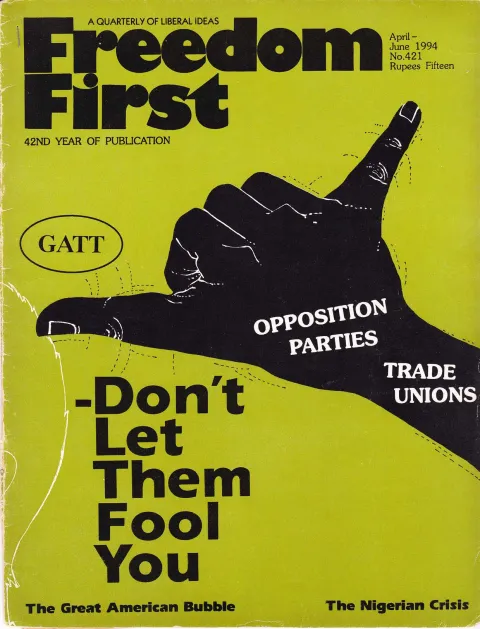
This is issue No. 421 of Freedom First (April–June 1994, 42nd year of publication), the Bombay-based quarterly of liberal ideas founded by Minoo Masani and edited in this issue by S. V. Raju and R. Srinivasan. The cover story, marked by a pointing-hand cartoon under the banner “Don’t Let Them Fool You,” targets the wave of hysteria from opposition parties and trade unions against India’s signing of the GATT/Uruguay Round agreement at Marrakesh. In the rendered pages, the issue opens with tributes to two recently deceased public figures (industrialist S. L. Kirloskar and scholar Tarkateerth Laxmanshastri Joshi), the regular “With Many Voices” and “Of Cabbages and Kings” miscellany columns, S. V. Raju’s explainer defending GATT against protectionist and sovereignty-based objections, Sharad Joshi’s essay on ‘ulti-patti’ (reverse/negative pricing) documenting decades of implicit taxation of Indian farmers, “The Masani Viewpoint” column of short political notes by Minoo Masani, and the opening of Sharad Bailur’s “The Great American Bubble” on U.S. fiscal and monetary policy. Other listed contents not covered in the rendered pages include pieces on euthanasia, West Asia peace prospects, Islam and Bosnia, God and Violence, the Nigerian crisis and corruption, and book reviews.
Key points
-
S.V. Raju’s explainer defends India’s April 1994 signing of the GATT Marrakesh accord against protectionist and sovereignty-based objections, tracing GATT’s history since 1947 and its impending conversion into the World Trade Organisation.
-
Sharad Joshi’s essay on “ulti-patti” (reverse settlement), opening with his own experience of being billed rather than paid for cucumbers, estimates Indian farmers’ annual loss from unremunerative pricing at Rs. 12,000 crores and links this history of implicit farm taxation to the GATT agricultural negotiations.
-
Sharad Bailur’s “The Great American Bubble” criticises U.S. passage of NAFTA and warns that America’s “credit card economy” of proliferating consumer debt underlies a broader fragility in the world economy.
-
Minoo Masani’s column criticises federal overreach in choosing Gujarat’s Chief Minister, praises T. N. Seshan’s independence as Chief Election Commissioner, and announces the planned launch of the Swatantra Bharat movement in Nagpur.
-
Tributes mark the deaths of industrialist S. L. Kirloskar, who favoured abolishing the Planning Commission and FERA, and scholar Tarkateerth Laxmanshastri Joshi, who campaigned against untouchability.
Essays
Essay 1
A brief editorial tribute marking the deaths in April and May 1994 of industrialist S. L. Kirloskar and scholar Tarkateerth Laxmanshastri Joshi. The Kirloskar tribute, reprinted from an article by D. R. Pendse, recalls Kirloskar’s blunt free-market convictions (abolition of the Planning Commission, scrapping of FERA and industrial licensing) and his composure when raided by tax and enforcement authorities. The Joshi tribute, reprinted from The Times of India, portrays him as a polymath scholar-activist who fought untouchability and championed Jyotiba Phule’s reforms while producing a 14-volume Marathi encyclopaedia.
- S. L. Kirloskar, industrialist and founder of the Kirloskar group, died on April 24, 1994 at age 91
- Tarkateerth Laxmanshastri Joshi, Maharashtrian scholar, died on May 27, 1994 at age 94
- Kirloskar favoured abolishing the Planning Commission and FERA and ending industrial licensing
- Kirloskar’s policy positions are described as later echoed in Manmohan Singh’s post-1991 reforms
- Joshi campaigned against untouchability and defended Gandhi’s anti-untouchability movement using shastric arguments
- Joshi was influenced by M. N. Roy’s new humanism after an earlier attraction to Marxist thought
s explainer piece answers reader requests to clarify what GATT (the
By S. V. Raju
S. V. Raju’s explainer piece answers reader requests to clarify what GATT (the ‘Dunkel Draft’) is and defends the government’s decision to sign the Marrakesh accord in April 1994. It walks through GATT’s history since 1947, its 117-member structure, the concept of Most Favoured Nation status, the eight negotiating ‘Rounds’ culminating in the Uruguay Round, and the impending conversion of GATT into the World Trade Organisation from April 1995. The piece then assesses India’s negotiating performance, quoting T. C. A. Srinivasan Raghavan’s Business Standard analysis that India gained in agriculture but lost ground in textiles, and argues India negotiated “from a position of weakness” partly because its GATT representation until 1989 was ideologically anti-market. It closes covering related trade issues: inconsistencies in Indian IPR/patent law per solicitor R. A. Shah, and a boxed rebuttal of the sovereignty objection to GATT.
- GATT was founded in 1947 by 23 countries, including India, and by 1994 had 117 member countries
- GATT member-countries account for an estimated 93% of world trade and enjoy Most Favoured Nation (MFN) status with each other
- The Uruguay Round (the 8th GATT round) concluded with the Marrakesh accord signed April 15, 1994
- From April 1995 GATT would convert into a formal body, the World Trade Organisation (WTO)
- T. C. A. Srinivasan Raghavan’s analysis (quoted at length) argues India gained in agricultural trade but lost in textiles for a decade, and negotiated from weakness partly due to ideological baggage
- A separate boxed item argues Indian patent law is inconsistent, citing solicitor R. A. Shah on the anomaly of a 7-year patent grant process against a 5-7 year patent term
- A boxed argument on ‘Sovereignty’ contends that GATT membership does not compromise India’s sovereignty, comparing objectors’ logic unfavourably
Many Voices
Sharad Joshi’s essay opens with a personal anecdote from his time as a UN-official-turned-farmer: after selling cucumbers at market, he was handed a bill for Rs. 32 rather than payment, having lost money net of marketing costs, cess, and commission — an experience he calls ‘ulti-patti’ (reverse settlement), where the farmer pays rather than receives. He generalizes this into an argument that Indian agricultural policy has systematically imposed negative real prices on farmers for decades, citing his own estimate of Rs. 12,000 crores in annual farmer losses from unremunerative prices, alongside the lower estimates of Dalip Swamy and Ashok Gulati (Rs. 5,000–6,000 crores). He criticizes what he calls the ‘Goebbels of the Left’ — filmmakers, actors, and left economists (naming Smita Patil, Shabana Azmi, and Dr. Ashok Mitra) — for portraying landholding farmers as class oppressors despite the sector’s actual negative subsidy. The piece connects this argument to the GATT/Uruguay Round debate, framing it as evidence the Indian farmer has effectively subsidized the rest of the economy.
- Sharad Joshi recounts his own experience being billed Rs. 32 instead of paid, after selling cucumbers, coining/using the term ‘ulti-patti’ (reverse settlement)
- He estimates the Indian farmer’s annual loss from unremunerative pricing at Rs. 12,000 crores
- Dalip Swamy and Ashok Gulati’s published estimate, using more conservative Agricultural Prices Commission data, put the loss at Rs. 5,000-6,000 crores
- He argues that in 1990 the Government of India first officially admitted farmers received a negative subsidy of 2.3%
- He criticizes prominent cultural and left-economist figures for depicting landholding farmers as a privileged ‘kulak’ class
- The essay links this history of implicit farm taxation directly to the ongoing GATT/Uruguay Round agricultural negotiations
The Masani Viewpoint
A column of short political notes attributed to Minoo Masani (‘The Masani Viewpoint’), covering several unrelated current issues in the rendered page: criticism of the federal government for allegedly overreaching in choosing Gujarat’s Chief Minister; praise for T. N. Seshan’s independence as Chief Election Commissioner; qualified support for and criticism of amendments to the Criminal Procedure Code; support for Deputy Municipal Commissioner G. R. Khairnar’s anti-corruption stance; and remarks on the newly planned Swatantra Bharat movement to be launched in Nagpur, which Masani hopes will revive the free-enterprise and dharma-based ideals of the original Swatantra Party.
- Criticizes the Union Government for allegedly being asked to select Gujarat’s Chief Minister, calling this inconsistent with federalism
- Praises T. N. Seshan for defending the independence of the Election Commission
- Discusses mixed amendments to the Criminal Procedure Code, welcoming protection for women from arrest between sunset and sunrise but opposing bail for serious offences like murder
- Supports Deputy Municipal Commissioner Khairnar’s anti-corruption efforts
- Announces the planned launch of the Swatantra Bharat movement in Nagpur on October 2, framed as reviving the original Swatantra Party’s ideals of free enterprise and dharma
- Argues neither the Congress nor the BJP can fulfil the constitutional tasks required, citing Congress’s reputation and BJP’s communal character as disqualifying
The Great American Bubble
By Sharad Bailur
Sharad Bailur’s essay opens by criticizing the U.S. Congress’s passage of the NAFTA Bill and America’s broader trade and monetary policy, arguing the health of the world economy depends heavily on the American economy and that a collapse there would have major political as well as economic repercussions worldwide. In the rendered portion, Bailur lays out a primer on money, central banking, inflation, and free trade before turning to what he calls America’s ‘credit card economy’ — the proliferation of consumer credit that has left the U.S. population, in his telling, among the most indebted in the world, creating fragility that underlies his ‘bubble’ thesis. The essay is cut off partway through the section on credit card companies’ reliance on national credit-information databases.
- Opens by criticizing the U.S. Senate and House’s passage of NAFTA, comparing American legislators unfavourably to Gadarene swine
- Argues American trade barrier reduction (customs duties down to a token 5% on selected items) drove a US-centred model of globalised trade via GATT and NAFTA
- Provides a primer defining money, the role of a central bank (the Federal Reserve), and the causes of inflation
- Introduces a ‘Credit Card Economy’ section arguing that in the US, virtually anyone can issue and obtain credit cards, fuelling a national reliance on deferred payment
- Warns the resulting consumer debt load makes the U.S. population ‘the most indebted in the world’
- Frames the essay’s stakes as global: an American economic collapse could trigger major worldwide political upheaval, not just economic disruption
Generated by the v1.5 extraction pipeline. Awaiting editorial review.
The Right to Choose a Dignified Death
By B. N. Colabawalla
No summary was extracted for this article. Listed for completeness.
West Asia: New Challenges to Peace
By Nitin G. Raut
No summary was extracted for this article. Listed for completeness.
Metadata and summary are AI-extracted from the source PDF and reviewed for editorial accuracy. The original work is available via the Read PDF tab above (where present); paragraph-level citation inside the PDF is deferred to a future engagement.