periodical issue
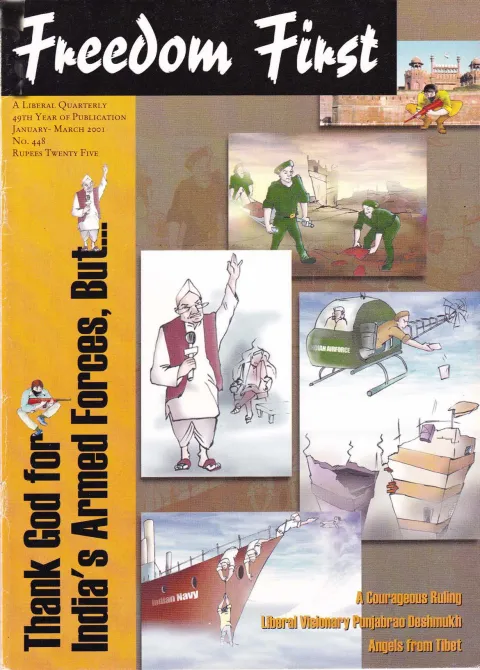
Freedom First
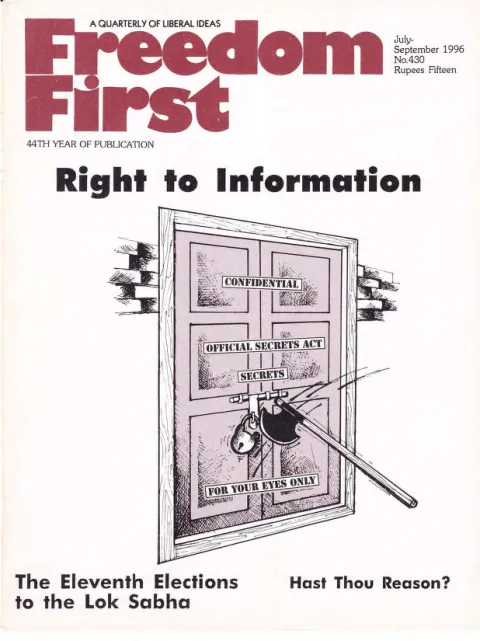
Right to Information
By S. P. Sathe, V. M. Tarkunde
Published by J. R. Patel for the Indian Committee for Cultural Freedom and printed by him at Kaiser-E-Hind Private Ltd., 300, Perin Nariman Street, Mumbai 400 001. · Mumbai · 1996
52 pages
Freedom First
Summary
This is the July-September 1996 issue (No. 430, 44th year of publication) of Freedom First, the Bombay-based quarterly of liberal ideas founded by Minoo Masani and edited by S. V. Raju. The cover feature, ‘Right to Information,’ anchors the issue: a cluster of essays by R. Srinivasan, S. P. Sathe, M. S. Srinivasan, and V. M. Tarkunde argue, from complementary angles (constitutional law, administrative practice, and democratic theory), that access to government information should be elevated to a fundamental right under the Indian Constitution, and that entrenched instruments like the Official Secrets Act, 1923 obstruct this. The editor’s note ties the theme to the recent Eleventh Lok Sabha elections and the end of one-party dominance, previews a seminar report on coalition politics, and apologises for recurring publication delays. In the rendered pages the issue also opens its regular satirical/miscellany features — ‘With Many Voices’ (a page of quoted extracts on Indian and world politics) and ‘Of Cabbages and Kings’ (a topical commentary column covering endocrine-disrupting chemicals, Saudi and Chinese human-rights issues, Aung San Suu Kyi’s Burma boycott call, and VIP security-culture critique in India).
Key points
-
The cover feature “Right to Information” anchors the issue: essays by R. Srinivasan, S. P. Sathe, M. S. Srinivasan and V. M. Tarkunde argue from constitutional, administrative and democratic-theory angles that access to government information should become a fundamental right, with the Official Secrets Act, 1923 identified as the chief obstacle.
-
R. Srinivasan’s “Towards an Open Government” cites James Madison’s warning that “a popular government without popular information…is but a prologue to a farce or a tragedy, or perhaps both” and surveys the US Freedom of Information Act, 1966 and comparable laws in Australia, Canada and Britain as models for a Union-level Indian FOI act.
-
S. P. Sathe’s “Access to Information: The Constitutional Position” traces information monopolies historically as tools of hegemony, analyses Supreme Court cases including the Judges Case and the LIC v. M. D. Shah ‘Yogakshema’ ruling, and concludes courts have treated the right to information only as collateral to free speech rather than a freestanding right, recommending a constitutional amendment and a Freedom of Information Act to supersede the Official Secrets Act.
-
M. S. Srinivasan’s “Right to Information” argues that withholding information from citizens amounts to a form of tyranny, cites the 1975 Emergency censorship as a cautionary precedent, and proposes state-subsidised information centres and a duty on media to present raw, factual information.
-
Justice V. M. Tarkunde’s “Right to Information and Accountability of the State” surveys M. N. Roy’s and Jayaprakash Narayan’s partyless-democracy ideas, credits public interest litigation and the National Human Rights Commission with extending accountability between elections, and calls for a comprehensive people’s-right-to-know statute modelled on the US Freedom of Information Reform Act, 1986, plus repeal of the Atomic Energy Act’s secrecy provisions.
-
The editor’s note ties the Right to Information theme to the recent Eleventh Lok Sabha elections and the end of one-party dominance, and previews a seminar report on coalition politics.
-
The regular “With Many Voices” column collects quoted extracts on Indian and world politics, while “Of Cabbages and Kings” covers endocrine-disrupting chemicals, the public beheading of an Indian expatriate in Saudi Arabia, Aung San Suu Kyi’s Burma boycott call, and a critique of India’s VIP security culture.
Essays
Many Voices
A short editorial-style feature (‘Many Voices’) is a compilation of quotations from Indian and international press on politics, secularism, and public figures — not a single-author essay but a curated page of extracts under the Tennyson epigraph ‘The deep moans round with many voices.’
- Quotes India Today, The Indian Express, The Times of India, and other outlets on the Ayodhya dispute, coalition politics, and the 1996 general election aftermath
- Includes remarks attributed to Laloo Prasad Yadav, CPM leader Namboodiripad, BJP leader K. R. Malkani, and Lok Sabha Speaker P. A. Sangma
- Touches on judicial activism, communalism, and Singapore’s rule of law under Lee Kuan Yew
Cabbages & Kings
‘Of Cabbages and Kings’ is the magazine’s recurring topical-commentary column, unsigned save initials ‘RS’ and ‘SVR’ on individual items, covering a miscellany of current-affairs observations: falling human sperm counts linked to environmental estrogens, the beheading of an Indian expatriate in a Saudi public execution, Hong Kong’s transition anxieties and Chinese Communist attitudes to democracy, Aung San Suu Kyi’s call for a foreign-investment boycott of Burma, and a critique of India’s VIP security culture (SPG costs, red-light convoys, and the Phoolan Devi train-halting episode).
- Opens with humorous Aldous Huxley verse on human fertility, segues into a serious item on endocrine-disrupting industrial chemicals and declining sperm counts
- Reports the public beheading of Indian citizen Manickam Ramalingam in Riyadh and questions the Indian Embassy’s diligence
- Notes Chinese Communist Party’s rejection of liberal democracy alongside concern for ‘a slice of China’s trade pie’
- Covers Aung San Suu Kyi’s appeal for foreign businesses to boycott investment in military-ruled Burma
- Criticises India’s VIP culture: red-light convoys, Shiv Sena’s Bal Thackeray threatening to strip ministers of perks, and the cost of Special Protection Group security (cited at Rs. 40 crores)
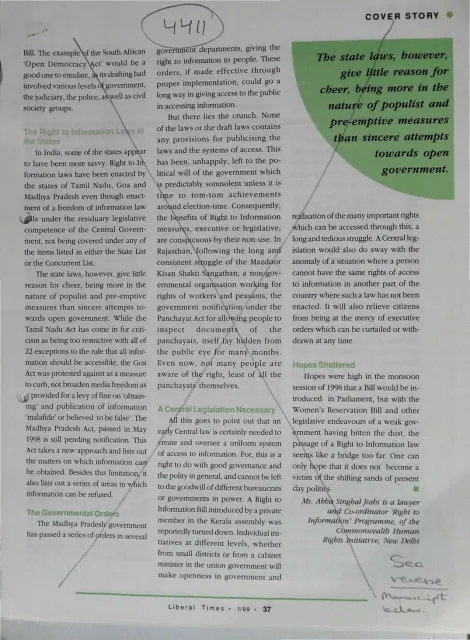
Towards an Open Government
By R. Srinivasan
R. Srinivasan’s ‘Towards an Open Government’ opens the Right to Information cover feature, framing government secrecy as a betrayal of nearly fifty years of Indian democracy. Drawing on James Madison and the U.S. Freedom of Information Act (1966), it surveys comparable transparency laws in Australia, Canada, and Britain, and critiques the weakness of India’s parliamentary oversight bodies (Lok Pal, Lok Ayukta, Public Accounts Committee) in curbing corruption. It closes by urging India to adopt a Union-level FOI act and extend transparency to municipal governance.
- Argues that oligarchic or plutocratic governments are inherently closed, while democracies should default to transparency
- Cites James Madison’s warning that ‘a popular government without popular information…is but a prologue to a farce or a tragedy, or perhaps both’
- Credits investigative journalists, in the absence of strong institutional checks, with exposing corrupt public dealings in India
- Describes the mechanics of the US Freedom of Information Act, 1966, including its ‘protected areas’ exemptions (personnel, medical, defence, trade secrets) and Justice Stewart’s Iran-Contra-era warning about over-classification
- Notes a draft transparency bill from the Consumer Education and Research Centre, Ahmedabad, and calls for similar Union and municipal-level Indian legislation
Access to Information: The Constitutional Position
By S. P. Sathe
S. P. Sathe’s ‘Access to Information: The Constitutional Position’ traces the historical link between information monopolies and social hegemony (from Roman Patricians to Brahminical control of religious knowledge), then conducts a close legal analysis of Indian Supreme Court jurisprudence on the right to information — including the Judges Case (S. P. Gupta v. India), the LIC v. M. D. Shah ‘Yogakshema’ case, and privacy-related rulings (Neera Mathur, Nishi Prem) — concluding that courts have treated the right to information only as collateral to freedom of speech (Article 19(1)(a)) rather than as a freestanding right. Sathe recommends a constitutional amendment making the right to information an explicit fundamental right, subject to enumerated reasonable restrictions, alongside a comprehensive Freedom of Information Act to supersede the Official Secrets Act, 1923.
- Frames information control historically as a tool of hegemony: Roman Patricians over Plebeians, Brahminical control of the Shudras and women, later colonial and imperial restriction
- Argues universal education (Article 45) is a precondition for a meaningful right to information, given mass illiteracy
- Analyses the LIC v. M. D. Shah ‘Yogakshema’ case in detail, questioning whether the Supreme Court’s ‘readers’ right to know’ rationale improperly overrode editorial freedom
- Reviews the Judges Case (S. P. Gupta v. India) as establishing the executive cannot withhold information except for narrowly justified confidentiality, subject to judicial review
- Recommends the right to information be made an explicit fundamental right, subject to restrictions for sovereignty/integrity, security, foreign relations, public order, decency, privacy, copyright, and contempt of court/legislature
- Calls for a comprehensive Freedom of Information Act (FOA) to replace the Official Secrets Act, 1923, whose Section 5 is described as ‘omnibus’ and prone to suppressing routine, non-sensitive documents
- Cites the Narmada Bachao andolan’s exclusion from Sardar Sarovar dam site information as a concrete instance of OSA misuse
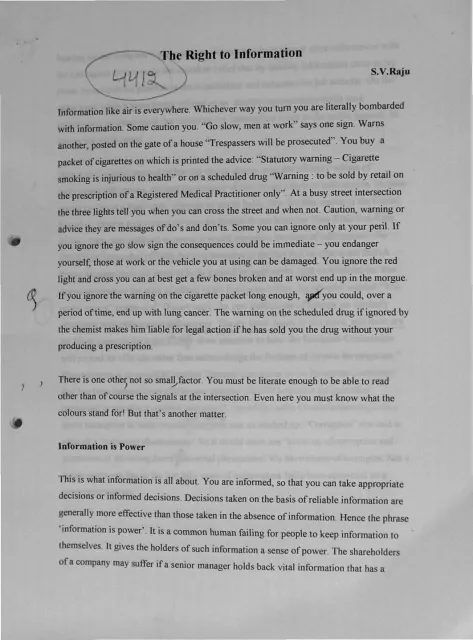
Right to Information
By M. S. Srinivasan
M. S. Srinivasan’s ‘Right to Information’ argues that democratic rule of law requires citizens to have full information about decisions that affect them, framing uninformed impositions by the state as a form of tyranny. It reviews Article 19(1) freedoms, contrasts India’s constitutional free-speech provision unfavourably with the American First Amendment, discusses the 1975 Emergency censorship as a cautionary precedent (quoting H. M. Seervai), and closes with concrete policy proposals: state-subsidised information centres, mandatory raw-data disclosure by media, and expanded library/communication infrastructure.
- Frames information as foundational to rational decision-making at every social level, from family to nation
- Quotes H. M. Seervai on the constitutional necessity of free speech and free press for democratic government
- Cites the 1975 Emergency’s press censorship as evidence of how governments can suppress information and erode freedoms
- Argues government has ‘simply reduced citizens to the status of dumb driven cattle’ by withholding information, likening this to a continuation of British-style imposition
- Recommends free/inexpensive government information centres in every state, subsidised information technology, and a duty on media to present ‘raw and factual information’ rather than editorialised coverage
Right to Information and Accountability of the State
By V. M. Tarkunde
Justice V. M. Tarkunde’s ‘Right to Information and Accountability of the State’ argues that governmental accountability need not be confined to election day even within India’s existing party-based parliamentary system. Tarkunde reviews M. N. Roy’s and Jayaprakash Narayan’s partyless-democracy and Gram Panchayat ideas as a deeper structural alternative, then identifies three concrete mechanisms that have, in practice, extended government accountability between elections: public interest litigation, the National Human Rights Commission, and (the article’s main proposal) a statutory ‘people’s right to know,’ modelled on the US Freedom of Information Reform Act, 1986. He calls for a comprehensive Indian access-to-information law, flags the Atomic Energy Act’s Section 18 secrecy provision for repeal, and welcomes the Press Council of India’s move to draft a ‘Bill for Access to Information.’
- Opens by noting representative democracy gives citizens power only ‘on the day of voting’ and is otherwise ‘essentially weak and superficial,’ vulnerable to overthrow (citing Hitler in 1933 and the 1975 Indian Emergency)
- Surveys M. N. Roy’s and Jayaprakash Narayan’s advocacy of partyless democracy built on people’s committees/Gram Panchayats as a radical decentralisation alternative to party rule
- Credits public interest litigation (from the late 1960s-70s in the US/UK, adopted enthusiastically by the Indian Supreme Court) with letting any genuinely interested party seek redress for others’ wrongs
- Credits the National Human Rights Commission, despite restricted powers, with usefully increasing state transparency and accountability
- Calls the U.S. Freedom of Information Reform Act, 1986 a model, and recommends India pass a comprehensive people’s-right-to-know statute
- Singles out Section 18 of the Atomic Energy Act, 1962 (barring disclosure about nuclear plants) for full repeal as incompatible with public safety needs
- Notes the Press Council of India is organising a seminar dedicated to drafting a ‘Bill for Access to Information’
Generated by the v1.5 extraction pipeline. Awaiting editorial review.
Metadata and summary are AI-extracted from the source PDF and reviewed for editorial accuracy. The original work is available via the Read PDF tab above (where present); paragraph-level citation inside the PDF is deferred to a future engagement.