periodical issue
Freedom First
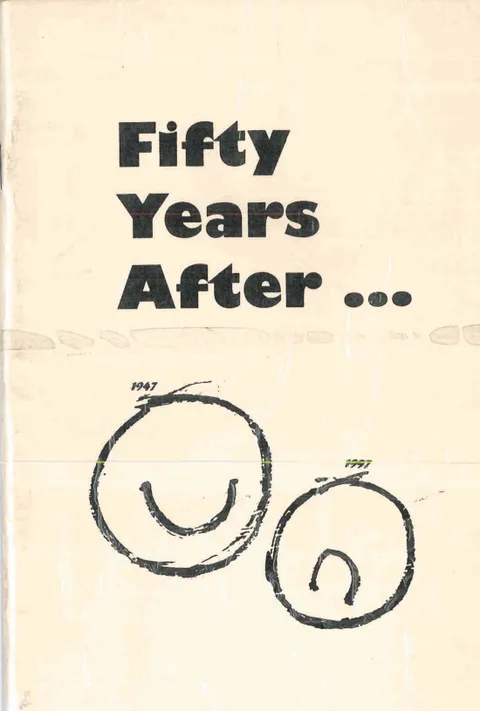
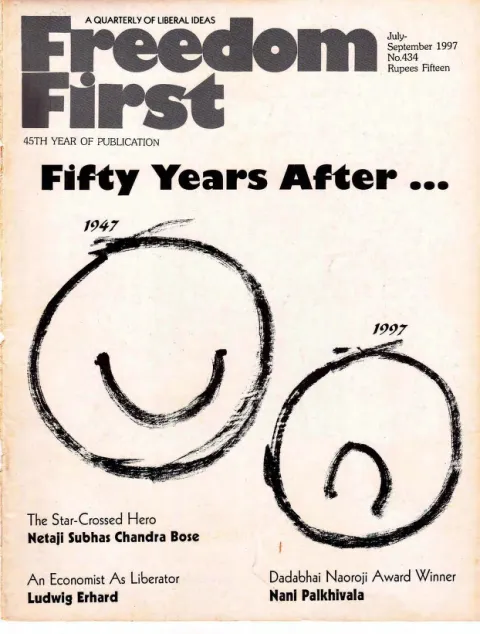
Fifty Years After ...
By Sadanand Varde, Indumati Parikh, Jiban Mukhopadhyay, M. R. Pai, Siegfried Herzog
Published by J. R. Patel for the Indian Committee for Cultural Freedom and printed by him at Kaiser-E-Hind Private Ltd., 300, Perin Nariman Street, Mumbai 400 001. · Mumbai · 1997
52 pages
Freedom First
Summary
Freedom First No. 434 (July-September 1997) is the golden-jubilee issue of this Bombay liberal quarterly, published in its 45th year. The cover story, “Fifty Years After…”, reprints presentations from a day-long seminar held in April 1997 by the Project for Economic Education, in which panelists take stock of fifty years of Indian independence with a marked lack of celebratory tone. In the rendered pages, Sadanand Varde argues that the freedom generation’s vision of accountable, dutiful self-government has curdled into a scramble for rights without responsibility; Indumati Parikh contends that formal freedom from British rule was never matched by a social revolution against caste and gender hierarchy, leaving mass illiteracy and neglected women’s health as the real unfinished business; and Jiban K. Mukhopadhyay lays out a statistical balance sheet of fifty years of centralised planning and public-sector dominance, concluding with an explicit India-China comparison that finds India lagging on growth, literacy, and infrastructure. The issue’s regular editorial and miscellany sections (“Between Ourselves”, “With Many Voices”, “Of Cabbages and Kings”) frame the golden jubilee against contemporary preoccupations: the state of founder Minoo Masani’s health, tributes to Dadabhai Naoroji award winner Nani Palkhivala, and press commentary on corruption, human rights abuses, and Tibet.
Key points
-
The golden-jubilee cover story “Fifty Years After…” reprints a Project for Economic Education seminar taking stock of fifty years of Indian independence with a marked lack of celebratory tone.
-
Sadanand Varde questions the moral authority of the “freedom fighter” label given how many holders have since been implicated in corruption, quoting Achyut Patwardhan’s despairing verdict that neither British departure nor socialism delivered on freedom’s promise, and arguing development has bypassed the majority the freedom struggle claimed to serve.
-
Indumati Parikh argues formal political freedom in 1947 was never matched by a social revolution against caste and gender hierarchy, citing declining female-to-male sex ratios and persistent mass illiteracy as evidence that Phule’s and Ranade’s nineteenth-century reform demands remain unmet.
-
Jiban K. Mukhopadhyay lays out a statistical balance sheet of fifty years of centralised planning, citing the “Hindu rate of growth” of 1.5% annual per-capita GDP growth from 1950-79, a loss-making public sector, and a stark India-China comparison on growth, literacy and foreign investment that finds India lagging.
-
The issue’s regular editorial and miscellany sections frame the golden jubilee against contemporary concerns including founder Minoo Masani’s health and tributes to Dadabhai Naoroji award winner Nani Palkhivala.
Essays
Many Voices
Sadanand Varde, a former Maharashtra education minister and freedom-struggle participant, reflects on his discomfort with the label ‘freedom fighter’ given how many holders of that title have since been implicated in corruption. In the rendered pages he recalls the idealism of the 1942 Quit India movement and contrasts it with today’s disillusioned survivors, quoting Achyut Patwardhan’s confession that he no longer believes either British departure or socialism delivered on freedom’s promise. Varde surveys fifty years of development (industry, railways, education) but argues it bypassed the majority for whom 1942’s promises were made, closing (in the visible portion) with reflections on Gandhi’s frugality being invoked ironically in a shoe advertisement and later with a critical letter exchange over the ‘Freedom Run’/Dandi March commemorations.
- Varde questions the moral authority of the ‘freedom fighter’ designation given corruption among some who held it.
- He recalls the 1942 Quit India ‘Do or Die’ resolution’s vision of power belonging to toilers, contrasted with present-day reality.
- He quotes Achyut Patwardhan’s despairing assessment that both the hope for British departure and the hope for socialism proved false, and that the State has ‘lost all moral authority’.
- He argues development has occurred (railways, education, industry) but has bypassed the majority the freedom struggle claimed to serve.
- He criticises the commercial use of Gandhian imagery (a shoe advertisement using a Gandhi photograph) as ironic given the anti-materialist ideals of the freedom generation.
- He closes with a 1988 letter exchange about a ‘Freedom Run’/Dandi March commemoration, arguing that pseudo-heroic gestures trivialise the original salt march.
Of Cabbages & Kings
Dr. Indumati Parikh, a physician and grassroots development worker, argues in the rendered pages that formal political freedom in 1947 was never accompanied by the social revolution needed to dismantle caste and gender hierarchy, and that this omission explains persistent mass illiteracy, poor women’s health, and weak primary education fifty years on. She cites M. N. Roy’s definition of freedom as the continuous removal of impediments to human development, invokes Phule’s and Ranade’s nineteenth-century reform programmes as unfinished business, and closes by describing India’s poor primary healthcare infrastructure and the need for non-formal, dignity-based education.
- Parikh argues freedom was never defined in terms of ordinary people’s lives, remaining a slogan (‘let the British go’) rather than a lived reality.
- She invokes M. N. Roy’s definition of freedom as the continuous removal of impediments to the development of human beings.
- She presents data on declining female-to-male sex ratios (971 per 1000 in 1901 down to 927) and stubborn illiteracy (71% of women illiterate by her count versus the government’s 56% figure).
- She credits Phule’s Satya Dharma Katha and Ranade’s thirty-two/thirty-three point reform programmes as having anticipated demands such as gender equality and human rights that India still has not achieved.
- She argues that unless a social revolution against caste and patriarchy precedes or accompanies political and economic reform, India will make no more progress in the next fifty years than in the last.
- She describes poorly staffed, poorly used primary health centres and the need for health education, and calls for non-formal, dignity-based education for the illiterate rather than more slogans.
Is This the Freedom We Fought For?
By Sadanand Varde
Jiban K. Mukhopadhyay, an economist and editor of the Statistical Outline of India, lays out a data-driven balance sheet of fifty years of Indian economic development: modest per-capita GDP growth under planning (1.5% real per-capita growth 1950-79, rising to 4.2%+ in the 1990s), a bloated and loss-making public sector protected under the 1956 Industrial Policy Resolution’s ‘commanding heights’ schedules, chronic underinvestment and technical losses in power and railways, and administered pricing distortions in petroleum. He closes the rendered portion with a stark India-China comparison across GDP, literacy, infant mortality, foreign investment, and purchasing power parity, concluding that India retains a 7%+ growth potential but gives only an ‘80-20 chance’ of the political system allowing that potential to be realised.
- India’s per-capita real GDP growth was only about 1.5% annually between 1950 and 1979 (the ‘Hindu rate of growth’), rising to roughly 4.2% by 1992-97.
- The 1956 Industrial Policy Resolution reserved core ‘commanding heights’ industries for the public sector, assigning private enterprise a residual role; specific firms (Tata Airlines, TISCO) were nationalised or blocked from expansion by policy.
- Public-sector investment of roughly Rs. 400,000 crores yielded returns of only about 1.5% excluding oil companies, which Mukhopadhyay calls a ‘financial blackhole’.
- State Electricity Boards’ combined rate of return was minus 17.7% in 1996-97, driven by subsidised power pricing and non-payment by government-linked consumers.
- Railways added only 9,300 route km over fifty years (about 186 km/year) despite being India’s largest employer, with over 40% of railway revenue spent on salaries and pensions.
- A direct India-China comparison shows China ahead on per-capita GNP, foreign direct investment ($37.5bn vs $1.75bn), literacy, infant mortality, and purchasing power parity, which Mukhopadhyay attributes partly to China’s market-oriented agricultural reforms.
- He assigns an ‘one Return Potato Chip to Mumbai’ 80-20 chance that India’s political economy will allow the country’s 7%+ growth potential to be realised, blaming layers of middlemen and bureaucrats for eating into social-sector allocations.
Generated by the v1.5 extraction pipeline. Awaiting editorial review.
Metadata and summary are AI-extracted from the source PDF and reviewed for editorial accuracy. The original work is available via the Read PDF tab above (where present); paragraph-level citation inside the PDF is deferred to a future engagement.