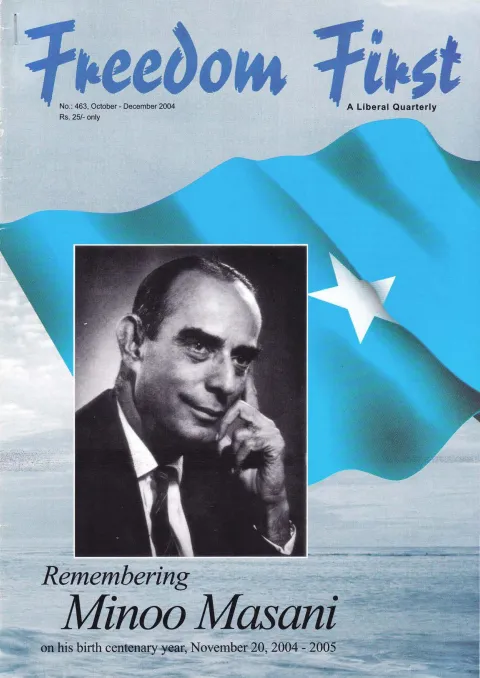
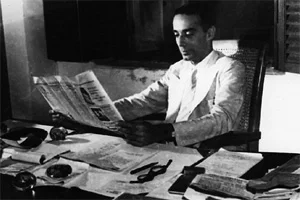
periodical issue
Freedom First
A Quarterly of Liberal Ideas
By Minoo Masani
Published by J. R. Patel for the Indian Committee for Cultural Freedom and printed by him at Kaiser-E-Hind Private Ltd., 300, Perin Nariman Street, Mumbai 400 001 · Mumbai · 1998
60 pages
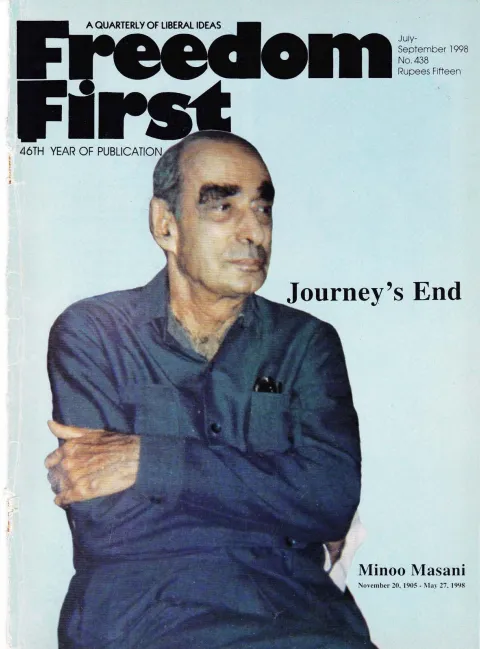
Freedom First
Summary
This is issue No. 438 (July–September 1998) of Freedom First, the Bombay-based quarterly of liberal ideas, published in its 46th year. The issue is dominated by a memorial tribute section, ‘Minoo Masani – Journey’s End,’ marking the death of the magazine’s founder and long-time editor on May 27, 1998, at age 92. It opens with a poem by Dr. Louella Lobo Prabhu, followed by S. V. Raju’s biographical obituary ‘The Quintessential Dissenter’ tracing Masani’s path from Congress Socialist Party leader and disillusioned admirer of the Soviet Union to co-founder of the Swatantra Party and champion of a free economy, and a condensed record of tributes paid at a June 12, 1998 condolence meeting in Mumbai by figures including Arvind Deshpande, N. A. Palkhivala, Navroz Seervai, Naozer Aga, Yogesh Kamdar, S. V. Raju, and Masani’s son Zareer Masani. The editor’s note (‘Between Ourselves’) explains that the issue reprints three previously published Masani pieces as a fuller testament to his beliefs: ‘I Believe’ (a personal credo on humanism, freedom, and stoicism), a 1934 dialogue between Gandhi and Masani on socialism (recorded by K. R. Malkani), and an essay on liberalism. The rendered pages also reach the start of a second major section, a symposium of four articles on the ethics and politics of India’s May 1998 Pokhran-II nuclear tests, which the editor’s note says the magazine condemns despite running dissenting pro-test pieces.
Key points
-
The issue is dominated by a memorial tribute, “Minoo Masani - Journey’s End”, marking the founder’s death on May 27, 1998, at age 92, opening with a poem by Dr. Louella Lobo Prabhu eulogising him as a fearless dissenter unafraid of being “a minority of one”.
-
S. V. Raju’s obituary “The Quintessential Dissenter” traces Masani’s arc from Congress Socialist Party leader disillusioned with Soviet communism to co-founder of the Swatantra Party, Lok Sabha opposition leader, and Emergency-era editor of Freedom First who fought censorship in court.
-
A condensed record of tributes from a June 12, 1998 condolence meeting includes N. A. Palkhivala praising Masani’s Constituent Assembly membership and advocacy for deregulation, and Masani’s son Zareer Masani giving a frank tribute describing his father’s impatience and total refusal to compromise principle for office.
-
A reprinted personal credo, “I Believe”, lays out Masani’s humanism grounded in the “Brotherhood of Man” independent of religious belief, his rejection of chauvinism, and his debt to Stoic philosophy, particularly Marcus Aurelius, for resisting unpopularity.
-
A transcript recorded by K. R. Malkani of a 1934 conversation between Gandhi and Masani has Gandhi arguing that a socialist programme imposed by a minority amounts to violence if the majority lacks genuine desire for it, while Masani counters that land nationalisation is intelligible and acceptable to ordinary peasants.
-
The rendered pages also open a symposium of four articles on the ethics and politics of India’s May 1998 Pokhran-II nuclear tests, which the editor’s note says the magazine condemns despite running dissenting pro-test pieces for balance.
Essays
Between Ourselves
An unsigned editorial note (‘Between Ourselves’) announces Minoo Masani’s death on May 27, 1998, and reflects on Freedom First’s founding mission in 1952 to ‘combat communist subversion among the intelligentsia’ with Sardar Patel’s encouragement, and its 1985 conversion into a quarterly of liberal values. It notes the English-language press gave Masani’s death little attention compared to language papers, previews the memorial section’s condolence-meeting report and three reprinted articles, and states the magazine ‘condemns unequivocally’ the Pokhran II tests despite carrying four pro-test articles for balance.
- Confirms Minoo Masani died May 27, 1998, aged 92
- States Freedom First’s 1952 founding mission was to counter communist influence, with Sardar Patel’s support
- Notes the magazine became a quarterly of liberal values in 1985 after the Soviet Union’s decline
- Records that English-language papers under-covered Masani’s death versus the vernacular press
- Previews reprinted Masani pieces: a personal credo, the 1934 Gandhi dialogue, and an essay on liberalism
- States the magazine opposes the Pokhran II nuclear tests but publishes dissenting pro-test articles for balance
Many Voices
A poem, ‘In Remembrance of My Friend and Mentor Minoo Masani,’ by Dr. Louella Lobo Prabhu, opening the memorial section. It eulogizes Masani as a fearless dissenter unafraid of being ‘a minority of one,’ credits the Swatantra Party’s free-market philosophy with having quietly shaped later economic policy despite the party’s dissolution, laments that his death drew little public ceremony compared to the ‘feckless heirs of Dynasty,’ and closes with a direct address bidding him rest.
- Frames Masani as someone unafraid of ‘intellectual strife’ and being ‘in a minority of one’
- Credits the Swatantra Party’s philosophy with being vindicated by later governments’ retreat from state control
- Notes the lack of public/state honours at his death, contrasted with dynastic political figures
- Personal, elegiac register from a friend and self-described admirer of his humanism
The Quintessential Dissenter
By S. V. Raju
S. V. Raju’s obituary essay ‘The Quintessential Dissenter’ gives a full biographical arc of Minoo Masani: his early life and education (Elphinstone College, LSE, Lincoln’s Inn), his 1930s imprisonment as a satyagrahi, his role in founding the Congress Socialist Party with Jayaprakash Narayan and others, his disillusionment with Soviet communism and resignation from the CSP alongside Ram Manohar Lohia and Achyut Patwardhan, his founding of the Democratic Research Service and Indian Committee for Cultural Freedom to counter communist influence, his 1957 election to the Lok Sabha, his 1959 co-founding of the Swatantra Party with C. Rajagopalachari, his chairing of the Public Accounts Committee, his opposition to the Goa ‘liberation’ and to the abolition of Privy Purses, his 1972 return to edit Freedom First and fight Emergency-era censorship, his later Minorities Commission chairmanship and resignation, his founding of the Leslie Sawhny Programme and the Society for the Right to Die with Dignity, and his authorship of books from Our India to the autobiography Against the Tide / We Indians. Raju closes by calling him ‘the quintessential dissenter.’
- Traces Masani from CSP socialist and Comintern critic to Swatantra Party co-founder and Lok Sabha leader of the opposition (1957-1971)
- Describes his founding of the Democratic Research Service and Indian Committee for Cultural Freedom to combat communist infiltration, with Sardar Patel’s backing
- Notes Swatantra Party grew to 44 MPs by 1967 under his organisational leadership, then collapsed in the 1971 ‘Indira wave’
- Covers his 1972-return editorship of Freedom First and his court fight against Emergency censorship (the ‘Freedom First case’)
- Lists later-life institution-building: Minorities Commission chairmanship (resigned over principle), Leslie Sawhny Programme (1968), Project for Economic Education (1985), Society for the Right to Die with Dignity
- Lists his major publications including Our India, Socialism Reconsidered, Plea for a Mixed Economy, and the two-volume autobiography Against the Tide / We Indians
Tributes to a Lover of Freedom & Individual Liberty
A condensed record of tributes delivered at a condolence meeting held in Mumbai on June 12, 1998, chaired by freedom fighter and Gandhian Dr. Usha Mehta, with more than twenty co-sponsoring organisations listed (including the Forum of Free Enterprise, Indian Committee for Cultural Freedom, and Freedom First itself). Speakers excerpted include Arvind Deshpande (thirty years’ colleague, reading condolence letters from figures such as Manmohan Singh, B. K. Nehru, and Justice H. R. Khanna, and recounting Masani’s shift from socialism to admiration for Sardar Patel’s policies), N. A. Palkhivala (calling him one of India’s noblest sons and a Constituent Assembly member, praising his integrity, championing of deregulation, and belief in India’s talented workforce despite low ‘wisdom’/buddhi), Navroz Seervai (on his refusal of a parliamentary ticket at 72, his rigid punctuality, and fearlessness before unpopular causes), Naozer Aga (recalling J. R. D. Tata’s remark that Masani was ‘way ahead of his time’), Yogesh Kamdar (on his discipline, bluntness, and intellectual honesty in publicly repudiating his own earlier views), S. V. Raju (on Masani as an exacting mentor and stickler for correct English), and Zareer Masani, his son, who candidly discussed his father’s impatience and intolerance of inefficiency alongside his refusal to compromise principle for political office, closing on his rejection of populism and his self-styled role as a dissenting voice (his autobiography being titled Against the Tide).
- Condolence meeting held June 12, 1998, in Mumbai, chaired by Dr. Usha Mehta, with over twenty co-sponsoring liberal and civic organisations
- Arvind Deshpande read condolence messages from Manmohan Singh, B. K. Nehru, Justice H. R. Khanna, P. G. Mavalankar, and Dr. Freddie Mehta
- N. A. Palkhivala praised Masani’s Constituent Assembly membership, integrity, and advocacy for deregulation, quoting Sir William Ryrie on India’s entrepreneurial talent
- Navroz Seervai recounted Masani declining a 1977 parliamentary candidacy at age 72, citing his own rigid punctuality and fearlessness
- Zareer Masani gave a frank, unsentimental filial tribute describing his father’s impatience, intolerance of inefficiency, and total refusal to compromise principle for office
- Speakers repeatedly framed Masani as a principled ‘dissenter’ who never held ministerial office despite influence
I Believe
By Minoo Masani
Note: the byline in the table of contents reads ‘Minoo Masani’ for the essay ‘I Believe,’ credited in the rendered text to ‘M. R. Masani.’ It is a first-person credo essay in which Masani lays out his personal philosophy: a humanism grounded in the ‘Brotherhood of Man’ independent of religious belief, a rejection of moral relativism toward different nations’ social outcomes, opposition to chauvinism and xenophobia in an interconnected world, a utilitarian-leaning ethics of balancing happiness against unhappiness, and an avowed debt to Stoic philosophy (particularly Marcus Aurelius) for cultivating truth-telling resistance to unpopularity.
- Grounds the ‘Brotherhood of Man’ in universal human nature rather than religious faith
- Argues human beings everywhere respond to the same incentives, rejecting claims that a country’s poor outcomes reflect something unique about its people
- Frames chauvinism and xenophobia as ‘as reactionary as racism’ in an interconnected, post-space-age world
- Describes a personal ethics based on maximizing the balance of happiness over unhappiness
- Cites Stoic philosophy, especially the Meditations of Marcus Aurelius, as the source of his resilience against unpopularity and pressure to conform
Gandhiji & Masani in a dialogue on Socialism
By M. R. Pai
A transcript, recorded by Prof. K. R. Malkani, of a 1934 conversation between Mahatma Gandhi and Minoo Masani during Gandhi’s walking tour of Orissa, in which the two debate whether socialism is inherently coercive. Gandhi argues that a socialist programme imposed by a minority, however well-intentioned, amounts to violence if the majority lacks genuine desire for it, and that peasants in Orissa or Gujarat cannot grasp abstractions like ‘nationalisation of industry.’ Masani counters that coercion used for the good of the many is different in kind, and that at least land nationalisation is intelligible to Gujarati or Deccani peasants; Gandhi responds with an anecdote about Gujarati peasants defending their village Bania as a benefactor, arguing such attitudes must first be ‘awakened’ rather than assumed away.
- Recorded during Gandhi’s May 25, 1934 walking tour from Sisua to Patpur, Orissa, with K. R. Malkani present
- Gandhi frames socialism as founded on coercion even where the coercion is not physical
- Gandhi argues a reform imposed by a determined minority (5 of 100) without the desire of the remaining majority cannot guarantee a better outcome
- Masani argues land nationalisation, unlike industrial nationalisation, is intelligible and acceptable to ordinary Gujarati or Deccani peasants
- Gandhi counters with an example of Gujarati peasants defending the traditional Bania moneylender, arguing peasant consciousness must be ‘awakened,’ not presumed
Generated by the v1.5 extraction pipeline. Awaiting editorial review.
The Big Bang
By Minoo Masani
No summary was extracted for this article. Listed for completeness.
Metadata and summary are AI-extracted from the source PDF and reviewed for editorial accuracy. The original work is available via the Read PDF tab above (where present); paragraph-level citation inside the PDF is deferred to a future engagement.