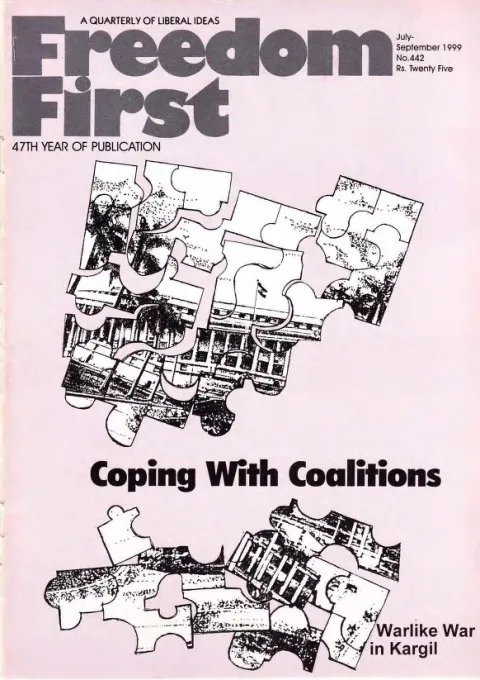
periodical issue
Freedom First
Are the Armed Forces being Politicised?
Indian Committee for Cultural Freedom, 3rd Floor, Army & Navy Building, 148, Mahatma Gandhi Road, Mumbai 400 001. Published by J. R. Patel for the Indian Committee for Cultural Freedom and printed by him at Kaiser-E-Hind Private Ltd., 300, Perin Nariman Street, Mumbai 400 001. · Mumbai · 1999
52 pages
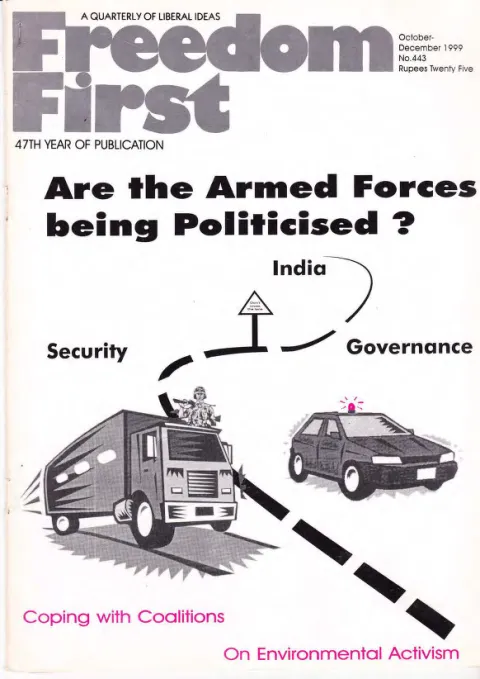
Freedom First
Summary
This is the October–December 1999 issue (No. 443, 47th year of publication) of Freedom First, the Bombay-based quarterly of liberal ideas published by the Indian Committee for Cultural Freedom, edited by S. V. Raju. The issue’s cover package asks ‘Are the Armed Forces Being Politicised?’, opened by Major General (Retd.) E. D’Souza’s essay ‘A Storm Warning’, which traces the Indian Army’s tradition of political neutrality from Field Marshal Cariappa onward and warns against creeping political interference in senior appointments, alongside pieces by Brigadier N. B. Grant (‘Medals of Honour’) and Mr. Prem Vaidya (‘A Tribute to our Brave Fighting Men’). A second thematic cluster, ‘Coping with Coalitions’, assembles several short essays (by Professor S. V. Kogekar, Sisir K. Dhar, Dr. P. R. Dubhashi, and Dr. Gerhart Raichle) debating whether India should adopt a presidential system or other constitutional devices to produce stable governments, prompted by the era’s coalition instability. The issue also carries the regular ‘With Many Voices’ and ‘Of Cabbages and Kings’ opinion-roundup columns, an editorial (‘Between Ourselves’) explaining the postponement of a planned cover story on ‘The Maturing of Indian Democracy’ to the next issue (to coincide with the Constitution’s 50th anniversary), R. Srinivasan’s essay on the history and fragility of libraries (‘Alzheimer in the Nation’s Brain’), and J. B. D’Souza’s obituary tribute to Pesi Masani (Minoo Masani’s brother). Further sections on environmental activism and other topics (per the table of contents) extend beyond the rendered pages.
Key points
-
The cover package “Are the Armed Forces being Politicised?” opens with Major General (Retd.) E. D’Souza’s “A Storm Warning”, which traces the Army’s tradition of political neutrality from Field Marshal Cariappa onward and warns against creeping political interference, citing General Thimayya’s near-resignation and the non-appointment of Lieutenant General P. S. Bhagat as troubling precedents.
-
A second cluster, “Coping with Coalitions”, debates whether India should adopt a presidential system tailored to its federal diversity, with P. R. Dubhashi’s contribution noting only Congress governments have completed full terms since independence and recalling Gandhi’s advice, unheeded by Nehru, that Congress should disband after independence.
-
R. Srinivasan’s “Alzheimer in the Nation’s Brain” surveys the long history of libraries as repositories of collective memory, from ancient Mesopotamian archives through the burning of the Library of Alexandria to the 1998 destruction of a research centre in Guinea-Bissau’s civil war.
-
J. B. D’Souza’s obituary tribute to Pesi Masani, Minoo Masani’s mathematician brother who died in Pittsburgh in October 1999, recalls their shared boyhood and Pesi’s quiet decades-long support of a homeless-women’s charity.
-
The regular “With Many Voices” and “Of Cabbages and Kings” columns compile press quotations on the Kargil war and Pakistan coup, and satirise VIP security disruptions alongside a critical comment on the Pope’s 1999 visit to India.
Essays
Many Voices
The magazine’s recurring ‘With Many Voices’ column, a compilation of pointed quotations clipped from the Indian and international press over August-November 1999, covering topics from Kargil war deaths and coalition politics to the Pakistan coup and the millennium population milestone.
- Opens with a Tennyson epigraph framing the column as a chorus of contemporary voices
- Quotes span Indian dailies (Times of India, The Statesman, The Hindu, Mid-Day) and international commentary
- Includes a U.S. senator’s comment describing Pakistan’s 1999 military takeover as a coup
- Includes commentary on Indian electoral politics, population growth, and disaster management
Of Cabbages & Kings
The ‘Of Cabbages and Kings’ column takes up two items: a reader’s satirical complaint about VIP security disruptions during visits by Prime Minister Vajpayee and Congress leader Sonia Gandhi in Patna and Delhi, and a critical comment on the controversy over the Pope’s 1999 visit to India and the Vatican document ‘Ecclesia in Asia’, alongside a note on a Mercedes purchase for the Maharashtra Governor and a reader letter on the Pakistan coup.
- Satirizes VIP security culture disrupting ordinary citizens’ lives during visits by top politicians
- Criticizes the ‘lunatic fringe’ opposing the Pope’s visit while also questioning the wisdom of proselytizing language in ‘Ecclesia in Asia’
- Cites a 1966 Rajaji anecdote about German Chancellor Erhard being denied a new car by his own audit office, contrasted with a lavish Mercedes gifted to the Maharashtra Governor
- Includes a Pakistani reader’s letter reflecting on secularism and humanism after the 1999 coup
Alzheimer in the Nation’s Brain
By Dr. R. Srinivasan
R. Srinivasan’s essay ‘Alzheimer in the Nation’s Brain’ (title from a Ted Hughes epigraph) surveys the long history of libraries as repositories of collective memory, from oral traditions and ancient Mesopotamian and Egyptian archives through the deliberate destruction of libraries by conquerors (Shih Huang Ti, the burning of the Library of Alexandria under Caliph Umar) and modern wars and civil conflicts, including the 1998 Guinea-Bissau civil war’s destruction of a research centre. It closes noting a proposal to build a new monumental library at Alexandria.
- Traces library preservation from Mesopotamian/Egyptian tablets to living oral-tradition ‘human libraries’ in Africa and India’s Suta caste
- Describes the Chinese emperor Shih Huang Ti’s destruction of the Imperial Library (BC 221) as the archetypal act of politically motivated memory erasure
- Recounts Caliph Umar’s reported justification for burning the Library of Alexandria in 642 AD
- Cites the 1998 Guinea-Bissau civil war’s destruction of a fifteen-year research archive as a modern instance of loss
- Notes a contemporary proposal to build a new international library at Alexandria
- Appends ‘Gateways to Knowledge’, extracted IFLA principles on library neutrality and freedom from censorship
A Storm Warning
Major General (Retd.) E. D’Souza’s cover essay ‘A Storm Warning’ argues that India’s armed forces, especially the Army, have historically remained apolitical and secular thanks to the precedent set by Field Marshal Cariappa, but warns that recent incidents show this norm is at risk of political erosion. In the rendered pages, D’Souza recounts the 1962 Krishna Menon-era interference (crediting Prem Vaidya’s account in the prior Freedom First issue), General Thimayya’s near-resignation, and two further incidents — the non-appointment of Lieutenant General P. S. Bhagat and the appointment of General Vaidya — as episodes that risked politicizing senior command decisions.
- Frames the armed forces’ apolitical, secular character as a fragile legacy established by Field Marshal Cariappa after Partition
- Identifies 1962 (the Krishna Menon period) as the genesis of political interference in Army affairs
- Recounts General Thimayya’s tendered resignation over bureaucratic/political interference, later withdrawn at Nehru’s urging
- Cites Prem Vaidya’s account (Freedom First, July-September 1999) as a key source on the episode
- Flags the non-appointment of Lt. Gen. P. S. Bhagat as a further troubling precedent
- Calls on the next government to actively prevent politicization of the military
Are the Armed Forces being Politicised? - A Storm Warning
By Major General(Retd.) E. D’Souza
J. B. D’Souza’s obituary tribute to Pesi Masani, Minoo Masani’s younger brother, who died in Pittsburgh on 18 October 1999 after a career as a mathematician at Pittsburgh University and the Institute of Science, Bombay. The piece recalls their shared boyhood at Versova, Pesi’s growing academic reputation in mathematics and philosophy, his late-life turn toward religious and Christian doctrine, and closes with an anecdote about a homeless-women’s charity that Pesi had quietly supported with annual $3000 gifts.
- Pesi Masani died in Pittsburgh on 18 October 1999 after decades on the Mathematics faculty there
- He and the author were childhood friends and swimming companions at Seven Bungalows, Versova, near Dadabhai Naoroji’s house
- He built an international reputation in mathematics and philosophy, and had written on ‘peccatores’ (sinning administrators) and democratic corruption
- In later years he developed an intense, unaccountable-seeming regard for Christian doctrine, a shift the author found hard to reconcile with Pesi’s earlier secular life
- He anonymously donated $3000 annually to a charity serving homeless women in Bombay
- His father, Sir Rustom Masani, had been Bombay’s Municipal Commissioner
Medals of Honour
By Brigadier N. B. Grant
No summary was extracted for this article. Listed for completeness.
A Tribute to our Brave Fighting Men
By Mr. Prem Vaidya
Under the ‘Coping with Coalitions’ banner, this cluster of short essays debates constitutional remedies for India’s post-1989 coalition instability. In the rendered pages, Professor S. V. Kogekar and Sisir K. Dhar argue for or discuss a presidential system tailored to Indian federalism, while Dr. P. R. Dubhashi’s ‘In Search of Stable Governments’ reviews the Congress party’s claim to uniquely deliver stability, quotes BJP leaders Vajpayee and Kushabhau Thakre on coalition politics, and revisits Gandhi’s advice that the Congress disband after independence.
- Argues India’s presidential system, if adopted, need not copy the American model and could be adapted to Indian federal diversity
- Contends that removing legislators’ ‘king-making’ power in choosing the executive would reduce electoral ‘villainy and vulgarity’
- Dubhashi’s essay notes Congress’s claim that only its own governments have completed full terms since independence, while all non-Congress governments (Janata 1977, Charan Singh, V. P. Singh, UDF 1996-97, BJP coalition 1998-99) fell short
- Cites Vajpayee’s and Kushabhau Thakre’s 1999 statements that even a BJP majority government would still seek coalition partners
- Recalls Gandhiji’s advice that the Congress should be wound up after achieving independence, an advice Nehru did not follow
- Frames Congress’s 17 years of stable government under Nehru as historically exceptional, with parallels only to Japan’s Liberal Party
Generated by the v1.5 extraction pipeline. Awaiting editorial review.
Metadata and summary are AI-extracted from the source PDF and reviewed for editorial accuracy. The original work is available via the Read PDF tab above (where present); paragraph-level citation inside the PDF is deferred to a future engagement.