periodical issue
Freedom First
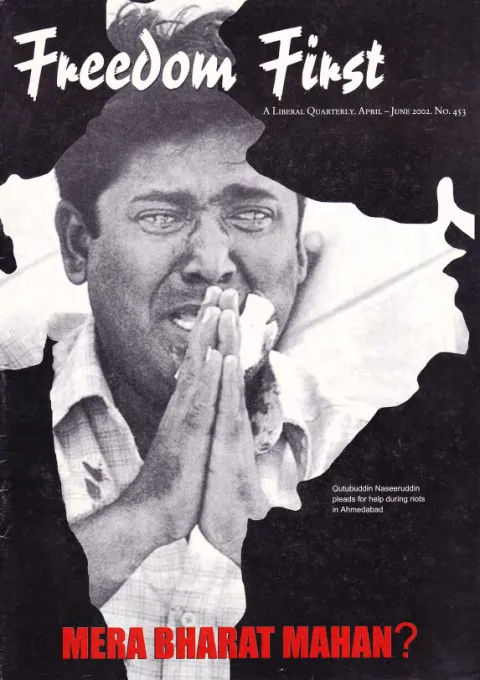
Mera Bharat Mahan?
Published by J. R. Patel for the Indian Committee for Cultural Freedom and printed by him at Kaiser-E-Hind Private Ltd., 300, Perin Nariman Street, Mumbai 400 001. · Mumbai · 2002
64 pages
Freedom First
Summary
This is Freedom First No. 453 (April–June 2002), a special issue of the liberal quarterly devoted almost entirely to the 2002 Gujarat riots, under the cover theme “Mera Bharat Mahan?” (My India is Great?). The issue opens with a dedication to “Geetaben,” a Hindu woman killed in Ahmedabad for helping a Muslim man escape a mob, quoting Siddharth Varadarajan’s Times of India report, and a cover photo (credited to Reuters) of a frightened man pleading for help during the Ahmedabad riots. In the rendered pages, editor S. V. Raju’s editorial argues Freedom First does not call for Narendra Modi’s removal as Gujarat chief minister despite the state’s failure of law and order, instead framing the BJP as a front controlled by the RSS and calling the Gujarat violence a ‘pogrom’ bordering on genocide. Kusum Choppra’s “Gujarat: The Beginning of the End?” narrates the Godhra train burning and the subsequent three-phase communal violence in visceral detail, coining the phrase ‘Jehadi Hindus’ for Hindutva foot soldiers. Nagindas Sanghavi’s “In the Grip of a Frightening Mindset” examines the psychology of ordinary, otherwise ‘nice’ Gujaratis supporting the violence, the role of NRIs as VHP financiers, and Modi’s political position within the BJP. A short unsigned or excerpted piece, “The BJP Rope Trick!,” criticizes the National Executive’s stage-managed ‘offer to resign’ by Modi and recounts atrocities against Muslims in Naroda Patiya and elsewhere. Cyrus Guzder’s “Is Secularism Good for Business?” makes an economic case against communal disorder, invoking Milton Friedman and Peter Drucker and the Gujarati poet Narmadashankar Lalshankar’s inclusive vision of Gujarati identity. A boxed piece, “The Case for ‘Aggressive’ Secularism” by Shubh Saumya (reprinted from the IndiaPolicy site), argues secularism is a strategic national interest rather than a moral abstraction. The ‘Many Voices’ page compiles contemporaneous press quotations on the riots from figures such as Arundhati Roy, Tavleen Singh, and Praveen Togadia. Dr. Louella Lobo Prabhu’s poem “The Masque” (about Vajpayee) also appears within the editorial section. The table of contents indicates further essays by C. R. Irani (“Caveats on Gujarat”), Nitin G. Raut (“The Debauching of Secularism in India”), Sadanand Varde (“Elected Representatives as Trustees”), an SRDD Newsletter, N. B. Grant, Najma (on Saadat Hasan Manto), and M. D. Kini (on Kissinger’s New World Order), plus book reviews — none of which were reached in the rendered page range.
Key points
-
This special issue, under the cover theme “Mera Bharat Mahan?”, is devoted almost entirely to the 2002 Gujarat riots, opening with a dedication to a Hindu woman killed in Ahmedabad for helping a Muslim man escape a mob.
-
Editor S. V. Raju’s editorial declines to call for Narendra Modi’s removal as Gujarat chief minister given his electoral mandate, but calls the violence an “organised massacre” bordering on genocide and argues the BJP is “a creation of and controlled by” the RSS.
-
Kusum Choppra’s “Gujarat: The Beginning of the End?” narrates the Godhra train burning that killed 58 people and the ensuing organised mob violence using voter lists to target Muslim homes and businesses, coining the term “Jehadi Hindus” for Hindutva militants.
-
Nagindas Sanghavi examines the psychology of ordinary, otherwise moderate Gujaratis endorsing the violence as necessary “cleansing”, citing over 800 killed and 30,000 houses or shops burnt, and identifies NRIs as the VHP’s chief financiers.
-
Cyrus Guzder’s “Is Secularism Good for Business?” argues communal disorder damages the economy, invoking Milton Friedman and Peter Drucker alongside 19th-century Gujarati poet Narmadashankar Lalshankar’s inclusive vision of Gujarati identity.
Essays
Many Voices
In the rendered pages, editor S. V. Raju’s editorial ‘Mera Bharat Mahan? Editorial’ states that Freedom First does not support demanding Narendra Modi’s removal as Gujarat chief minister, since his party holds a legitimate majority and elections are due in September, but insists the state and Central governments must restore law and order and prosecute the guilty regardless of community. The editorial characterizes the Gujarat violence as an ‘organised massacre’ verging on genocide, argues the BJP is not independent but ‘a creation of and controlled by’ the RSS, and dismisses the political theatre of Modi’s resignation offer at the BJP’s Goa meet as ‘Natak.’ It also criticizes Prime Minister Vajpayee for using a ‘mask’ of moderation while never disavowing Hindutva, and closes by questioning the ridiculous framing of 40 million Gujarati Muslims as a ‘minority.’
- Freedom First opposes calls to remove Narendra Modi as Gujarat CM, citing his party’s electoral mandate and upcoming September elections.
- The editorial calls the Gujarat violence an ‘organised massacre’ and warns unchecked continuation would amount to genocide.
- It argues the BJP’s independence from the RSS is ‘only apparent, not real,’ with RSS cadre as hardcore members and others as tolerated ‘outsiders.’
- It criticizes the stage-managed drama around Modi’s resignation offer at the BJP’s Goa National Executive meeting.
- It argues Vajpayee never wore a real ‘mask’ of moderation and always remained an RSS/Hindutva loyalist underneath his charm.
- It questions the ‘majority/minority’ framing applied to Gujarat’s 40 million Muslims as ridiculous and dangerous.
- It states Freedom First still opposes banning the RSS or VHP despite the violence, on liberal free-association grounds, provided guilty individuals are prosecuted.
Mera Bharat Mahan? Editorial: Gujarat: The Beginning of the End?
By Kusum Choppra
Kusum Choppra’s essay narrates the Godhra train-burning of February 27 and the ensuing communal violence across Ahmedabad, Vadodara, and rural Gujarat, describing organized mobs with voter lists targeting Muslim homes, shops, and factories. She coins ‘Jehadi Hindus’ for Hindutva activists who invoke jehad rhetoric and describes the construction of instant ‘Godhriya Mahadev’ temples at razed mosque and dargah sites. The essay also covers the shift of violence to rural/tribal areas, army deployment delays, and the political pressure the riots placed on Modi and Vajpayee ahead of the VHP’s March 15 Ayodhya deadline.
- Describes the February 27 Godhra train fire killing 58, mostly women and children, and the near-immediate escalation into citywide violence.
- Coins the term ‘Jehadi Hindus’ for Hindutva militants claiming their own ‘jehad’ to exterminate Muslim ‘kafirs’.
- Details organized mob tactics using voter lists to target Muslim homes, shops, hotels, and factories in Ahmedabad, Vadodara, and Godhra.
- Reports instant temple-building at desecrated mosque/dargah sites with names like ‘Godhriya Mahadev’ and ‘Hulladiya Mahadev’.
- Notes violence later shifted to rural tribal areas, a first for Gujarat, and describes George Fernandes deploying army brigades that stood by for hours.
- Frames the riots as political blackmail leverage for the VHP’s March 15 Ayodhya deadline, and situates the crisis alongside past ‘blood price’ episodes for Ram Mandir mobilisation (Advani’s Rath Yatra, Mandal politics, Babri demolition).
In the Grip of a Frightening Mindset
By Nagindas Sanghavi
Nagindas Sanghavi examines the psychology behind ordinary, otherwise moderate Gujaratis’ support for anti-Muslim violence, describing it as a ‘frightening mindset’ spanning businessmen, academics, journalists, and even policemen. He notes the historical pattern of communal rioting in Gujarat dating to at least 1969, the role of NRIs as the ‘most obscurantist’ financiers of the VHP, and Modi’s precarious position within a factionalized BJP that has nonetheless captured the state uniquely on its own.
- Describes shock at seeing ‘nice, sober mild mannered businessmen, academics, journalists’ endorsing the violence as necessary ‘cleansing.’
- Cites statistics: over 800 killed, 30,000 houses/shops burnt or looted, 3,000 vehicles destroyed, 100,000+ refugees.
- Traces Gujarat’s communal-riot-prone reputation back to at least 1969 per Union Home Ministry records.
- Identifies NRIs as the most obscurantist section of the Gujarati community and chief financiers of the VHP.
- Notes Advani’s 1990 Rathyatra began in Somnath, Gujarat, and Gujarat contributed the largest Karsevak contingent to the Babri Masjid demolition.
- Assesses Modi’s political durability despite BJP instability (five governments in seven years) and internal feuds.
Is Secularism Good for Business?
By Cyrus Guzder
Cyrus Guzder argues that communal disorder is bad for business, invoking Milton Friedman’s ‘the business of business is business’ alongside Peter Drucker’s view of profit as a social responsibility, to explain why businessmen must nonetheless engage with a ‘non-business’ theme like secularism when government fails to maintain law and order. He recalls Gujarati poet Narmadashankar Lalshankar’s inclusive 19th-century vision of Gujarati identity (‘Jay Jay Garvi Gujarat’) as belonging to all castes, religions, and communities, and contrasts it with the present crisis, invoking a documentary titled ‘Genocide in the Land of Gandhi.’
- Opens with Milton Friedman’s dictum on business neutrality, paired with Peter Drucker’s view that profit is a social responsibility.
- Argues government failure to maintain law and order directly damages business through labour flight, market closures, and consumer exodus.
- Invokes 19th-century Gujarati poet Narmadashankar Lalshankar’s poem asserting Gujarat belongs to all communities regardless of caste or religion.
- Connects Narmad’s tradition of tolerance to Gandhi’s ahimsa, contrasting both with the present violence.
- Cites a documentary titled ‘Genocide in the Land of Gandhi’ to characterize the scale of the crisis.
Generated by the v1.5 extraction pipeline. Awaiting editorial review.
Metadata and summary are AI-extracted from the source PDF and reviewed for editorial accuracy. The original work is available via the Read PDF tab above (where present); paragraph-level citation inside the PDF is deferred to a future engagement.