periodical issue
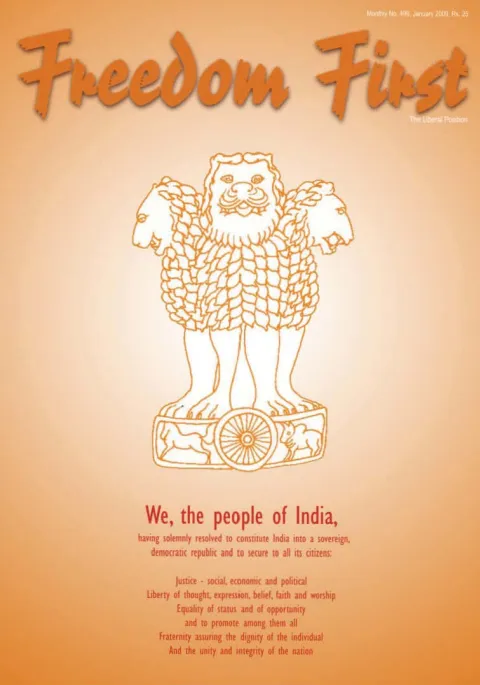
Freedom First
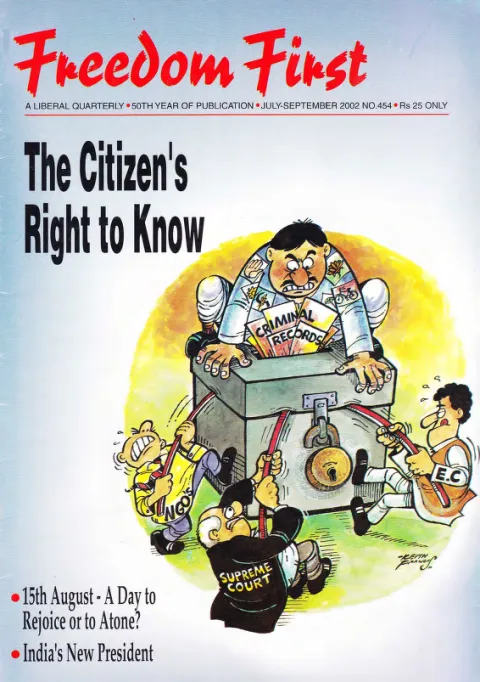
The Citizen's Right to Know
By Sharad Joshi, A. P. J. Abdul Kalam, Minoo Masani
Published by J. R. Patel for the Indian Committee for Cultural Freedom and printed by him at Kaiser-E-Hind Private Ltd., 300, Perin Nariman Street, Mumbai 400 001. · Mumbai · 2002
60 pages
Freedom First
Summary
This is the July-September 2002 issue (No. 454, marking the journal’s 50th year of publication) of Freedom First, the Bombay-based liberal quarterly founded by Minoo Masani and edited by S. V. Raju. The cover feature, ‘The Citizen’s Right to Know,’ anchors the issue around the 2002 Supreme Court judgment compelling candidates for public office to disclose their criminal, financial, and educational antecedents. Jagdeep S. Chhokar, who was among the petitioners in the case, lays out the electoral-reform case for disclosure and traces the government’s and political parties’ resistance to it; Sharad Joshi, founder of the Shetkari Sanghatana, follows with a sharper libertarian critique arguing that the disclosure regime is poorly designed, potentially unfair to political detenus and agitation leaders like himself, and that the deeper fix lies in getting the state out of economic life altogether so that money power in elections withers. The issue also carries Thomas Sowell’s obituary tribute to the development economist Lord Peter Bauer, and documentary filmmaker Prem Vaidya’s polemical essay arguing that 15th August 1947 should be remembered as a day of Partition and atonement rather than untroubled celebration. Regular features in the rendered pages include the ‘With Many Voices’ page of quotations, the editorial notes column ‘Between Ourselves,’ the ‘Of Cabbages and Kings’ notes column (covering the V. B. Karnik birth centenary, the POTA/Vaiko controversy, and an ILG press release calling for POTA’s repeal), and tribute notices for the late Professor P. G. Mavalankar and S. R. Mohan Das, and for the Marathi litterateur Durga Bhagwat.
Key points
-
The cover feature “The Citizen’s Right to Know” centres on the Supreme Court’s May 2002 judgment compelling candidates for public office to disclose their criminal, financial and educational antecedents.
-
Jagdeep S. Chhokar, a petitioner in the case, lays out the electoral-reform case for disclosure, reviews decades of unimplemented reform reports, and cites the MKSS-led Right to Information campaign in Rajasthan as a model for citizen-forced change.
-
Sharad Joshi offers a libertarian counter-argument that mandatory disclosure could weaponise criminal charges against agitation leaders like himself, drawing on his own record of over 700 cases in 22 years of farmer activism, and argues the deeper fix is withdrawing the state from economic life so money power in elections withers.
-
Thomas Sowell’s obituary tribute to development economist Lord Peter Bauer credits him with rejecting the orthodoxy that Third World poverty could only be escaped through foreign aid, noting Hernando de Soto’s later research vindicated his thesis.
-
Documentary filmmaker Prem Vaidya argues 15th August 1947 should be remembered as a day of Partition and atonement rather than untroubled celebration, detailing Gandhi’s absence from official celebrations and the mass migration that followed.
-
The “Of Cabbages and Kings” column covers the V. B. Karnik birth centenary and the POTA/Vaiko controversy, alongside tribute notices for Professor P. G. Mavalankar and litterateur Durga Bhagwat.
Essays
Many Voices
Jagdeep S. Chhokar’s essay opens the cover package on electoral reform, arguing that India’s frequent elections do not by themselves guarantee an effective democracy. He surveys the electoral system’s components (who can vote, who can stand, how funding and conduct are regulated) and reviews the long history of reform reports — the Indrajit Gupta Report, the Dinesh Goswami Report, the Law Commission’s 170th Report, and the NCRWC recommendations — almost none of which were implemented. He then narrates, in detail, the 2002 disclosure controversy: the Association for Democratic Reforms’ PIL in the Delhi High Court, the Supreme Court’s May 2, 2002 judgment directing candidates to disclose criminal cases, assets, liabilities, and educational qualifications by affidavit, the government and Election Commission’s back-and-forth over implementation timelines, and the unprecedented cross-party unanimity to introduce a bill blocking the judgment. Chhokar insists the reform is about disclosure, not disqualification, and closes by calling on citizens and civil-society groups (citing the MKSS-led Right to Information campaign in Rajasthan as a model) to force change since politicians will not reform the system on their own.
- Frequent elections do not equal effective democracy; the electoral system’s design (voter eligibility, candidacy, conduct, post-election disputes) shapes outcomes.
- Multiple official reform reports (Indrajit Gupta, Dinesh Goswami, Law Commission 170th Report, NCRWC) went almost entirely unimplemented over 25+ years.
- Explanation 1 to Section 77 of the Representation of People Act let unaccounted money into elections by excluding party/supporter spending from a candidate’s official expenditure.
- The Association for Democratic Reforms’ 1999 PIL led to a Delhi High Court ruling and a Supreme Court judgment (May 2, 2002) mandating disclosure of candidates’ criminal cases, assets, liabilities, and education via affidavit.
- Political parties, despite public objections, showed ‘unprecedented alacrity’ in drafting a bill to override the judgment, revealing an aversion to disclosure rather than genuine reform intent.
- The reform is explicitly about disclosure, not disqualification — voters retain the right to elect a candidate with a criminal record if they choose.
- Chhokar cites the MKSS’s Aruna Roy-led campaign for Rajasthan’s Right to Information Act as a model of citizen action forcing political change.
Cabbages & Kings
Sharad Joshi, founder of the Shetkari Sanghatana, responds to the same Supreme Court disclosure judgment with a more skeptical, libertarian argument. He notes the cross-ideological political consensus against the ruling was right in outcome though wrong in motive, and warns that mandatory ‘confessional’ disclosure of criminal cases could become a weapon for political rivals and a threat to ordinary citizens’ Fifth-Amendment-style protection against self-incrimination. Drawing on his own experience — over 700 cases filed against him over 22 years for leading farmers’ agitations, including one manslaughter charge of which he was acquitted — he argues that detenus arrested for satyagraha-style civil disobedience are wrongly treated on par with criminals, creating ‘lame duck’ and ‘grey’ categories of MPs. He proposes that the Election Commission distinguish agitation-related charges from ordinary crime, though he concedes this risks letting mafia-linked candidates exploit the same carve-out. His deeper prescription is structural: the state should withdraw from economic functions entirely so that money power in politics withers on its own, and in the interim proposes simple fixes like compressing the campaign period and banning propaganda beyond word of mouth in the final 36 hours before polling.
- Joshi argues political parties’ opposition to the disclosure judgment was right in conclusion (bad reform) though wrong in motive (self-interest).
- He warns ‘confessional’ nomination disclosures could become tools for political persecution and violate a citizen’s implicit right against self-incrimination.
- Draws on his own record of over 700 cases and 27 arrests over 22 years of farmer agitation leadership, including an acquittal on a manslaughter charge tied to the 1980 Nashik sugarcane agitation.
- Distinguishes satyagraha-style civil disobedience detainees from ordinary criminals, arguing the current disclosure regime conflates the two.
- Warns of new categories of ‘lame duck’ and ‘grey’ MPs/ministers under the disclosure and disqualification threat.
- Attributes political criminalization to the license-permit-inspector raj: an interventionist economic state creates opportunities for money power and corruption that inevitably corrupt the electoral system.
- Proposes concrete interim fixes: compress polling to within a week of nomination withdrawal, and restrict campaigning to word of mouth in the last 36 hours before polling.
Electoral Reforms: Key to Effective Democracy
By Jagdeep S. Chhokar
Thomas Sowell’s tribute marks the death of the development economist Lord Peter Bauer, describing him as a lifelong dissenter from the orthodoxy of development economics, which held that Third World poverty was a trap escapable only through foreign aid and government planning. Sowell recounts Bauer’s arguments that poor countries’ populations were as responsive to market incentives as anyone, that ‘overpopulation’ theories were self-serving justifications for controlling other people’s lives, and that Hernando de Soto’s later research (in ‘The Mystery of Capital’) vindicated Bauer’s thesis about the poor’s capacity to create wealth despite bad government policy. Sowell notes Bauer’s professional path — from LSE professor to a life peerage under Margaret Thatcher — and closes by observing that Bauer received the half-million-dollar Milton Friedman prize on the eve of his death, even though the Nobel committee, which honored his rival Gunnar Myrdal, never recognized him.
- Bauer opposed the dominant view that Third World countries were trapped in a poverty cycle breakable only by foreign aid.
- He argued Third World peoples respond to market incentives as well as anyone, contrary to economists like Gunnar Myrdal who favored imposed government planning.
- Bauer rejected ‘overpopulation’ as a cause of poverty, noting many poor countries were less densely populated than prosperous ones like Japan.
- Bauer called some foreign aid merely ‘transferring money from poor people in rich countries to rich people in poor countries.’
- Hernando de Soto’s later research in ‘The Mystery of Capital’ reinforced Bauer’s thesis about wealth creation capacity in the developing world.
- Bauer was made a life peer by Margaret Thatcher and received the Milton Friedman Prize (worth half a million dollars) shortly before his death, despite never winning a Nobel Prize.
Seeking Surrender of Criminal Politicians
By Sharad Joshi
Documentary filmmaker Prem Vaidya argues that celebrating 15th August as ‘Independence Day’ distorts history, since that date in 1947 marked the Partition of the subcontinent rather than unclouded independence. He retraces the events of 1947: the Mountbatten Plan, Nehru’s and Jinnah’s acceptance of Partition, Gandhi’s isolation and refusal to join the official celebrations (fasting and working amid riots in Calcutta instead), the mass migration and communal violence that followed, and Sardar Patel’s integration of the princely states. Vaidya quotes Maulana Azad, Vinoba Bhave, Gandhi’s own anguished statements, and Radhakrishnan’s later reflections to argue that Partition was never accepted by a majority of Hindus, Sikhs, or Muslims, and was pushed through by a small leadership. He concludes that 15th August should be a day of atonement and vigilance against repeating past mistakes — ‘Never again’ — rather than simple celebration, since strictly speaking it was also only the day Britain granted dominion status, not full independence.
- Vaidya argues 15th August 1947 marked Partition, not full independence — India remained a Dominion, with full ‘Transfer of Power’ status rather than an acknowledgment of prior sovereignty.
- Recounts the political and military pressures (INA trials, Royal Indian Navy mutiny) that forced Britain’s hand, per PM Clement Attlee’s own account.
- Notes that Congress leaders, per Maulana Azad’s memoir and the AICC vote (29-15), reluctantly accepted Partition despite Gandhi’s efforts to resist it.
- Documents Gandhi’s absence from the official celebrations, fasting and working amid communal riots in Calcutta instead, and his later anguish over the refugee crisis in his September 15, 1947 prayer meeting remarks.
- Cites Vinoba Bhave calling Partition ‘a Himalayan blunder’ and Radhakrishnan’s October 2, 1947 broadcast describing Partition as a wrong the country had acquiesced to.
- Details the mass migration — the world’s biggest convoy, eight lakh non-Muslim refugees crossing West Punjab by mid-September 1947 — and Sardar Patel’s integration of 562 princely states with V. P. Menon’s help.
- Concludes 15th August should be a day of atonement and vigilance (‘Never again’) for all citizens, not merely ceremonial celebration from the Red Fort.
Generated by the v1.5 extraction pipeline. Awaiting editorial review.
Metadata and summary are AI-extracted from the source PDF and reviewed for editorial accuracy. The original work is available via the Read PDF tab above (where present); paragraph-level citation inside the PDF is deferred to a future engagement.