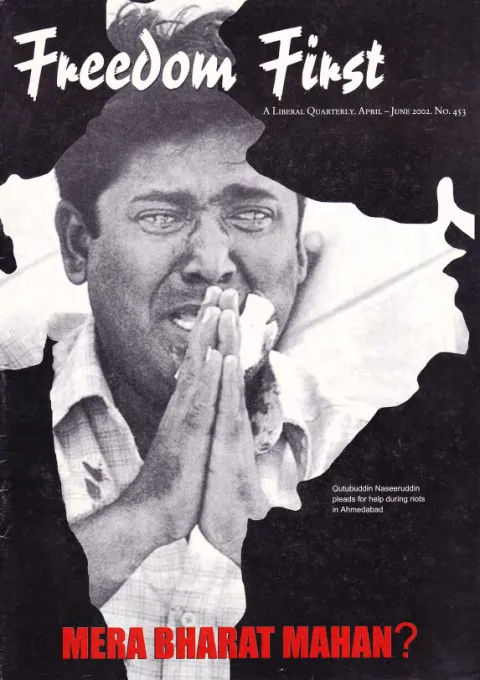
periodical issue
Freedom First
A Liberal Quarterly
Published by J. R. Patel for the Indian Committee for Cultural Freedom and printed by him at Kaiser-E-Hind Private Ltd., 300, Perin Nariman Street, Mumbai 400 001. · Mumbai · 2003
56 pages
Freedom First
Summary
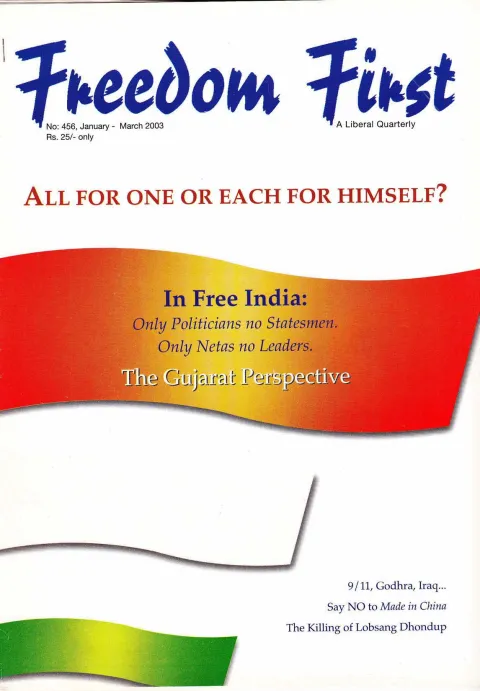
Freedom First No. 456 (January-March 2003), marking the journal’s 51st year of publication, opens with a re-dedication to the founding 1952 editorial “The Open Society,” reframing its old fight against totalitarianism as a present-day fight against religious fundamentalism and communalism. The issue’s editorial note (“Between Ourselves”) sets up a running symposium — to continue over the next several issues — asking why free India has produced “only politicians, no statesmen” and “only netas, no leaders,” examined here specifically through the Gujarat Assembly election of December 2002 and its aftermath. In the rendered pages, contributors Nagindas Sanghavi, S. V. Vaidya, Ashok Karnik, A. D. Moddie, Cyrus Guzder, and Satish Sahney each take up this theme from different angles: electoral arithmetic and the BJP’s actual (versus perceived) mandate, the failure and future of secularism as practiced in Gujarat, a set of pointed questions to Hindutva ideologues, and prescriptions for bridging the Hindu-Muslim divide going forward. The issue also carries a “With Many Voices” digest of press quotations on Gujarat and communalism, a “Going By Instinct” editorial on 9/11, Godhra, and the looming Iraq war, and a tribute by Minoo Shroff to Nani Palkhivala (1920-2002), the constitutional lawyer and Forum of Free Enterprise stalwart who died in December 2002.
Key points
-
An unsigned editorial reprints the founding June 1952 “The Open Society” editorial marking the journal’s 51st year, reframing India’s fight against totalitarianism and communism as today’s fight against religious fundamentalism and communalism.
-
A “Going By Instinct” editorial on 9/11, Godhra, and the looming Iraq war argues the “war on terrorism” rhetoric enabled both India’s POTA law and the Gujarat pogrom, while taking the position that Iraq bears responsibility for defying UN disarmament resolutions.
-
Nagindas Sanghavi opens the “Only Politicians, No Statesmen” symposium by arguing the BJP’s December 2002 Gujarat win (127 seats, 51% vote) was a continuation of a trend visible since 1995 rather than a post-Godhra landslide, faulting the Congress’s outsourced campaign under Kamalnath and the media’s failed pre-poll predictions.
-
Ashok Karnik’s “A Wake Up Call From Gujarat” argues the result was a defeat of how secularism was practiced, not of the principle itself, criticising the Congress’s “soft Hindutva” temple-visit campaigning and unsubstantiated post-Godhra conspiracy theories blaming the VHP.
-
A. D. Moddie poses nine pointed questions to Hindutva ideologues, contrasting “cultural nationalism” with Rajaji’s self-control and Amartya Sen’s account of a “receptive and creative” Indian culture, and challenging the movement to address corruption and land-grabbing at pilgrimage sites.
-
Cyrus Guzder’s “Bridging the Communal Divide: 1” argues uncompromising constitutional citizenship, applied equally regardless of religion, is now the only workable ideology, citing the Shiv Sena’s unpunished arson of a Muslim-owned hospital in Thane.
-
Satish Sahney’s companion piece argues the Hindu-Muslim divide will keep spreading unless both communities’ fundamentalism is checked, urging that the word “secular” be retired since it is read as anti-Hindu code, and that reconciliation efforts should focus on youth.
-
The issue also carries a “With Many Voices” digest of press quotations on Gujarat and communalism, and a tribute by Minoo Shroff to Nani Palkhivala, the constitutional lawyer and Forum of Free Enterprise stalwart who died in December 2002.
Essays
Many Voices
An unsigned editorial reprint of “The Open Society,” the lead article from Freedom First’s very first issue in June 1952, reproduced here to mark the journal’s 51st year. It argues that India’s national movement, from Rammohun Roy through Tagore and Gandhi, sought to broaden freedom and deepen responsibility against a countervailing pull toward regimentation of thought. The Movement for Cultural Freedom is described as having no fixed remedies but a conviction that a free society’s ills cannot be cured outside a climate of freedom, and the piece closes by reasserting that the open society — not any sect or cause — is the movement’s abiding objective. An editorial framing note added in 2003 explicitly updates the enemy from 1952’s totalitarianism/communism to today’s religious fundamentalism and communalism.
- Reprints the founding June 1952 Freedom First editorial in full to mark the journal’s 51st year
- Frames India’s national movement (Roy, Tagore, Gandhi) as a struggle to broaden freedom against regimentation
- The 2003 editorial preface reinterprets 1952’s enemy (totalitarianism/communism) as today’s religious fundamentalism/communalism
- Defines the open society as one where behaviour, not just thought, is free and responsive to ideas
- States the Movement for Cultural Freedom’s purpose as preserving freedom of choice, not imposing any single remedy
Freedom First: A Re-Dedication
An unsigned ‘Going By Instinct’ editorial column reflecting on 9/11, the Godhra incident, and the imminent Iraq war. It argues that 9/11’s damage went beyond the World Trade Centre to enable POTA-style curtailments of the rule of law and racialized treatment of travellers, and suggests the Gujarat pogrom drew on the same ‘war on terrorism’ logic as an excuse for communal violence. On Iraq, the piece takes a deliberately non-consensus position: that Iraq’s own defiance of Security Council disarmament resolutions bears real responsibility, while also noting that anti-war street demonstrations in India (including by a Maharashtra Chief Minister and an actor-politician) look like selective ‘vote bank politics’ given the silence on Tibet and China. It closes by quoting Polish historian Marcin Krol’s Economic Times op-ed arguing that liberal states must be willing to use force against ‘rogues states’ if liberalism is to survive.
- Argues 9/11’s ‘war on terrorism’ rhetoric enabled both POTA in India and the Gujarat pogrom as a ‘convenient excuse’
- Takes a stated non-politically-correct position that Iraq bears responsibility for defying UN disarmament resolutions
- Criticises Indian anti-Iraq-war street protests (a state Chief Minister, an actor-politician) as selective and vote-bank-driven, contrasting the silence on Tibet
- Recounts the 1956 Hungarian uprising and Imre Nagy’s execution as an example of the US/West failing to help East European revolts during the Cold War
- Closes with Marcin Krol’s argument that liberals must be prepared to use force against enemies who cannot be appeased, illustrated by Osama bin Laden
Going By Instinct: 9/11, Godhra, Iraq …
Nagindas Sanghavi opens the ‘In Free India: Only Politicians, No Statesmen. Only Netas, No Leaders’ symposium with an analysis of the December 2002 Gujarat Assembly election, arguing that the BJP’s win, while real, has been wildly overstated as a ‘landslide’ and a defeat for India’s fragile liberal spirit. Comparing seat and vote shares across the 1990, 1995, 1998, and 2002 elections, he shows the BJP’s 2002 performance (127 seats, 51% vote) as a continuation of a trend already visible in 1995 (121 seats, 42.5%) rather than a sudden post-Godhra surge, and walks through the BJP’s internal 1995-2001 turmoil (Keshubhai Patel, Shankersinh Vaghela’s Khajuria splinter group, Suresh Mehta) to show the party’s underlying strength survived years of factional chaos. He is sharply critical of both the Congress’s outsourced, out-of-touch campaign under Kamalnath and the national media’s confident pre-poll predictions of a BJP defeat, arguing the real story is smaller and more structural: minor parties and independents were squeezed out (falling from 12 to 2 seats) while both major parties consolidated support.
- Argues the 2002 BJP win (127/182 seats, 51% vote) is a marginal continuation of the 1995 trend (121 seats, 42.5%), not a landslide or turning point
- Traces the BJP’s internal 1995-2001 collapse and factionalism (Keshubhai Patel, Shankersinh Vaghela’s ‘Khajuria group’, Suresh Mehta) to argue the party’s core voter loyalty survived chaos at the top
- Criticises the Congress’s decision to run its campaign ‘by proxy’ through an outsider (Kamalnath) unfamiliar with Gujarat ground realities
- Notes minor parties and independents lost 80% of their seats (12 to 2), with both major parties gaining at their expense
- Faults the media for confidently predicting a weak BJP performance and then failing to admit the error afterward
A Wake Up Call From Gujarat
By S. V. Vaidya
Ashok Karnik asks whether the Gujarat verdict represents a defeat of secularism itself or merely of how secularism was practiced. He argues secularists misjudged the depth of majority-community anxiety, allowing ‘secularism’ to be perceived (unfairly, in his view) as code for anti-Hindu appeasement, and that the VHP successfully exploited this perception gap. He is critical of the Congress’s ‘soft Hindutva’ posturing during the campaign (Sonia Gandhi’s temple visits) as counterproductive, and argues secularists lost credibility in the post-Godhra period by rushing to defend Modi’s opponents and by advancing conspiracy theories (e.g., that the VHP had itself planned Godhra) without evidence. His prescriptions: secularists should stop being politicians, keep religion a personal matter, and not act as prosecutor-judge in communal disputes — while warning that the VHP will grow more aggressive and Muslim alienation from the majority community will deepen if nothing changes.
- Frames the Gujarat outcome as a defeat of the practice of secularism, not of the principle itself
- Argues secularists failed to address majority-community anxiety, letting ‘secularism’ be perceived as anti-Hindu appeasement
- Criticises the Congress’s ‘soft Hindutva’ campaign tactics (temple tours, courting Sants and Mahants) as a costly misstep
- Cites unsubstantiated post-Godhra theories blaming Ram Sevaks or the VHP itself as damaging to secularist credibility
- Prescribes that secularists depoliticize religion and avoid acting as investigator-prosecutor-judge in communal incidents
A Wake Up Call From Gujarat
By S. V. Vaidya
A. D. Moddie, writing further into the ‘Only Netas, No Leaders’ symposium, poses a numbered series of nine pointed questions to Hindutva ideologues about the coherence and consequences of their project. He asks how Hindutva’s notion of ‘cultural nationalism’ compares to Rajaji’s ‘self control’, Sampurnanand’s admission of the movement’s ‘lack of spiritual equipment’, and Amartya Sen’s account of Indian culture as historically ‘receptive and creative’; whether Hindutva has produced any comparable modern minds of its own; why its votaries have not cleaned up corruption, land-grabbing and extortion at Hindu pilgrimage sites; and whether the omission of caste and of Gandhi’s assassination from Hindutva-aligned textbooks constitutes a ‘fundamental historical error’. He closes by comparing unchecked clerical violence at Hindu temples to terrorist attacks and invoking T. S. Eliot’s ‘Murder in the Cathedral’ as an image for Hinduism’s internal corruption.
- Poses nine numbered questions challenging Hindutva’s intellectual and moral coherence
- Contrasts Hindutva’s ‘cultural nationalism’ against Rajaji’s ‘self-control’, Sampurnanand’s candid ‘lack of spiritual equipment’, and Amartya Sen’s ‘receptive and creative’ account of Indian culture
- Challenges Hindutva to name modern figures of its own comparable to Vivekananda, Rajagopalachari, Radhakrishnan, Sampurnanand, or Sen
- Criticizes the movement for not addressing corruption, land-grabbing, and extortion by priests and sadhus at major pilgrimage sites
- Argues the omission of caste history and Gandhi’s assassination from certain textbooks is a serious, unjustifiable historical error
Gujarat - Defeat of Secularism?
By Ashok Karnik
Cyrus Guzder’s ‘Bridging the Communal Divide: 1’ argues that uncompromising support for the Constitution of India, on the basis of equal citizenship, must now be the only workable ideology for repairing the Hindu-Muslim divide. He argues that continuing hostility toward Pakistan makes reconciliation with Indian Muslims (a population as large as Pakistan’s) internally incoherent, and criticizes the Sangh Parivar’s ‘two-nation theory’ framing of Indian Muslims as inconsistent, given that the BJP itself invokes the same Constitution when dealing with Kashmiris and Nagas. He faults civil society — not just politicians — for failing to consistently and promptly condemn injustice regardless of which community commits it, citing the Shiv Sena’s arson of a Muslim-owned hospital in Thane as an example of a wrong that went unpunished because ‘nobody in his own business community’ stood up. His closing prescription is individual, not just political: react to injustice against any individual or community, every time, regardless of who benefits politically.
- Argues the only viable ideology now is uncompromising constitutional citizenship, applied equally regardless of religion
- Criticizes continued India-Pakistan hostility as incompatible with reconciling with India’s ~100-million-strong Muslim population
- Points out the BJP’s inconsistency in invoking the Constitution for Kashmiris/Nagas while entertaining a ‘two-nation theory’ framing of Muslims elsewhere
- Cites the Shiv Sena’s burning of Mr. Singhania’s hospital in Thane as an unpunished act that undermines claims of principled outrage
- Calls for individual, not just institutional, responses to injustice, ‘however small we are’
Holding A Candle To Hate
By A. D. Moddie
Satish Sahney’s short companion piece, ‘Bridging the Communal Divide: 2,’ argues that the Hindu-Muslim divide will keep spreading unless both Hindu and Muslim fundamentalism are checked, and offers two remedies. First, reconciliation efforts should focus on the youth, who he says are ‘more amenable to reason’ and deserve direct, non-evasive answers rather than the silence that currently prevails in schools. Second, he argues the word ‘secular’ itself should be retired from public use since it is now widely read as anti-Hindu code, and replaced with a direct appeal to constitutional values and the rule of law as the basis for the safety and dignity of every citizen.
- Argues the communal divide will keep spreading unless both Hindu and Muslim fundamentalism are checked
- Recommends prioritizing dialogue with youth, described as more open to reasoned argument than adults
- Calls for retiring the word ‘secular’ because it is perceived as anti-Hindu, in favor of direct appeals to the Constitution
- Notes evasive non-engagement occurs even at the teacher-student level and should be corrected
Generated by the v1.5 extraction pipeline. Awaiting editorial review.
Metadata and summary are AI-extracted from the source PDF and reviewed for editorial accuracy. The original work is available via the Read PDF tab above (where present); paragraph-level citation inside the PDF is deferred to a future engagement.