periodical issue
Freedom First
A Liberal Quarterly
Edited by S. V. Raju
Published by J. R. Patel for the Indian Committee for Cultural Freedom and printed by him at Kaiser-E-Hind Private Ltd., 300, Perin Nariman Street, Mumbai 400 001. · Mumbai · 2003
56 pages
Freedom First
Summary
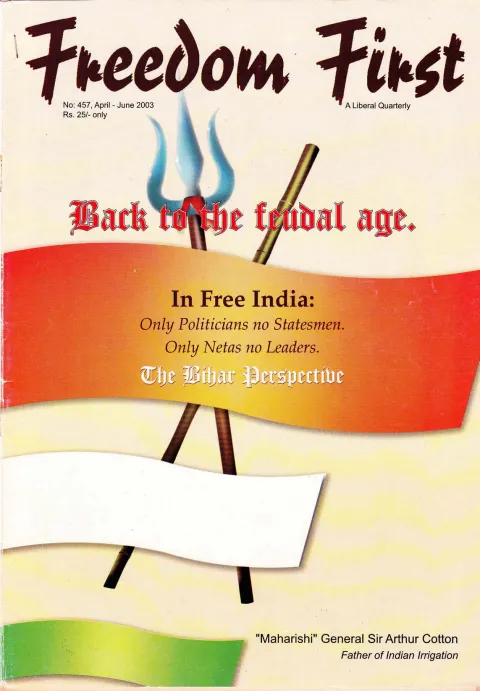
This is issue No. 457 (April–June 2003) of Freedom First, “A Liberal Quarterly” published in Bombay by the Indian Committee for Cultural Freedom, in its 51st year of publication, edited by S. V. Raju. The cover theme, “Back to the Feudal Age,” frames the issue’s lead package: a three-part symposium titled “In Free India: Only Politicians No Statesmen, Only Netas No Leaders,” viewed this quarter through “The Bihar Perspective.” Shanker Prasad Tekriwal (Bihar’s former finance minister), Manuwant Choudhary (an NDTV reporter in Patna), and Manoje Nath (a senior Bihar police officer) each indict Laloo Prasad Yadav’s rule for corruption, criminalised politics, collapsed public services, and the post-bifurcation abandonment of Bihar following Jharkhand’s creation, while boxed sidebar pieces by N. Dharmeshwaran, V. N. Torgal, and P. K. Sabhlok extend the ‘why India lacks statesmen’ theme to the national level. A companion piece by Major General E. D’Souza, PVSM, “Captains Courageous,” profiles three exemplary Indian military leaders — Field Marshal Cariappa, General K. S. Thimayya, and Field Marshal Sam Manekshaw — as counter-examples of genuine leadership. In the rendered pages, the issue also carries obituary tributes to P. R. Brahmananda, S. Ramakrishnan, and K. F. Rustamji; a regular “With Many Voices” page of quoted public remarks; an editorial notes column (“Of Cabbages and Kings”) on Bihar, Gujarat, CII politics, and Kashmir; a report marking the V. B. Karnik birth centenary; a short piece by Arvind Deshpande giving a liberal view on the Iraq War; and the opening pages of a longer feature by Prem Vaidya on General Sir Arthur ‘Maharishi’ Cotton, the East India Company engineer credited as the father of Indian irrigation in the Godavari and Cauvery deltas.
Key points
-
Freedom First No. 457 (April-June 2003), edited by S. V. Raju, runs a three-part “Only Politicians No Statesmen” symposium framed through “The Bihar Perspective.”
-
Shanker Prasad Tekriwal’s “Laloo’s Lathi Raj” catalogues failures in education, welfare and rural electrification under the Laloo-Rabri Devi government, and accuses it of corruption including the fodder and bitumen scams.
-
Manuwant Choudhary’s “Living Dangerously in Bihar” gives a first-person account of the state’s decline after the Jharkhand bifurcation, covering CARE-India’s exit, endemic kidnapping-for-ransom, and naxal violence, and argues Nitish Kumar is no credible alternative to Laloo.
-
Manoje Nath’s “The Bihari: Prisoner of his Own Image” argues the self-effacing “Bihari” stereotype is a psychological trap that keeps Biharis from demanding their fair share of national resources.
-
Major General E. D’Souza’s “Captains Courageous” profiles Field Marshal Cariappa, General K. S. Thimayya, and Field Marshal Sam Manekshaw as evidence that India has in fact produced genuine military statesmen, rebutting the magazine’s own framing question.
-
The issue carries obituary tributes to P. R. Brahmananda, S. Ramakrishnan, and K. F. Rustamji, alongside a report marking the V. B. Karnik birth centenary.
-
Arvind Deshpande contributes a short piece giving a liberal view on the Iraq War, and Prem Vaidya opens a longer feature on General Sir Arthur “Maharishi” Cotton, the East India Company engineer credited as father of Indian irrigation in the Godavari and Cauvery deltas.
Essays
Laloo’s Lathi Raj
By Shanker Prasad Tekriwal
In the rendered pages, this section opens the issue’s central symposium on Indian leadership failures, framed through Bihar. Shanker Prasad Tekriwal’s “Laloo’s Lathi Raj” (pp.5-6) argues that Laloo Yadav’s lathi rally was a sign of frustration, cataloguing failures in education, welfare schemes, rural electrification, road-building and agricultural spending, and accusing the Laloo-Rabri Devi government of large-scale corruption and criminal patronage. Manuwant Choudhary’s “Living Dangerously in Bihar” (pp.6-8) is a first-person reporter’s account of Bihar’s decline after bifurcation, covering CARE-India’s exit, a self-immolation, endemic kidnapping-for-ransom, naxal violence in Jharkhand, and the entrenchment of Laloo Yadav despite thirteen years of alleged misrule. Manoje Nath’s “The Bihari: Prisoner of his Own Image” (pp.8-9) is a reflective essay arguing that the self-effacing ‘Bihari’ stereotype is a psychological trap that keeps Biharis from demanding their fair share of national resources.
- Tekriwal details unimplemented welfare schemes (red card scheme, old-age pensions, rural electrification funds) and alleges the Laloo-Rabri Devi government is ‘defacto’ run by Laloo despite his wife holding the chief ministership.
- Tekriwal cites Bihar topping CBI-probed scams (fodder scam, bitumen scam, poshahaar yojna scam) and describes a Rs.50 crore ‘rangdaree’ collection during a lathi rally that disrupted the marriage season.
- Choudhary’s account centers on the aftermath of Bihar’s bifurcation into Bihar and Jharkhand, describing CARE-India’s relocation, a youth’s self-immolation over unpaid wages, and an activist (Dr. R. Suman) on a four-year ‘maun vrat’ protesting the bifurcation via pending PILs.
- Choudhary reports engineering-staff shortages (Bihar and Jharkhand lack any Engineer-in-Chief between them) and argues Nitish Kumar is not a credible alternative to Laloo due to his own record on railway-contract criminalisation.
- Nath argues the Bihari stereotype (meek, loyal, a ‘standard butt of joke’) is self-reinforcing: Bihar exports labour and talent to richer states while its own institutions stagnate, and social convention discourages Biharis from demanding proportionate investment or resource-sharing.
- All three essays are attributed by the magazine to the ‘Bihar Perspective’ on a national theme: only politicians/netas, no statesmen/leaders, in post-Independence India.
Captains Courageous
By E. D’Souza
E. D’Souza’s “Captains Courageous” (pp.11-15) profiles three Indian military leaders as evidence that India has produced genuine statesmen, contrary to the editorial’s opening lament. Field Marshal Cariappa is depicted as India’s first Commander-in-Chief, prized for integrity and attention to detail; General K. S. Thimayya is presented as the exemplary leader of the Kashmir operations and later UN peacekeeping missions in Korea and Cyprus, who nearly resigned over political interference by Krishna Menon; Field Marshal Sam Manekshaw is described from his Amritsar upbringing through the 1971 war, noted for standing up to Indira Gandhi over the timing of the East Pakistan offensive.
- D’Souza frames the essay as a rebuttal to the January-March 2003 Freedom First editorial’s question of why India has produced no outstanding leader or statesman.
- Cariappa is credited with instilling discipline via the ‘Code of Conduct for Officers’ and rising from Brigadier to Commander-in-Chief without attending Sandhurst or the Indian Military Academy.
- Thimayya is credited with the Zoji La Pass tank operation that saved Ladakh in 1947-48, and with nearly resigning as Army Chief over interference by Defence Minister Krishna Menon.
- Manekshaw is credited with resisting pressure to launch a premature 1971 offensive against Indira Gandhi’s wishes, and was made India’s first Field Marshal.
- The essay closes by asking rhetorically ‘who says we lack leadership material,’ directly answering the magazine’s own framing question for this issue.
- The author identifies himself as an octogenarian defence analyst who served under all three officers profiled.
Generated by the v1.5 extraction pipeline. Awaiting editorial review.
Metadata and summary are AI-extracted from the source PDF and reviewed for editorial accuracy. The original work is available via the Read PDF tab above (where present); paragraph-level citation inside the PDF is deferred to a future engagement.